Question 13 Marks
Use ruler and compasses only for this question. Draw a circle of radius 4 cm and mark two chords AB and AC of the circle of length f 6 cm and 5 cm respectively.
(i) Construct the locus of points, inside the circle, that are equidistant from A and C. Prove your construction.
(ii) Construct the locus of points, inside the circle, that are equidistant from AB and AC.
(i) Construct the locus of points, inside the circle, that are equidistant from A and C. Prove your construction.
(ii) Construct the locus of points, inside the circle, that are equidistant from AB and AC.
Answer
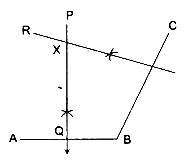
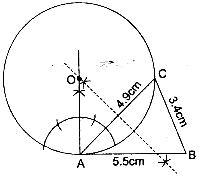
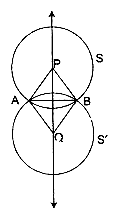
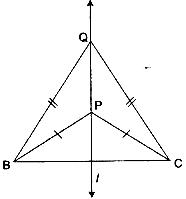
View full question & answer→ (I) Draw PQ, the perpendicular bisector of chord AC. PQ is the required locus, which is the diameter of the circle.
Reason: We know each point on the perpendicular bisector of AB is equidistant from A and B. Also the perpendicular bisector of a chord, passes through the centre of the circle and any chord passing through the centre of the circle is its diameter.
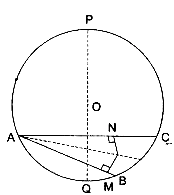
∴ PQ is the diameter of the circle.
(ii) Chords AB and AC intersects at M and N is a moving point such that LM = LN, where LM ⊥ AB and LN ⊥ AC
In right ΔALN and ΔALB
∠ANL = ∠ABL ...(90° each)
AL = AL ...(Common)
NL = BL ...[Given]
∴ ΔALN = ΔALB ...[R.H.S.]
Hence ∠MAL = ∠BAL ...c.p.c.t.
Thus, L lies on the bisector of ∠BAC.
Hence proved.
Reason: We know each point on the perpendicular bisector of AB is equidistant from A and B. Also the perpendicular bisector of a chord, passes through the centre of the circle and any chord passing through the centre of the circle is its diameter.
∴ PQ is the diameter of the circle.
(ii) Chords AB and AC intersects at M and N is a moving point such that LM = LN, where LM ⊥ AB and LN ⊥ AC
In right ΔALN and ΔALB
∠ANL = ∠ABL ...(90° each)
AL = AL ...(Common)
NL = BL ...[Given]
∴ ΔALN = ΔALB ...[R.H.S.]
Hence ∠MAL = ∠BAL ...c.p.c.t.
Thus, L lies on the bisector of ∠BAC.
Hence proved.