Question
How will you find a point equidistant from three given points A, B, C which are not in the same straight line?

Answer

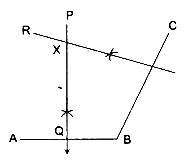
(i) The locus of points equidistant from three given points A, B & C is the straight line PQ, which bisects AB at right angles.

(ii) Similarly, the locus of points equidistant from B and C is the straight line RS which bisects BC at right angles.
Hence, the point common to PQ and RS must satisfy both conditions; that is to say, X the point of intersection of PQ and RS will be equidistant from A, B and C.

Need a full question paper?

Generate a complete, print-ready paper with questions like this in minutes — across 16+ boards, with answer keys.
Start Generating Free

Similar questions

If $4 \cos^2 A – 3 = 0$ and $\leq A \leq 90^\circ$, then prove that :
$\sin 3 A = 3 \sin A – 4 \sin^3 A$
In a musical chairs game, a person has been advised to stop playing the music at any time within 40 seconds after its start. What is the probability that the music will stop within the first 15 seconds? 
From a well shuffled deck of 52 cards, one card is drawn. Find the probability that the card drawn is:  a card with number between 2 and 9 
Find the value of $m$ if the distance between the points $(m,-4)$ and $(3,2)$ is $3 \sqrt{5}$ units.
The radius of the internal and external surfaces of a hollow spherical shell are $3 cm$ and $5 cm$ respectively! If it is melted and recast into a solid cylinder of height $\frac{8}{3}$ cm, find the diameter of the cylinder.
The total area of a solid metallic sphere is $1256 \ cm^2.$ It is melted and recast into solid right circular cones of radius $2.5 \ cm$ and height $8 \ cm.$ Calculate: the radius of the solid sphere.
A stone is thrown vertically downwards and the formula $d = 16t^2 + 4t$ gives the distance, d metres, that it falls in t seconds. How long does it take to fall $420$ metres?
Two squares have sides A cm and $(x + 4)$ cm. The sum of their areas is $656$ sq. cm.Express this as an algebraic equation and solve it to find the sides of the squares.
Solve $3 x^2-2 \sqrt{6} x+2=0$
A circus tent is cylindrical to a height of $3$ meters and conical above it. If its diameter is $105$ m and the slant height of the conical portion is $53 m$ calculate the length of the canvas which is $5m$ wide to make the required tent.