Questions

[2 Mark Question Answer]

🎯

Test yourself on this topic

9 questions · timed · auto-graded

Question 12 Marks
In the adjoining figure, the medians BD and CE of a ∆ABC meet at G. Prove that
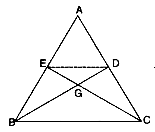
(i) ∆EGD ∼ ∆CGB and
(ii) BG = 2GD for (i) above.
Answer
Since D and E are mid-point of AC and AB respectively in ∆ABC, Ed is parallel to BC.
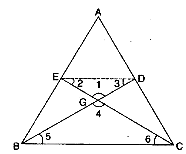

(i) In ∆'s EGD and CGB,
∠EGD = ∠CGB ...(Vertically opp., angles)
∠EGD = ∠CBG ...(Alternative angles)
So, ∆EGD ∼ ∆CGB.
Hence proved.
(ii) $\therefore \frac{ BG }{ GD }=\frac{ BC }{ DE }$
But $\frac{ BC }{ DE }=2$, So $\frac{ BG }{ GD }=2$
⇒ BG = 2GD.
Hence Proved.
View full question & answer
Question 22 Marks
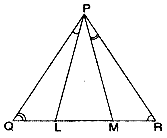
In ΔPQR, L and M are two points on the base QR, such that ∠LPQ = ∠QRP and ∠RPM = ∠RQP.
Prove that : (i) ΔPQL ∼ ΔRPM
(ii) QL. Rm = PL. PM
(iii) $PQ^2 = QR. QL$.
Answer
(i) Consider
ΔPQL and ΔRPM
Since ∠PQL = ∠RPM
and ∠QPL = ∠RPM and
∠QPL = ∠PRM
By A. A. Criterion
ΔPQL ∼ ΔRPM
Hence Proved.
(ii) In ΔPQL ∼ ΔRPM
$\frac{ PQ }{ RP }=\frac{ OL }{ PM }=\frac{ PL }{ MR }$
$\text { then } \frac{ OL }{ PM }=\frac{ PL }{ MR }$
QL · MR = PL · PM.
Hence Proved.
(iii) In ΔPQR and ΔLQP
∠PQR = ∠LQP
PQ = PQ
Hence ΔPQR ∼ ΔLQP
$\frac{ QR }{ PQ }=\frac{ PQ }{ LQ }$
$PQ^2 = QR · QL$.
Hence proved.
View full question & answer
Question 32 Marks
Triangles ABC and DEF are similar.
If area $(\triangle ABC) = 9 cm^2$, area ($\triangle$ DEF) = $64 cm^2$ and $BC = 5.1$ cm find AB.
Answer
We have
area $(\triangle ABC) = 9 cm^2$
area $(\triangle DEF) = 64 cm^2$
and DE = 5·1 cm
Since, $\frac{\operatorname{area}(\triangle ABC )}{\operatorname{area}(\triangle DEF )}=\frac{ AB ^2}{ DE ^2}$
$\Rightarrow \frac{9}{64}=\frac{ AB ^2}{ DE ^2}$
$\Rightarrow \frac{ AB }{ DE }=\frac{3}{8}$
$\Rightarrow \frac{ AB }{5 \cdot 1}=\frac{3}{8}$
$\Rightarrow AB =\frac{3}{8} \times 5.1=\frac{15 \cdot 3}{8}$
$\Rightarrow AB =1.9125 cm .$
View full question & answer
Question 42 Marks
Triangles $ABC$ and $DEF$ are similar.
If area $(\triangle ABC) = 16 cm^2$, area $(\triangle DEF) = 25 cm^2$ and $BC = 2.3 cm$ find $EF.$
Answer
We have
area $(\triangle ABC) = 16 cm^2$
area $(\triangle DEF) = 25 cm^2$​​​​​​​
and $BC = 2·3 cm$
Since , $\frac{\operatorname{area}(\triangle ABC )}{\operatorname{area}(\triangle DEF )}=\frac{ BC ^2}{ EF ^2}$
$\Rightarrow \frac{16}{25}=\frac{(2.3)^2}{ EF ^2}$
$\Rightarrow \frac{2 \cdot 3}{ EF }=\frac{4}{5}$
$\Rightarrow 4 EF =5 \times 2 \cdot 3$
$\Rightarrow EF =\frac{11.5}{4}$
$\Rightarrow EF =2.875 cm .$
View full question & answer
Question 52 Marks
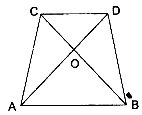
In fig. ABCD is a trapezium in which AB | | DC and AB = 2DC. Determine the ratio between the areas of ΔAOB and ΔCOD.
Answer
In triangle $AOB$ and $COD,$ we have
$\angle AOB = \angle COD, ...$ [Vertically opposite angles]
and $\angle OAB = \angle OCD, ...$ [Corresponding angles]
So, by AA-criterion of similarly, we have
$\triangle AOB \sim \triangle COD$
$\Rightarrow \frac{\operatorname{Area}(\triangle AOB )}{\operatorname{Area}(\triangle COD )}=\frac{ AB ^2}{ DC ^2}$
$\Rightarrow \frac{\operatorname{Area}(\Delta AOB )}{\operatorname{Area}(\Delta COD )}=\frac{(2 DC )^2}{( DC )^2}$
$=\frac{4}{1}$
Hence, area $(\triangle AOB) :$ area $(\triangle COD) = 4 : 1.$
View full question & answer
Question 62 Marks
Triangles ABC and DEF are similar.
If area $(\triangle ABC) = 36 cm^2$​​​​​​​, area $(\triangle DEF) = 64 cm^2$​​​​​​​​​​​​​​ and $DE = 6.2\ cm$, find $AB$.
Answer
Area $(\triangle ABC) = 36 cm^2$
Area $(\triangle DEF) = 64 cm^2$
$DE = 6.2\ cm$
$AB =?$
We have
$\frac{\text { area }(\Delta ABC )}{\operatorname{area}(\Delta DEF )}=\frac{ AB ^2}{ DE ^2}$
$\Rightarrow \frac{36}{64}=\frac{ AB ^2}{(6.2)^2}$
$\Rightarrow A B=\frac{6}{8}$
$\Rightarrow A B=\frac{6 \times 6.2}{8}$
$\Rightarrow A B=4.65 cm .$
View full question & answer
Question 72 Marks
Triangles ABC and DEF are similar.
If area $(ΔABC) = 9 cm^2$, area $(ΔDEF) = 64 cm^2$ and $DE = 5.1 cm$, find $AB$.
Answer
We have
area $(\triangle ABC) = 9 cm^2$​​​​​​​
area $(\triangle DEF) = 64 cm^2$​​​​​​​​​​​​​​
and $DE = 5.1 cm$
Since, $\frac{\operatorname{area}(\Delta ABC )}{\operatorname{area}(\Delta DEF )}=\frac{ AB ^2}{ DE ^2}$
$\Rightarrow \frac{9}{64}=\frac{ AB ^2}{ DE ^2}$
$\Rightarrow \frac{ AB }{ DE }=\frac{3}{8}$
$\Rightarrow \frac{ AB }{5.1}=\frac{3}{8}$
$\Rightarrow AB =\frac{3}{8} \times 5.1=\frac{15.3}{8}$
$\Rightarrow AB = 1.9125 cm.$
View full question & answer
Question 82 Marks
Triangles ABC and DEF are similar.
If area $(\triangle ABC) = 16\ cm$, area $(\triangle DEF) = 2\ cm^2$​​​​​​​ and $BC = 2.3\ cm$ find $EF$.
Answer
We have
area $(\triangle ABC) = 16\ cm^2$
area $(\triangle DEF) = 25\ cm2$
and $BC = 2.3\ cm$
Since, $\frac{\operatorname{area}(\triangle ABC )}{\operatorname{area}(\triangle DEF )}=\frac{ BC ^2}{ EF ^2}$
$\Rightarrow \frac{16}{25}=\frac{(2.3)^2}{ EF ^2}$
$\Rightarrow \frac{2.3}{ EF }=\frac{4}{5}$
$\Rightarrow 4 EF =5 \times 2.3$
$\Rightarrow EF =\frac{11.5}{4}$
$\Rightarrow EF =2.875 cm .$
View full question & answer
Question 92 Marks
The model of a building is constructed with scale factor $1:30$.
(i) If the height of the model is $80\ cm$, find the actual height of the building in metres.
(ii) If the actual volume of a tank at the top of the building is $27\ m^3$​​​​​​​, find the volume of the tank on the top of the model.
Answer
Preview is shown here:
(i) $\frac{\text { Height of model }}{\text { Height of actual building }}=\frac{1}{30}$
$\frac{80}{ H }=\frac{1}{30}$
$\Rightarrow H = 2,400 cm = 24 m.$
(ii) $\frac{\text { Volume of model }}{\text { Volume of tank }}=\left(\frac{1}{30}\right)^3$
$\frac{ V }{27}=\frac{1}{27,000}$
$V =\frac{1}{1,000} m ^3$
$= 1,000 cm^3.$
View full question & answer
[2 Mark Question Answer] - Mathematics STD 10 Questions - Vidyadip