Questions

[3 marks sum]

🎯

Test yourself on this topic

15 questions · timed · auto-graded

Question 13 Marks
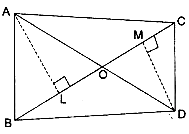
In figure ABC and DBC are two triangles on the same base BC. Prove that
$\frac{\text { Area }(\triangle ABC )}{\text { Area }(\triangle DBC )}=\frac{ AO }{ DO }$.
Answer
In ΔAOL and ΔDOM
∠ALO = ∠DMO, ...(90° each)
∠AOL = ∠DOM,
(Vertically opposite 2 sides)
(Vert. opp-angles)
∴ ΔAOL ∼ ΔDOM
$\therefore \frac{ AL }{ DM }=\frac{ AO }{ DO }$ ...(1)
If two Δ's are similar the ratio between their corresponding sides is the same.
Now, $\frac{\operatorname{area}(\triangle ABC )}{\operatorname{area}(\triangle DBC )}=\frac{\frac{1}{2} \times BC \times AL }{\frac{1}{2} \times BC \times Dm }=\frac{ AL }{ DM }$
From (1), we get
$\frac{\operatorname{area}(\triangle ABC )}{\operatorname{area}(\triangle DBC )}=\frac{ AO }{ DO }$
Hence proved.
View full question & answer
Question 23 Marks
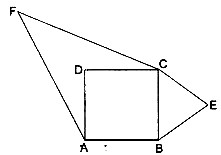
Prove that the area of the triangle BCE described on one side BC of a square ABCD as base is one half of the area of similar triangle ACF described on the diagonal AC as base.
Answer
ABCD is a square. ∆BCE is described on side BC is similar to ∆ACF described on diagonal AC.


Since ABCD is a square. Therefore,
AB = BC = CD = DA
and AC = $=\sqrt{2} BC \ldots[\because$ Diagonal $=\sqrt{2}($ side $)]$
Now, $\triangle BCE \sim \triangle ACF$
$\Rightarrow \frac{\text { Area }(\triangle BCE )}{\text { Area }(\triangle ACF )}=\frac{ BC ^2}{ AC ^2}$
$\Rightarrow \frac{\text { Area }(\triangle BCE )}{\text { Area }(\triangle ACF )}=\frac{ BF ^2}{(\sqrt{2} BC )^2}=\frac{1}{2}$
$\Rightarrow \text { Area }(\triangle BCE )=\frac{1}{2} \operatorname{area}(\Delta ACF )$
Hence proved.
View full question & answer
Question 33 Marks
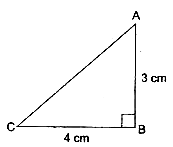
On a map drawn to a scale of $1: 2,50,000$, a triangular plot of land has the following measurements, $AB =3 cm, BC =$ $4 cm, \angle ABC =90^{\circ}$. Calculate:
(i) The actual length of $A B$ in Kms .
(ii) The area of Plot in sq. kms.
Answer
The scale of a map $= 1: 2,50,000$ that is
$1 cm =$ $\frac{2,50,000}{1,000 \times 100}$
$= 2·5 kms$

(i) Actual length of $AB$
$= 3 cm = 3 \times 2·5 kms$
$= 7·5 kms.$
(ii) Area of triangular plot
$=\frac{1}{2} AB \times BC$
$=\frac{1}{2} \times 3 \times 4$
$= 6 \times 2·5 \times 2·5 km^2$
$= 37.5 km^2.$
View full question & answer
Question 43 Marks
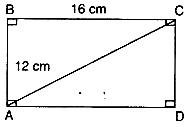
On a map drawn to scale of $1: 2,50,000$ a rectangular plot of land $A B C D$ has the following measurement $A B=12 cm$, $B C=16 cm$ angles $A, B, C$, and $D$ are $90^{\circ}$ each. Calculate:
(i) The diagonal distance of the plot of land in
(ii) Actual length of diagonal.
Answer
(i) Here $k =\frac{1}{2,50,000}$


Length of diagonal (on map)
$=\sqrt{ AB ^2+ BC ^2}$
$=\sqrt{12^2+16^2}$
$=\sqrt{400}$
$=20 cm $
(ii) Length of diagonal on map
= k x Actual length of the diagonal
$\Rightarrow 20 = \frac{1}{2,50,000} \times$ Actual length of the diagonal
$\Rightarrow$ Actual length of diagonal
$= 20 (2,50,000)$ cm
$= 5000000$ cm
$= 50$ km.
View full question & answer
Question 53 Marks
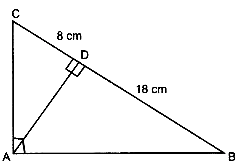
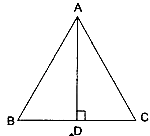
In the adjoining figure $\text{ABC}$ is a right angle triangle with $\angle B A C=90^{\circ}$, and $A D \perp B C$.
$(i)$ Prove $\triangle ADB \sim \triangle CDA$.
$(ii)$ If $BD =18 \ cm, C D=8 \ cm$ find $AD$ .
$(iii)$ Find the ratio of the area of $\triangle A D B$ is to area of $\triangle C D A$.
Answer
$(i)$ In $\triangle ADB$ and $\triangle ADC$
$AD = AD ...($self$)$
$\angle ADC = 90^\circ ...(AD \perp BC)$
$\angle ADB = 90^\circ ...(AD \perp BC)$
then $\angle ADC = \angle ADB$
so$, \triangle ADB \sim \triangle ADC . . . ($By $\text{AAA}$ similarity$)$
or $\triangle ADB \sim \triangle CDA$
Hence proved.
$(ii)\ \because \triangle ADB \sim \triangle CDA$
$\therefore \frac{ AD }{ BD }=\frac{ CD }{ AD }$
$($corresponding parts of similar $\Delta$ 's are proportional$)$
or
$AD^2 = BD x CD$
$\Rightarrow AD^2 = 18 \times 8 ...$
$BD =18$
$CD =8$
$($given$)$
$\Rightarrow AD^2= 144$
$AD = 12 \ cm$
$(iii)\ \frac{\text { Area of } \triangle ADB }{\text { Area of } \triangle CDA }=\frac{ BD ^2}{ AD ^2}$
$($Area theorem of similar triangles$)$
$=\frac{18^2}{12^2}=\frac{18 \times 18}{12 \times 12}$
$=\frac{3 \times 3}{2 \times 2}=\frac{9}{4}$
$\Rightarrow $ area $(\triangle ADB) :$ area $(\triangle CDA) = 9 : 4.$
View full question & answer
Question 63 Marks
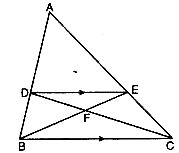
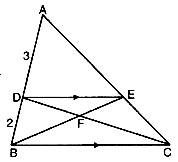
In the given figure, ABC is a triangle. DE is parallel to BC and $\frac{ AD }{ DB }=\frac{3}{2}$.
(i) Determine the ratios $\frac{ AD }{ AB }, \frac{ DE }{ BC }$.
(ii) Prove that ΔDEF is similar to ΔCBF.
Hence, find $\frac{ EF }{ FB }$
(iii) What is the ratio of the areas of ΔDEF and ΔBFC?

Answer
(i) Given
$DE \| BC$
and $\frac{ AD }{ DB }=\frac{3}{2}$
In $\triangle ADE$ and $\triangle ABC,$
$\angle A = \angle A, ...$(Common Angles)
$\angle D = \angle B ...$ (Corresponding Angles)
$\therefore \triangle ADE \sim \triangle ABC ...$ (by A.A. criterion)
$\therefore \frac{ AD }{ AB }=\frac{ AE }{ AC }=\frac{ DE }{ BC }$
$\text { Now } \frac{ AD }{ AB }=\frac{ AD }{ AD + BC }$
$=\frac{3}{3+2}=\frac{3}{5}$
$\therefore \frac{ AD }{ AB }=\frac{3}{5}=\frac{ DE }{ BC } .$

(ii) In $\triangle DEF$ and $\triangle CBF,$
$\angle FDE = \angle FCB ...$ (Alternate Angle)
$\angle DFE = \angle BFC ...$(Vertically Opposite Angle)
$\therefore \triangle DEF \sim \triangle CBF ...$ (by A.A. criterion)
Hence proved.
$\frac{ EF }{ FB }=\frac{ DE }{ BC }=\frac{3}{5}$
$\therefore \frac{ EF }{ FB }=\frac{3}{5}$
(iii) $\frac{\text { Area of } \triangle DFE }{\text { Area of } \triangle CBF }=\frac{ EF ^2}{ FB ^2}=\frac{3^2}{5^2}=\frac{9}{25}$.
View full question & answer
Question 73 Marks
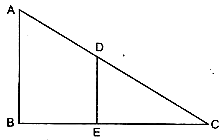
In the given figure, AB and DE are perpendicular to BC.
(i) Prove that ΔABC ∼ ΔDEC
(ii) If AB = 6 cm; DE = 4 cm and AC = 15 cm. Calculate CD.
(iii) Find the ratio of the area of ΔABC: area of ΔDEC.
Answer
(i) Given AB ⊥ BC
DE ⊥ BC
To prove ΔABC ∼ ΔDEC
Proof: If ΔABC and ΔDEC
∠ABC = ∠DEC = 90°each ...(given)
∠C = ∠C ...{common}
∴ ΔABC ∼ ΔDEC ...{A. A criteria}
Hence proved.
(ii) AB = 6 cm, DE = 4 cm
AC = 15 cm, CD = ?
Since ΔABC ∼ ΔDEC
$\Rightarrow \frac{ AB }{ DE }=\frac{ AC }{ CD }$ ...{Corresponding sides of similar Δ's are proportional}
$\therefore \frac{6}{4}=\frac{15}{C D}$
$\Rightarrow C D=\frac{15 \times 4}{6}=10$
(iii) $\frac{\text { Area of } \triangle ABC }{\text { Area of } \triangle DEC }=\frac{ AB ^2}{ DF ^2}$ ...{Area theorem}
$=\frac{36}{16}=\frac{9}{4}$ or $9: 4$.
View full question & answer
Question 83 Marks
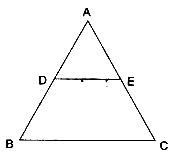
In $\triangle ABC,$ and E are the mid-points of $AB$ and $AC$ respectively. Find the ratio of the areas of $\triangle ADE$ and $\triangle ABC.$
Answer
Since, $D$ and $E$ are the mid-points of $AB$ and $AC$ respectively.
Therefore, $DE \| BC.$


Consequently,
$\triangle ADE \sim \triangle ABC$
$\Rightarrow \frac{\operatorname{area}(\triangle ADE )}{\operatorname{area}(\Delta ABC )}=\frac{ AD ^2}{ AB ^2}$
$=\frac{ AD ^2}{(2 AD )^2}$
$=\frac{1}{4} \quad \ldots\{\because AB =2 AD )$
View full question & answer
Question 93 Marks
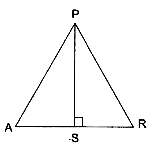
Two isosceles triangle have equal vertical angles and their areas are in the ratio of $36 : 25.$ Find the ratio between their corresponding heights.
Answer
$\triangle ABC$ and $\triangle PQR$ be the two isosceles triangles such that
$\angle A = \angle P.$
Then $\triangle ABC \sim \triangle PQR.$


Let $AD$ and $PS$ be their height then
$\frac{\operatorname{area}(\triangle ABC )}{\operatorname{area}(\triangle PQR )}=\frac{ AD ^2}{ PS ^2}$
$\Rightarrow \frac{36}{25}=\frac{ AD ^2}{ PS ^2}$
$\Rightarrow \frac{ AD }{ PS }=\frac{6}{5}$
$\Rightarrow AD : PS =6: 5 .$
View full question & answer
Question 103 Marks
Triangles $A B C$ and $D E F$ are similar.
If area $(\triangle A B C)=36 cm^2$, area $(\triangle D E f)=64 cm^2$ and $D E=6.2 cm$, find $A B$.
Answer
Area $(\triangle ABC) = 36 cm^2$
Area $(\triangle DEF) = 64 cm^2$
$DE = 6.2 cm$
$AB =?$
We have
$\frac{\operatorname{area}(\triangle ABC )}{\operatorname{area}(\triangle DEF )}=\frac{ AB ^2}{ DE ^2}$
$\Rightarrow \frac{36}{64}=\frac{ AB ^2}{(6.2)^2}$
$\Rightarrow \frac{ AB }{6 \cdot 2}=\frac{6}{8}$
$\Rightarrow AB =\frac{6 \times 6 \cdot 2}{8}$
$\Rightarrow AB =4.65 cm .$
View full question & answer
Question 113 Marks
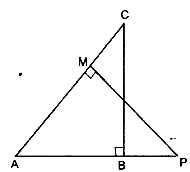
 In the given figure $\triangle A B C$ and $\triangle A M P$ are right angled at $B$ and $M$ respectively. Given $A C=10 cm, A P=15 cm$ and $P M=12 cm$.
(i) Prove $\triangle ABC \sim \triangle AMP$.
(ii) Find $A B$ and $B C$.
Answer
In $\triangle ABC$ and $\triangle AMP$
i) $\angle ABC =\angle AMP . . .\left(90^{\circ}\right.$ each)
$\angle BAC =\angle PAM . .$. (common angles)
$\therefore \triangle ABC \sim \triangle AMP . .$. (by AA similarity)
Hence proved.
(ii) $\triangle ABC \sim \triangle AMP$
$\Rightarrow \frac{ AB }{ AM }=\frac{ BC }{ PM }=\frac{ AC }{ AP }$
$\Rightarrow \frac{ BC }{ PM }=\frac{ AC }{ AP }$
$\Rightarrow \frac{ BC }{12}=\frac{10}{15}$
$\Rightarrow BC =\frac{10}{15} \times 12$
$BC = 8$
Now, $AB^2= AC^2 - BC^2$
$= 10^2 - 8^2$
$= 100 - 64 = 36$
$AB = 6 cm.$
View full question & answer
Question 123 Marks
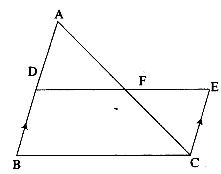
In the given figure $ABC$ and $CEF$ are two triangles where $BA$ is parallel to $CE$ and $AF: AC = 5: 8.$

(i) Prove that $\triangle ADF \sim \triangle CEF$
(ii) Find $AD$ if $CE = 6 cm$
(iii) If $DF$ is parallel to $BC$ find area of $\triangle ADF:$ area of $\triangle ABC.$
Answer
(i) In $\triangle ADF$ and $\triangle CFE$
$\angle DAF = \angle FCE ...$ (alternate angles)
$\angle AFD = \angle CEF ...$ (vertically opp. angles)
$\angle ADF = \angle CEF$
$\therefore \triangle ADF \sim \triangle CEF ...$ (by A.A.)
Hence Proved.
(ii) $\triangle ADF \sim \triangle CEF$
$\frac{ AD }{ CE }=\frac{ AF }{ FC }$
$FC = AC - AF$
$= 8 - 5 = 3$
$\therefore \frac{ AD }{6}=\frac{5}{3}$
$\Rightarrow AD = 10 cm.$
(iii) $DF \| BC \therefore \triangle ADF \sim \triangle ABC$
$\because \angle D = \angle B$ and $\angle F = \angle C.$
$\therefore \frac{\text { Ar. of } \triangle ADF }{\text { Ar. of } \triangle ABC }=\frac{ AF ^2}{ AC ^2}$
$=\left(\frac{5}{8}\right)^2=\frac{25}{64}$
View full question & answer
Question 133 Marks
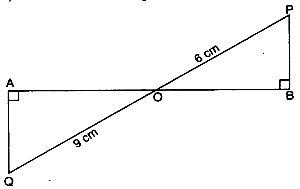
In the figure below, $P B$ and $Q A$ are perpendiculars to the line segment $A B$. If $P O=6 cm, Q O=9 cm$ and the area of $\triangle P O B$ $=120 cm^2$, find the area of $\triangle Q O A$.
Answer
$PO=6 cm, QO=9 cm .$
Area of $\triangle POB =120$
In $\triangle POB$ and $\triangle Q O B$,
$\angle B = \angle A ...(each 90^\circ )$
$\angle POB = \angle QOA ...$(Opposite vertical angel)
$\therefore \triangle POB \sim \triangle QOA$
In similar Δ's $\frac{\text { Area of } \triangle QOA }{\text { Area of } \triangle POB }=\frac{ OQ ^2}{ OP ^2}$
$\frac{\text { Area of } \triangle QOA }{120}=\frac{9^2}{6^2}$
$\text { Area of } \triangle QOA =\frac{81 \times 120}{36}$
$= 27 \times 10$
Area of $\triangle QOA = 270 cm^2.$
View full question & answer
Question 143 Marks
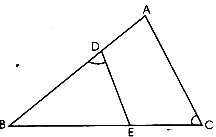
In the given figure ABC is a triangle with $\angle EDB = \angle ACB.$
(i) Prove that $\triangle ABC \sim \triangle EBD.$
(ii) If $BE = 6 cm, EC = 4 cm, BD = 5 cm$ and area of $\triangle BED = 9 cm^2.$
 Calculate the length of $AB$ and area of $\triangle ABC.$
Answer
(i) In $\triangle ABC$ and \triangle $EBD,$
$\angle ACB = \angle EDB ...$(given)
$\angle ABC = \angle EBD ...$(common)
$\therefore \triangle ABC \sim \triangle EBD$
Hence Proved.
(ii) We have, $\frac{ AB }{ BE }=\frac{ BC }{ BD }$
$\Rightarrow A B=\frac{6 \times 10}{5}=12 cm$
(iii) $\frac{\text { Area of } \triangle ABC }{\text { Area of } \triangle BED }=\left(\frac{ AB }{ BE }\right)^2$
Area of $\triangle A B C=\left(\frac{12}{16}\right)^2 \times 9 cm ^2$
$= 4 x 9 cm^2$
$= 36 cm^2.$
View full question & answer
Question 153 Marks
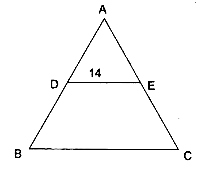
In the adjoining figure. $BC$ is parallel to $DE$, area of $\triangle ABC = 25$ sq cm, area of trapezium $BCED = 24$ sq cm, $DE = 14 cm.$ Calculate the length of $BC.$
Answer
Given: Area of $\triangle ABC = 25 cm^2$​​​​​​​
Area of trapezium $BCED = 24 cm^2​​​​​​​$​​​​​​​
and $DE = 14 cm$
$\therefore $  Area of $\triangle ADE =$ area of $\triangle ABC$ - area of trap. $BCED$
$= 25 - 24$
$= 1 cm^2$
$\because \triangle ABC \sim \triangle ADE$
$\therefore \frac{\text { Area of }(\Delta ABC )}{\text { Area of }(\Delta ADE )}=\frac{ BC ^2}{ DE ^2}$
$\frac{25}{1}=\frac{ BC ^2}{14^2}$
$\frac{ BC }{14}=\frac{5}{1}$
$BC =5 \times 14$
$= 70 cm.$
View full question & answer
[3 marks sum] - Mathematics STD 10 Questions - Vidyadip