Question 14 Marks
D and E are points on the sides AB and AC respectively of a Δ ABC such that DE | | BC and divides Δ ABC into two parts, equal in area. Find $\frac{ BD }{ AB }$.
Answer
View full question & answer→We have
area $(\triangle ADE) =$ area (trapezium BCED)
$\Rightarrow$ area $(\triangle ADE) +$ area $(\triangle ADE)$
= area (trapezium BCED) + area $(\triangle ADE)$
$\Rightarrow 2$ area $(\triangle ADE) =$ area $(\triangle ABC) ...(i)$
In $\triangle ADE$ and $\triangle ABC,$ we have
$\angle ADE = \angle B, ...[\because DE | | BC]$
$\therefore \angle AED = \angle C $...(corresponding angles)]
and $\angle A = \angle A,$ ...[Common]
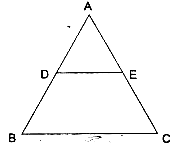
∴ Δ ADE ∼ Δ ABC
$\Rightarrow \frac{\operatorname{area}(\Delta ADE )}{\operatorname{area}(\Delta ABC )}=\frac{ AD ^2}{ AB ^2}$
$\Rightarrow \frac{\operatorname{area}(\Delta ADE )}{\text { 2area }(\Delta ADE )}=\frac{ AD ^2}{ AB ^2}$
$\Rightarrow \frac{1}{2}=\left(\frac{ AD }{ AB }\right)^2$
$\Rightarrow \frac{A D}{A B}=\frac{1}{\sqrt{2}}$
$\Rightarrow A B=\sqrt{2} A D$
$\Rightarrow A B=\sqrt{2}(A B-B D)$
$\Rightarrow(\sqrt{2}-1) A B=\sqrt{2} B D$
$\Rightarrow \frac{ BD }{ AB }=\frac{\sqrt{2}-1}{\sqrt{2}}$
$=\left(2-\frac{\sqrt{2}}{2}\right)$
area $(\triangle ADE) =$ area (trapezium BCED)
$\Rightarrow$ area $(\triangle ADE) +$ area $(\triangle ADE)$
= area (trapezium BCED) + area $(\triangle ADE)$
$\Rightarrow 2$ area $(\triangle ADE) =$ area $(\triangle ABC) ...(i)$
In $\triangle ADE$ and $\triangle ABC,$ we have
$\angle ADE = \angle B, ...[\because DE | | BC]$
$\therefore \angle AED = \angle C $...(corresponding angles)]
and $\angle A = \angle A,$ ...[Common]
∴ Δ ADE ∼ Δ ABC
$\Rightarrow \frac{\operatorname{area}(\Delta ADE )}{\operatorname{area}(\Delta ABC )}=\frac{ AD ^2}{ AB ^2}$
$\Rightarrow \frac{\operatorname{area}(\Delta ADE )}{\text { 2area }(\Delta ADE )}=\frac{ AD ^2}{ AB ^2}$
$\Rightarrow \frac{1}{2}=\left(\frac{ AD }{ AB }\right)^2$
$\Rightarrow \frac{A D}{A B}=\frac{1}{\sqrt{2}}$
$\Rightarrow A B=\sqrt{2} A D$
$\Rightarrow A B=\sqrt{2}(A B-B D)$
$\Rightarrow(\sqrt{2}-1) A B=\sqrt{2} B D$
$\Rightarrow \frac{ BD }{ AB }=\frac{\sqrt{2}-1}{\sqrt{2}}$
$=\left(2-\frac{\sqrt{2}}{2}\right)$