Why should bits of ice be wiped dry before adding them to the calorimeter during the determination of specific latent heat of fusion of ice?
Question types
Calorimetry question types
68 questions across 6 question groups — pick any mix to generate a Physics paper with step-by-step answer keys.
68
Questions
6
Question groups
5
Question types
01
[1 Mark Question Answer]
1 Q→02[2 Mark Question Answer]
21 Q→03[3 Mark Question Answer]
8 Q→04[5 Mark Question Answer]
5 Q→05MCQ
28 Q→06fill in the blanks.
5 Q→Sample Questions
Calorimetry questions
One sample from each question group in this chapter. Select any group above to see the full set with answer keys.
View full solution →
(a) Define calorimetry.
(b) Name the material used for making a calorimeter.
(c) Why is a calorimeter made up of thin sheets of the above material answered in (b)?
(b) Name the material used for making a calorimeter.
(c) Why is a calorimeter made up of thin sheets of the above material answered in (b)?
A metal ball of specific heat capacity $400 Jkg ^{-1}{ }^{\circ} C ^{-1}$ is allowed to fall from a height of 100 m . If the ball on hitting the ground stops and all the energy possessed by it is converted into heat energy, calculate the rise in temperature of the ball. [Take $g -10 ms^{-2}$ ].
View full solution →Define specific heat capacity and state its SI and CGS units.
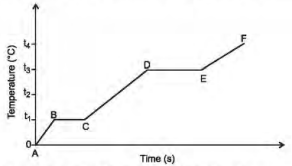
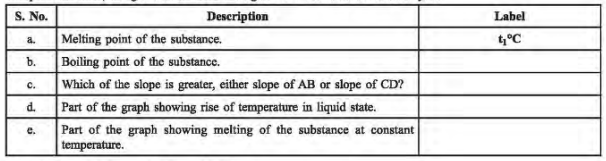
The diagram shows the change of phases of a substance on a temperature vs time graph on heating the substance at a constant rate.
(a) Why is the slope of CD less than slope of AB ?
(b) What is the boiling and melting points of the substance?
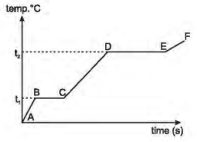
(a) Why is the slope of CD less than slope of AB ?
(b) What is the boiling and melting points of the substance?
(a) What is a calorimeter?
(b) Name the material of which a calorimeter is generally made.
(c) A calorimeter of mass 25.5 g has specific heat capacity of $0.42 Jg ^{-10} C ^{-1}$. Calculate its heat capacity.
View full solution →(b) Name the material of which a calorimeter is generally made.
(c) A calorimeter of mass 25.5 g has specific heat capacity of $0.42 Jg ^{-10} C ^{-1}$. Calculate its heat capacity.
The melting point of naphthalene is $80^{\circ} C$ and the room temperature is $30^{\circ} C$. A sample of liquid naphthalene at $100^{\circ} C$ is cooled down to the room temperature. Draw a temperature time graph to represent this cooling. In the graph, mark the region which corresponds to the freezing process.
View full solution →0.04 kg of water at $80^{\circ} C$ is poured in a copper calorimeter with a stirrer of mass 0.32 kg and initially at $25{ }^{\circ} C$. After stirring, the final temperature recorded is $55^{\circ} C$. If the specific heat capacity of water is $4200 Jkg ^{-1}{ }^{\circ} C ^{-1}$, answer the following questions :
(a) What is the quantity of heat released when the temperature of 1 kg of water falls through $1^{\circ} C$ ?
(b) Calculate the total heat energy released by water in the above question on cooling from $80^{\circ} C$ to $55{ }^{\circ} C$.
(c) If all the heat energy released by water is absorbed by calorimeter, calculate the specific beat capacity of calorimeter,
View full solution →(a) What is the quantity of heat released when the temperature of 1 kg of water falls through $1^{\circ} C$ ?
(b) Calculate the total heat energy released by water in the above question on cooling from $80^{\circ} C$ to $55{ }^{\circ} C$.
(c) If all the heat energy released by water is absorbed by calorimeter, calculate the specific beat capacity of calorimeter,
40 g of water at $60^{\circ} C$ is poured into a vessel containing 50 g of water at $20^{\circ} C$. The final temperature recorded is $30^{\circ} C$. Calculate the thermal capacity of the vessel. (Take specific heat capacity of water as $4.2 J g ^{-10} C ^{-1}$ )
View full solution →400 g of wax at $10^{\circ} C$ is beated to $80^{\circ} C$, when it starts melting. On complete melting wax is further heated so that temperature rises to $130^{\circ} C$. Calculate (a) Heat energy required to bring the wax to its melting point (b) Heat energy required to melt the wax (c) Heat energy required to bring the molten wax to $130^{\circ} C$.
[sp, beat capacity of solid wax $=1.5 Jg ^{-10} C ^{-1}$; sp. heat capacity of liquid wax $=1.8 Jg ^{-19} C ^{-1}$ and sp . latent heat of wax $\left.=20 Jg ^{-1}\right]$
View full solution →[sp, beat capacity of solid wax $=1.5 Jg ^{-10} C ^{-1}$; sp. heat capacity of liquid wax $=1.8 Jg ^{-19} C ^{-1}$ and sp . latent heat of wax $\left.=20 Jg ^{-1}\right]$
(i) (a) What is meant by specific heat capacity of a substance?
(b) Why does the heat supplied to a substance during its change of state not cause any rise in its temperature?
(ii) A student performs the following experiment in order to calculate specific latent heat of fusion of ice. He takes a calorimeter of mass 5.0 g containing 50 g of water at $30^{\circ} C$. Into this calorimeter he adds 5 g of dry ice at $0^{\circ} C$. When all the ice melts the final temperature recorded by him is $20^{\circ} C$ ?
(a) What is the total quantity of water in the calorimeter at $20^{\circ} C$ ?
(b) What quantities of heat are released by water and calorimeter in attaining the temperature of $20{ }^{\circ} C$.
(c) What is the total amount of heat gained by the ice?
(d) Calculate the value of latent heat of fusion of ice from the above calculations.
[Take SHC of water $=4.2 Jg ^{-10} C ^{-1}$ and SHC of copper $=0.4 Jg ^{-10} C ^{-1}$ ]
(iii) (a) Define heat capacity of a substance.
(b) Write the SI unit of heat capacity.
(c) What is the relationship between heat capacity and specific heat capacity of a substance?
View full solution →(b) Why does the heat supplied to a substance during its change of state not cause any rise in its temperature?
(ii) A student performs the following experiment in order to calculate specific latent heat of fusion of ice. He takes a calorimeter of mass 5.0 g containing 50 g of water at $30^{\circ} C$. Into this calorimeter he adds 5 g of dry ice at $0^{\circ} C$. When all the ice melts the final temperature recorded by him is $20^{\circ} C$ ?
(a) What is the total quantity of water in the calorimeter at $20^{\circ} C$ ?
(b) What quantities of heat are released by water and calorimeter in attaining the temperature of $20{ }^{\circ} C$.
(c) What is the total amount of heat gained by the ice?
(d) Calculate the value of latent heat of fusion of ice from the above calculations.
[Take SHC of water $=4.2 Jg ^{-10} C ^{-1}$ and SHC of copper $=0.4 Jg ^{-10} C ^{-1}$ ]
(iii) (a) Define heat capacity of a substance.
(b) Write the SI unit of heat capacity.
(c) What is the relationship between heat capacity and specific heat capacity of a substance?
(i) A copper vessel of mass 100 g contains 150 g of water at $50^{\circ} C$. How much ice is needed to cool it to $5^{\circ} C$ ?
Given : Specific heat capacity of copper $=0.4 J g ^{-1}{ }^{\circ} C ^{-1}$
Specific heat capacity of water $=4.2 Jg ^{-1}{ }^{\circ} C ^{-1}$
Specific latent heat of fusion of ice $=336 Jg ^{-1}$
(ii) A piece of ice of mass 60 g is dropped into 140 g of water at $50^{\circ} C$. Calculate the final temperature of water when all the ice has melted. (Assume no heat is lost to the surrounding)
Specific heat capacity of water $=4.2 Jg ^{-1} K^{-1}$.
Specific latent beat of fusion of ice $=336 Jg ^{-1}$.
(iii) (a) Define specific latent heat of fusion of ice.
(b) What happens to the heat supplied to the substance when the heat supplied causes no change in the temperature of the substance?
View full solution →Given : Specific heat capacity of copper $=0.4 J g ^{-1}{ }^{\circ} C ^{-1}$
Specific heat capacity of water $=4.2 Jg ^{-1}{ }^{\circ} C ^{-1}$
Specific latent heat of fusion of ice $=336 Jg ^{-1}$
(ii) A piece of ice of mass 60 g is dropped into 140 g of water at $50^{\circ} C$. Calculate the final temperature of water when all the ice has melted. (Assume no heat is lost to the surrounding)
Specific heat capacity of water $=4.2 Jg ^{-1} K^{-1}$.
Specific latent beat of fusion of ice $=336 Jg ^{-1}$.
(iii) (a) Define specific latent heat of fusion of ice.
(b) What happens to the heat supplied to the substance when the heat supplied causes no change in the temperature of the substance?
(i) (a) Define calorie.
(b) What do you understand by the term latent heat of fusion?
(ii) A piece of metal of mass 50 g is at $100^{\circ} C$. It is placed on a block of ice. Calculate the amount of ice which melts, if the specific heat capacity of metal is $0.8 Jg ^{-1} C ^{-1}$ and specific latent heat of fusion of ice is $340 Jg ^{-1}$.
(iii) A vessel of negligible thermal capacity contains 60 g of water at $40^{\circ} C$. In this water is placed 10 g of ice at $-10^{\circ} C$. If all the ise melts calculate the final temperature of water.
Specifle heat capacity of ice $=2100 Jkg ^{-19} C ^{-1}$
Specific heat capacity of water $=4200 Jkg ^{-19} C ^{-1}$
Specific latent heat of fission of ice $=336 \times 10^3 J / kg$
View full solution →(b) What do you understand by the term latent heat of fusion?
(ii) A piece of metal of mass 50 g is at $100^{\circ} C$. It is placed on a block of ice. Calculate the amount of ice which melts, if the specific heat capacity of metal is $0.8 Jg ^{-1} C ^{-1}$ and specific latent heat of fusion of ice is $340 Jg ^{-1}$.
(iii) A vessel of negligible thermal capacity contains 60 g of water at $40^{\circ} C$. In this water is placed 10 g of ice at $-10^{\circ} C$. If all the ise melts calculate the final temperature of water.
Specifle heat capacity of ice $=2100 Jkg ^{-19} C ^{-1}$
Specific heat capacity of water $=4200 Jkg ^{-19} C ^{-1}$
Specific latent heat of fission of ice $=336 \times 10^3 J / kg$
(i) A piece of ice of mass 40 g is dropped into 200 g of water at $50^{\circ} C$. Calculate the final temperature of water after all the ice has melted. (specific heat capacity of water $=4200 J / kg { }^{\circ} C$, specific latent heat of fusion of ice $\left.=336 \times 10^3 H / kg \right)$
(ii) A piece of iron of mass 2.0 kg has a thermal capacity of $966 J / \circ C$.
(a) How mach heat is needed to warm it by $15^{\circ} C$ ?
(b) What is its specific heat capacity in SI units?
(iii) Explain the following :
(a) Why is water used as coolant in motor car radiators?
(b) Why it takes more time to change water at $100^{\circ} C$ to steam at $100^{\circ} C$ compared to heating same mass of water from $0^{\circ} C$ to $100^{\circ} C$ ?
View full solution →(ii) A piece of iron of mass 2.0 kg has a thermal capacity of $966 J / \circ C$.
(a) How mach heat is needed to warm it by $15^{\circ} C$ ?
(b) What is its specific heat capacity in SI units?
(iii) Explain the following :
(a) Why is water used as coolant in motor car radiators?
(b) Why it takes more time to change water at $100^{\circ} C$ to steam at $100^{\circ} C$ compared to heating same mass of water from $0^{\circ} C$ to $100^{\circ} C$ ?
(i) 50 g of ice at $0^{\circ} C$ is added to 300 g of a liquid at $30^{\circ} C$. What will be the final temperature of the mixture when all the ice has melted? The specific heat capacity of the liquid is $2.65 Jg ^{-19} C ^{-1}$ while that of water is $4.2 Jg ^{-1}{ }^{\circ} C ^{-1}$. Specific latent heat of fision of ice $=336 Jg ^{-1}$.
(ii) A metal drill of power 500 W , drills a bole in a metal cube of mass 0.25 kg in 6.5 s . If the specific heat capacity of metal cube is $130 Jkg ^{-1}{ }^{\circ} C ^{-1}$, calculate
(a) Energy generated by the drill in ls.
(b) Energy generated by the drill in 6.5 s.
(c) If $t^{\circ} C$ is the rise in temperature, state the amount of heat energy absorbed by metal cube in terms of $t$.
(d) Write down an equation and calculate the value of t .
(iii) Explain the following
(a) Water is used in hot water bottles for fomentation purposes.
(b) A wise farmer always waters his fields in the evening, if there is a forecast for frost.
(c) The specific heat of fusion of lead is $27 Jg ^{-1}$. What do you understand from the statement?
View full solution →(ii) A metal drill of power 500 W , drills a bole in a metal cube of mass 0.25 kg in 6.5 s . If the specific heat capacity of metal cube is $130 Jkg ^{-1}{ }^{\circ} C ^{-1}$, calculate
(a) Energy generated by the drill in ls.
(b) Energy generated by the drill in 6.5 s.
(c) If $t^{\circ} C$ is the rise in temperature, state the amount of heat energy absorbed by metal cube in terms of $t$.
(d) Write down an equation and calculate the value of t .
(iii) Explain the following
(a) Water is used in hot water bottles for fomentation purposes.
(b) A wise farmer always waters his fields in the evening, if there is a forecast for frost.
(c) The specific heat of fusion of lead is $27 Jg ^{-1}$. What do you understand from the statement?
Asertion (A): The base of a cooking pan is made thick.
Reason (R): Its heat capacity becomes large due to which it gets heated slowly and imparts sufficient heat energy at a slow rate to the food for its proper cooking.
Reason (R): Its heat capacity becomes large due to which it gets heated slowly and imparts sufficient heat energy at a slow rate to the food for its proper cooking.
- ABoth A and R are the true and R is a correct explanation of A .
- BBoth A and R are the true but R is not a correct explanation of A .
- CAssertion is false and Reason is true.
- ✓Assertion is true and Reason is false,
Answer: D.
View full solution →Assertion (A): Specific heat capacity of a substance $X$ is $3.8 Jg ^{-1} K^{-1}$ and of the substance $Y$ is $0.4 Jg ^{-1} K^{-1}$.
Reason (R): For the same heat energy and same mass, the rise in temperature of $X$ will be more than $Y$, thus $X$ is a good conductor of heat.
Reason (R): For the same heat energy and same mass, the rise in temperature of $X$ will be more than $Y$, thus $X$ is a good conductor of heat.
- ABoth A and R are the true and R is a correct explanation of A .
- BBoth A and R are the true but R is not a correct explanation of A .
- CAssertion is false and Reason is true.
- ✓Assertion is true and Reason is false,
Answer: D.
View full solution →Water is used in hot water bottles for fomentation, because :
- Awater has highest sp . heat capacity
- Bwater at comparatively low temperature ( $50^{\circ} C$ ) can store lot of heat energy
- Cwater slowly radiates heat and keeps the temperature cozy
- ✓all of these.
Answer: D.
View full solution →When land breeze blows :
- Ait always blows during night.
- Bthe cold and heavy air from land blows towards sea.
- Cthe warm and light air above the sea rises up and blows towards land.
- ✓all of these.
Answer: D.
View full solution →When sea breeze blows:
- Athe warm air rises up and blows towards sea
- Bthe cold and heavy air from sea blows towards land
- Cit always blows during day time
- ✓all of these
Answer: D.
View full solution →The direct change from solid to vapour is called ___________ [sublimation / solidification] and the reverse change from vapour to solid is called ___________ [sublimation / solidification].
A calorimeter is made up of a thin sheet of ___________ [aluminium/Iron/copper].
Usually, a/an ___________ [good conducter / bad conductor / insulator] of heat has a low specific heat capacity.
When ice melts its volume ___________ [increases / decreases / remains same].
The SI unit of heat is ___________ [calorie / joule [kilojoule].
Generate a Calorimetry paper free
Pick question groups from the list above, set marks and difficulty, and export a branded PDF with step-by-step answer keys. First 3 chapters free — no signup.