Questions

[2 Mark Question Answer]

🎯

Test yourself on this topic

21 questions · timed · auto-graded

Question 22 Marks
(a) Define calorimetry.
(b) Name the material used for making a calorimeter.
(c) Why is a calorimeter made up of thin sheets of the above material answered in (b)?
Answer
(a) Calorimetry : The branch of physics which deals with the measurement of heat energy is called calorimetry.
(b) Copper material used for making a calorimeter.
(c) The thermal capacity of copper is very low. Thus, it can easily attain the termperature of contents within it, but absorbs negligible amount of heat energy. This reduces experimental error.
View full question & answer
Question 32 Marks
A metal ball of specific heat capacity $400 Jkg ^{-1}{ }^{\circ} C ^{-1}$ is allowed to fall from a height of 100 m . If the ball on hitting the ground stops and all the energy possessed by it is converted into heat energy, calculate the rise in temperature of the ball. [Take $g -10 ms^{-2}$ ].
Answer
Mechanical energy possessed by the metal ball $=m g h=m \times 10 \times 100$
Heat energy absorbed by the metal ball $=m c \theta_{ R }=m \times 400 \times \theta_{ R }$
By the law of conservation of energy,
Heat energy absorbed by metal ball = Mechanical energy of metal ball
$\Rightarrow m \times 400 \times \theta_R=m \times 10 \times 100$
$\therefore$ Rise in temperature, $\theta_{ R }=\frac{1000}{400}=2.5^{\circ} C$
View full question & answer
Question 42 Marks
Define specific heat capacity and state its SI and CGS units.
Answer
The amount of heat energy required to raise the temperature of a unit mass of substance through 1 K is called the specific heat capacity of that substance.
In CGS system, the unit of specific heat capacity is $Jg ^{-1} K^{-1}$.
In SI system its unit is $J kg ^{-1} K^{-1}$.
View full question & answer
Question 52 Marks
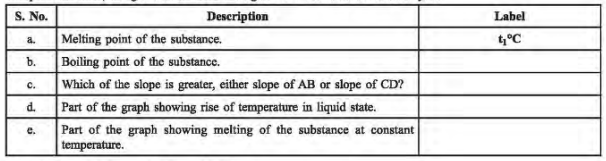
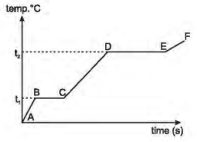
The diagram shows the change of phases of a substance on a temperature vs time graph on heating the substance at a constant rate.
(a) Why is the slope of CD less than slope of AB ?
(b) What is the boiling and melting points of the substance?
Image
Answer
(a) It is because,
$\frac{\text { Rise in temperature }}{\text { Time interval }} $ (For slope AB ) is greater than
$\frac{\text { Rise in temperature }}{\text { Time interval }} $ (For slope CD)
(b) Boiling point of the substance $= t _2{ }^{\circ} C$ and
Melting point of the substance $=t_1{ }^{\circ} C$
View full question & answer
Question 62 Marks
Explain why water is used in hot water bottles for fomentation and also used as a universal coolant.
Answer
Water has highest specific heat capacity of $4200 Jkg ^{-1}{ }^{\circ} C ^{-1}$. Thus, hot water can retain lot of heat energy at comparitively bearable temperature and hence is used for fomentation purposes.
Conversely, water can extract out 4200 J of heat energy per kilogram for $1^{\circ} C$ fall in temperature. This is the largest amount of heat energy which a given substance can extract out from hot substances, and hence, it is used as universal coolant.
View full question & answer
Question 72 Marks
State in brief, the meaning of each of the following :
(a) The heat capacity of a body is $50 J^{\circ} C { }^{-1}$.
(b) The specific latent heat of fusion of ice is $336000 J kg ^{-1}$.
(c) The specific heat capacity of copper is $0.4 Jg ^{-1}{ }^{\circ} C ^{-1}$
Answer
(a) From the statement it implies that a given body will need or give 50 J of heat energy for every $1^{\circ} C$ rise or fall in its temperature.
(b) From the statement it implies that 1 kg of ice at $0^{\circ} C$ will absorb $336,000 J$ of heat energy so as to form 1 kg of water at $0^{\circ} C$.
(c) From the statement it implies that if 1 g of copper is heated through $1^{\circ} C$, in order to do so, it will absorb 0.4 J of heat energy.
View full question & answer
Question 82 Marks
(a) Why is the base of a cooking pan generally made thick?
(b) Why does stone lying in the sum get heated up much more than water lying for the same duration of time?
Answer
(a) More the mass of the base of a cooking vessel, more it will be able to store heat energy and less will be its temperature rise. Thus, the food cooked in such a vessel escapes burning or charring.
(b) Stone gets heated up much more than water because water has higher specific heat capacity, so it requires more heat energy than stone for same rise in temperature.
View full question & answer
Question 92 Marks
(a) The heat capacity of a vessel is $150 JK ^{-1}$. Calculate the heat energy required to raise its temperature from 293 K to 373 K .
(b) Calculate the mass of ioe required to lower the temperature of 300 g of water at $40^{\circ} C$ to water at $0^{\circ} C$. (Specific latent heat of ice $=336 J / g$, Specific heat capacity of water $=4.2 J / g ^{\circ} C$ )
Answer
(a) Heat capacity of the vessel $=150 JK ^{-1}$
Rise in temperature of vessel $=(373-293) K =80 K$
$\therefore$ Heat energy required - Heat capacity $*$ rise in temperature $=150 JK ^{-1} \times 80 K=12000 J=12 kJ$.,(b) Heat absorbed by ice to melt $=$ Heat given out by water
$m($ ice $) \times L($ ice $)=m($ water $) \times c($ water $) \times$ fall in temperature $(\theta)$
\Rightarrow \quad m \text { (ice) } \times 336=300 \times 4.2 \times 40
$\therefore m($ ice $)=\frac{300 \times 4.2 \times 40}{336}=150 g$
View full question & answer
Question 102 Marks
Define specific latent heat of fusion of ice. State its magnitude in calories and joules.
Answer
Amount of heat energy required to melt one kg of ice at $0^{\circ} C$ to form water at $0^{\circ} C$ is called specific latent heat of fusion of ice.
The magnitudes of specific latent heat of fusion of ice in different systems are :
(i) $80 calg ^{-1}$ (old system)
(ii) $336 Jg ^{-1}$ (CG.S system)
(iii) $336000 Jkg ^{-1}$ (SI system)
View full question & answer
Question 112 Marks
(a) What do you understand by the term latent heat of fusion?
(b) Why does the temperature remain constant during the fusion of a substance?
Answer
(a) The heat energy supplied to a solid so as to change it into the liquid state, without any rise in temperature is called latent heat of fusion.
(b) During fasion, the heat energy supplied to the solid is used in increasing the intermolecular space within the substance and is stored as potential energy of the molecules. The kinetic energy of the molecules do not change during change of state. Thus, the temperature of the substance does not rise until whole of solid is converted into liquid.
View full question & answer
Question 122 Marks
Heat energy is given to 150 g of water, such that its temperature rises by 20 K . When the same amount of heat energy is given to a liquid X of mass 100 g its temperature rises by 80 K . Calculate (a) heat energy given to water (b) the specific heat capacity of liquid X . [Take up specific heat capacity of water $=4.2 Jg ^{-1} K^{-1}$ ]
Answer
(a) Heat energy given to water $=m c \theta_{ R }=150 g \times 4.2 Jg ^{-1} K^{-1} \times 20 K=12600 J$.
(b) Thus, heat energy given to liquid $X =12600 J$
Now, Heat energy given to liquid $X =m c \theta_{ R }=100 g \times c \times 80 K$
Or, $\quad 12600 J=100 g \times c \times 80 K$
$\therefore c =\frac{12600 J}{100 g \times 80 K}=1.575 Jg ^{-1} K^{-1}$
View full question & answer
Question 132 Marks
400 g of mercury of specific heat capacity $0.14 Jg ^{-1}{ }^{\circ} C ^{-1}$ is heated by a 200 W heater for 1 min . and 40 s . If initially mercury is at $0^{\circ} C$, calculate its final temperature.
Answer
Given, $m=400 g ; c=0.14 Jg ^{-1}{ }^9 C ^{-1} ; P =200 W=200 J^{-1} ; t=1 min 40 s=100 s$
Heat supplied by the heater, $H = P \times t=200 Js ^{-1} \times 100 s=20000 J$
Rise in temperature of mercury, $ \theta_{ R }=\frac{ H }{m c}=\frac{20000 J}{400 g \times 0.14 Jg ^{-10} C ^{-1}}=\frac{2500}{7}=357.14^{\circ} C$.
$\therefore$ Final temperature $=0^{\circ} C +357.14^{\circ} C =357.14^{\circ} C$
View full question & answer
Question 142 Marks
(a) Explain how is land breeze caused.
(b) Why is the weather in coastal regions moderate?
Answer
(a) During night, the land as well as the sea radiate heat energy. However, the temperature of land falls more rapidly as compared to that of sea water, as the sea water has higher specific heat capacity. Thus, temperature of sea water is more than land. The air above the sea water being warm and hence light, rises up. This results in drop in pressure over the sea. To make up for this drop in pressure, the cold air from land starts blowing towards the sea. This in turn sets up land breeze.
(b) Land breeze and sea breeze help in moderating weather in costal regions.
View full question & answer
Question 152 Marks
(a) Define calorie.
(b) State the modern unit of heat energy. How is this unit related to calorie?
Answer
(a) The amount of heat energy required to raise the temperature of 1 g of pure water through $1^{\circ} C$ is called one calorie.
(b) Modern unit of heat energy is joule. 1 calorie $=4.186 J \simeq 4.2 J$
View full question & answer
Question 162 Marks
(a) What are the factors on which heat absorbed by a body depends?
(b) What are the factors that effects heat given out by a body?
Answer
(a) 1. Heat energy absorbed by a cold body is directly proportional to the mass of the body.
2. Heat energy absorbed by a cold body is directly proportional to the rise in temperature of the body.
(b) 1. Heat energy given out by a hot body is directly proportional to the mass of the body.
2. Heat energy given out by a bot body is directly proportional to the fall in temperature of the body.
View full question & answer
Question 172 Marks
(a) Which material is the calorimeter commonly made of?
(b) Give one practical example, where high specific heat capacity of water is used : (i) as heat reservoir, (ii) in cooling
Answer
(a) Calorimeter is commonly made of copper metal.
(b) (i) In hot water bottles or for internal heating of rooms, the high specific heat capacity of water is used as beat reservoir.
(ii) In spraying water on roads in hot summer or using water in automobile radiators, the high specific heat capacity of water is used in cooling.
View full question & answer
Question 182 Marks
(a) What energy changes would you expect to take place in the molecules of a substance when it undergoes a change in state without any change in its temperature?
(b) Define specific heat capacity of a substance and state its SI units.
Answer
(a) The intermolecular spaces increase or decrease to a great extent resulting in the change of state of substance.
(b) The amount of heat encrgy required to raise the temperature of 1 kg of a substance through $1^{\circ} C$ is called its specific heat capacity. Its SI unit is $J kg ^{-1} K^{-1}$.
View full question & answer
Question 192 Marks
(a) An equal quantity of heat is supplied to two substances A and B . The substance A shows a greater rise in temperature. What can you say about the specific heat capacity of A as compared to that of B ?
(b) Why are burns caused by steam more severe than those caused by boiling water at the same temperature?
Answer
(a) The specific heat capacity of A is less than B .
(b) It is on account of very high specific latent heat of vaporisation of steam. 1 g of steam at $100^{\circ} C$ has 2260 J of heat energy more than 1 g of water at $100^{\circ} C$. Thus, steam causes more severe burns than the water at $100^{\circ} C$.
View full question & answer
Question 202 Marks
(a) Name the liquid which has the highest specific heat capacity.
(b) Why do pieces of ice added to a drink cool it much faster than ice cold water?
Answer
(a) Water has the highest specific heat capacity ( $4200 J kg ^{-1} K^{-1}$ ).
(b) Ice has the highest specific latent heat of fusion, i.e., $336 J / g$. Thus, every 1 g of ice extracts out 336 J of heat energy more from the drink as compared to water at $0^{\circ} C$, and hence, cools it at a much faster rate.
View full question & answer
Question 212 Marks
(a) Define the term specific latent heat of fusion of a substance.
(b) Which material is the calorimeter commonly made of?
(c) Give one reason for using this material.
Answer
(a) The amount of heat energy required to convert 1 kg of solid at its melting point to its liquid state without any rise in temperature is known as specific latent heat of fusion.
(b) Calorimeter is commonly made from pure copper metal.
(c) Copper has a very low specific heat capacity. Thus, calorimeter absorbs very small amount of heat energy to take the temperature of contents within it.
View full question & answer
[2 Mark Question Answer] - Physics STD 10 Questions - Vidyadip