Questions · Page 2 of 2

[3 Mark Question Answer]

Question 513 Marks
How does the resistance of a wire depend on its radius? Explain your answer.
Answer
Resistance of a wire is inversely proportional to the area of cross-section of the wire.
$\begin{aligned} & R \propto \frac{1}{A} \\ & R \propto \frac{1}{\pi r 2}\end{aligned}$
This means if a wire of same length, but of double radius is taken, its resistance is found to be one-fourth.
View full question & answer
Question 523 Marks
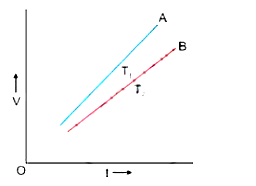
Draw a V-I graph for a conductor at two different temperature. What conclusion do you draw from your graph for the variation of resistance of conductor with temperature?

Answer


In the above graph, T1 > T2. The straight line A is steeper than the line B, which leads us to conclude that the resistance of conductor is more at high temperature T1 than at low temperature T2. Thus, we can say that resistance of a conductor increases with the increase in temperature.
View full question & answer
Question 533 Marks
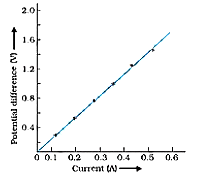
What is an ohmic resistor? Give one example of an ohmic resistor. Draw a graph to show its current voltage relationship. How is the resistance of the resistor determined from this graph?
Answer
An ohmic resistor is a resistor that obeys Ohm's law.
For example: all metallic conductors (such as silver, aluminium, copper, iron etc.)


From above graph, resistance is determined in the form of a slope.
View full question & answer
[3 Mark Question Answer] - Page 2 - Physics STD 10 Questions - Vidyadip