Questions · Page 1 of 2

MCQ

🎯

Test yourself on this topic

50 questions · timed · auto-graded

MCQ 11 Mark
An electrical appliance has a rating 100 W, 120V. The resistance of element of appliance when in use:
  • A
    1.2 Ω
  • 144 Ω
  • C
    120 Ω
  • D
    100 Ω
Answer
Correct option: B.
144 Ω
$144 \Omega$
Given, Power $(P)=100 W$
Potential difference , V = 120 volt
$\therefore$ Resistance, $R =\frac{ V ^2}{ P }=\frac{(120)^2}{100}=144 \Omega$
View full question & answer
MCQ 21 Mark
In series combination of resistances:
  • A
    P.d. is same across each resistance
  • B
    Total resistance is reduced
  • Current is same in each resistance
  • D
    All of the above are true
Answer
Correct option: C.
Current is same in each resistance
In series combination of resistances, current is same in each resistance.

Hint: In a series combination, the current has a single path for its flow. Hence, the same current passes through each resistor.

View full question & answer
MCQ 31 Mark
For which of the following substance, resistance decreases with increase in temperature?
  • A
    Copper
  • B
    Mercury
  • Carbon
  • D
    Platinum
Answer
Correct option: C.
Carbon
For carbon, resistance decreases with increase in temperature.
Hint: For semiconductors such as carbon and silicon, the resistance and resistivity decreases with the increase in temperature.
View full question & answer
MCQ 41 Mark
Which of the following is an ohmic resistance?
  • A
    LED
  • B
    Junction diode
  • C
    Filament of a bulb
  • Nichrome wire
Answer
Correct option: D.
Nichrome wire
Nichrome is an ohmic resistance.
Hint: Substances that obey Ohm's law are called Ohmic resistors.
View full question & answer
MCQ 51 Mark
When a current I flows through a resistance R for time t, the electrical energy spent is given by :
  • A
    $IRt$
  • $1^2 Rt$
  • C
    $I^2 t t$
  • D
    $I^{\wedge} 2 R / t$
Answer
Correct option: B.
$1^2 Rt$
$I^2 R t$
Note: Electrical energy $( W )= I ^2 Rt = VIt =\frac{ V ^2 t }{ R }$
View full question & answer
MCQ 61 Mark
The potential difference between terminals of a cell in a closed electric circuit is:
  • A
    terminal voltage
  • electro motive force
  • C
    voltage drop
  • D
    none of these
Answer
Correct option: B.
electro motive force
(b)
electro motive force
Explanation:
This is because when current is drawn from it, then the potential difference between its electrodes is called the terminal voltage. It is always less than the e.m.f. because when charge flows in a circuit.
View full question & answer
MCQ 71 Mark
The resistance of a wire, which impedes the flow of electric current, is referred to as:
  • A
    Current
  • B
    Potential
  • Resistance
  • D
    Charge
Answer
Correct option: C.
Resistance
(c)
Resistance
Explanation:
Resistance is the term used to describe the obstruction to the flow of current through a wire or any other electrical component.
View full question & answer
MCQ 81 Mark
The potential difference between two points in an electric circuit is measured using:
  • A
    Voltmeter, connected in series
  • Voltmeter, connected in parallel
  • C
    Ammeter, connected in series
  • D
    Ammeter, connected in parallel
Answer
Correct option: B.
Voltmeter, connected in parallel
(b)
Voltmeter, connected in parallel
Explanation:
A voltmeter is connected in parallel to the circuit points between which the potential difference is to be measured, ensuring it does not significantly alter the current path.
View full question & answer
MCQ 91 Mark
A point's potential is considered 1 volt when:
  • 1 joule of work is done to move 1 coulomb of charge from infinity to that point.
  • B
    5 joules of work are done
  • C
    10 joules of work are done
  • D
    1 erg of work is done
Answer
Correct option: A.
1 joule of work is done to move 1 coulomb of charge from infinity to that point.
(a)
1 joule
Explanation :
The potential at a point is 1 volt if it takes 1 joule of work to move a 1 coulomb charge from infinity to that point.
View full question & answer
MCQ 101 Mark
If a work of $W$ joules is performed to bring a test charge $Q$ coulombs from infinity to a point $P$, the electric potential $V$ at point $P$ is calculated as:
  • A
    $V = WQ$
  • B
    $V=Q / W$
  • $V=W / Q$
  • D
    None of the above
Answer
Correct option: C.
$V=W / Q$
(c)
$V=W / Q$
Explanation:
The electric potential V at point P , given the work W joules to move a charge Q coulombs, is defined as $V = W / Q$.
View full question & answer
MCQ 111 Mark
The instrument used to measure the current in a circuit is:
  • A
    Voltmeter, connected in series
  • B
    Voltmeter, connected in parallel
  • Ammeter, connected in series
  • D
    Ammeter, connected in parallel
Answer
Correct option: C.
Ammeter, connected in series
(c)
Ammeter, connected in series
Explanation:
An ammeter must be connected in series with the circuit components to measure the total current flowing through the circuit accurately.
View full question & answer
MCQ 121 Mark
Choose the correct relation for $e . m . f .(\varepsilon)$ and terminal voltage V :
  • A
    $e = V$ (always)
  • B
    $V > e$ [always]
  • $V < e$ [when the cell is in use]
  • D
    None of the above
Answer
Correct option: C.
$V < e$ [when the cell is in use]
(c)
$V <\varepsilon$ [when the cell is in use]
Explanation:
Some amount of energy is utilised for the flow of charges through a circuit.
View full question & answer
MCQ 131 Mark
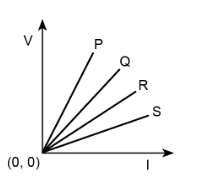
The graph of voltage vs current for four different materials is shown below.
Image
Which of these four materials would be used for making the coil of a toaster?

  • A
    Q
  • B
    S
  • P
  • D
    R
Answer
Correct option: C.
P
(c)
P
Explanation:
Greater the slope, more is the resistance and hence more the heating effect. Thus, we use material with higher resistance for making a toaster.
View full question & answer
MCQ 141 Mark
Choose the correct relation for e.m.f. (e) and terminal voltage V:
  • A
    $e=V$ (always)
  • B
    V>e [always]
  • $V < e$ [when the cell is in use]
  • D
    None of the above
Answer
Correct option: C.
$V < e$ [when the cell is in use]
(c)
V $<e$ [when the cell is in use]
Explanation:
Some amount of energy is utilised for the flow of charges through a circuit.
View full question & answer
MCQ 151 Mark
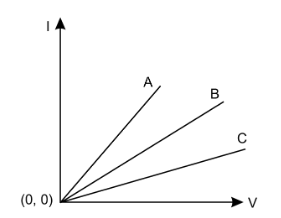
The graph shows I against $V$ relation for three conductors $A, B$ and $C$. Choose the correct relation for the resistors of $A, B$ and $C$.
Image
  • A
    $R_A>R_B>R_C$
  • B
    $R _{ B }> R _{ C }< R _{ A }$
  • C
    $R _{ C }> R _{ B }< R _{ A }$
  • $R_C>R_B>R_A$
Answer
Correct option: D.
$R_C>R_B>R_A$
(d) $R_C>R_B>R_A$
Explanation:
Slope of the graph $( I - V )=\frac{1}{ R }=\frac{ I }{ V }$
Since, Slope $A >$ SlopeB $>$ Slope C
$
\therefore R_{A}<R_{B}<R_{C}
$
View full question & answer
MCQ 161 Mark
A 10 metre wire has a resistance of $R W$. When the wire is cut into five equal pieces, what will be the resistance of each piece of wire?
  • A
    $\frac{R}{2} \Omega$
  • B
    $\frac{ R }{5} W$
  • $\frac{R}{5} \Omega$
  • D
    10 R W
Answer
Correct option: C.
$\frac{R}{5} \Omega$
(c)
$\frac{R}{5} \Omega$
Explanation:
Each small wire will have a length of 2 metre. We know, $R=\frac{\rho l}{A}$. If cross sectional area of the wire $(A)$ and resistivity ( $\rho$ ) are constant, then resistance of each piece of wire will be $R / 5 W$.
View full question & answer
MCQ 171 Mark
The equivalent resistance of ' $n$ ' resistances of equal resistance ' $R$ ' connected in series is $X$ and connected in parallel is $Y$. Which of the following is the correct relation?
  • A
    $X Y=n R$
  • B
    $X Y=n^2 R$
  • C
    $X Y=n R ^2$
  • D
    $XY = R ^2$
View full question & answer
MCQ 181 Mark
In a circuit three resistors $1 W, 2 W$ and 3 W are connected in (i) series, (ii) in parallel. What is the ratio of the current flowing through the circuit when they are connected in series to that they are connected in parallel?
[Take supply voltage $=8 V$ ]
  • $1: 11$
  • B
    $3: 2$
  • C
    $2: 5$
  • D
    $2: 3$
Answer
Correct option: A.
$1: 11$
(a)
$1: 11$
Explanation:
When they are connected in series the equivalent resistance is $=1+2+3=6 W$.
When they are connected in parallel the equivalent resistance is
$
\frac{(1 \times 2+2 \times 3+3 \times 1)}{(1+2+3)}=\frac{6}{11} W \text {. }
$
The current flowing through the circuit in series connection is $\frac{8}{6}=\frac{4}{3}=1.33 A$.
The current flowing through the circuit in parallel connection is $\frac{8}{6 / 11}=\frac{44}{3} A$.
Thus, the required ratio is, $1: 11$.
View full question & answer
MCQ 191 Mark
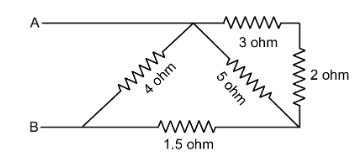
Equivalent resistance of the circuit is?
Image
  • 2 W
  • B
    4 W
  • C
    6 W
  • D
    8 W
Answer
Correct option: A.
2 W
(a)
2 W
Explanation:
2 W and 3 W are in series. Their equivalent resistance is $R_1=5 W$.
$R_1$ is in parallel connection with 5 W . Their equivalent resistance is $R_2=2.5 W$.
$R_2$ is in series connection with 1.5 W . Their equivalent resistance is $R_3=4 W$.
$R_3$ is in parallel connection with 4 W . Their equivalent resistance is $R_4=2 W$.
Thus, the equivalent resistance is 2 W .
View full question & answer
MCQ 201 Mark
Consider the following figure:
Image
Circuit for Resistors
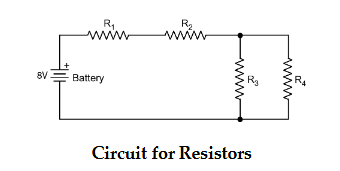
Given: $R _1=2 \Omega, R _2=4 \Omega, R _3= R _4=5 \Omega$. Battery has 8 V
Current passes through $R_2$ is?
  • A
    1 A
  • 0.94 A
  • C
    2.06 A
  • D
    2 A
Answer
Correct option: B.
0.94 A
(b)
0.94 A
Explanation:
Current passes through $R_2$ is,
$=\frac{\text { Total voltage }}{\text { Equivalent resistance of the circuit }}$
$
=\frac{8}{8.5}=0.94 A .
$
View full question & answer
MCQ 211 Mark
Consider the following figure:
Image
Circuit for Resistors
Given: $R _1=2 \Omega, R _2=4 \Omega, R _3= R _4=5 \Omega$. Battery has 8 V
(ii) Voltage across $R_4$ is?
  • A
    7 V
  • B
    7.5 V
  • 8 V
  • D
    8.5 V
Answer
Correct option: C.
8 V
(c)
8 V
Explanation:
In parallel connection, voltage across the resistor is same as the e.m.f. of the battery. Hence, voltage across $R_4$ is 8 V .
View full question & answer
MCQ 221 Mark
Consider the following figure:
Image
Circuit for Resistors
Given: $R _1=2 \Omega, R _2=4 \Omega, R _3= R _4=5 \Omega$. Battery has 8 V .
(i) The equivalent resistance of the circuit is?
  • A
    $7 \Omega$
  • B
    $7.5 \Omega$
  • C
    $8 \Omega$
  • $8.5 \Omega$
Answer
Correct option: D.
$8.5 \Omega$
(d)
$8.5 \Omega$
Explanation:
First calculate equivalent resistance of $R_3$ and $R_4$, connected in parallel. It gives $2.5 \Omega$. Then simply sum up this equivalent resistance with $R_1$ and $R_2$. This final summation is the equivalent resistance of the circuit. By calculation we get it as $8.5 \Omega$.
View full question & answer
MCQ 231 Mark
A battery of voltage 8 V is connected to 3 resistors of resistances $7 \Omega, 9 \Omega$, and $11 \Omega$ in parallel connection. What is the voltage across $9 \Omega$ resistor?
  • A
    2 V
  • B
    4 V
  • C
    6 V
  • 8 V
Answer
Correct option: D.
8 V
(d)
8 V
Explanation:
In parallel connection, voltage across any resistor will be the same as the potential difference across the terminals of the battery.
View full question & answer
MCQ 241 Mark
When 4 resistors of resistances $10 \Omega, 12 \Omega, 5 \Omega$, and $6 \Omega$ connected in series, the equivalent resistance will be __________ .
  • A
    $30 \Omega$
  • $33 \Omega$
  • C
    $36 \Omega$
  • D
    $40 \Omega$
Answer
Correct option: B.
$33 \Omega$
(b)
$33 \Omega$
Explanation:
Equivalent resistance in series will be
$
=(10+12+5+6)=33 \Omega .
$
View full question & answer
MCQ 251 Mark
  • $3 \Omega$
  • B
    $2 \Omega$
  • C
    $5 \Omega$
  • D
    $1 \Omega$
Answer
Correct option: A.
$3 \Omega$
(a)
$3 \Omega$
Explanation:
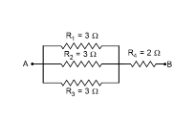
$R_1, R_2, R_3$ are in parallel
$
\begin{aligned}
\frac{1}{R^{\prime}} & =\frac{1}{R_1}+\frac{1}{R_2}+\frac{1}{R_3} \\
\Rightarrow R^{\prime} & =\frac{1}{3}+\frac{1}{3}+\frac{1}{3} \\
& =1 \Omega
\end{aligned}
$
$R^{\prime}$ and $R_4$ are in series
$
R=R^{\prime}+R_4=1 \Omega+2 \Omega=3 \Omega
$
View full question & answer
MCQ 261 Mark
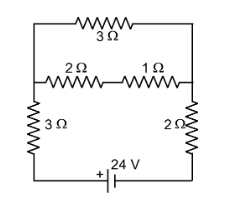
The total currents flowing in the circuit is :
Image
  • A
    4 A
  • B
    6.93 A
  • 3.69 A
  • D
    5 A
Answer
Correct option: C.
3.69 A
(c)
3.69 A
Explanation:
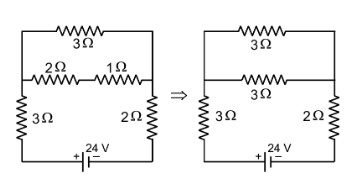
$2 \Omega$ and $1 \Omega$ are in series
Image
$3 \Omega$ and $3 \Omega$ are in parallel $\downarrow$
Image

$
\begin{array}{l}
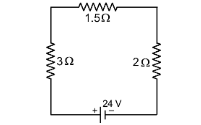
\frac{1}{R}=\frac{1}{3}+\frac{1}{3}=\frac{2}{3} \\
\Rightarrow R=\frac{3}{2} \\
=1.5 \Omega
\end{array}
$
And, all resistance are in series
Total resistance $=3+1.5+2$
$
=6.5 \Omega
$
Total current, $I=\frac{V}{R}=\frac{24}{6.5}$
$
=3.69 A
$
View full question & answer
MCQ 271 Mark
Three identical cells of e.m.f. 4 V are connected in parallel. What is the combined e.m.f. of all?
  • 4 V
  • B
    $\left(\frac{4}{3}\right) V$
  • C
    12 V
  • D
    Data is insufficient.
Answer
Correct option: A.
4 V
(a)
4 V
Explanation:
In parallel combination only the size of the electrodes is increased and it does not change the e.m.f. of the cell. Thus, the combined e.m.f. is also 4 V .
View full question & answer
MCQ 281 Mark
If e.m.f. of a cell is twice of terminal voltage of the cell, then which of the following is correct relation? $[ R =$ external resistance, $r=$ internal resistance of the cell $]$
  • $R =r$
  • B
    $R >r$
  • C
  • D
    None of these
Answer
Correct option: A.
$R =r$
(a)
$R =r$
Explanation:
We know $r=\left(\frac{\varepsilon}{ V }-1\right) R$, As per the question, $\frac{\varepsilon}{ V }=2$. Putting this value, we get $r= R$.
View full question & answer
MCQ 291 Mark
When current begins to run through such materials, it persists even if no potential difference exists. In this case, which of the following options is correct?
  • A
    Conductor
  • B
    Semiconductor
  • C
    Insulator
  • Superconductor
Answer
Correct option: D.
Superconductor
(d)
Superconductor
Explanation:
Superconductors are materials that, below a certain critical temperature, exhibit zero electrical resistance, allowing current to flow without any loss of energy, even in the absence of a potential difference.
View full question & answer
MCQ 301 Mark
The potential difference measured across a battery is 10 V . On connecting $10 \Omega$ resistance across terminals of battery, it reads 6 V . The internal resistance of battery:
  • $6.67 \Omega$
  • B
    $6 \Omega$
  • C
    $6 \Omega$
  • D
    $20 \Omega$
Answer
Correct option: A.
$6.67 \Omega$
(a)
$6.67 \Omega$
Explanation:
$\varepsilon=10 V, V =6 V, R =10 \Omega, r=$ ?
$r=\left(\frac{\varepsilon}{ V }-1\right) \times R =\left(\frac{10}{6}-1\right) \times 10=6.67 \Omega$
View full question & answer
MCQ 311 Mark
A copper wire has the length of 369.4 m and radius of 1 mm . If the resistance of the wire is 2 ohm , what is its resistivity?
  • $1.7 \times 10^{-8} W$-m
  • B
    $1.7 \times 10^{-18} W$-m
  • C
    $9.7 \times 10^{-8} W$-m
  • D
    $7.1 \times 10^{-8} W- m$
Answer
Correct option: A.
$1.7 \times 10^{-8} W$-m
(a)
$1.7 \times 10^{-8} W$-m
Explanation:
We know that resistivity, $\rho=\frac{ RA }{t}$. Putting all these values, we will get $\rho=1.7 \times 10^{-8} Wm$.
View full question & answer
MCQ 321 Mark
What is the approximate range of resistance of human body?
  • A
    $10-1000 \Omega$
  • B
    $100-500 \Omega$
  • C
    $500-5000 \Omega$
  • $1000-100,000 \Omega$
Answer
Correct option: D.
$1000-100,000 \Omega$
(d)
$1000-100,000 \Omega$
Explanation:
As per the 'National Institute for Occupational Safety and Health', human body can have as high as $100,000 \Omega$ resistance. So, the range could be, $1000-100,000 \Omega$.
View full question & answer
MCQ 331 Mark
Consider the following:
(I) Surface area of electrodes
(II) Distance between two electrodes
(III) Temperature of the electrolyte
Which of the above affect the internal resistance of a cell?
  • A
    Only I and II
  • B
    Only II and III
  • C
    Only I and III
  • All of these
Answer
Correct option: D.
All of these
(d)
All of these
Explanation:
Factors affecting internal resistance of a cell are, Surface area of electrodes, distance between two electrodes, temperature of the electrolyte, and concentration of the electrolyte.
View full question & answer
MCQ 341 Mark
Read the case and answer the following questions:
Case 1: 2 A current is flowing through a copper wire X of length 2 km and radius 2 cm.
Case 2: 4 A current is flowing through a copper wire Y of length 1 km and radius 2 cm.
Case 3: A copper wire Z carrying P amount of current by having potential difference of 16 V and resistance of 2 ohm.
Answer the following question?
(iii) Which wire can be used for wiring a circular ring of radius 318 m ?
  • Wire $X$
  • B
    Wire Z
  • C
    Wire $Y$
  • D
    Wire $X$ and Wire $Y$
Answer
Correct option: A.
Wire $X$
(a)
Wire $X$
Explanation:
Wire $X$ can be used to make circle of radius, $\frac{2000}{2 \pi}=318 m$. Similarly, for wire Y it's 159 m and for Wire Z it's 79 m .
View full question & answer
MCQ 351 Mark
Read the case and answer the following questions:
Case 1: 2 A current is flowing through a copper wire X of length 2 km and radius 2 cm.
Case 2: 4 A current is flowing through a copper wire Y of length 1 km and radius 2 cm.
Case 3: A copper wire Z carrying P amount of current by having potential difference of 16 V and resistance of 2 ohm.
Answer the following question?
(ii) Which wire is offering maximum resistance?
  • Wire $X$
  • B
    Wire Z
  • C
    Wire Y
  • D
    Wire $X$ and Wire $Y$
Answer
Correct option: A.
Wire $X$
(a) Wire $X$
Explanation:
We know,
$
R \propto \frac{1}{r^2}
$
where, r is constant. Amount of resistance offered by each wire can be determined by the value of $\left(\frac{l}{r^2}\right)$. If this value is more, resistance will be more. In this way, wire X will have more $\left(\frac{l}{r^2}\right)$ than wire Y and Z .
View full question & answer
MCQ 361 Mark
Read the case and answer the following questions:
Case 1: 2 A current is flowing through a copper wire X of length 2 km and radius 2 cm.
Case 2: 4 A current is flowing through a copper wire Y of length 1 km and radius 2 cm.
Case 3: A copper wire Z carrying P amount of current by having potential difference of 16 V and resistance of 2 ohm.
Answer the following question?
(i) Which wire is carrying maximum amount of current?
  • A
    Wire X
  • B
    Wire Y
  • Wire Z
  • D
    Wire X and Wire Z
Answer
Correct option: C.
Wire Z
(c)
Wire Z
Explanation:
Current carried by wire $Z$ is $\frac{16}{2}=8 A$, which is more that wire $X$ and $Y$.
View full question & answer
MCQ 371 Mark
What will happen to conductance if the conductor's resistance is increased by 4 times?
  • Conductance will decrease by 4 times
  • B
    Conductance will increase by 4 times
  • C
    Conductance will increase by 2 times
  • D
    Conductance will remain the same
Answer
Correct option: A.
Conductance will decrease by 4 times
(a)
Conductance will decrease by 4 times
Explanation:
We know,
Conductance $=\frac{1}{\text { Resistance }}$.
View full question & answer
MCQ 381 Mark
The specific resistance of a conductor depends on its:
  • A
    length
  • material
  • C
    area of cross section
  • D
    radius
Answer
Correct option: B.
material
(b)
material
Explanation:
It is a property of material and does not depend on the dimensions of the wire like shape or size, length, area, radius..
View full question & answer
MCQ 391 Mark
What is the primary function of a Rheostat?
  • Depending on our need, we can increase or decrease resistance.
  • B
    It actually provide high voltage AC current
  • C
    It actually provide high voltage DC current
  • D
    It helps to control temperature of thermal system
Answer
Correct option: A.
Depending on our need, we can increase or decrease resistance.
(a)
Depending on our need, we can increase or decrease resistance.
Explanation:
A rheostat is a device used to regulate the resistance of an electric circuit.
View full question & answer
MCQ 401 Mark
Match the following:
Column IColumn II
(i) Good conductor of heat1. Salt water
(ii) Bad conductor of electricity2. Distilled water
(iii) Good conductor of electricity3. Mercury
  • A
    (i)-1, (ii)-3, (iii)-2
  • B
    (i)-1, (ii)-2, (iii)-3
  • C
    (i)-2, (ii)-1, (iii)-2
  • (i)-3, (ii)-2, (iii)-1
Answer
Correct option: D.
(i)-3, (ii)-2, (iii)-1
(d)
(i)-3, (ii)-2. (iii)-1
Explanation:
Salt water have NaCl. So it can act as good conductor of electricity. Distilled water has almost zero impurity, thus there is no free electrons. So, it is bad conductor of electricity. Mercury is good conductor of heat, that's why it is used in thermometer.

View full question & answer
MCQ 411 Mark
  • (i)-1, (ii)-3, (iii)-2
  • B
    (i)-1, (ii)-2, (iii)-3
  • C
    (i)-2, (ii)-1, (iii)-3
  • D
    (i)-3, (ii)-2, (iii)-1
Answer
Correct option: A.
(i)-1, (ii)-3, (iii)-2
(a)
(i)-1, (ii)-3, (iii)-2
Explanation:
For an ohmic resistor, slope of V-I graph is always same at a given temperature. For a non-ohmic resistor, slope of V-I graph changes with any changes of V or I or both, even at a given temperature. For a variable resistor the resistance can be increased or decreased.

View full question & answer
MCQ 421 Mark
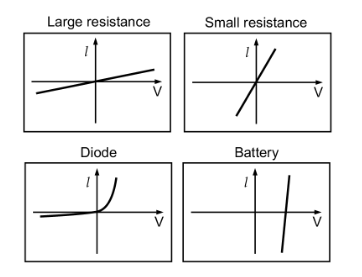
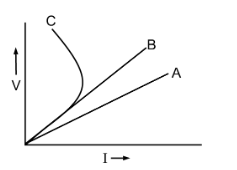
Consider the following figure and answer the question?
Image
In which case/cases Ohm's law is/are violated?
[I-current, V-voltage]
  • A
    Large resistance and battery
  • B
    Small resistance and battery
  • Diode and battery
  • D
    Only diode
Answer
Correct option: C.
Diode and battery
(c)
Diode and battery
Explanation:
In order to satisfy Ohm's law, the graph should be a straight line and must pass through the origin. Therefore, the first two resistors are Ohmác, but the diode and battery are not.
View full question & answer
MCQ 431 Mark
  • A
    Trend A
  • B
    Trend C
  • Trend B
  • D
    Both Trend A and B
Answer
Correct option: C.
Trend B
(c)
Trend B
Explanation:
As equivalent resistance in series connection is more compared to parallel connection, hence, in series connection the slope will be more. Thus, if in parallel connection, we get trend A, then in series we will get trend B.
View full question & answer
MCQ 451 Mark
S.I. unit of conductivity is _________ .
  • A
    siemen-1metre
  • siemen metre-1

  • C
    siemen metre
  • D
    siemen-1 meter-1
Answer
Correct option: B.
siemen metre-1

(b)
siemen metre ${ }^{-1}$
Explanation:
Conductivity is the reciprocal of specific resistance. Its S.I. unit is ohm ${ }^{-1}$ metre $^{-1}$ or siemen metre ${ }^{-1}$.
View full question & answer
MCQ 461 Mark
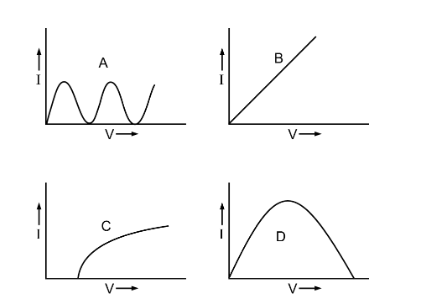
Which of the following represents V-I curve of a conductor? [Material properties of the conductor does not vary]
Image
  • Plot B
  • B
    $\operatorname{Plot} C$
  • C
    Plot D
  • D
    Plot A
Answer
Correct option: A.
Plot B
(a)
Plot B
Explanation:
Voltage $(V)=$ Current $(I) \times$ Resistance $(R)$. When the material properties are the same, the resistance will be the same. In this condition plot B can be obtained by plotting V-I plot. Thus, (a) is the correct option.
View full question & answer
MCQ 471 Mark
Ohm's law is _________ .
  • A
    $V = IR$
  • B
    $I=\frac{V}{R}$
  • C
    $R =\frac{ V }{ I }$
  • All of these
Answer
Correct option: D.
All of these
(d)
All of these
Explanation :
Ohm's law states that the potential difference is proportional to current flowing in that circuit.
Hence $V \propto I$
$
V=RI
$
Where, $R$ is resistance.
It can be written as
$
R=\frac{V}{I}
$
or $I=\frac{V}{R}$
View full question & answer
MCQ 481 Mark
Which of the following is the electrostatic unit of charge?
  • e.s.u.
  • B
    $q / m ^2 sec$
  • C
    Becquerel
  • D
    calorie
Answer
Correct option: A.
e.s.u.
(a)
e.s.u.
Explanation:
The statcoulomb or franklin or electrostatic unit (e.s.u) of charge is the physical unit for electrical charge used in the e.s.u-c.g.s and Gaussian units.
View full question & answer
MCQ 491 Mark
Suppose in a confined space there are 3 charged particles X, Y and Z. Particle X is positively charged, particle Y and Z are negatively charged. In this situation answer the following questions?
(ii) If particles $Y$ and $Z$ starts to run in north direction, in which direction current will flow?
  • A
    North
  • South
  • C
    East
  • D
    West
Answer
Correct option: B.
South
(b)
South
Explanation:
Current flows in the opposite direction of the flow of the negatively charged particles.
View full question & answer
MCQ 501 Mark
Suppose in a confined space there are 3 charged particles $X, Y$ and $Z$. Particle $X$ is positively charged, particle $Y$ and $Z$ are negatively charged. In this situation answer the following questions?
(i) Which two particles will not attract each other?
  • A
    $X$ and $Y$
  • Y and Z
  • C
    Z and X
  • D
    None of these
Answer
Correct option: B.
Y and Z
(b)
$Y$ and $Z$
Explanation:
This is because particles with like charges repel each other, while particles with opposite charges attract each other. Therefore, Y and Z will repel each other, not attract.
View full question & answer
MCQ - Physics STD 10 Questions - Vidyadip