Questions

[3 Mark Question Answer]

🎯

Test yourself on this topic

43 questions · timed · auto-graded

Question 13 Marks
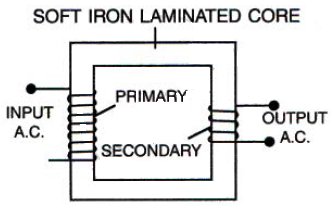
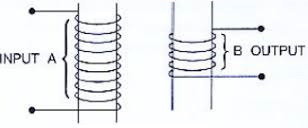
Complete the following diagram of a transformer and name the parts labeled A and B. Name the part you have drawn to complete the diagram . What is the material of this part? In this transformer a step-up or step-down? Why?
Image

Answer
Image

The part drawn to complete the diagram is the core.

Material of core is soft-iron .

It is a step down transformer because the number of turns in the primary is more than the number of turns in the secondary.
View full question & answer
Question 23 Marks
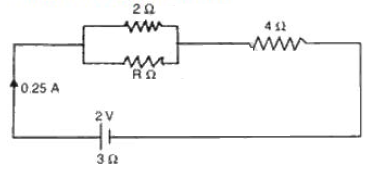
The circuit diagram (Fig .) shows three resistors 2 Ω, 4 Ω and RΩ connected to a battery of e.m.f. 2 V and internal resistance 3 Ω. A main current of 0 .25
A flows through the circuit.

Image

(i ) What is the p.d . across the 4 Ω resistor?
(ii ) Calculate the p.d . across the in ternal resistance of the cell.
(iii ) What is the p.d . across the R Ω or 2 Ω resistors?
(iv) Calculate the value of R.

Answer
(i) Potential difference across the $4 \Omega$ resi star $=$ current through the resistDr $\mathrm{x}$ its resistance $ =0.25 \times 4=1 \mathrm{~V} $
(ii) Potential difference across internal resistance $=$ current through internal resistance $x$ internal resistance $ =0.25 \times 3=0.75 \mathrm{~V} $
(iii) P.d. across the $\mathrm{R} \Omega$ or $3 \Omega$ resistor $=$ emf -(p.d. across $4 \Omega$ resistor + p.d. across internal resistar $ =2-(1+0.75)=0.25 \mathrm{~V} $
(iv) We know, $\mathrm{e}=\mathrm{I}\left[(r+4 \Omega)+\left(\frac{1}{2}+\frac{1}{R}\right)^{-1}\right]$
$ 2=0.25\left[7+\left(2 \frac{\mathrm{R}}{\mathrm{R}}+2\right)\right] $
or, $\frac{2 R}{R+2}=1$
or $2 R=R+2$
or $\mathrm{R}=2 \Omega$
View full question & answer
Question 33 Marks
A transformer has 400 turns in the primary winding and 10 turns in the secondary winding. The primary e.m.f. is 250 V and the primary current is 2.0 A. calculate:
(a) The secondary voltage,
(b) The secondary current, assuming 100% efficiency.
Answer
Since, the number of turns in the primary is more than the no. of turns in the secondary it is a step-down transformer.
Given, $N_P=400, N_S=10, E_P=250 \mathrm{~V}, I_P=2 \mathrm{~A}$
(a) Let Es be the secondary voltage.
We know that for transformer turn ratio $\frac{N_s}{N_p}=\frac{I_p}{I_s}=\frac{E_s}{E_p}$
$E_S=\frac{N_s}{N_p} \times E_p=\frac{10}{400} \times 250=6.25 V$
(b) Let Is be the current though secondary
We know that for transformer turn ratio $\frac{N_s}{N_p}=\frac{I_P}{I_s}$
$I_S=\frac{400}{10} \times 2=80 \mathrm{~A}$
View full question & answer
Question 43 Marks
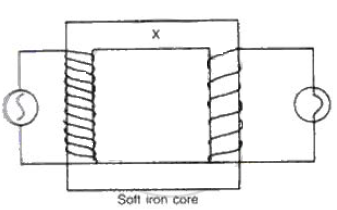
Name the type of transformer shown in fig . What changes will you observe regarding the brightness of the lamp, if
(a) The no. of turns in the secondary is doubled?
(b) The part X of the transformer is removed?
(c) The core of the transformer is made out of copper?
(d ) The A.C. supply is replaced by D.C.?

Image

Answer
It is a diagram of step-down transformer.
(a) Brightness of bulb will increase because increasing the number of turns in the secondary will increase the change in magnetic flux linked with the coil.
(b) Part X is the core of the transformer is removed, it shall become an open core and there shall be magnetic flux link loss; i.e. the entire magnetic field lines produced by the primary shall not be linked with the secondary.
(c) If the core of the transformer is made of copper due to the formation of eddy currents a lot of energy shall be lost.
(d) A transformer cannot be used with direct current (d.c.) since its working is based on the principle that when there is a change of magnetic field lines due to varying current of same in one coil, an induced varying current of same frequency flows in the other coil. If the current in one coil is constant (i.e. d.c.), no induced current will flow in the other coil since there will be no change in the magnetic field lines linked with the coil.
View full question & answer
Question 53 Marks
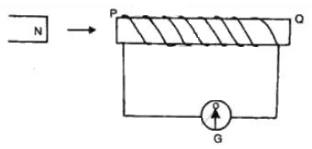
The diagram shows a coil connected to a center zero galvanometerG . The galvanometer shows a deflect ion to the right when the north pole N of a powerful magnet is moved to the right as shown .

Image

(i) Explain, why the defelct ion occurs in the galvanometer.
(ii ) State whether th e current in the coil is cl ockwise or anticl ockwise
when viewed from the end P.
(iii ) State th e observation in G when the coil is moved away from north
pole N of the magnet keeping the magnet stationary.
(iv)State the observation in G when both the coil and the magnet are
moved to right at th e same speed .

Answer
(i) This is due to change in magnetic flux in the coil. Due to change in magnetic flux an induced emf is produced in the coil. Hence, a current flows through the galvanometer.
(ii) The current appears anticlockwise when viewed from end A because end A will form north-pole.
(iii) The galvanometer now deflects towards left.
(iv) No deflection is observed as there is no relative motion between the magnet and the coil.
View full question & answer
Question 63 Marks
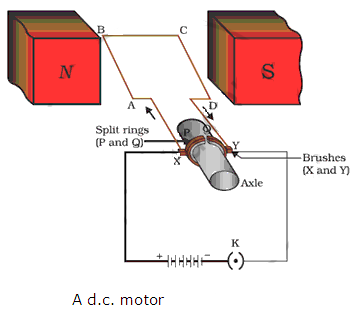
Draw and label the diagram of a simple D.C. motor.
(a) Explain the rotation of the coil, giving a reason for your answer.
(b) How can you reverse the direction of rotation of the armature?
(c) How can you increase the speed of rotation of the motor?
Answer
Image

(a) The coil rotates because equal and opposi te forces act on its arms which form a couple.
(b) The direct ion of rotation of armature can be reversed by interchanging the connections at the terminals of the battery joined to the brushes of the motor.
(c) The speed of rotation of the motor can be increased by increasing the current through the coil or by increasing the number of turns in the coil and by increasing the strength of the magnetic field.

View full question & answer
Question 73 Marks
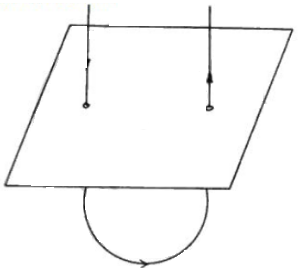
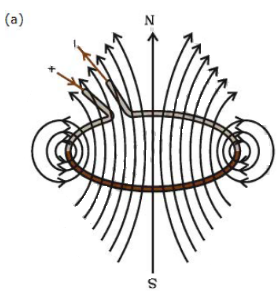
A wire is passed through a piece of cardboard as shown in fig .. An electric current flows vertically down the wire and then flows back up. The two sections of the write are observed to repel each other.
(a) Wi th the aid of a diagram, describe how you would plot the magnetic field lines on the card .

Image

(b) Sketch the magnetic field patterns around both the sections of the wire. Use your sketch to explain why the two sections repel each other.
(c) The repulsive force between the two sections is small. What changes could be made to increase it?

Answer
Image

(b) Since the magnetic field lines pass through the loop in th e same direction, the two sections repel each other.
(c) To increase the repulsive force, the current through the loop should be increased .

View full question & answer
Question 83 Marks
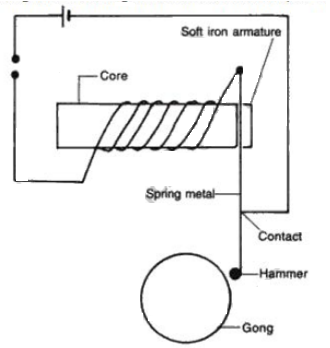
Fig . shows the essent ial features of a battery operated bell. The hammer strikes the gong when the swi tch is closed . State and explain the effect of using the following material successively to form the core.

Image

(a) Plastic
(b) Steel
(c) Copper

Answer
(a) Plastic being non-magnetic cannot be used as a material for core. It shall not intensify the formed magnetic field.
(b) Steel has high retentivity. Hence, after prolonged use even when the switch is off, it may retain some magnetic property and attract the armature.
(c) Using copper as a material for core will introduce eddy currents in the core and thus, interfere with the working of the bell.
View full question & answer
Question 93 Marks
An auto lamp is joined to a battery of e.m.f. 4 V and internal resistance 2.5Ω. A steady current of 0.5 A flows through the circuit. Calculate the
(a) Total energy provided by battery in 10 minutes,
(b) Heat dissipated in the bulb in 10 minutes.
Answer
Given, emf, e = 4 V, internal resistance $r=2.5 \Omega$ , current I= 0.5A
(a) Energy provided by battery in 10 mins =Power x time= (VIt)= 4 x 0.5 x 20= 40 watt-hour
(b) Heat dissipated in the bulb in 10 minutes=$I^2 R t$
Let R be the resistance of the bulb, then:
$I=\frac{e}{R+r}$
or, $0.5=\frac{4}{R+2.5}$
or, R + 2.5 = 8
or,$R=5.5 \Omega$
Heat dissipated in the bulb in 10 minutes=$I^2 R t=(0.5)^2(5.5)(10 \times 60)=825$ joules
View full question & answer
Question 103 Marks
In a house there are 6 bulbs of 100 W each used for 4 hours a day, 4 bulbs of 60 W each used for 8 hours a day, an immersion heater of 2.5 kW used for 1 hour per day, and an electric iron of 800 W used for 2 hours per day. Calculate the cost of monthly electric bill for the month of April at the rate of 80 p per unit.
Answer
Energy consumed by 6 bulbs per day $=6 \times \frac{100}{1000} \times 4=2.4 \mathrm{kWh}$
Energy consumed by 4 bulbs per day =$4 \times \frac{60}{1000} \times 8=1.92 \mathrm{kWh}$
Energy consumed by immersion heater per day = 2.5 x I= 2.5 kWh
Energy consumed by electric iron per day =$\frac{800}{1000} \times 2=1.6 \mathrm{kWh}$
Total energy consumed in I day= 2.4 + 1.92 + 2.5 + 1.6 = 8.42 kWh
Total energy consumed in the month of April (30 days) = 8.42 x 30 = 252.6 kWh
Electric bill for the month of April= 252.6 x 0.8 =Rs. 202.08
View full question & answer
Question 113 Marks
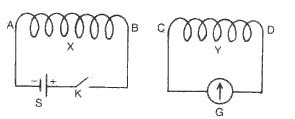
The diagram 10 shows two coils X and Y. The coil X is connected to a battery S and a key K. The coil Y is connected to a galvanometer G.

Image

When the key K is closed. State the polarity
(i)At the end of the coil X,
(ii)At the end C of the coil Y,
(iii)At the end C of the coil Y if the coil Y is (a) Moved towards the coil X, (b) Moved away from the coil X.

Answer
(i) Current at the end B of the coil X is anticlockwise therefore at this end there is north pole.
(ii) While closing the key, polarity at the end C of the coil Y will be north. There will be no polarity at the end C of the coil Y when the current becomes steady in the coil X.
(iii) (a) While the coil Y is moved towards the coil X, the polarity at the end C of the coil Y is north.
(b) While the coil Y is moved away the coil X, the polarity at the end C of the coil Y is south.
View full question & answer
Question 123 Marks
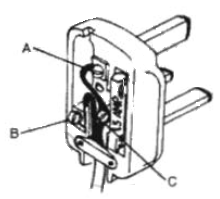
Fig. shows a 3 pin plug with the cover removed. The electric cable
connected to the plug contains 3 wires with colour coded insulation namely brown, blue and green.

Image

  1. Identify each of the colour coded wires by stating to which of the
    terminals A, B or C in the diagram they should be connected.
  2. Identify the terminal through which no current passes in normal
    circumstances.
  3. What is the purpose of the earthed wire connected to an electric
    appliance like an electric heater? Describe how it works.
Answer
(a) Brown wire or live wire should be connected to terminal C.
Blue wire or neutral wire should be connected to terminal B.
Green wire or earth wire should be connected to terminal A.
(b) No, current passes through the earth terminal i.e. terminal A in normal circumstances.
(c) The metal case of an electrical appliance is earthed so that in any case of accidental contact of live wire with the metallic body of the appliance, the earth wire would provide a safe and easy path for the electric charges to flow down to the earth which acts as very large sink. Thus, user is thereby protected from any fatal electric shock.
View full question & answer
Question 133 Marks
60 joules of heat was dissipated in a resistor when 20 C flowed for 5 s. Calculate:
(a) P.d. across the resistor,
(b) Resistance of the resistor, and
(c) Average power dissipated in the resistor.
Answer
Given, heat dissipated= 60 joules, charge Q = 20 C, time t= 5s
(a) P.d. across the rsistor, $V=\frac{W}{Q}=\frac{60}{20}=3 V$
(b) Power = $=\frac{W}{t}=\frac{V^2}{R}$
$\mathrm{R}=\mathrm{V}^2 \times \frac{\mathrm{t}}{\mathrm{W}}=(3)^2 \times \frac{5}{60}=0.75 \Omega$
(c) Power dissipated,$P=\frac{W}{t}=\frac{60}{5}=12 \mathrm{watt}$
View full question & answer
Question 143 Marks
A coil of copper wire is connected to a galvanometer. What would happen if a bar magnet is:
(i) Pushed into the coil with its north pole entering first?
(ii) Held at rest inside the coil?
(iii) Pulled out again?
Answer
(i)
When the north-pole is pushed into the coil, a momentary deflection is observed in the galvanometer that indicates the production of a momentary current in the coil.
(ii)
When the magnet is held at rest, there is no deflection in the galvanometer, indicating that no current is produced in the coil.
(iii)
When the north-pole is pulled out from the coil, the deflection of the galvanometer is along the opposite direction, indicating the production of an opposite current.
View full question & answer
Question 153 Marks
Usually three insulated wires of different colours are used in an electrical appliance. Name the three colours.
Answer
Three colours are:
(i) Red (for live wire)
(ii) Green (for earth wire)
(iii) Black (for neutral wire)
View full question & answer
Question 163 Marks
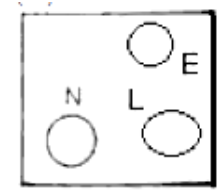
The diagram 31 shows a 3 terminal plug socket.
(i) What is the purpose of the terminal E?
(ii) To which part of the appliance is the terminal E connected?
(iii) To which wire L or N, is the fuse connected and why?
Image
Answer
(i) The purpose of the terminal E is to provide earth connection.
(ii) Terminal E is connected to the earth pin of the plug.
(iii) Fuse is connected in series with the wire L, so that if excess current flows through the circuit, the fuse wire get heated up and melts thus, breaking the circuit and preventing the flow of current to the appliance.
View full question & answer
Question 173 Marks
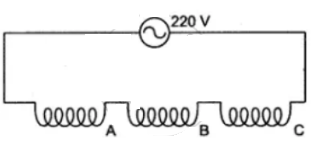
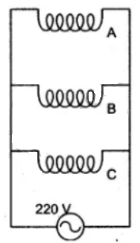
The diagram shows two ways of connecting three lamps P, Q and R to A.C. supply of 220 V.

Image

Image

Name the two arrangements. Which of them would you prefer in a household circuit? Give a reason for your answer.
Answer
The arrangement is shown in the figure (i) is a series arrangement. The arrangement in figure (ii) is the parallel arrangement.
We prefer a parallel arrangement. The reasons are:
(i) In series arrangement, if one of the bulbs is fused, the other bulbs also cease to glow. But in a parallel arrangement, if one bulb fuses, the other bulbs continue to glow.
(ii) In the series arrangement, while one bulb glows if the other bulb is switched on, the resistance of the circuit increases, and hence the bulbs glow less bright. But in a parallel arrangement, each bulb glows at the same voltage, therefore the glow of a bulb is unaffected if another bulb is switched on.
View full question & answer
Question 183 Marks
Distinguish between electric power and electrical energy. State their units. Give the other name of kWh.
Answer
Electrical energy is defined as the total amount of work done to maintain current in a circuit in a given time. Its SI unit is joule.
The rate at which electrical energy is consumed per unit time is called electrical power. It is denoted by P. i.e., Its SI unit is watt.
Electrical power $=\frac{\text { Electrical energy }}{\text { time }}$
The other name of kWh is Board of Trade Unit (BOTU).
View full question & answer
Question 193 Marks
A battery of e.m.f. 15 V and internal resistance$2 \Omega$ is connected to tvvo resistors of 4 ohm and 6 ohm joined.
(i) In series,
(ii) In para 1 lel. Find in each case the electrica I energy spent per minute in 6 ohm resistor.
Answer
Given, emf $=15 \mathrm{~V}$, internal resistance, $2 \Omega$
(i) Total resistance of given resistors in series, $\mathrm{R}_{\mathrm{s}}=4+6=10 \Omega$
Now, current through series combination on, $I_S=\frac{e m f}{R_s+r}=\frac{15}{10+2}=\frac{15}{12}=1.25 \mathrm{~A}$
In series, the same current will pass through each resistor
$\therefore$ electrical energy spent per minute in the $6 \Omega$ resistor, $H_s=I^2(R) t=
(1.25)^2(6)(60)=562.5 \mathrm{~J}$
(ii) Total resistance of given resistors in parallel, $\mathrm{R}_{\mathrm{p}}=\left(\frac{1}{4}+\frac{1}{6}\right)^{-1}=2.4 \Omega$
Current in parallel circuit, $\mathrm{I}=\frac{15}{2.4+20}=3.4 \mathrm{~A}$
In parallel, each resistor is connected across the same voltage, say $\mathrm{V}$.
Then, $V=e-I r=15-(3.4 \times 2)=8.18$ volt
$\therefore$ electrical energy spent per minute in the $6 \Omega$ resistor, $\mathrm{H}_{\mathrm{p}}=\frac{\mathrm{V}^2}{\mathrm{R}} t=\frac{(8.18)^2}{6} \times 60=669.1 \mathrm{~J}$
View full question & answer
Question 203 Marks
What purpose is served by the terminals of a three way pin plug?
Answer
A three pin-plug has three terminals:
(i) Earth pin: It provides connection for earthing.
(ii) Neutral pin: It provides connection to the neutral wire.
(iii) live pin: It provides connection to the live wire.
View full question & answer
Question 213 Marks
Two resistors of 4 Ω and 6 Ω are connected in parallel. The combination is
connected across a 6 volt battery of negligible resistance. Calculate:
( i) The power supplied by the battery,
(ii) The power dissipated in each resistor.
Answer
Total resistance of resitors of$4 \Omega$ and$4 \Omega$ in parallel is:$\mathrm{R}_{\mathrm{p}}=\left[\frac{1}{4}+\frac{1}{6}\right]^{-1}=2.4 \Omega$Given voltage supply= 6 volt
(i) Power supplied by the battery,$P=\frac{V^2}{R}=\frac{6 \times 6}{2.4}=15$ watt
(ii) Power dissipated in$4 \Omega$resistor, $P_1=\frac{V^2}{R}=\frac{6 \times 6}{4}=9$ wattPower dissipated in $4 \Omega$ resistor,$P_1 \frac{V^2}{R}=\frac{6 \times 6}{6}=6$ watt
View full question & answer
Question 223 Marks
An electric bulb is rated at 220 V, 100 W. What is its resistance? What maximum current can be passed through it?
Answer
Given, P = 100 W, p.d. = 220 V
We know that,
$P=\frac{V^2}{R}$
$P=\frac{V^2}{R}=\cdot \frac{(220)^2}{100}=484 \Omega$
Also, we know that,
P=VI
$I=\frac{P}{V}=\frac{100}{220}=0.45 \mathrm{~A}$"
Thus a fuse of rating 7A may be used with the appliance and it should be connected in the live wire before connectimg it to the appliance
View full question & answer
Question 233 Marks
What should be the current rating of a fuse to be used with an electric appliance of rating 1.5 kW-220 V? How is the fuse connected with the appliance?
Answer
Given, P = 1.5 kW= 1500 W, p.d. = 220 V
We know that,
P=VI
$I=\frac{P}{V}=\frac{1500}{220}=6.8 \mathrm{~A}$
Thus a fuse of rating 7A may be used with the appliance and it should be connected in the live wire before connectimg it to the appliance.
View full question & answer
Question 243 Marks
A current of 0.2 A flows through a wire whose ends are at a potential difference of 15 V. Calculate:
(i) The resistance of the wire, and
(ii) The heat energy produced in 1 minute.
Answer
Given, current, I= 0.2 A; p.d. = 15 V
(i) A/C to Ohm's law V=IR
$\mathrm{R}=\frac{\mathrm{v}}{\mathrm{l}}=\frac{15}{0.2}=75 \Omega$
(ii) energy produced in one minutes is:
$\mathrm{H}=\mathrm{I}^2 \mathrm{Rt}=(0.2)^2 \times 75 \times 60=180 \mathrm{~J}$
View full question & answer
Question 253 Marks
What is international convention of colour coding in a cable?
Answer
International convention of colour coding:
1. Live wire - Brown
2. Neutral wire - Light blue
3. Earth wire - Green or yellow
View full question & answer
Question 263 Marks
In a house two 60 W electric bulbs are lighted for 4 hours, and three 100 W bulbs for 5 hours every day. How much is the electric energy consumed during the month of June?
Answer
Case (i) Energy consumed by two bulbs per day
=$2 \times \frac{60}{1000} \times 4=0.48 \mathrm{kWh}$
Case (ii) Energy consumed by three bulbs per day
= $3 \times \frac{100}{1000} \times 5=1.5 \mathrm{kWh}$
:. total energy consumed per day = 0.48 + 1.5 = 1.98 kWh
Required consumption of electrical during the month of June (30 days)=
= 1.98 x 30 = 59.4 kWh<
View full question & answer
Question 273 Marks
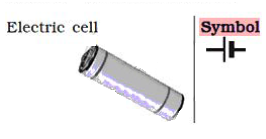
What is the difference between a cell and a battery?
Answer
An electric cell produces electricity from the chemicals stored inside it. When the chemicals in the electric cell are used up, the electric cell stops producing electricity. It has two
terminaIs - positive and negative.

Image When two or mo re cells are connected together such that the positive terminaI of one cell is connected to the negative terminal of the next cell; such a combination of two or more cells is called a battery. A battery is thus a combination of two or more cells. Image
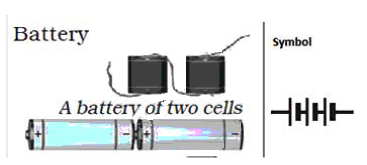
View full question & answer
Question 283 Marks
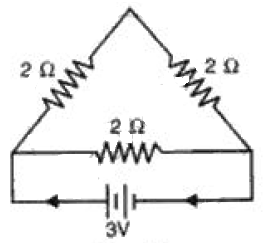
What is the current I in the given circuit (Fig. )?

Image

Answer
In given circuit, two 2 ohm resistors in series are connected in parallel with another 2 ohm resistor;
Therefore equivalent resistance of the circuit.$R=\left[\left(2+2^{-1}+(2)^{-1}\right]^{-1}\right.\
$\mathrm{R}=\left(\frac{1}{4}+\frac{1}{2}=\frac{3}{4}\right)^{-1}$
$\mathrm{R}=\frac{4}{3}$
$\mathrm{I}=\frac{\mathrm{V}}{\mathrm{R}}=\frac{3}{4 / 3}=\frac{9}{4} \mathrm{~A}=225 \mathrm{~A}$
View full question & answer
Question 293 Marks
Name the following substances:
(i) Showing low resistivity,
(ii) Showing very high resistivity,
(iii) Showing moderate resistivity.
Answer
(i) Metals e.g. copper
(ii) Alloys e.g. Constantan
(iii) Semiconductors e.g. Germanium
View full question & answer
Question 303 Marks
On what factors does the resistance of a conductor depend?
Answer
Factors on which the resistance of a conductor depends:
  1. Length of conductor: Resistance is directly proportional to the length of the conductor. This means Resistance increases with an increase in the length of the conductor. This is the cause that long electric wires create more resistance to the electric current.
  2. Area of cross-section: Resistance is inversely proportional to the area of the cross-section of the conductor. This means Resistance will decrease with an increase in the area of the conductor and vice versa. This is the cause that thick copper wire creates less resistance to the electric current.
  3. Temperature: Resistance is directly proportional to the temperature.
  4. Nature of material: Some materials create the least hindrance and hence are called good conductors. Silver is the best conductor of electricity. While some other materials create more hindrance in the flow of electric current, i.e. flow of electrons through them. Such materials are called bad conductors. Bad conductors are also known as insulators. The hard plastic is one of the best insulators of electricity.
View full question & answer
Question 313 Marks
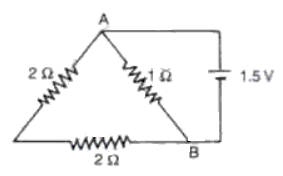
What is the equivalent resistance between A and B in the given circuit (Fig?)

Image

Answer
Between A and B, the series combination of two resistors of resistances 2 ohm each is connected in parallel with the 1 ohm resistor.
Equivalent series resistance between A and B, R, = $=2+2=4 \Omega$
Now, between A and B this $4 \Omega$resistor is connected in parallel with $1 \Omega$ resistor.
Equivalent resistance between A and B, R = $\left(\frac{1}{4}+\frac{1}{1}\right)^{-1}=\left(\frac{5}{4}\right)^{-1}=\frac{4}{5} \Omega$
View full question & answer
Question 323 Marks
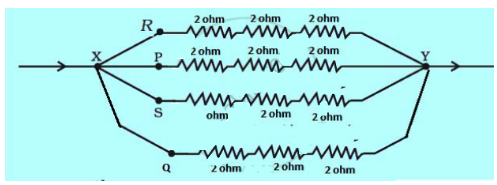
A combination consists of three resistors in series. Four similar sets are connected in parallel. If the resistance of each resistor is 2 ohm, find the resistance of the combination.
Answer
The combination of resistors will be as shown in the diagram: Image
Equivalent resistance between Rand $Y=2+2+2=6 \Omega$
Equivalent resistance between P and $Y=2+2+2=6 \Omega$
Equivalent resistance between Sand $Y=2+2+2=6 \Omega$
Equivalent resistance between Rand $Y=2+2+2=6 \Omega$
Equivalent resistance between X and Y = $\left[\frac{1}{6}+\frac{1}{6}+\frac{1}{6}+\frac{1}{6}\right]^{-1}=\left[\frac{3}{2}\right]=1.5 \Omega$
View full question & answer
Question 333 Marks
Write the SI units for:
(a) Electric current
(b) Potential difference

(c) Charge.

Answer
(a) Ampere
(b) Volt
(c) Coulomb
View full question & answer
Question 343 Marks
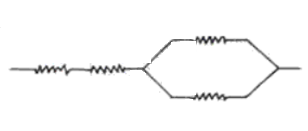
Calculate the equivalent resistance of the following combination of resistor $r_1, r_2, r_3$​​​​​​​, and $r_4$​​​​​​​Image
Answer
In the given network, the series combination of resistors,$r_1$ and $r_2$ is connected in series with the parallel combination of resistors,$r_3$ and $r_4$
Equivalent resistance of resistor$r_1$ and $r_2, R s=r_1+r_2$Equivalent resistance of resistor $r_3$ and $r_3$ Rp =$\left[\frac{1}{r^3}+\frac{1}{r^4}\right]^{-1}=\frac{r_3 r_4}{r_3+r_4}$
equivalent resistance of the given network,$R=R_s+R_p=r_1+r_2+\frac{r_3 r_4}{r_3+r_4}$
View full question & answer
Question 353 Marks
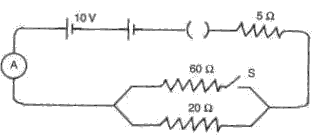
In the circuit shown in fig. 6, find the reading of the ammeter A when the switch S is
(a) Opened.
(b) Closed.

Image

Answer
(a) When the switch $\mathrm{S}$ is opened, resistance $60 \Omega$ is not connected in the circuit and current flows through the $20 \Omega$ resistor." :. Resistance of the circuit. when the switch is open: $ R=20+5=25 \Omega $ Given, voltage $=10 \mathrm{~V}$ :. current through the circuit, $\mathrm{I}=\frac{\mathrm{V}}{\mathrm{R}}=\frac{10}{25}=0.4 \mathrm{~A}$ The reading of the ammeter is thus $0.4 \mathrm{~A}$, when the switch is open.
(b) When the switch is closed, resistance $60 \Omega$ gets connected to the circuit
Thus, in the circuit the parallel combination of $60 \Omega$ and 200 resistors is connected in series with the 5 $\Omega$ resistor. $\therefore$ Resistance in parallel, $\frac{1}{\mathrm{R}_{\mathrm{p}}}=\frac{1}{60}+\frac{1}{20}=\frac{1+3}{60}=\frac{4}{60} \Omega$
or "R" "P" = $15 \Omega$ Now, total resistance of the circuit $=15+5=20 \Omega$
current through the circuit, $\mathrm{I}=\frac{\mathrm{V}}{\mathrm{R}}=\frac{10}{20}=0.5 \mathrm{~A}^{\text {' }}$
The reading of the ammeter is thus $0.5 \mathrm{~A}$, when the switch is closed.
View full question & answer
Question 363 Marks
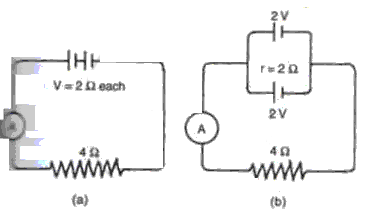
Two cells each having an e.m.f. of 2 V and an internal resistance of 2Ω are
connected (a) In series, and ( b) In para 1le l as shown in fig. . What is the
current flowing through the cir cu it in each_ case?

Image

Answer
(a) Given, emf (e) of the battery= 2 x 2 = 4V,
internal resistance $r=2 \times 2=4 \Omega$
Total resistance of the given series circuit = $4+4=8 \Omega$
Current flowing through the circuit,$I=\frac{e}{R+r}=\frac{4}{8}=0.5 \mathrm{~A}$
(b) Given, emf of battery ( e) = emf of each cell in parallel = 2V,
Total internal resistance $\frac{1}{\mathrm{r}}=\frac{1}{2}+\frac{1}{2}=1 \Omega$
Resistance connected in the circuit $R=4 \Omega$
Total resistance of the circuit= 1 + 4 =$5 \Omega$
Current flowing through the circuit, $I=\frac{e}{R+r}=\frac{2}{5}=0.4 \mathrm{~A}$
View full question & answer
Question 373 Marks
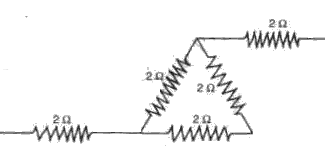
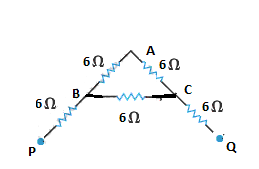
Find the effective resistance in the following circuit diagrams (Fig.):Image
Answer
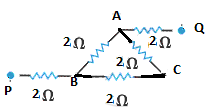
Image
In the path ACB, the series combination of two $2 \Omega$ resistor is connected in parallel with the third $2 \Omega$ resistor.
:. resislancein series= 2 + 2 = $2 \Omega$
total resistance between A and B $\left(\frac{1}{R_P}\right)=\frac{1}{4}+\frac{1}{2}=\frac{3}{4} \Omega$$\mathrm{R}_{\mathrm{p}}=\frac{4}{3} \Omega$
Now, between P and Q, two $2 \Omega$ resistors and $\frac{4}{3} \Omega$are connected in series.
total resistance of the given network,$\mathrm{R}_{,}=2+2+\frac{4}{3}=\frac{6+6+4}{3}=\frac{16}{3}=5.3 \Omega$
View full question & answer
Question 383 Marks
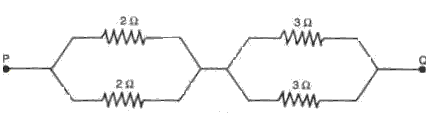
Find the effective resistance in the following circuit diagrams (Fig.):

Image

Answer
In the given network, the parallel combination of two $2 \Omega$ resistors is
connected in series with the parallel combination of two $3 \Omega$ resistors.
:. Resistance in parallel of two $2 \Omega$ resistors is:
$\frac{1}{R_p}=\frac{1}{2}+\frac{1}{2}=\frac{2}{2}=1$$R_p=1 \Omega$
Resistance in parallel of two $3 \Omega$ resistors is:
$\frac{1}{\mathrm{R}_{\mathrm{p}}}=\frac{1}{3}+\frac{1}{3}=\frac{2}{3}$$\mathrm{R}_{\mathrm{p}} \mathrm{I}=\frac{3}{2} \Omega$
Total resistance of the network
$\mathrm{R}_{\text {total }}=1+\frac{3}{2}=\frac{5}{2} \Omega$
View full question & answer
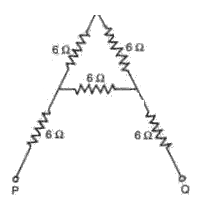
Question 393 Marks
Find the effective resistance in the following circuit diagrams (Fig.):Image
Answer

In the given network, between B and C the series combination
of two $6 \Omega$resistors is connected in parallel with the third $6 \Omega$resistor.
$\frac{1}{\mathrm{R}_{\text {equivalent }}}=\frac{1}{6+6}+\frac{1}{6}=\frac{1}{12}+\frac{1}{6}=\frac{3}{12}=\frac{1}{4}$
$\mathrm{R}_{\text {equivalent }}=4 \Omega$
Now, between P and Q, two$6 \Omega$ resistors and $4\Omega$ resistor are connected in series.
:. total resistance between P and Q is:
$R_{\text {total }}=6+6+4=16 \Omega$
View full question & answer
Question 403 Marks
Show how would you connect three resistors, each of resistance 6 O so that
the combination has a resistance of(a) 9 Ω (b) 4 .Ω
Answer
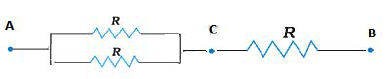
(a) To get an equivalent resistance of 9Ω using three 6 Ω resistors, they should be connected in parallel as shown:
Image
Between A and C, the equivalent resistance is
$\frac{1}{\mathrm{R}_{\text {parallel }}}=\frac{1}{6}+\frac{1}{6}=\frac{2}{6}=\frac{1}{3} \Omega$
"R"_"parallel" = $3 \Omega$
Between A and B, the equivalent resistance is
"R"_"series" = $3+6=9 \Omega$
(b) To get an equivalent resistance of$4 \Omega$using three $6 \Omega$ resistors, they should be connected in parallel as shown:
Image
Between A and B, the series combination of two 6 Ω resistors is connected in parallel with the third $6 \Omega$ resistor.
$\mathrm{R}_{\text {series }}=6+6=12 \Omega$
$\frac{1}{\mathrm{R}_{\text {equivalent }}}=\frac{1}{6}+\frac{1}{12}=\frac{3}{12}=\frac{1}{4} \Omega$
View full question & answer
Question 413 Marks
Two resistors P and Q of the same material and length but of different thickness are connected in parallel to a battery. The cross- sectional area of P is twice that of Q. What is the ratio of
(a) The resistance of P to the resistance of Q?
(b) The current in P to the current in Q?
Answer
We know that, $R=\rho \frac{1}{a}$
(a) Given length of resistors P and Q made of same material is same (say= 1)
Let 'a' be the area of cross-section of Q.
Then, the area of cross-section of Pis '2a'.
$\frac{\mathrm{R}_{\mathrm{p}}}{\mathrm{R}_{\mathrm{Q}}}=\frac{\rho\left(\frac{1}{2 \mathrm{a}}\right)}{\rho\left(\frac{1}{\mathrm{a}}\right)}=\frac{1}{2}$
the required ratio is 1: 2.
(b) AJC to ohm's law,
V=IR
If resistors P and Q are connected across the same voltage supply V, then
$\frac{I_p}{I_Q}=\frac{R_g}{R_p}=\frac{2}{1}$
:. the required ratio of current in P to current in Qi s 2: 1.
View full question & answer
Question 423 Marks
What are the factors on which the resistance of a conductor depends? Distinguish between conductors and insulators.
Answer
Factors on which the resistance of a conductor depends are:
(i) Nature of conductor: different materials have different concentration of free electrons and therefore resistance of a conductor depends on its material.
(ii) Length of conductor: Resistance of a conductor is directly proportional to the length of a conductor.
(iii) Area of cross-section of a conductor: Resistance of a conductor is inversely proportional to the area of cross-section of the uniform wire.
(iv) Temperature of conductor: In general for metallic conductors, higher the temperature larger is the resistance.
Materials which allow electric charges to flow through them easily are known as conductors. E.g. metals and materials which do not allow the electric charge to flow through them are known as insulators. E.g. rubber, dry wood etc.
View full question & answer
Question 433 Marks
State Ohm's law. What are its limitations?
Answer
According to Ohm's law, the current flowing in a conductor is directly proportional to the potential difference across its ends provided the physical conditions and temperature of conductor remains constant.
Limitations of Ohm's law:
1. Ohm's law does not apply to conductors such as diode, radio valves, metal rectifiers, where electricity passes through gases.
2. Ohm's law is applicable only when the physical conditions remain constant.
3. Ohm's law is applicable only when the temperature of the conductor is constant.
View full question & answer
[3 Mark Question Answer] - Physics STD 10 Questions - Vidyadip