Define internal resistance of a cell.
Question types
Electric Circuits, Resistance and Ohm's Law question types
61 questions across 6 question groups — pick any mix to generate a Physics paper with step-by-step answer keys.
61
Questions
6
Question groups
5
Question types
01
[1 Mark Question Answer]
6 Q→02[2 Mark Question Answer]
13 Q→03[3 Mark Question Answer]
10 Q→04[5 Mark Question Answer]
2 Q→05MCQ
25 Q→06fill in the blanks.
5 Q→Sample Questions
Electric Circuits, Resistance and Ohm's Law questions
One sample from each question group in this chapter. Select any group above to see the full set with answer keys.
View full solution →
A nichrome wire of length $l$ and area of cross-section $a / 4$ has a resistance R . Another nichrome wire of length $3 l$ and area of cross-section $\frac{a}{2}$ has a resistance of $R _1$. Find the ratio of $R _1: R$.
View full solution →What are ohmic and non ohmic resistance? Give example of each.
What is a superconductor? Name two materials and the temperature at which they become superconductors.
Define quantity of charge. States its practical unit and define it.
A cell of e.m.f. $E =2 V$ and internal resistance $r=1 \Omega$ is connected to an external resistance $R=4 \Omega$ as shown in the figure. The voltmeter $V$ measures the terminal voltage across the cell while the ammeter A measures the current in the circuit.
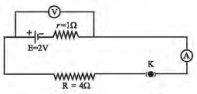
Complete the table, using the labels from the figure. The first label is done for you.
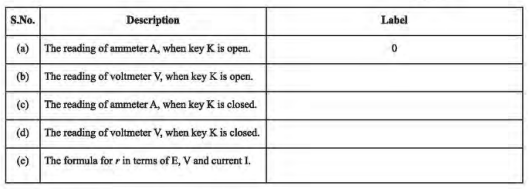
View full solution →Complete the table, using the labels from the figure. The first label is done for you.
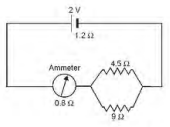
A cell of emf 2 V and internal resistance $1.2 \Omega$ is connected with an ammeter of resistance $0.8 \Omega$ and two resistors of $4.5 \Omega$ and $9 \Omega$ as shown in the diagram :
(a) What would be the reading on the Ammeter?
(b) What is the potential difference across the terminals of the cell?
View full solution →(a) What would be the reading on the Ammeter?
(b) What is the potential difference across the terminals of the cell?
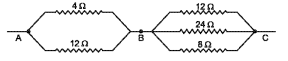
Consider mentioned figure alongside and calculate equivalent resistance between
(a) Points A and B
(b) Points B and C
(c) Points A and C
(a) Points A and B
(b) Points B and C
(c) Points A and C
State the factors on which internal resistance of a cell depends.
(a) State Ohm's law.
(b) What are the limitations of Ohm's law?
(b) What are the limitations of Ohm's law?
(i) Figure shows a circuit diagram containing 12 cells, each of e.m.f. 1.5 V and internal resistance $0.25 \Omega$ Calculate:
(a) Total internal resistance
(b) Total e.m.f
(c) Total external resistance
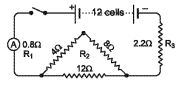
(ii) (a) Define the term electric resistance and state its SI unit.
(b) Mention two factors on which the resistance of a wire depends.
(iii) (a) Define potential difference.
(b) What is c.m.f. of a cell?
View full solution →(a) Total internal resistance
(b) Total e.m.f
(c) Total external resistance
(ii) (a) Define the term electric resistance and state its SI unit.
(b) Mention two factors on which the resistance of a wire depends.
(iii) (a) Define potential difference.
(b) What is c.m.f. of a cell?
(i) The diagram shows three resistors connected across a cell of e.m.f. 1.8 V and internal resistance $r$. Calculate:
(a) Current through $3 \Omega$ resistor.
(b) The internal resistance $r$.
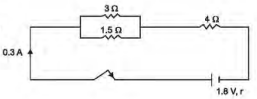
(ii) What is internal resistance of a cell? Write two factors on which it depends.
View full solution →(a) Current through $3 \Omega$ resistor.
(b) The internal resistance $r$.
(ii) What is internal resistance of a cell? Write two factors on which it depends.
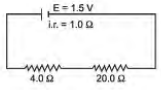
(i) A cell of e.m.f. 1.5 V and internal resistance $1.0 \Omega$ is connected to two resistors of $4.0 \Omega$ and $20.0 \Omega$ in series as shown in the figure.
Calculate the :
(a) current in the circuit.
(b) potential difference across the 4.0 ohm resistor.
(c) voltage drop when the current is flowing.
(d) potential difference across the cell.
(ii) In the figure, the ammeter A reads 0.3 A shown alongside,
Calculate :
(a) the total resistance of the circuit.
(b) the value of R .
(c) the current flowing through R .
(iii) (a) State Ohm's law
(b) Name two materials whose resistance decreases when the material is heated.
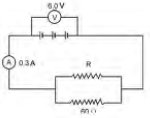
View full solution →Calculate the :
(a) current in the circuit.
(b) potential difference across the 4.0 ohm resistor.
(c) voltage drop when the current is flowing.
(d) potential difference across the cell.
(ii) In the figure, the ammeter A reads 0.3 A shown alongside,
Calculate :
(a) the total resistance of the circuit.
(b) the value of R .
(c) the current flowing through R .
(iii) (a) State Ohm's law
(b) Name two materials whose resistance decreases when the material is heated.
Study the diagram alongside carefully and calculate the magnitude of resistance offered by resistor $x$.
View full solution →Three resistors of $3 \Omega, 1.5 \Omega$ and $1 \Omega$ are connected in parallel. The combination of the above resistors is connected in series to a resistance of $8.5 \Omega$ and then to a battery of e.m.f. 4.5 V . If the internal resistance of the cell is negligible:
(a) Draw the circuit diagram.
(b) Calculate the current in the main circuit.
(c) Calculate the current in each of the resistors in parallel.
View full solution →(a) Draw the circuit diagram.
(b) Calculate the current in the main circuit.
(c) Calculate the current in each of the resistors in parallel.
(i) (a) Define volt.
(b) A wire of uniform thickness with a resistance of $27 \Omega$ is cut into three equal pieces and they are joined in parallel. Find the resistance of the parallel combination.
(ii) (a) What do you understand by the term internal resistance of cell?
(b) Which of the two cables, one of 10 A and other of 20 A will be thicker? Give one reason for your answer.
(iii) In the given figure, $A , B$ and C are three ammeters. The ammeter B reads 0.5 A (All the ammeters have negligible resistance.)
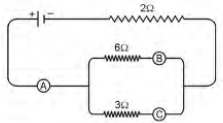 Calculate:
(a) the readings in the ammeters A and C .
(b) the total resistance of the circuit.
View full solution →(b) A wire of uniform thickness with a resistance of $27 \Omega$ is cut into three equal pieces and they are joined in parallel. Find the resistance of the parallel combination.
(ii) (a) What do you understand by the term internal resistance of cell?
(b) Which of the two cables, one of 10 A and other of 20 A will be thicker? Give one reason for your answer.
(iii) In the given figure, $A , B$ and C are three ammeters. The ammeter B reads 0.5 A (All the ammeters have negligible resistance.)
Calculate:(a) the readings in the ammeters A and C .
(b) the total resistance of the circuit.
(i) (a) Find the equivalent resistance between A and B .
(b) State whether the resistivity of a wire changes with the change in the thickness of the wire.
(ii) (a) Write down differences between resistance and specific resistance.
(b) What does the slope of a V-I graph for a conductor represent.
(c) A corrent of 0.2 A flows through a conductor of resistance $4.5 \Omega$ Calculate the p.d. at the ends of the conductor.
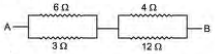
(iii) (a) Derive an expression for the current (I), when $n$ cells each of emf (E) and the internal resistance ( $r$ ) are connected in series to an external resistance $R$.
(b) State two conditions necessary to have maximum current in the external circuit when the cells are connected in series.
View full solution →(b) State whether the resistivity of a wire changes with the change in the thickness of the wire.
(ii) (a) Write down differences between resistance and specific resistance.
(b) What does the slope of a V-I graph for a conductor represent.
(c) A corrent of 0.2 A flows through a conductor of resistance $4.5 \Omega$ Calculate the p.d. at the ends of the conductor.
(iii) (a) Derive an expression for the current (I), when $n$ cells each of emf (E) and the internal resistance ( $r$ ) are connected in series to an external resistance $R$.
(b) State two conditions necessary to have maximum current in the external circuit when the cells are connected in series.
Assertion (A): When the resistance of the combination is to be increased, they are combined in series.
Reason (A): When the resistance of the combination is to be decreased, they are combined in parallel.
Reason (A): When the resistance of the combination is to be decreased, they are combined in parallel.
- ABoth A and R are true and R is the correct explanation of A
- ✓Both A and R are true and R is not the correct explanation of A
- CAssertion is false but reason is true.
- DAssertion is true but reason is false.
Answer: B.
View full solution →Assertion (A): Superconductors are not in common use.
Resson (A): Mercury below 4.2 K is a superconductor. It is very difficult to achieve such a low temperature.
Resson (A): Mercury below 4.2 K is a superconductor. It is very difficult to achieve such a low temperature.
- ✓Both A and R are true and R is the correct explanation of A
- BBoth A and R are true and R is not the correct explanation of A
- CAssertion is false but reason is true.
- DAssertion is true but reason is false.
Answer: A.
View full solution →A current 0.8A is drawn from a cell of e.m.f. 1.5V, when internal resistance of the cell is 1.60. The drop in potential across the terminal of the cell will be:
- A1.24 V
- ✓1.28 V
- C1.20 V
- D1.16 V
Answer: B.
View full solution →If 'r' is the internal resistance of a cell, such that 'E' is its e.m.f., V is potential difference and R is the external resistance of circuit then the expression for internal resistance is:
- ✓$r=\frac{ R ( E - V )}{ V }$
- B$r=\frac{ E - V }{ RV }$
- C$r=\frac{ V }{ R ( E - V )}$
- DNone of these
Answer: A.
View full solution →The physical conditions of a conductor remaining same, the current flowing through it is directly proportional to the potential difference at its ends. The above law was stated by:
- AMicheal Faraday
- BFleming
- COersted
- ✓George Simon Ohm
Answer: D.
View full solution →Good conductors have a ___________ [large / less] concentration of electrons, offer ___________ [large / less] resistance.
A longer conductor offers more ___________ [resistance / current / conductance].
The reciprocal of resistance is called ___________ [inductance / capacitance / conductance].
The potential is ___________ [negative / positive / neutral ] at a point in the vicinity of a positive charge.
Current is defined as the rate of flow of ___________ [electron / proton / charge].
Generate a Electric Circuits, Resistance and Ohm's Law paper free
Pick question groups from the list above, set marks and difficulty, and export a branded PDF with step-by-step answer keys. First 3 chapters free — no signup.