Questions

[2 Mark Question Answer]

🎯

Test yourself on this topic

13 questions · timed · auto-graded

Question 12 Marks
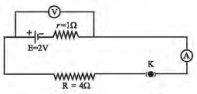
A cell of e.m.f. $E =2 V$ and internal resistance $r=1 \Omega$ is connected to an external resistance $R=4 \Omega$ as shown in the figure. The voltmeter $V$ measures the terminal voltage across the cell while the ammeter A measures the current in the circuit.
Image
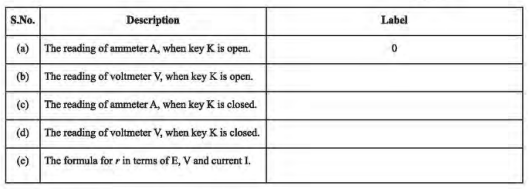
Complete the table, using the labels from the figure. The first label is done for you.
Image
Answer
(b) 2 V
(c) $0.4 A\left[\because I =\frac{ E }{ R +r}-\frac{2 V}{(4+1) \Omega}=\frac{2 V}{5 \Omega}=0.4 A\right]$
(d) $1.6 V .[\because V = E - Ir =2 V-0.4 A \times 1 \Omega=2 V-0.4 V=1.6 V]$
(e) $r=\frac{( E - V )}{ I }$
View full question & answer
Question 22 Marks
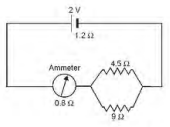
A cell of emf 2 V and internal resistance $1.2 \Omega$ is connected with an ammeter of resistance $0.8 \Omega$ and two resistors of $4.5 \Omega$ and $9 \Omega$ as shown in the diagram :
(a) What would be the reading on the Ammeter?
(b) What is the potential difference across the terminals of the cell?
Image
Answer
Resistance of $4.5 \Omega$ and $9 \Omega$ in parallel
$\frac{1}{R_p}=\frac{1}{4.5}+\frac{1}{9}=\frac{2+1}{9}=\frac{1}{3} \therefore \quad R_p=3 \Omega$
(a) Current reading on the ammeter ( I $)=\frac{ E }{ R + r }=\frac{2}{(0.8+3)+1.2}=\frac{2}{5}=0.4 A$.
(b) $I =\frac{ E - V }{r} \Rightarrow 0.4=\frac{2- V }{1.2} \Rightarrow 0.48=2- V$
$\therefore$ Potential difference $( V )=2-0.48=1.52 V$.
View full question & answer
Question 32 Marks
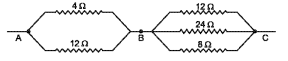
Consider mentioned figure alongside and calculate equivalent resistance between
(a) Points A and B
(b) Points B and C
(c) Points A and C
Image
Answer
(a) Equivalent resistance between A and B
$\frac{1}{R p_1}=\frac{1}{4}+\frac{1}{12}=\frac{3+1}{12}=\frac{4}{12}=\frac{1}{3} ; \quad \therefore R p_1=3 \Omega$
(b) Equivalent resistance between B and C
$\frac{1}{R_2}=\frac{1}{12}+\frac{1}{24}+\frac{1}{8}=\frac{2+1+3}{24}=\frac{6}{24}=\frac{1}{4} ; \quad \therefore RP_2=4 \Omega$
(c) Equivalent resistance between A and C
$R_{S}=3+4=7 \Omega$
View full question & answer
Question 42 Marks
State the factors on which internal resistance of a cell depends.
Answer
The internal resistance of a cell
(i) is inversely proportional to the surface area of electrodes in contact with the electrolyte.
(ii) is directly proportional to the distance between the electrodes of the cell.
(iii) depends on nature, concentration and temperature of the electrolyte.
View full question & answer
Question 52 Marks
(a) State Ohm's law.
(b) What are the limitations of Ohm's law?
Answer
(a) According to Ohm's law, the current flowing through a conductor is directly proportional to the potential difference across its ends, provided the physical conditions of the conductor remains the same.
(b) Certain resistors such as diodes, triodes, semiconductors, do not obey Ohm's law. For these resistors, the V-I graph is not a straight line. Also, Ohm's law is valid as long as the temperature of the conductor is constant.
View full question & answer
Question 62 Marks
(a) State three characteristics of a series circuit.
(b) State three characteristics of a parallel circuit
Answer
(a) (i) Magnitude of current through each resistor is same.
(ii) There is a contimuous drop in the potential all along the series circuit.
(iii) Potential difference across the entire circuit is equal to the sum of potential differences across each of the individual resistors.
(b) (i) Potential difference across all the resistors in a parallel circuit is a constant quantity.
(ii) Current divides in different resistors in the inverse ratio of the resistances of the parallel circuit. It means a low resistance allows more current and vice-verse.
(iii) Sum of currents in the individual resistors is equal to the total current following into parallel circuit.
View full question & answer
Question 72 Marks
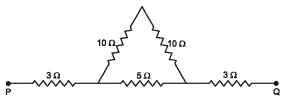
Calculate the equivalent resistance between $P$ and $Q$ in the following diagram.
Image
Answer
Resistance of two $10 \Omega$ resistance in series, their equivalent resistance $\left(R_1\right)=10+10=20 \Omega$
Equivalent resistance of $20 \Omega\left( R _1\right)$ in parallel with $5 \Omega$ resistance,
$\frac{1}{R_2}=\frac{1}{20}+\frac{1}{5}=\frac{1+4}{20}=\frac{5}{20}=\frac{1}{4} \quad \Rightarrow R_2=4 \Omega$
$\therefore$ Equivalent resistance between P and $Q =3 \Omega+ R _2+3 \Omega=3 \Omega+4 \Omega+3 \Omega=10 \Omega$
View full question & answer
Question 82 Marks
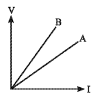
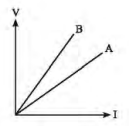
(a) The V-I graph for a series combination and for a parallel combination of two resistors is as shown in the figure below. Which of the two A and B represents the parallel combination?
(b) A cell of e.m.f. 1.5 V is comnected to an external resistance of $2 \Omega$, when the p.d. recorded is 1.2 V . Calculate the internal resistance of cell.
Image
Answer
(a) The graph line A represents parallel combination.
(b) $I =\frac{ E }{ R +r}=\frac{1.5}{2+r}$........(i)
Now, $V = IR$
$\begin{array}{l}\Rightarrow 1.2=\frac{1.5}{2+r} \times 2 \quad \text { [Putting the value of I from equ. (i)] } \\
\Rightarrow 2+r=\frac{1.5 \times 2}{1.2}=2.5 \\
\therefore r=2.5-2=0.5\end{array}$
Thus, internal resistance of cell $=0.5 \Omega$
View full question & answer
Question 92 Marks
(a) What do you understand by the term ohmic resistance?
(b) A wire of length 120 cm and area of cross-section $0.2 cm^2$ offers a resistance of $4 \Omega$. Calculate the specific resistance of the wire.
Answer
(a) A resistor, which obeys Ohm's law, is said to have ohmic resistance.
(b) Given, $I=120 cm=1.2 m, a=0.2 cm^2=0.2 \times 10^{-4} m^2, R =4 \Omega$
Thus, specific resistance $(\rho)=\frac{ R \times a}{l}$
$\begin{array}{l}=\frac{4 \Omega \times 0.2 \times 10^{-4} m^2}{1.2 m}=\frac{2}{3} \times 10^{-4} \Omega m \\
=0.667 \times 10^{-4} \Omega m=6.67 \times 10^{-5} \Omega m\end{array}$
View full question & answer
Question 102 Marks
(a) State the SI unit of specific resistance.
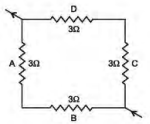
(b) Four resistance A, B, C and D of resistance $3 \Omega$ each are joined to form a square. Calculate the equivalent resistance between the opposite ends of the square
Image
Answer
(a) The SI unit of specific resistance is ohm-metre ( $\Omega- m )$.
(b) Resistance of $A$ and $B$ in series, $R_1=3+3=6 \Omega$ Resistance of C and D in series, $R _2=3+3=6 \Omega$
$\therefore$ Resistance of $R _1$ and $R _2$ in parallel,
$\frac{1}{R}=\frac{1}{R_1}+\frac{1}{R_2}=\frac{1}{6}+\frac{1}{6}=\frac{2}{6}=\frac{1}{3}$
$\therefore$ Equivalent resistance $(R)=3 \Omega$
View full question & answer
Question 112 Marks
State the laws of resistance.
Answer
Laws of resistance -
(i) Resistance of a conductor depends upon its nature of material.
(ii) Resistance of a conductor is directly proportional to its length (R $\propto l$ ).
(iii) Resistance of a conductor is imversely proportional to its area of cross-section, $\left( R \propto \frac{1}{ a }\right)$.
View full question & answer
Question 122 Marks
Define electric potential. State its practical unit and define it.
Answer
The amount of work done in moving a unit positive charge from infinity to a given point in an electric field is called electric potential.
The unit of electric potential is volt. It is denoted by the symbol V.
One volt is defined as the electric potential at a point when 1 J of work is done in bringing 1 C of electric charge from infinity to the given point in an electric field.
View full question & answer
Question 132 Marks
(a) Define the term potential. State its SI unit.
(b) The V-I graph for a series combination and for a parallel combination of two resistors is as shown in the figure. Which of the two A or B represents the parallel combination? Give a reason for your answer.
Image
Answer
(a) The amount of work done (energy spent) in moving a unit positive charge from infinity to a given point in an electric field is called electric potential. SI unit of electric potential is volt (V).
(b) The graph line A represents parallel combination. It is because, in parallel combination, the magnitude of resistance decreases and hence, the current in the circuit increases.
View full question & answer
[2 Mark Question Answer] - Physics STD 10 Questions - Vidyadip