Questions · Page 2 of 3

[2 Mark Question Answer]

Question 512 Marks
A woman pulls a bucket of water of total mass 5 kg from a well which is 10 s. calculate the power used by her.
Answer
Given mass $=5 \mathrm{~kg}$, height $=10 \mathrm{~m}$, time $=10 \mathrm{~s}$
Power $=\frac{\mathrm{mgh}}{\mathrm{t}}=\frac{5 \times 10 \times 10}{10} 50$ watt
View full question & answer
Question 522 Marks
If an electric bulb of $100$ watt is lighted for $2$ hours, how much electric energy would be consumed?
Answer
Given power $=100$ watt, time $=2$ hrsEnergy consumed $=$ power $x$ time
$=100 \times 2 \times 60 \times 60$
$=7.2 \times 10^5 J$
View full question & answer
Question 532 Marks
A horse exerts a pull on a cart of 300 N so that the horse-cart system moves with a uniform speed 18 km/h on a level road. Calculate the power developed by the horse in watt and also find its equivalent in horse power.
Answer
Given force $F=300$ N, u = $18 \mathrm{~km} / \mathrm{hr}$
Now, power $=\frac{\mathrm{W}}{\mathrm{t}}=\frac{\mathrm{F} \cdot \mathrm{s}}{\mathrm{t}}=\mathrm{F} . \mathrm{V}$
or $P=300 \times \frac{18 \times 10^3}{60 \times 60}=1500$ watt
\Now $1 \mathrm{H}>\mathrm{P}=746$ watt
1500 watt $=2 \mathrm{H}>\mathrm{P}$ (approx)
View full question & answer
Question 542 Marks
A 100 W electric lamp emits energy in the form of light at the rate 10 J per second. What percentage of electric energy does the lamp transform into light energy?
Answer
Given power of lamp $=100$ watt
rate of dissipation of light $=10 \mathrm{~J} / \mathrm{s}$
Therefore, percentage of electrical energy converted into light energy $=\frac{10}{100} \times 100 \%=10 \%$
View full question & answer
Question 552 Marks
The head of a nail becomes warm when it is hammered into a plank of wood. Explain the series of energy transformation taking place in the process.
Answer
When the head of a nail is struck with a hammer, the mechanical energy of the hammer pushes the nail into the plank of wood and in this process a part of energy is converted into heat energy.
View full question & answer
Question 562 Marks
What is the difference between K.E. and P.E.?
Answer
P.E. is the energy possessed by a body by virtue of its position, shape or configuration but K.E. is the energy possessed by a body by virtue of its velocity or motion.
E.g. A ball kept on a cliff possesses P.E. but as soon as it is kicked it possesses K.E.
View full question & answer
Question 572 Marks
A body does 20 J of work in 10 s. What is its power?
Answer
POWER $=\frac{\text { work done }}{\text { time taken }}=\frac{20}{10}=2$ watt
View full question & answer
Question 582 Marks
Define the unit 'watt'. How is it related to horse power?
Answer
If 1 joule of work is done in 1 second, the power is said to be 1 watt.
1 H.P. = 746 watt
View full question & answer
Question 592 Marks
Define one horse power.
Answer
Horse power is the unit of power. The horsepower used for electrical machines is defined as exactly 746 watt.
Classically, a horse exerting 1 H.P. can raise 330 pounds of coal 100 feet in a minutes, or 33 pounds of coal 1,000 feet in one minute, or, 1,000 pounds 33 feet in one minute.
View full question & answer
Question 602 Marks
Name four different forms of energy.
Answer
Four different forms of energy:
(i) Solar energy
(ii) Mechanical energy
(iii) Wind energy
(iv) Nuclear energy
View full question & answer
Question 612 Marks
What do you mean by the term 'work'?
Answer
'Work' is said to be done when the applied force makes the body move i.e., there is a displacement of body. It is equal to the product of force and the displacement of the point of application of the force in the direction of force.
View full question & answer
Question 622 Marks
A man lifts a mass of 10 kg from the floor to a shelf 4 meter high. If $g =10 ms^{-2}$, what is the work done?
Answer
Given, mass m = 10kg; height $h = 4m; g = 10ms^2$
W = mgh $= 10 x 10 x 4 = 400J$
View full question & answer
Question 632 Marks
What is the work when a load of 500 kg is lifted vertically by 5 m ? Given, $g =10 ms^{-2}$. Express your answer in kilo joule.
Answer
Given, loadm $=500 kg$; height $h =5 m ; g =10 ms^2$
$W=mgh=500 \times 10 \times 5=25000 J=25 kJ$
View full question & answer
Question 642 Marks
Work is a scalar quantity because it is a measure of transfer of energy without indicating any direction
Answer
When the displacement of the body is in the direction opposite to that of the applied force,the work done is negative.
W = Fd cos 0 = Fd cos 180° = -Fd
View full question & answer
Question 652 Marks
Distinguish between work and power.
Answer
Work is said to be done only when the applied force on a body makes the body move but power is the rate of doing work.
The SI unit of work is 'joules' and that of power is 'watt'.
View full question & answer
Question 662 Marks
What is the work done when the force on the object and the displacement of the object are perpendicular to each other?
Answer
The work done is zero because:
Work done = force x displacement x cos 0
Now, since 0 = 90°; cos 0 = and hence work done is equal to zero.
View full question & answer
Question 672 Marks
No work is done by a man moving on a horizontal road while carrying a box on his head. Explain.
Answer
The displacement of the man and box is along the horizontal direction. Thus, the angle between the displacement and the force of gravity is $90^0;$
Thus, W = Fd $\cos 90^0 = 0$
Hence, no work is done against gravity in this case; however some work is done against friction.
View full question & answer
Question 682 Marks
On what factors does the work done by a force depend?
Answer
Work done depends upon:
(i) the magnitude and direction of the applied force, and
(ii) the displacement it produces.
View full question & answer
Question 692 Marks
Give two examples of work done.
Answer
Examples of work done:
(i) In free fall of a body of mass m, under gravity from a height h, the force of gravity (F=mg) is in the direction of displacement (=h) and the work done by the gravity is mgh.
(ii) A coolie lifting a load does work against gravity.
View full question & answer
Question 702 Marks
How much force is applied on a body when 150 J of work is done in displacing the body through a distance of 10 m in the direction of the force?
Answer
Given work done $=150 \mathrm{~J}$, Displacement $=10 \mathrm{~m}, 0=0^{\circ}$
Now work done $=$ force $x$ displacement $x \cos 0^{\circ}$
or force $=\frac{150}{10}=15 \mathrm{~N}$
View full question & answer
Question 712 Marks
An engine does 54,000 J of work by exerting a force of 6000 N on it. What is the displacement in the direction of the force?
Answer
Given work done $=54,000 \mathrm{~J}$, force $=6000 \mathrm{~N}, 0=0^{\circ}$
Now work done $=$ force $x$ displacement $x \cos 0^{\circ}$
or displacement $=\frac{54000}{6000}=9 \mathrm{~m}$
View full question & answer
Question 722 Marks
What is the ratio of SI units to $CGS$ units of 'work'?
Answer
The SI unit of work is 'joules' and the CGS unit is 'erg'.
1 joule $= 10^7$​​​​​​​ erg
Thus the ratio is $10^7: 1$
View full question & answer
Question 732 Marks
Define 'joule'.
Answer
The SI unit of work is joule.
1 joule of work is said to be done when a force of 1 newton displaces a body through 1 metre in its own direction.
View full question & answer
Question 742 Marks
What is the work done on the earth by the gravitational force of the sun during its motion around the sun?
Answer
The work done by the gravitational force of the sun on earth during its motion around the sun is zero because at every point, the displacement of earth is perpendicular to the gravitational force of sun i.e., $W = Fd$ cos $90^0 = 0$
View full question & answer
Question 752 Marks
A man carrying a suitcase in his hand is walking horizontally. What is the work done against gravity?
Answer
The displacement of the man and suitcase is along the horizontal direction. Thus, the angle between the displacement and the force of gravity is 90°;
Thus, W = Fd cos 90° = 0
Hence, no work is done against gravity in this case.
View full question & answer
Question 762 Marks
In which one of the following cases is the work done more? When the angle between the direction of motion and that of the force is (i) 90° (ii) 0°.
Answer
When the angle between the direction of motion and that of the force is 90°;
W = Fd cos 90° = 0
When the angle between the direction of motion and that of the force is 0°;
W = Fd cos 0° = Fd
Hence in the second case, when the angle is 0°; the work done is more.
View full question & answer
Question 772 Marks
What are the quantities on which the work done depends?
Answer
Work done depends upon:
(i) the magnitude and direction of the applied force, and
(ii) the displacement it produces.
View full question & answer
Question 782 Marks
A machine raises a load of 750 N through a height of 16 m in 5s. calculate:
(i) work done by machine,
(ii) power at which the machine works.
Answer
Given, load $\mathrm{m}=750 \mathrm{~N}$, displacement $\mathrm{h}=16 \mathrm{~m}$, time $=5 \mathrm{~s}, \mathrm{~g}=10 \mathrm{~N} \mathrm{~kg}^{-1}$
now work done $=\mathrm{mgh}=750 \times 16=12000 \mathrm{~J}$
or power $=\frac{\text { work done }}{\text { time taken }}=\frac{12000}{5}=2400$ watt
View full question & answer
Question 792 Marks
Write the SI and CGS units of power. How are they related?
Answer
$\begin{aligned} & \text { SI unit of power = watt } \\ & \text { CGS unit of power = erg per second } \\ & 1^{\prime} \mathrm{W}=1 \mathrm{~J} \mathrm{~s}^{-1}=10^7 \mathrm{erg} \mathrm{s}^{-1}\end{aligned}$
View full question & answer
Question 802 Marks
It takes 20 s for A to climb up the stairs, while B does the same in 15 s. compare the (i) work done, and (ii) power developed by A and B.
Answer
(i) work done depends on the displacement, now, vertical distance travelled by A and B is same, hence ratio of wok done by them is $1: 1$.
(ii) Power $=\frac{\text { work done }}{\text { time taken }}$
$ \frac{\mathrm{P}_{\mathrm{A}}}{\mathrm{P}_{\mathrm{E}}}=\frac{1}{1} \times \frac{15}{20}=\frac{3}{4} $
The required ratio is $3: 4$.
View full question & answer
Question 812 Marks
What is a block and tackle system of pulleys?
Answer
A block and tackle system of pulleys consists of two blocks of pulleys, each block having one or more than one pulley. The upper block of pulleys is fixed to a rigid support and the lower block of pulleys is movable. The number of pulleys in the movable block is either equal to or one less than the number of pulleys in the fixed block.
View full question & answer
Question 822 Marks
What is the purpose of a machine?
Answer
The purpose of a machine is:
(i) To multiply force
(ii) To obtain a gain or decrease in speed
(iii) To change to direction of application of force in a convenient direction
View full question & answer
Question 832 Marks
Define velocity ratio? State its unit.
Answer
elocity ratio is defined as the ratio of velocity of the $\left(V_E\right)$ to the velocity of the resistanve force (load) $\left(\mathrm{V}_{\mathrm{L}}\right)$.
It is also defined as the ratio of the displacement of the effort to the displacement of the load. Mathematically, we have:
$ \text { V.E. }=\frac{\mathrm{V}_{\mathrm{E}}}{\mathrm{V}_{\mathrm{L}}}=\frac{\mathrm{d}_{\mathrm{E}}}{\mathrm{d}_{\mathrm{L}}} $
Since velocity ratio is the ratio of two similar quantities, therefore, it does not have a unit.
View full question & answer
Question 842 Marks
Can a machine be 100% efficient?
Answer
No, a machine cannot be 100% efficient because mechanical advantage is always less than theoretical mechanical advantage due to friction and the weight of the moving parts.
View full question & answer
Question 852 Marks
The efficiency of a pulley is always less than 100%.
Answer
The two reasons are:
(a) Some effort is wasted and overcoming the friction between the strings and the grooves of the pulley.
(b) Some effort is wasted in lifting up the movable block along with the load.
View full question & answer
Question 862 Marks
In a single fixed pulley, the velocity ratio is always more than the mechanical advantage.
Answer
In a single fixed pulley, some effort is wasted in overcoming friction between the strings and the grooves of the pulley; so the effort needed is greater than the load and hence the mechanical advantage is less than the velocity ratio.
View full question & answer
Question 872 Marks
Name the type of single pulley that can act as a force multiplier. Draw a labeled diagram of the pulley mentioned by you.
Answer
single movable pulley acts as a force multiplier
View full question & answer
Question 882 Marks
What is a block and tackle system of pulleys?
Answer
A block and tackle system of pulleys consists of two blocks of pulleys, each block having one or more than one pulley. The upper block of pulleys is fixed to a rigid support and the lower block of pulleys is movable. The number of pulleys in the movable block is either equal to or one less than the number of pulleys in the fixed block.
View full question & answer
Question 892 Marks
Write two uses of pulleys. Is pulley a force multiplier?
Answer
Two uses of pulley:
(i) To change the direction of application of force to a convenient direction.
(ii) To multiply force.
Yes, a pulley is a force multiplier
View full question & answer
Question 902 Marks
Name the force needed for circular motion. What is the direction of the force?
Answer
The force needed for circular motion is 'centripetal force'.
This force is always directed towards the centre of circle at each point of its path.
View full question & answer
Question 912 Marks
Explain the difference between a uniform linear motion and a uniform circular motion.
Answer
In uniform linear motion, the velocity is constant and acceleration is zero i.e., the uniform linear motion is an un-accelerated motion, while in a uniform circular motion the velocity is variable (although speed is uniform), so it is an accelerated motion. 
View full question & answer
Question 922 Marks
Is centrifugal force considered as the force of reaction of the centripetal force?
Answer
Centrifugal force is not a real force, but it is considered to describe (understand) a certain motion. It should not be considered as the force of reaction of centripetal force, although its magnitude is same as that of centripetal force.
View full question & answer
Question 932 Marks
A uniform circular motion is an accelerated motion. Justify it.
Answer
In uniform circular motion, a particle travels equal distances along the circular path in equal intervals of time, so the speed of particle is uniform. But the direction of motion of the particle changes at each point of circular path. Due to continuous change in direction of motion, the velocity of the particle is not uniform (or velocity is variable) i.e., the motion is accelerated.
View full question & answer
Question 942 Marks
State the condition when a force produces
(i) linear motion.
(ii) rotational motion, in a body.
Answer
(i) If a rigid body is free to move, the applied force will cause translational motion.
(ii) If a rigid body moves around a center or is pivoted at a point, the applied force will cause rotational motion.
View full question & answer
Question 952 Marks
What do you understand by the clockwise and anti clockwise moment of force?
Answer
If the turning effect on the body is clockwise, moment of force is called the clockwise moment and is taken as negative.
If the turning effect on the body is anticlockwise, moment of force is called the anticlockwise moment and is taken as positive.
View full question & answer
Question 962 Marks
State the factors on which moment of force about a point depends.
Answer
The factors on which the moment of force about a point depends are :
1. The magnitude of force applied.
2. The distance of the line of action of the force from the axis of rotation.
View full question & answer
Question 972 Marks
What is meant by a rotatory motion? Give one example.
Answer
If a rigid body is pivoted at a point, then the applied force will rotate the body about the fixed point or about the axis passing through the fixed point. This motion is called rotational motion.
e.g. Earth's rotation about its axis, wheels of car in motion.
View full question & answer
Question 982 Marks
What is meant by a translational motion? Give one example.
Answer
When some force is applied on a rigid body free to move and the body starts moving along a straight path in the direction of force. This is known as linear or translational motion. Points on the rigid body, undergo displacements forming parallel lines and magnitude of displacement is the same for individual point.
e.g. the motion of a bullet fired from a gun, a ball thrown straight up and falling back straight down.
View full question & answer
Question 992 Marks
Define moment of force and state its SI unit.
Answer
The turning effect produced by a force on a rigid body about a point, pivot or fulcrum is called the moment of force or torque. It is measured by the product of force and the perpendicular distance of the pivot from the line of action of force.
Moment of a force = Force x perpendicular distance of the pivot from the force.
Its SI unit is newton-metre (Nm).
View full question & answer
Question 1002 Marks
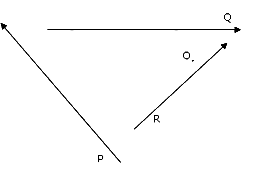
P, Q and R are three forces which act as shown in fig.

The point O lies in the same plane. Given, P = Q = R = 10N
(i) Which force has the least moment about O? Give a reason.
(ii)Which force has the greatest moment about O? Give a reason.
Answer
(i) Force 'R' has the least moment about 'O' because its perpendicular distance is least from 'O'.
(ii) Force 'P' has the maximum moment about 'O' because its perpendicular distance is maximum from 'O'.
View full question & answer
[2 Mark Question Answer] - Page 2 - Physics STD 10 Questions - Vidyadip