Questions

[2 Mark Question Answer]

🎯

Test yourself on this topic

45 questions · timed · auto-graded

Question 12 Marks
Calculate the length of arm of couple, if a force of 13 N produces a moment of couple of 14.3 Nm.
Answer
Moment of couple = Force × Arm of couple
14.3 Nm = 13 N × Arm of couple
Arm of couple $=\frac{14.3}{13}$
= 1.1 m.
View full question & answer
Question 22 Marks
If the power of a motor is 40 KW, at what speed can it raise a load of 20,000 N?
Answer
Power = 40KW
Force = 20,000N
Power = force × velocity
Velocity $=\frac{\text { Power }}{\text { Force }}=\frac{40 KW }{20,000}=\frac{40,000}{20,000}=2 m / s$.
View full question & answer
Question 32 Marks
Calculate the magnitude of the force of a couple, when the arm of the couple is 63 cm and the moment of the couple is 21 Nm.
Answer
Moment of couple = F × Arm of couple
21 Nm = F × 63 cm
21 Nm = F × 0.63 m
$F=\frac{21}{0.63}=33.33 N$
View full question & answer
Question 42 Marks
Calculate the minimum distance between point of application of force and axis of rotation of a rigid body, if a force 125 N produces a moment of force of 25.75 Nm.
Answer
Moment of force = Force × Perpendicular distance
25.75 Nm = 125 N × Perpendicular distance
Perpendicular distance $=\frac{25.75}{125}=0.206 m$.
View full question & answer
Question 52 Marks
The perpendicular distance between the point of application of force and turning point is 1.75 m when a force of 80 N acts on a rigid body. Calculate the moment of force.
Answer
Force (F) = 80 N
Perpendicular distance = 1.75 m
∴ Moment of force = F × perpendicular distance
= 80 × 1.75 = 140 Nm.
View full question & answer
Question 62 Marks
A body is thrown vertically upwards. Its velocity keeps on decreasing. What happens to its kinetic energy as its velocity becomes zero?
Answer
K.E. = 0
∵ v = 0
∵ K.E. =$\frac{1}{2} mv ^2$

View full question & answer
Question 72 Marks
A ball of mass $200$ g falls from a height of $5 m$. What will be its kinetic energy when it just reaches the ground? $(g = 9.8 m s^{−2})$
Answer
Given, $m = 200 g.$
$h = 5m.$
When the ball reaches the ground then $P.E. = K.E.$
K.E. $=m g h=\frac{200}{1000} \times 9.8 \times 5=9.8$ Joule
View full question & answer
Question 82 Marks
A body of mass $0.2 kg$ falls from a height of $10 m$ to a height of $6 m$ above the ground. Find the loss in potential energy taking place in the body. $[g = 10ms^{−2}]$
Answer
Given, Mass $= 0.2 kg$
Height, $h = 10 m$ to $6 m$
Loss in Potential Energy $= mg (h_1 − h_2)$
$= 0.2 \times 10 (10 − 6) = 8 J$
View full question & answer
Question 92 Marks
 A girl of mass $35 \ kg$ climbs up from the first floor of a building at a height $4 \ m$ above the ground to the third floor at a height $12 \ m$ above the ground. What will be the increase in her gravitational potential energy? $\left[ g =10 ms^{-2}\right.$ ]
Answer
Increase in gravitational energy
$= mg (h_2 − h_1)$
$= 35 \times 10 (12 − 4)$
$= 350 \times 8$
$= 2,800 J$
View full question & answer
Question 102 Marks
A coolie carrying a load on his head and moving on a frictionless horizontal platform does no work. Explain the reason why.
Answer
We know W = F d cos θ.
Since force is normal to displacement.
So θ = 90°
Hence work done W = Fd cos θ 90 = 0.
View full question & answer
Question 112 Marks
Define non-contact forces.
Answer
The forces which act on a body without the help of any connector, are called non-contact forces or forces of distance. Gravitational force, Mechanical force, etc., are non-contact forces.
View full question & answer
Question 122 Marks
Name two places in India where electricity is generated from nuclear power plants.
Answer
(i) At Kalpakkam in Tamil Nadu, and
(ii) At Narora, in Uttar Pradesh.
View full question & answer
Question 132 Marks
Give two examples each of renewable and non-renewable sources of energy?
Answer
Renewable sources of energy: Solar energy and wind energy.
Non-renewable sources of energy: coal and oil.
View full question & answer
Question 142 Marks
A man climbs a slope and another walks same distance on level road. Which of the two expends more energy and why?
Answer
The man moving along the slope expends more energy. It is because, while moving along the slope, he gains height and hence has extra potential energy.
View full question & answer
Question 152 Marks
What is dissipation of energy?
Answer
In transforming the mechanical energy if a part of it gets converted into another form of energy that cannot be utilized for useful work, this loss of energy is called the dissipation of energy.
View full question & answer
Question 162 Marks
A man climbs a slope and another walks same distance on level road. Which of the two expends more energy and why?
Answer
The man moving along the slope expends more energy. It is because, while moving along the slope, he gains height and hence has extra potential energy.
View full question & answer
Question 172 Marks
Define $1$ Dyne.
Answer
$1$ dyne is that force which when acting on a body of mass 1 gram, produces an acceleration of $1 cm s^{-2} $ in it.
$1$ dyne $= 1 g \times 1 cm s^{-2}.$
View full question & answer
Question 182 Marks
How is kinetic energy possessed by a moving body measured?
Answer
The kinetic energy possessed by a moving body is measured by the amount of work done by an opposing force in bringing the body to rest from its present state of motion.
View full question & answer
Question 192 Marks
State larger units of power.
Answer
The larger units of power are:
$1$ Kilowatt $= 1000$ watt $10^3 W$
$1$ Megawatt $= 1000,000 W = 10^6 W.$
View full question & answer
Question 202 Marks
State two conditions for work to be done.
Answer
The two conditions are:
(i) Application of-force on the body.
(ii) Displacement of the body in the direction of the force.
View full question & answer
Question 212 Marks
Can two agents, doing the same work, have different power?
Answer
Yes, since power = work/time the two agents can have different powers if they take different amounts of time to do the same work.
View full question & answer
Question 222 Marks
State two conditions when the work done by a force acting on a body is zero.
Answer
(i) When there is no displacement by the force in the body.
(ii) When the displacement is normal to the direction of the force.
View full question & answer
Question 232 Marks
What is the weight of a body placed at the centre of the earth?
Answer
The weight of a body placed at the centre of the earth is zero as
g = 0
∴ W = mg
= 0
View full question & answer
Question 242 Marks
Explain why One leans forward while climbing up a hill.
Answer
A person going uphill has to bend forward but while coming down has to bent backward, this is to keep the CG at the centre of the body and between his feet.
View full question & answer
Question 252 Marks
Define Centripetal force.
Answer
At each of circular path, the particle, instead of moving straight continuously, turn towards the centre. Therefore, the motion in the circular path is under the action of a force called the centripetal force.
View full question & answer
Question 262 Marks
Define one newton. Write the relation between the $S. I.$ unit and the $C.G.S.$ unit of force.
Answer
If a body of mass $1 kg$ moves with an acceleration of $1 m / s ^2$ then force acting on the body is said to be one $Newton.1N=$ $10^5$ Dyne.
Relation between $S. I.$ and $CGS$ unit of force is $1$ Newton $=1 kg \times 1 ms^{-2}$.
View full question & answer
Question 272 Marks
Give the units of couple.
Answer
In the MKS system, the unit of the couple is Nm and kgf m.
In the CGS system, the units of the couple are Dyne cm and gf cm.
View full question & answer
Question 282 Marks
State when the moment of force is positive and when it is negative.
Answer
If the couple has a tendency to rotate the body in an anti-clockwise direction then its moment is taken positive and if the tendency of rotation is clockwise then the moment is negative.
View full question & answer
Question 292 Marks
State the principle of moments.
Answer
When the number of forces acting on a body, keep it in equilibrium, then the sum total of clockwise moments about any turning point is equal to sum total of anticlockwise moments about the point.
View full question & answer
Question 302 Marks
State the units of moment of force.
Answer
In the CGS system, the unit of moment of a force is Dyne-cm and in the MKS system, the unit of moment of a force is Newton-metre. The gravitational units in CGS and MKS system of measurement are gf cm and kg m respectively.
View full question & answer
Question 312 Marks
A force is applied on (i) a non-rigid body and (ii) a rigid body. How does the effect of the force differ in the above two cases?
Answer
When force is applied on a non-rigid body it undergoes deformation i.e. change in size, shape, and position whereas a rigid body doesn’t undergo a change in shape, position, and size.
View full question & answer
Question 322 Marks
What is the work done by the gravitational force on the moon that revolves around the earth?
Answer
The moon is revolving around the earth. In this process, the work done by the gravitational force is zero because the displacement of the moon is at the right angle to the gravitational force.
View full question & answer
Question 332 Marks
Give any two effects of a force on a non-rigid body.
Answer
Two effects of a force on a non-rigid body are:
(i) Force can change the state of rest or motion of the body
(ii) Force can change the size or shape of the body.
View full question & answer
Question 342 Marks
State the energy changes which take place when:
A stone projected vertically upwards, returns back to the thrower.
Answer
The kinetic energy changes to potential energy when stone rises up. The potential energy then changes back to kinetic energy, when stone comes down.
View full question & answer
Question 352 Marks
State the energy changes which take place when:
An air gun is loaded and then fired.
Answer
During loading, the mechanical energy changes to the potential energy of spring. On firing, the potential energy of spring changes to the kinetic energy of the bullet.
View full question & answer
Question 362 Marks
State the energy changes which take place when:
A toy car spring is wound and car is made to run on level floor.
Answer
The mechanical energy changes to potential energy during winding. The potential energy is then released in the form of kinetic energy.
View full question & answer
Question 372 Marks
Distinguish between work and power.
Answer
Work is said to be done only when the applied force on a body makes the body move but power is the rate of doing work.
The SI unit of work is 'joules' and that of power is 'watt'.
View full question & answer
Question 382 Marks
Calculate the work done when:
A car is moved on a rough road through 30 m against a frictional resistance of 75 N.
Answer
Resisting force = 75 N; Distance moved = 30 m
∴ Work done = 75 × 30 J = 2250 J.
View full question & answer
Question 392 Marks
Calculate the work done when:
A $5 \ kg$ weight is lifted $10 \ m$ vertically. $(g = 9.8 m/s^2)$
Answer
Force $= m \times g = 5 \times 9.8 = 49 N$; Distance $= 10 m$
$\therefore $ Work done $= F \times d = 49 \times 10 = 490 J.$
View full question & answer
Question 402 Marks
A ball is placed on a compressed spring. When the spring is released, the ball is observed to fly away.
(i) What form of energy does the compressed spring possess?
(ii) Why does the ball fly away?
Answer
(i) Compressed spring possesses potential energy.
(ii) Potential energy of the spring is imparted to the ball in the form of kinetic energy.
View full question & answer
Question 422 Marks
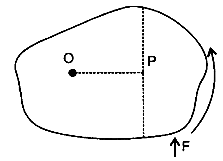
Write the expression for calculating the moment of force about a given point.


Answer
Moment of a force about the point O
= Force × Perpendicular distance of force from the point O
= F × OP
View full question & answer
Question 432 Marks
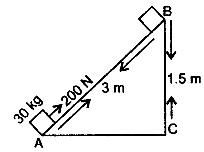
A block of mass $30 kg$ is pulled up a slope, as shown in diagram with a constant speed, by applying a force of $200 N$ parallel to slope.
$A$ and $B$ are initial and final positions of block.

(i) Calculate the work done by force in moving the block from $A$ to $B.$
(ii) Calculate $P.E$. gained by block.$ [g=10ms^{-2}]$
Answer
(i) Work done in moving the block from = F × d
A to B = 200 N × 3m = 600 J
(ii) Gain in potential energy = mgh = 30 × 10 × 1.5 = 450 J.
View full question & answer
Question 442 Marks
Give three examples of bodies possessing kinetic energy.
Answer
(i) A moving bullet
(ii) A flowing river
(iii) Wind.
View full question & answer
Question 452 Marks
What are the different forms of mechanical energy?
Answer
Mechanical energy is of two forms:
(i) potential energy, and
(ii) kinetic energy.
View full question & answer
[2 Mark Question Answer] - Physics STD 10 Questions - Vidyadip