Question 13 Marks
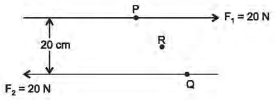
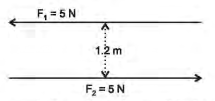
$(i)\ (a)$ Study the diagram alongside and calculate the moment of couple.
$(b)$ Two forces $F_1= F_2$ are applied on a wheel of radius $1.5\ m,$ such that moment of couple is $30\ Nm$. Calculate the magnitude of each of the force.
$(ii)\ A$ force of $50\ N$ produces a moment of force of $10\ Nm$ in a rigid body. Calculate the perpendicular distance between the point of application of force and the turning point.
$(iii)\ (a)$ State the laws of moments.
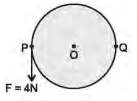
$(b)$ The diagram shows a wheel of diameter $4\ m,$ and pivoted at $O$. Calculate the moment of force about point $(1)\ O, (2)\ Q,$ when a force$ F = 4N$ acts at point $P$ or $Q$.
$(b)$ Two forces $F_1= F_2$ are applied on a wheel of radius $1.5\ m,$ such that moment of couple is $30\ Nm$. Calculate the magnitude of each of the force.
$(ii)\ A$ force of $50\ N$ produces a moment of force of $10\ Nm$ in a rigid body. Calculate the perpendicular distance between the point of application of force and the turning point.
$(iii)\ (a)$ State the laws of moments.
$(b)$ The diagram shows a wheel of diameter $4\ m,$ and pivoted at $O$. Calculate the moment of force about point $(1)\ O, (2)\ Q,$ when a force$ F = 4N$ acts at point $P$ or $Q$.
Answer
View full question & answer→$(i)\ (a)$
Moment of couple $=$ Force $\times$ arm of couple
$ =5\ N \times 1.2\ m$ in $\text{ACWD}$
$ =6\ Nm$ in $\text{ACWD}$
$(b)$ Radius of the wheel $=1.5\ m$; Moment of couple $=30\ Nm$
Arm of couple $=$ diameter of the wheel $=1.5\ m \times 2=3.0\ m$
Magnitude of each of the force; $F = F _1= F _2=\frac{\text { Moment of couple }}{\perp \text { distance }}=\frac{30 Nm }{3.0}=10 N$.
$(ii)$ Given$, F =50\ N$; Moment of force $=10\ Nm$
$\therefore \perp$ distance $=\frac{\text { moment of force }}{\text { force }}=\frac{10 Nm}{50\ N}=0.2\ m$
$(iii)\ (a)$ When number of forces are acting on a body, such that body is in equilibrium, then sum total moments of forces in clockwise direction is equal to sum total of anticlockwise moment of forces.
$(b)$ Diameter of wheel $=4\ m$ ;
$\therefore$ Radius of wheel $-2\ m$
$1.$ Moment of force about point $O = F\ \times \perp$ distance $=4\ N \times 2\ m=8\ Nm$ in $\text{ACWD}$
$2.$ Moment of force about point $Q = F\ \times \perp$ distance between $O$ and $Q$
$=4 N \times 2\ m=8\ Nm$ in $\text{ACWD}.$
Moment of couple $=$ Force $\times$ arm of couple
$ =5\ N \times 1.2\ m$ in $\text{ACWD}$
$ =6\ Nm$ in $\text{ACWD}$
$(b)$ Radius of the wheel $=1.5\ m$; Moment of couple $=30\ Nm$
Arm of couple $=$ diameter of the wheel $=1.5\ m \times 2=3.0\ m$
Magnitude of each of the force; $F = F _1= F _2=\frac{\text { Moment of couple }}{\perp \text { distance }}=\frac{30 Nm }{3.0}=10 N$.
$(ii)$ Given$, F =50\ N$; Moment of force $=10\ Nm$
$\therefore \perp$ distance $=\frac{\text { moment of force }}{\text { force }}=\frac{10 Nm}{50\ N}=0.2\ m$
$(iii)\ (a)$ When number of forces are acting on a body, such that body is in equilibrium, then sum total moments of forces in clockwise direction is equal to sum total of anticlockwise moment of forces.
$(b)$ Diameter of wheel $=4\ m$ ;
$\therefore$ Radius of wheel $-2\ m$
$1.$ Moment of force about point $O = F\ \times \perp$ distance $=4\ N \times 2\ m=8\ Nm$ in $\text{ACWD}$
$2.$ Moment of force about point $Q = F\ \times \perp$ distance between $O$ and $Q$
$=4 N \times 2\ m=8\ Nm$ in $\text{ACWD}.$