Two forces each of magnitude 2 N act vertically upward and downward respectively on two ends of a uniform rod of length 1 m, freely pivoted at its centre. Determine the resultant moment of forces about the mid-point of the rod.
Question types
Forces : Turning Forces and Uniform Circular Motion question types
54 questions across 6 question groups — pick any mix to generate a Physics paper with step-by-step answer keys.
54
Questions
6
Question groups
5
Question types
01
[1 Mark Question Answer]
6 Q→02[2 Mark Question Answer]
8 Q→03[3 Mark Question Answer]
4 Q→04[5 Mark Question Answer]
1 Q→05MCQ
30 Q→06fill in the blanks.
5 Q→Sample Questions
Forces : Turning Forces and Uniform Circular Motion questions
One sample from each question group in this chapter. Select any group above to see the full set with answer keys.
View full solution →
Calculate the force which will produce a moment of force of 1575 dyne-cm, when the perpendicular distance between point of application of force and turning point is 45 cm.
A force of 50 dynes acts on a rigid body, such that the perpendicular distance between the fulcrum and the point of application of force is 75 cm. Calculate the moment of force.
(a) What do you understand by the term center of gravity?
(b) What is the position of the CG for a cylinder?
(b) What is the position of the CG for a cylinder?
With reference to magnitude of force and its direction, how does centripetal force differ from centrifugal force?
A , B and C are three forces each of magnitude 5 N acting in the plane of paper as shown in the figure. Point O lies in the same plane.
Complete the table using the labels from the figure. The first label is done for you.
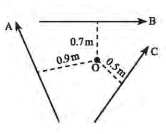
Complete the table using the labels from the figure. The first label is done for you.
| S.No. | Description | Label |
| (a) | The force having the greatest moment about O | A |
| (b) | The force having the least moment about O | |
| (c) | The forces producing clockwise moment | |
| (d) | The forces producing anticlockwise moment | |
| (e) | The forces producing anticlockwise moment O |
A uniform metre scale balances horizontally on a knife edge placed at 55 cm mark, when a mass of 25 g is supported from one end. Draw the diagram of the arrangement. Calculate mass of the scale.
The diagram alongside shows a force $F =5 N$ acting at point A produces a moment of force of 6 Nm about point O . What is the diameter of the wheel?
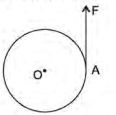
View full solution →Define
(a) Circular motion (b) Centripetal force (c) Centrifugal force
(a) Circular motion (b) Centripetal force (c) Centrifugal force
Explain the following
(a) Why does a jack screw provided with a long arm?
(b) It is easier to turn a steering wheel of larger diameter than a steering wheel of small diameter.
(a) Why does a jack screw provided with a long arm?
(b) It is easier to turn a steering wheel of larger diameter than a steering wheel of small diameter.
$(i)\ (a)$ Study the diagram alongside and calculate the moment of couple.
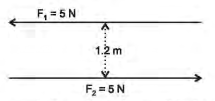
$(b)$ Two forces $F_1= F_2$ are applied on a wheel of radius $1.5\ m,$ such that moment of couple is $30\ Nm$. Calculate the magnitude of each of the force.
$(ii)\ A$ force of $50\ N$ produces a moment of force of $10\ Nm$ in a rigid body. Calculate the perpendicular distance between the point of application of force and the turning point.
$(iii)\ (a)$ State the laws of moments.
$(b)$ The diagram shows a wheel of diameter $4\ m,$ and pivoted at $O$. Calculate the moment of force about point $(1)\ O, (2)\ Q,$ when a force$ F = 4N$ acts at point $P$ or $Q$.
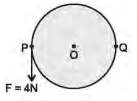
View full solution →$(b)$ Two forces $F_1= F_2$ are applied on a wheel of radius $1.5\ m,$ such that moment of couple is $30\ Nm$. Calculate the magnitude of each of the force.
$(ii)\ A$ force of $50\ N$ produces a moment of force of $10\ Nm$ in a rigid body. Calculate the perpendicular distance between the point of application of force and the turning point.
$(iii)\ (a)$ State the laws of moments.
$(b)$ The diagram shows a wheel of diameter $4\ m,$ and pivoted at $O$. Calculate the moment of force about point $(1)\ O, (2)\ Q,$ when a force$ F = 4N$ acts at point $P$ or $Q$.
(i) Define equilibrium and briefly discuss types of equilibrium.
(ii) Compare uniform circular motion and uniform linear motion.
(iii) Explain the motion of moon around the earth.
(ii) Compare uniform circular motion and uniform linear motion.
(iii) Explain the motion of moon around the earth.
Study the diagram alongside carefully and calculate the resultant moment of force about:
(a) point P
(b) point Q
(c) about point R which is exactly in the middle of P and Q.
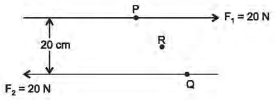
(a) point P
(b) point Q
(c) about point R which is exactly in the middle of P and Q.
(a) What do you understand by the term equilibrium of a body?
(b) State the condition when a body is in (i) dynamic equilibrium (ii) static equilibrium. Support your answer with one example each.
(c) A body is acted upon by number of forces acting in different directions. State two conditions for a body to be in equilibrium.
(b) State the condition when a body is in (i) dynamic equilibrium (ii) static equilibrium. Support your answer with one example each.
(c) A body is acted upon by number of forces acting in different directions. State two conditions for a body to be in equilibrium.
(i) Write down the differences between centripetal force and centrifugal force.
(ii) A uniform metre scale of weight 50 gf, is balanced at 60 cm mark, when a weight of 15 gf is suspended at the 10 cm mark. Where must a weight 100 gf be suspended to balance the metre scale?
(iii)(a) State the law of moments.
(b) State the absolute units of the moment of force in CGS system and SI system.
(ii) A uniform metre scale of weight 50 gf, is balanced at 60 cm mark, when a weight of 15 gf is suspended at the 10 cm mark. Where must a weight 100 gf be suspended to balance the metre scale?
(iii)(a) State the law of moments.
(b) State the absolute units of the moment of force in CGS system and SI system.
Assertion (A): The position of the centre gravity of a body remains unchanged even when the body is deformed.
Reason (A): The centre of gravity of a freely suspended body always lies below the point of suspension
Reason (A): The centre of gravity of a freely suspended body always lies below the point of suspension
- ABoth A and R are true and R is the correct explanation of A.
- BBoth A and R are true but R is not the correct explanation of A.
- ✓Assertion is false but reason is true.
- DAssertion is true but reason is false.
Answer: C.
View full solution →Assertion (A): Actually, rotation is always produced by a pair of forces.
Reason (R): The pair of forces formed by the external force and the force of reaction is called a couple.
Reason (R): The pair of forces formed by the external force and the force of reaction is called a couple.
- ✓Both A and R are true and R is the correct explanation of A.
- BBoth A and R are true but R is not the correct explanation of A.
- CAssertion is false but reason is true.
- DAssertion is true but reason is false.
Answer: A.
View full solution →Two equal and unlike parallel forces of magnitude 16 N acting on a rigid body, such that moment of couple is 12 Nm. The arm of couple is
- A0.25m
- B0.50m
- ✓0.75m
- D0.85m
Answer: C.
View full solution →A force of 525 N produces a moment of force of 420 Nm. The shortest distance between the point of application of force and the turning point is
- A0.5M
- ✓0.8m
- C0.9m
- D1.2m
Answer: B.
View full solution →The moon revolving around the earth is in
- Astatic equilibrium
- ✓dynamic equilibrium
- Cneutral equilibrium
- Dnone of these
Answer: B.
View full solution →For the ___________ [stable/unstable) equilibrium of a body its centre of gravity must be as ___________ [high/low] as possible.
For a body moving in a circular path, a force is needed which acts as the ___________ [centripetal/centrifugal/fictious] force.
An aeroplane moves at a constant height is an example of ___________ [static/dynamic/neutral] equilibrun.
A physical balance works on the principle of ___________ [energy/motion/moments]
A ___________ [torque/couple/force] is always needed to produce rotation.
Generate a Forces : Turning Forces and Uniform Circular Motion paper free
Pick question groups from the list above, set marks and difficulty, and export a branded PDF with step-by-step answer keys. First 3 chapters free — no signup.