Question 15 Marks
(i) Write down the differences between centripetal force and centrifugal force.
(ii) A uniform metre scale of weight 50 gf, is balanced at 60 cm mark, when a weight of 15 gf is suspended at the 10 cm mark. Where must a weight 100 gf be suspended to balance the metre scale?
(iii)(a) State the law of moments.
(b) State the absolute units of the moment of force in CGS system and SI system.
(ii) A uniform metre scale of weight 50 gf, is balanced at 60 cm mark, when a weight of 15 gf is suspended at the 10 cm mark. Where must a weight 100 gf be suspended to balance the metre scale?
(iii)(a) State the law of moments.
(b) State the absolute units of the moment of force in CGS system and SI system.
Answer
View full question & answer→(i) Centripetal force is directed towards the centre of rotating body along the radius, whereas centrifugal force is directed away from the centre of rotating body along the radius.
Centripetal force and centrifugal force act on two different bodies. For example, when a stone attached to a string is whirled, the centripetal force acts on the stone, whereas centrifugal force acts on the hand
(ii)
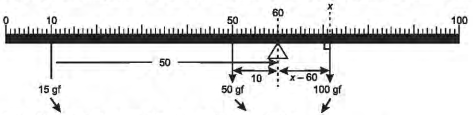
Let $x$ be the point where 100 gf weight is suspended.
Anticlockwise moment $=15 gf \times 50 cm+50 gf \times 10 cm=1250 gfcm$.
Clockwise moment $=100 gf (x-60 cm)=100 \times gf -6000 gfcm$"
$\therefore$ By the law of moments,
$100 x gf -6000 gfcm =1250 gfcm$
$\Rightarrow \quad 100 \times gf =7250 gfcm$
$\therefore x=\frac{7250}{100}=72.50 cm$.
(iii) (a) When number of forces are acting on a body, such that body is in equilibrium, then sum total moments of forces in clockwise direction is equal to sum total of anticlockwise moment of forces.
(b) The unit of moment of force in CGS system is dyne-em and the SI unit of moment of force is Nm.
Centripetal force and centrifugal force act on two different bodies. For example, when a stone attached to a string is whirled, the centripetal force acts on the stone, whereas centrifugal force acts on the hand
(ii)
Let $x$ be the point where 100 gf weight is suspended.
Anticlockwise moment $=15 gf \times 50 cm+50 gf \times 10 cm=1250 gfcm$.
Clockwise moment $=100 gf (x-60 cm)=100 \times gf -6000 gfcm$"
$\therefore$ By the law of moments,
$100 x gf -6000 gfcm =1250 gfcm$
$\Rightarrow \quad 100 \times gf =7250 gfcm$
$\therefore x=\frac{7250}{100}=72.50 cm$.
(iii) (a) When number of forces are acting on a body, such that body is in equilibrium, then sum total moments of forces in clockwise direction is equal to sum total of anticlockwise moment of forces.
(b) The unit of moment of force in CGS system is dyne-em and the SI unit of moment of force is Nm.