Questions

[2 Mark Question Answer]

🎯

Test yourself on this topic

17 questions · timed · auto-graded

Question 12 Marks
Answer
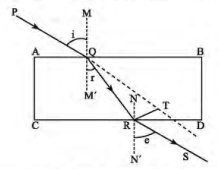
(b) $\angle i=\angle e$ (c) PQ and RS (d) RT (e) Angle of incidence ( $\angle i$ )
View full question & answer
Question 22 Marks
Answer
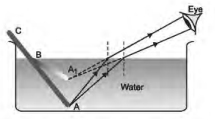
Consider a stick $A C$, immersed obliquely in water, such that part $A B$ of the stick is within water. Consider a point A on the tip of the stick. A divergent beam starting from it, after refraction will bend away from the normal. When this refracted beam reaches the eye, the eye retraces back a straight-line path. Thus, the rays appear to come from point $A _1$, which is higher than A . This is true for all other point between A and B. Thus, on the whole, the stick appears bent and short within water.
View full question & answer
Question 32 Marks
Why does the sky appear blue on the earth, but black on the moon?
Answer
The blue light due to its short wavelength, is scattered more in the atmosphere as compared to red light of long wavelength. Thus, light reaching us from all other directions is the scattered blue light. Therefore, the sky, appears blue. On the moon, there is no atmosphere. Thus, sunlight does not get scattered, and hence the sky appears dark.
View full question & answer
Question 42 Marks
What do you understand by the term "scattering of light"? Which colour of white light is scattered the least and why?
Answer
Scattering : When an incident light strikes a particle which has a diameter greater than the wavelength of incident light, then the incident light is absorbed by the particle and then transmitted in all possible directions. This phenomenon is called scattering of light. Red colour of light is scattered the least because of its longer wavelengths.
View full question & answer
Question 52 Marks
(a) Define the term dispersion of light.
(b) Explain the cause of dispersion of white light through a prism.
Answer
(a) The phenomenon due to which white light splits up into seven colours on passing through a prism is called dispersion of light.
(b) White light is made of seven colour bands (VIBGYOR), such that the rays in each band have different wavelength and different frequencies. When the white light is incident on the refracting face of the prism each coloured ray deviates through different angle, depending upon its wavelength. The red rays deviate least, whereas the violet waves deviate most. It is this differential deviation of rays, which causes dispersion.
View full question & answer
Question 62 Marks
Define the following with respect to converging lens
(a) Principal axis
(b) Focal length
(c) Optical centre
Answer
(a) Principal axis : An imaginary line joining the centres of curvature $C _1$ and $C _2$ of two spherical surfaces of the lens is called principal axis.
(b) Focal length : The distance of the first focal point from the optical centre of the lens is called focal length of the lens.
(c) Optical centre : It is a point on the principal axis, within the lens, such that a ray of light passing through this point emerges parallel to its direction of incidence
View full question & answer
Question 72 Marks
$(a)$ State the nature of the lens and the focal length if its power is $+4 D .$
$(b)$ The focal length of a concave lens is $10 \ cm$ . Calculate its power.
Answer
$(a) P =+4 D , \therefore$ the lens is convex.
$P=\frac{100}{f(in \ cm)}$
$\Rightarrow f=\frac{100}{P}=\frac{100}{+4}=25 \ cm$
$(b) f=-10 \ cm $ ( $\because$ The lens is concave$)$
$P=\frac{100}{f(\text { in } \ cm)}=\frac{100}{-10}=-10 D$
View full question & answer
Question 82 Marks
A convex lens forms a 2.5 times magnified virtual image when an object is placed at a distance of 8 cm from the lens. Calculate
(a) the distance of the image from the lens
(b) the focal length of lens.
Answer
(a) Given, $m=2.5 ; u=-8 cm$ ( $\because u$ is always negative)
$m=\frac{V}{n} \Rightarrow V=m \times u=2.5 \times-8=-20 cm \quad(\because$ image is virtual)
(b) Again, $\frac{1}{f}=\frac{1}{V}-\frac{1}{u}=\frac{1}{-20}-\frac{1}{-8}=\frac{-2+5}{40}=\frac{3}{40}$
$\Rightarrow f-\frac{40}{3}=13.3 cm$
View full question & answer
Question 92 Marks
A convex lens of focal length 10 cm is placed at a distance of 60 cm from a screen. How far from the lens should be placed an object so as to obtain a real image on the screen? Calculate the magnification of the image and its characteristics.
Answer
Given, $f=10 cm ; V=60 cm$
Let, $u=x$
Applying, $\frac{1}{V}-\frac{1}{u}=\frac{1}{f}$
$\Rightarrow \frac{1}{u}=\frac{1}{V}-\frac{1}{f} \Rightarrow \frac{1}{x}=\frac{1}{60}-\frac{1}{10}=-\frac{5}{60} \Rightarrow x=-\frac{60}{5}=-12 cm$
$\therefore u=-12 cm$. So the object should be 12 cm from the lens.
Magnification, $m=\frac{V}{u}=\frac{60}{-12}=-5$.
The image is real, inverted and enlarged.
View full question & answer
Question 102 Marks
Why does diamonds sparkle for sometimes in the dark?
Answer
Critical angle for diamond is $24^{\circ}$, for the ray of light travelling from diamond to air. Moreover, the diamonds are usually cut at very sharp angles, such that once a ray of bight enters into it, it surfers a series of total invernal reflections. When the angle of incidence at any face is less than $24^{\circ}$, the light emerges out from it and as a whole the diamond appears to be bright. Thus, the ray on entering a cut diamond, gets trapped within it for some time and causes it to sparkle in the dark.
View full question & answer
Question 112 Marks
(a) What do you understand by the statement, "critical angle for water is $48^{\circ}$ ?
(b) State two conditions for total internal reflection.
Answer
(a) Critical angle for water is $48^{\circ}$, means, the rays of light travelling in water, when strike the water-air surface at an angle of $48^{\circ}$, then angle of refraction is $90^{\circ}$.
(b) Two conditions for total internal reflection:
(i) Rays of light must travel from an optically denser medium to an optically rarer modium.
(ii) The angle of incidence in optically denser medium must be greater than the critical angle.
View full question & answer
Question 122 Marks
(a) What do you understand by the term lateral displacement?
(b) State three factors which determine lateral displacement.
Answer
(a) The perpendicular shift in the path of the incident ray, while emerging out from an optical slab is called lateral displacement.
(b) The three factors that determine the lateral displacement are:
(i) thickness of the optical slab
(ii) refractive index of the material of the slab
(iii) wavelength of light.
View full question & answer
Question 132 Marks
(a) State the laws of refraction.
(b) What do you understand by the statement that refractive index of water is $1.33 ?$
Answer
(a) First law of refraction : The ratio between the values of the sine of angle of incidence and the sine of angle of refraction for two given optical media is a constant quantity.
Second law of refraction : The incident ray, the refracted ray and the normal lie in the same plane at the point of incidence.
(b) Refractive index of water is 1.33 means that the speed of light in vacuum or air is 1.33 times of speed of water.
View full question & answer
Question 142 Marks
(a) What do you understand by the term refraction of light?
(b) How does the light deviate when it travels from :
(i) a rarer to a denser medium
(ii) a denser to a rarer medium?
Answer
(a) Refraction : The phenomenon, due to which a ray of light deviates from its original path, while travelling from one optical medium to another optical medium is called refraction.
(b) (i) When light travels from a rarer to a denser medium, it bends towards the normal, drawn at the point of incidence.
(ii) When light travels from a denser to a rarer medium, it bends away from the normal.
View full question & answer
Question 152 Marks
(a) How is the refractive index of a material related to:
(i) real and apparent depth?
(ii) velocity of light in vacuum or air and the velocity of light in a given medium?
(b) State the conditions required for total internal reflection of light to take place.
Answer
(a) (i) Refractive index $=\frac{\text { Real depth }}{\text { Apparent depth }}$.
(ii) Refractive index $=\frac{\text { Velocity of light in vacuum or air }}{\text { Velocity of light in a given medium }}$.
(b) (i) The ray of light must travel from denser medium, towards the rarer medium.
(ii) The angle of incidence in denser medium should be more than the critical angle of denser medium.
View full question & answer
Question 162 Marks
(a) Write a relationship between the angle of incidence and the angle of refraction for a given pair of media.
(b) When a ray of light enters from one medium to another medium having different optical density, it bends. Why does this phenomenon occur?
(c) Write a condition where it does not bend when entering a medium of different optical density.
Answer
(a) Refractive index $(\mu)=\frac{\sin i}{\sin r}$.
(b) It is because the velocity of light changes while moving from one medium to another medium, when the light is incident at the surface of separation obliquely.
(c) When the rays of light strike the surface of separation of two media at $90^{\circ}$, it does not suffer any refraction.
View full question & answer
Question 172 Marks
(a) Name one factor that affects the lateral displacement of light as it passes through a rectangular glass block.
(b) The speed of light in glass is $2 \times 10^5 km / s$. What is the refractive index of glass?
Answer
(a) Lateral displacement increases with the increase in width of glass slab and the angle of incidence of light on the glass slab.
(b) Refractive index of glass $=\frac{\text { Speed of light in air }}{\text { Speed of light in glass }}=\frac{3 \times 10^5 km / s }{2 \times 10^5 km / s }=1.5$.
View full question & answer
[2 Mark Question Answer] - Physics STD 10 Questions - Vidyadip