Write the names of all the components of electromagnetic spectrum in the order of increasing frequency.
Question types
Light question types
74 questions across 6 question groups — pick any mix to generate a Physics paper with step-by-step answer keys.
74
Questions
6
Question groups
5
Question types
01
[1 Mark Question Answer]
5 Q→02[2 Mark Question Answer]
17 Q→03[3 Mark Question Answer]
7 Q→04[5 Mark Question Answer]
10 Q→05MCQ
30 Q→06fill in the blanks.
5 Q→Sample Questions
Light questions
One sample from each question group in this chapter. Select any group above to see the full set with answer keys.
View full solution →
A stone placed at the bottom of a water tank appears raised by 80 cm . If the refractive index of water is $4 / 3$, find the actual depth of water in the tank.
View full solution →The angle of refraction in a glass block of refractive index $1.5$ is $19^{\circ}$. Calculate the angle of incidence.
View full solution →(a) Define critical angle.
(b) State one important factor which affects the critical angle of a given medium.
(b) State one important factor which affects the critical angle of a given medium.
(a) Define refractive index of a medium in terms of velocity of light.
(b) Can the absolute refractive index of a medium be less than one?
(b) Can the absolute refractive index of a medium be less than one?
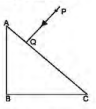
PQ is a ray of light incident on a rectangular glass slab. A student traces the path of ray which is refracted at the both the surfaces of the glass slab and finally emerges from slab as shown in the figure.
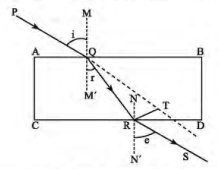
Complete the table, using the labels from the figure. The first label is done for you.
View full solution →Complete the table, using the labels from the figure. The first label is done for you.
| S.No | Description | Label |
| (a) | The refractive index of glass | $\sin i / \sin r$ |
| (b) | Relation between angles i and e | |
| (c) | Two rays which are parallel to each other | |
| (d) | Lateral displacement between the emergent ray and incident ray. | |
| (e) | State one factor which affects the lateral displacement |
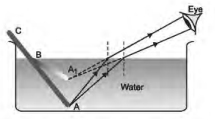
Why does the sky appear blue on the earth, but black on the moon?
What do you understand by the term "scattering of light"? Which colour of white light is scattered the least and why?
(a) Define the term dispersion of light.
(b) Explain the cause of dispersion of white light through a prism.
(b) Explain the cause of dispersion of white light through a prism.
(a) What are infrared rays. What is the range of wavelengths of infrared rays in $A$ ?
(b) State four important properties and four uses of infrared rays.
View full solution →(b) State four important properties and four uses of infrared rays.
(a) What is ultraviolet spectrum? What is the range of its wavelengths in $A$ ?
(b) Stale four important properties of ultraviolet rays.
(c) State four uses of ultraviolet rays.
View full solution →(b) Stale four important properties of ultraviolet rays.
(c) State four uses of ultraviolet rays.
Briefly describe an experiment to show that a prism itself produces no colour, during disperssion of white light.
(a) What do you understand by the term lens?
(b) What are the various kinds of lenses? Draw a neat diagram of each kind.
(b) What are the various kinds of lenses? Draw a neat diagram of each kind.
State four differences between reflection and total internal reflection.
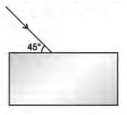
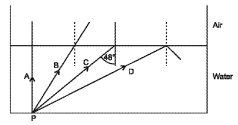
$(i) \ (a)$ A ray of light falls normally on a rectangular glass slab. Draw a ray diagram showing the path of the ray till it emerges out of the slab.
$(b)$ Where should an object be placed in front of a convex lens in order to get a real and enlarged image?
$(ii) \ (a)$ A lens of focal length $20 \ cm$ forms an inverted image at a distance $60 \ cm$ from the lens. Identify the lens and how far is the lens present in front of the object?
$(b)$ During the day why does the clouds appear white?
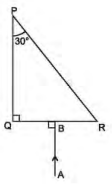
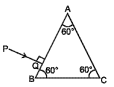
$(iii)$ Complete the path of the ray $AB$ through the glass prism in $\text{PQR}$ till it emerges out of the prism. Given the critical angle of the glass as $42^{\circ}$,
View full solution →$(b)$ Where should an object be placed in front of a convex lens in order to get a real and enlarged image?
$(ii) \ (a)$ A lens of focal length $20 \ cm$ forms an inverted image at a distance $60 \ cm$ from the lens. Identify the lens and how far is the lens present in front of the object?
$(b)$ During the day why does the clouds appear white?
$(iii)$ Complete the path of the ray $AB$ through the glass prism in $\text{PQR}$ till it emerges out of the prism. Given the critical angle of the glass as $42^{\circ}$,
(i) (a) State the laws of refraction of light.
(b) Write a relation between the angle of incidence ( $i$ ), angle of emergence (e), angle of prism ( $A$ ) and angle of deviation (D) for a ray of light passing through an equilateral prism.
(ii) (a) Suggest one way, in each case, by which we can detect the presence of:
1. Infrared radiations
2. Ultraviolet radiations.
(b) Give one use of infrared radiations.
View full solution →(b) Write a relation between the angle of incidence ( $i$ ), angle of emergence (e), angle of prism ( $A$ ) and angle of deviation (D) for a ray of light passing through an equilateral prism.
(ii) (a) Suggest one way, in each case, by which we can detect the presence of:
1. Infrared radiations
2. Ultraviolet radiations.
(b) Give one use of infrared radiations.
Assertion (A): Total internal reflection occurs only when a ray of light passes from a denser medium to a rarer medium. Reason (A): Critical angle is the angle of incidence in a denser medium for which the angle of refraction in rarer medium is $90^{\circ}$
- ABoth A and R are true and R is the correct explanation of A.
- ✓Both A and R are true but R is not the correct explanation of A
- CAssertion is false but reason is true
- DAssertion is true but reason is false.
Answer: B.
View full solution →Assertion (A): When a ray of light passes from one medium to another medium, its frequency changes.
Reason (A): The frequency of light depends on the source of light.
Reason (A): The frequency of light depends on the source of light.
- ABoth A and R are true and R is the correct explanation of A.
- BBoth A and R are true but R is not the correct explanation of A
- ✓Assertion is false but reason is true
- DAssertion is true but reason is false.
Answer: C.
View full solution →A lens forms the image of an object placed at a distance 15 cm from it, at a distance 60 cm in front of it. The focal length of the lens is
- A10 cm
- B15 cm
- ✓12 cm
- D25 cm
Answer: C.
View full solution →A ray of light bends while passing from one transparent medium to another medium having different refractive indices. If the second medium is denser than first medium, then how does frequency change?
- AIncreases
- BDecreases
- ✓Remains same
- DNone of these
Answer: C.
View full solution →Figure above allows a source of light S, placed at the bottom a trough containing water. Name the phenomenon exhibit by ray $C$ is
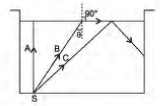
- AReflection
- BRefraction
- ✓Total internal reflection
- Dnone of these
Answer: C.
View full solution →Total internal reflection occurs only when a ray of light passes from a ___________ [rarer/denser] medium to a ___________ [rarer/denser] medium.
For an object placed at a distance 30 cm in front of a convex lens, the image is at a distance 30 cm behind the lens. The focal length of the convex lens is ___________ [ $30 cm / 20 cm / 15 cm]$.
View full solution →The focal length of a thin convex lens is ___________ [less than/more than/equal to] that of a thick convex lens.
The critical angle for glass-air interface is ___________ $\left[48^{\circ} / 45^{\circ} / 42^{\circ}\right]$
View full solution →When light travels from a rarer to a denser medium, its speed ___________ [increases/decreases/does not change].
Generate a Light paper free
Pick question groups from the list above, set marks and difficulty, and export a branded PDF with step-by-step answer keys. First 3 chapters free — no signup.