Question 15 Marks
View full question & answer→Questions
[5 Mark Question Answer]
🎯
Test yourself on this topic
10 questions · timed · auto-graded
Question 25 Marks
View full question & answer→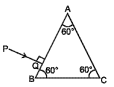
Question 35 Marks
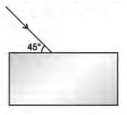
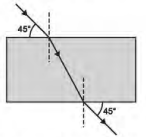
$(i) \ (a)$ A ray of light falls normally on a rectangular glass slab. Draw a ray diagram showing the path of the ray till it emerges out of the slab.
$(b)$ Where should an object be placed in front of a convex lens in order to get a real and enlarged image?
$(ii) \ (a)$ A lens of focal length $20 \ cm$ forms an inverted image at a distance $60 \ cm$ from the lens. Identify the lens and how far is the lens present in front of the object?
$(b)$ During the day why does the clouds appear white?
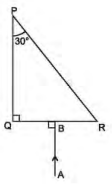
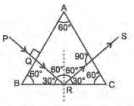
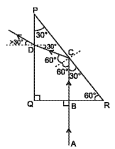
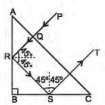
$(iii)$ Complete the path of the ray $AB$ through the glass prism in $\text{PQR}$ till it emerges out of the prism. Given the critical angle of the glass as $42^{\circ}$,
$(b)$ Where should an object be placed in front of a convex lens in order to get a real and enlarged image?
$(ii) \ (a)$ A lens of focal length $20 \ cm$ forms an inverted image at a distance $60 \ cm$ from the lens. Identify the lens and how far is the lens present in front of the object?
$(b)$ During the day why does the clouds appear white?
$(iii)$ Complete the path of the ray $AB$ through the glass prism in $\text{PQR}$ till it emerges out of the prism. Given the critical angle of the glass as $42^{\circ}$,
Answer
View full question & answer→$(i) \ (a)$
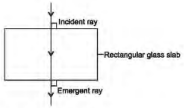
$(b)$ Object should be placed between centre of curvature and focal point of the convex lens.
$(ii) \ (a)$ Convex lens, because only convex lens can form an inverted image at a distance, more than its focal length.
$f=20 \ cm ($For convex lens$); V=60 \ cm ($For inverted image$); u= ?$
$\frac{1}{V}-\frac{1}{u}=\frac{1}{f}$
$\Rightarrow \frac{1}{u}=\frac{1}{V}-\frac{1}{f}=\frac{1}{60}-\frac{1}{20}=\frac{1-3}{60}=\frac{-2}{60}=\frac{-1}{30}$
$\therefore u=-30 \ cm$
Thus. lens is uresent at a distance of $30 \ cm$ in front of the obiect.
$(b)$ The clouds are nearer the earth's surface. They contain dust particles and aggregates of water molecules of size bigger than the wavelength of visible light, which scatter all colours of incident white light from the sun to the same extent. So, when the scattered light reaches our eyes, the clouds appear white.
$(iii)$
$(b)$ Object should be placed between centre of curvature and focal point of the convex lens.
$(ii) \ (a)$ Convex lens, because only convex lens can form an inverted image at a distance, more than its focal length.
$f=20 \ cm ($For convex lens$); V=60 \ cm ($For inverted image$); u= ?$
$\frac{1}{V}-\frac{1}{u}=\frac{1}{f}$
$\Rightarrow \frac{1}{u}=\frac{1}{V}-\frac{1}{f}=\frac{1}{60}-\frac{1}{20}=\frac{1-3}{60}=\frac{-2}{60}=\frac{-1}{30}$
$\therefore u=-30 \ cm$
Thus. lens is uresent at a distance of $30 \ cm$ in front of the obiect.
$(b)$ The clouds are nearer the earth's surface. They contain dust particles and aggregates of water molecules of size bigger than the wavelength of visible light, which scatter all colours of incident white light from the sun to the same extent. So, when the scattered light reaches our eyes, the clouds appear white.
$(iii)$
Question 45 Marks
(i) (a) State the laws of refraction of light.
(b) Write a relation between the angle of incidence ( $i$ ), angle of emergence (e), angle of prism ( $A$ ) and angle of deviation (D) for a ray of light passing through an equilateral prism.
(ii) (a) Suggest one way, in each case, by which we can detect the presence of:
1. Infrared radiations
2. Ultraviolet radiations.
(b) Give one use of infrared radiations.
(b) Write a relation between the angle of incidence ( $i$ ), angle of emergence (e), angle of prism ( $A$ ) and angle of deviation (D) for a ray of light passing through an equilateral prism.
(ii) (a) Suggest one way, in each case, by which we can detect the presence of:
1. Infrared radiations
2. Ultraviolet radiations.
(b) Give one use of infrared radiations.
Answer
View full question & answer→(i) (a) Snell's Law of Refraction : It states ;
The ratio between the values of the sine of angle incidence and the sine of angle of refraction for two given optical media is a constant quantity.
Thus, $\mu=\frac{\sin i}{\sin r}$
The constant quantity $\mu$ is refractive index.
(b) Angle of incidence ( $i$ ) + Angle of emergence (e) = Angle of prism (A) + Angle of deviation (D) $\Rightarrow \angle i+\angle e=\angle A +\angle D$
(ii) (a) 1. Mercury rises rapidly if a blackened bulb thermometer is kept in infrared radiations.
2. Photographic plates get exposed by ultraviolet radiation, even when wrapped in black paper.
(b) Infrared radiations are used in remote control of television and other gadgets.
The ratio between the values of the sine of angle incidence and the sine of angle of refraction for two given optical media is a constant quantity.
Thus, $\mu=\frac{\sin i}{\sin r}$
The constant quantity $\mu$ is refractive index.
(b) Angle of incidence ( $i$ ) + Angle of emergence (e) = Angle of prism (A) + Angle of deviation (D) $\Rightarrow \angle i+\angle e=\angle A +\angle D$
(ii) (a) 1. Mercury rises rapidly if a blackened bulb thermometer is kept in infrared radiations.
2. Photographic plates get exposed by ultraviolet radiation, even when wrapped in black paper.
(b) Infrared radiations are used in remote control of television and other gadgets.
Question 55 Marks
View full question & answer→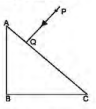
Question 65 Marks
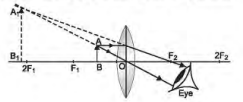
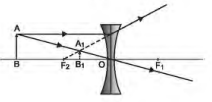
You are required to form an upright image of an object in case of (a) convex lens, (b) concave lens. What will be the position of the object with respect to the lens in each case? Support your answer by diagrams and state the characteristics of the image in each case.
Question 75 Marks
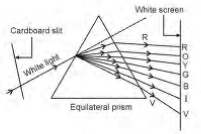
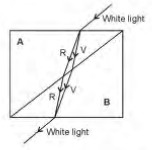
Draw a diagram showing the dispersion of white light. Can a glass slab disperse white light? If not, why?
Question 85 Marks
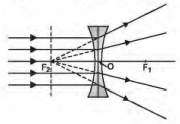
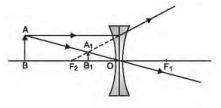
Draw neat diagrams for the formation of images in case of concave lens and state their characteristics when the object is:
(a) at infinity,
(b) anywhere between infinity and the optical centre
(a) at infinity,
(b) anywhere between infinity and the optical centre
Question 95 Marks
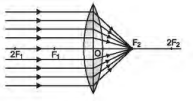
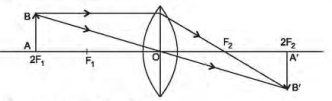
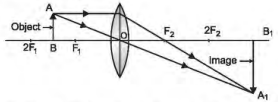
Draw neat diagrams for the formation of images in case of convex lens and state its characteristics when the object is :
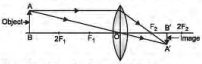
(a) At infinity (b) At 2 F (c) In between $F _1$ and $2 F_1$
View full question & answer→(a) At infinity (b) At 2 F (c) In between $F _1$ and $2 F_1$
Question 105 Marks
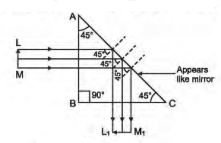
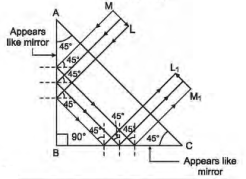
By drawing neat diagrams, explain how totally reflecting prisms are used to turn (a) rays through $90^{\circ}$, (b) rays through $180^{\circ}$.
View full question & answer→