Questions

MCQ

🎯

Test yourself on this topic

30 questions · timed · auto-graded

MCQ 11 Mark
Assertion (A): Total internal reflection occurs only when a ray of light passes from a denser medium to a rarer medium. Reason (A): Critical angle is the angle of incidence in a denser medium for which the angle of refraction in rarer medium is $90^{\circ}$
  • A
    Both A and R are true and R is the correct explanation of A.
  • Both A and R are true but R is not the correct explanation of A
  • C
    Assertion is false but reason is true
  • D
    Assertion is true but reason is false.
Answer
Correct option: B.
Both A and R are true but R is not the correct explanation of A
B
View full question & answer
MCQ 21 Mark
Assertion (A): When a ray of light passes from one medium to another medium, its frequency changes.
Reason (A): The frequency of light depends on the source of light.
  • A
    Both A and R are true and R is the correct explanation of A.
  • B
    Both A and R are true but R is not the correct explanation of A
  • Assertion is false but reason is true
  • D
    Assertion is true but reason is false.
Answer
Correct option: C.
Assertion is false but reason is true
C
View full question & answer
MCQ 31 Mark
A lens forms the image of an object placed at a distance 15 cm from it, at a distance 60 cm in front of it. The focal length of the lens is
  • A
    10 cm
  • B
    15 cm
  • 12 cm
  • D
    25 cm
Answer
Correct option: C.
12 cm
C
View full question & answer
MCQ 41 Mark
A ray of light bends while passing from one transparent medium to another medium having different refractive indices. If the second medium is denser than first medium, then how does frequency change?
  • A
    Increases
  • B
    Decreases
  • Remains same
  • D
    None of these
Answer
Correct option: C.
Remains same
View full question & answer
MCQ 51 Mark
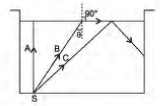
Figure above allows a source of light S, placed at the bottom a trough containing water. Name the phenomenon exhibit by ray $C$ is
Image
  • A
    Reflection
  • B
    Refraction
  • Total internal reflection
  • D
    none of these
Answer
Correct option: C.
Total internal reflection
View full question & answer
MCQ 61 Mark

Image
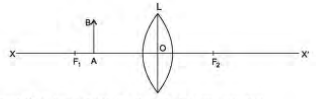
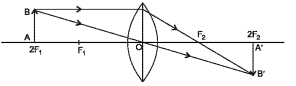
Object $AB$ is placed in front of the lens $L.$ Points $F_1, O$ and $F_2$ has usual meanings. Where will the image of object $AB$ form?
  • A
    On same side, before the object
  • On same side, behind the object
  • C
    On the other side, behind the focus
  • D
    On the other side, before the focus
Answer
Correct option: B.
On same side, behind the object
View full question & answer
MCQ 81 Mark
A total reflecting prism is used for the purposes
  • A
    to deviate a ray of light through $90^{\circ}$
  • B
    to deviate a ray of light through $180^{\circ}$
  • C
    to erect the inverted image without producing deviation in its path
  • all of these
Answer
Correct option: D.
all of these
View full question & answer
MCQ 91 Mark
While doing experiment a student placed an object at a distance of 30 cm in front of a convex lens with focal length of 20 cm. Image distance will be between
  • A
    20 cm and 40 cm
  • B
    10 cm and 20 cm
  • C
    30 cm and 40 cm
  • more than 40 cm
Answer
Correct option: D.
more than 40 cm
D
View full question & answer
MCQ 101 Mark
The device that has been used by a person to read small letters is a
  • convex lens
  • B
    concave lens
  • C
    prism
  • D
    convex mirror
Answer
Correct option: A.
convex lens
View full question & answer
MCQ 111 Mark
The wavelength range of white light is
  • 400 nm to 800 nm
  • B
    4000 nm to 8000 nm
  • C
    3000 nm to 7000 nm
  • D
    5000 nm to 8000 nm
Answer
Correct option: A.
400 nm to 800 nm
A
View full question & answer
MCQ 121 Mark
There is no loss of energy in the phenomenon of:
  • A
    reflection
  • B
    refraction
  • total internal reflection
  • D
    dispersion
Answer
Correct option: C.
total internal reflection
View full question & answer
MCQ 131 Mark
The apparent depth of a liquid in a vessel is 15 cm, when its real depth is 20 cm. Find the refractive index of the liquid.
  • A
    1.25
  • 1.33
  • C
    1.5
  • D
    None of these
Answer
Correct option: B.
1.33
B
View full question & answer
MCQ 141 Mark
A double convex lens of focal length 'f' is cut into two equal parts. The focal length of each part will be:
  • A
    $2f$
  • $f$
  • C
    $\frac{f}{2}$
  • D
    $0$
Answer
Correct option: B.
$f$
View full question & answer
MCQ 151 Mark
Samir obtained a sharp image of the grill of a window on a screen, using a convex lens. He then thought of focusing a distant building instead of the grill. What should he do to obtain clear image on screen?
  • A
    Keep lens behind the screen
  • Move lens towards the screen
  • C
    Move lens away from the screen
  • D
    Keep distance between lens and screen unchanged
Answer
Correct option: B.
Move lens towards the screen
View full question & answer
MCQ 161 Mark
A sharp image of a distant object is obtained on a screen by using a convex lens. In order to determine the focal length of the lens, you need to measure the distance between the:
  • A
    lens and the object
  • lens and the screen
  • C
    object and the screen
  • D
    both (a) and (b)
Answer
Correct option: B.
lens and the screen
B
View full question & answer
MCQ 171 Mark
The point on the principal axis of a thin lens, such that a ray of light directed towards it, passes undeviated through it, is called:
  • A
    focus
  • B
    centre of curvature
  • optical centre
  • D
    pole
Answer
Correct option: C.
optical centre
View full question & answer
MCQ 181 Mark
The critical angle for a given pair of media depends on:
  • A
    wavelength of light
  • B
    speed of light
  • C
    frequency of light
  • their refractive indices
Answer
Correct option: D.
their refractive indices
View full question & answer
MCQ 191 Mark
A stone placed at the bottom of a water tank appears raised by 80 cm. If the refractive index of water is 4/3, then the actual depth of water in the tank is:
  • 300 cm
  • B
    310 cm
  • C
    320 cm
  • D
    330 cm
Answer
Correct option: A.
300 cm
A
View full question & answer
MCQ 201 Mark
A glass block 3.0 cm thick is placed over a stamp. The refractive index of glass is 1.54. Then the height through which the image of stamp raised will be:
  • A
    1 cm
  • 1.06 cm
  • C
    1.5 cm
  • D
    1.45 cm
Answer
Correct option: B.
1.06 cm
B
View full question & answer
MCQ 211 Mark
The ratio of speeds of light of violet colour and red colour in vacuum is:
  • A
    2:1
  • B
    1:2
  • C
    2:3
  • 1:1
Answer
Correct option: D.
1:1
D
View full question & answer
MCQ 231 Mark
A convex lens will form a virtual, erect and enlarged image, when object is:
  • A
    in between $2 F_1$ and $F _1$
  • B
    at $2 F_1$
  • C
    in between $2 F_1$ and infinity
  • in between $F_1$ and ontical centre
Answer
Correct option: D.
in between $F_1$ and ontical centre
View full question & answer
MCQ 241 Mark
A lens forms an inverted image of an object equal to its own size. The object is:
  • A
    Beyond infinity and $2 F_1$
  • At $2 F_1$
  • C
    Between $2 F_1$ and $F _1$
  • D
    In between $2 F_1$ and optical centre
Answer
Correct option: B.
At $2 F_1$
View full question & answer
MCQ 251 Mark
The point on the principal axis of a convex lens, such that rays of light starting from it on passing through the lens move parallel to the principal axis is called:
  • First focal point
  • B
    Second focal point
  • C
    Optical centre
  • D
    Aperture of lens
Answer
Correct option: A.
First focal point
View full question & answer
MCQ 261 Mark
When an equilateral prism is in minimum deviation position the angle of incidence is:
  • A
    greater than angle of emergence
  • B
    smaller than the angle of emergence
  • equal to the angle of emergence
  • D
    none of these
Answer
Correct option: C.
equal to the angle of emergence
View full question & answer
MCQ 271 Mark
The velocity of light in air is $3 \times 10^8 ms^{-1}$ and in glass $2 \times 10^8 ms^{-1}$. The refractive index of glass is :
  • A
    0.67
  • 1.5
  • C
    1.33
  • D
    1.25
Answer
Correct option: B.
1.5
B
View full question & answer
MCQ 281 Mark
During spear fishing a fisherman aims at the:
  • tail of fish
  • B
    head of fish
  • C
    slightly ahead of the head of the fish
  • D
    none of these
Answer
Correct option: A.
tail of fish
View full question & answer
MCQ 291 Mark
During sunrise or sunset, the sun appears bigger because the rays of light coming from it pass through:
  • larger length of the atmosphere
  • B
    smaller length of the atmosphere
  • C
    the earth gets closer to the sun
  • D
    none of these
Answer
Correct option: A.
larger length of the atmosphere
View full question & answer
MCQ 301 Mark
A ray of light strikes a glass slab at $90^\circ $. The angle of incidence is:
  • A
    $90^{\circ}$
  • zero degree
  • C
    less than $90^{\circ}$, but not zero
  • D
    none of these
Answer
Correct option: B.
zero degree
View full question & answer
MCQ - Physics STD 10 Questions - Vidyadip