Questions

[2 Mark Question Answer]

🎯

Test yourself on this topic

41 questions · timed · auto-graded

Question 12 Marks
Two waves A and B have wavelength 0.01 Å and 9000 Å respectively.
Name the two waves. compare the speeds of these waves when they travel in vacuum.
Answer
Waves A are Gamma radiations.
Waves B are infrared radiations.
In vacuum, both travel with the same speed. Hence, the ratio of their speeds is 1:1.
View full question & answer
Question 22 Marks
Give two properties of ultraviolet radiations which differ from the visible light.
Answer
Two properties of ultraviolet radiation different from the visible light:
1. Ultraviolet radiation can pass through quartz, but they are absorbed by glass.
2. They are usually scattered by the dust particles present in the atmosphere.
View full question & answer
Question 32 Marks
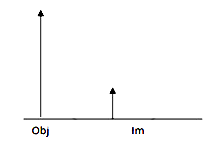
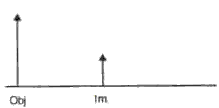
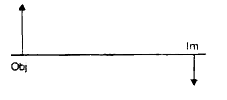
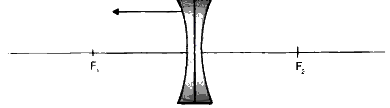
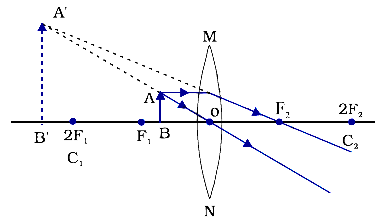
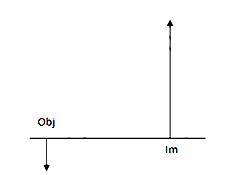
In the following diagram , the object and the image formed by the respective lenses are shown. Complete the ray diagram, and locate the focus. Find the focal length of the lens.
View full question & answer
Question 42 Marks
In the following diagram , the object and the image formed by the respective lenses are shown. Complete the ray diagram, and locate the focus. Find the focal length of the lens.
View full question & answer
Question 52 Marks
In the following diagram ., the object and the image formed by the respective lenses are shown. Complete the ray diagram, and locate the focus. Find the focal length of the lens.
Image

View full question & answer
Question 62 Marks
In the following diagram ., the object and the image formed by the respective lenses are shown. Complete the ray diagram, and locate the focus. Find the focal length of the lens.
View full question & answer
Question 72 Marks
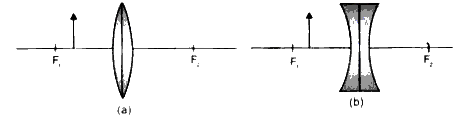
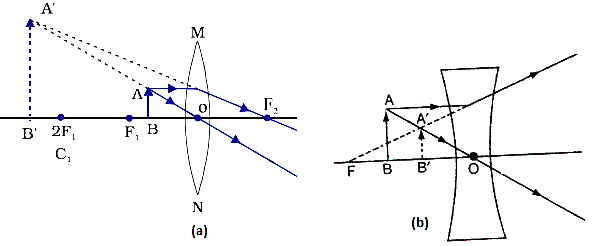
An object is placed in front of a converging lens and in front of a diverging lens as in fig.

(a)Complete the ray diagram to obtain an image.
(b)Compare the nature of image formed by both the lenses in the above case.
Answer
(a)

(b) In both the cases the image formed is virtual, upright and on the same side of the lens but the image formed by a convex lens is magnified and that formed by a concave lens is diminished.
View full question & answer
Question 82 Marks
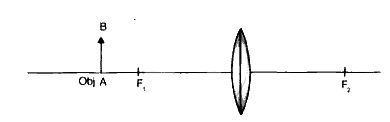
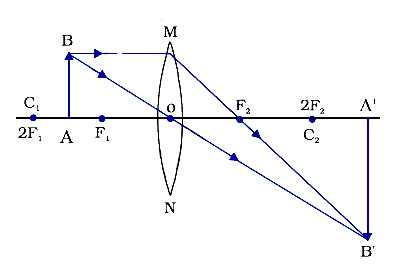
An object AB is placed in front of a convex lens as shown in fig. 4. Complete the ray diagram and obtain the image formed and state the nature of the image.
Answer
Nature of image: Real, inverted and magnified.
View full question & answer
Question 102 Marks
(a) What type of a lens can be used as a magnifying glass?
(b) Show by a ray diagram the formation of a real image by simple magnifying lens.
Answer
(a) A convex lens with short focal length can be used as a magnifying glass.
(b) A simple magnifying glass forma a virtual, erect and magnified image of a tiny object which is distinctly seen by the eye because the eye lens converges the rays to form a real image on the retina.

Ray diagram for the formation of image by a magnifying glass. 
View full question & answer
Question 112 Marks
Name the radiations of wavelength
(i) Longer than $8 x 10 ^{-7}m$
(ii) shorter than $4 x 10 ^{-7}m.$
Answer
(i) Ultra-violet radiation
(ii) Infra-red radiation
View full question & answer
Question 122 Marks
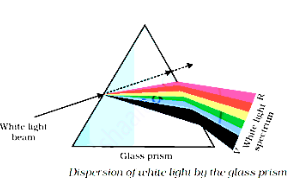
What is a spectrum? Draw a labeled ray diagram to show the formation of spectrum of white light.
Answer
The colour band obtained on a screen on passing white light through a prism is called teh spectrum.
Image
View full question & answer
Question 132 Marks
The wavelengths for the light of red and blue colours are roughly $7 X 10^{-7}m$ and $4 X 10^{-7} m$ respectively. Which colour has the greater speed in vacuum? Which colour has the greater speed in glass?
Answer
In vacuum both the colours have the same speed.
In glass, red colour has a greater speed.
View full question & answer
Question 142 Marks
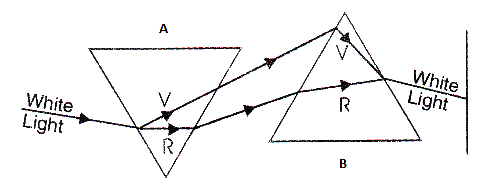
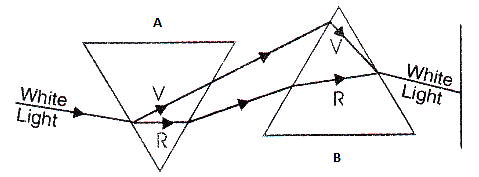
Complete the ray diagram given below to show the nature of light produced on the screen.
The completed ray diagram is as shown below :
Answer
The completed ray diagram is as shown below :
View full question & answer
Question 152 Marks
Draw another diagram to show how the colours of spectrum of white light can be combined to give the effect of white light.
View full question & answer
Question 172 Marks
State any two ways of increasing the frequency of vibration of a stretched string.
Answer
Frequency of vibration of a stretched string can be increased by:
1. By increasing the tension in the string.
2. By decreasing the length of the string.
View full question & answer
Question 182 Marks
Show by a diagram the refraction of two incident rays parallel to the principle axis passing through a convex lens by treating it as a combination of a glass block and two triangular glass prisms.
View full question & answer
Question 192 Marks
Define the term focal length of a lens.
Answer
Focal length of a lens: Rays of light can pass through the lens in any direction and hence there will be two focal lengths on either side of the lens and they are referred to as the first focal length and the second focal length of a lens:
(i) First focal length: The distance from the optical centre of the lens to its first focal point is called the first focal length $\left(f_1\right)$ of the lens.
(ii) Second focal length: The distance from the optical centre of the lens to its second focal point is called the second focal length $\left( f _2\right)$ of the lens.
View full question & answer
Question 202 Marks
Draw neat diagram to show the
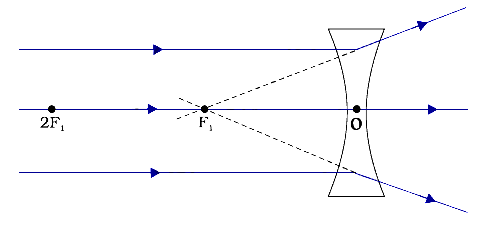
Divergent action of concave lens
Answer
Diagram showing divergent action of concave lens:
View full question & answer
Question 212 Marks
Draw neat diagram to show the
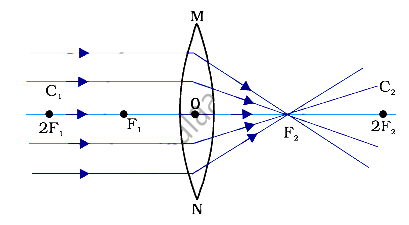
Convergent action of a convex lens,
Answer
Diagram showing convergent action of convex lens :
View full question & answer
Question 222 Marks
State two main differences between a convex and concave lens.
Answer
Convex lens Concave lens
1. A convex lens is thicker in the middle and thinner at its edges. 1. A concave lens is thicker at the edges and thinner in the middle.
2. A light beam converges on passing through a convex lens. 2. A light beam diverges on passing through a concave lens.
View full question & answer
Question 232 Marks
Show by a diagram, the refraction of two incident rays parallel to the principle axis passing through a concave lens by treating it as a combination of a glass block and two triangular glass prisms.
View full question & answer
Question 242 Marks
The power of a lens is +2.0 D. Find its focal length and state what kind of lens it is.
Answer
$ \begin{aligned} & \text { Focal length (in metres) }=\frac{1}{\text { power(in dioptres) }} \\ & \text { Focal length (in metres) }=\frac{1}{2}=0.5 \mathrm{~m}=50 \mathrm{~cm} \end{aligned} $
Since, the focal length is positive, the lens is aconvex lens. 
View full question & answer
Question 252 Marks
Express power of a concave lens of focal length 50 cm with its sign.
Answer
$ \text { Power }=\frac{1}{\text { focal length (in metres) }} $
Now, a concave lens has a virtual focal length $; \backslash f=-50 \mathrm{~cm}$ Power $=\frac{100}{-50}=-2 \mathrm{D}$
Powerof a concave lens is negative and the power is $-2 \mathrm{D}$.
View full question & answer
Question 262 Marks
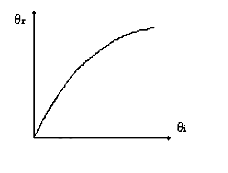
Plot a graph between
Angle of incidence versus angle of refraction.
Answer
Angle of incidence vs. angle of refraction graph :
View full question & answer
Question 272 Marks
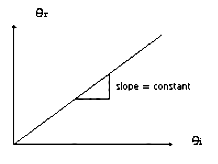
Plot a graph between
Angle of incidence versus angle of reflection,
Answer
Angle of incidence vs. angle of reflection graph :
View full question & answer
Question 282 Marks
What do you mean by the statement that the refractive index of diamond is 2.42?
Answer
This statement means that diamond is 2.42 times optically denser than air. Thevelocity of light in diamond is equal to $\frac{1}{2.42}$ times velocity of light in vacuum. Thus, $v_d=\frac{3 \times 10^8}{2.42}=1.24 \times 10^8 \mathrm{~m} / \mathrm{s}$.
View full question & answer
Question 292 Marks
A ray of light is incident normally on a plane glass slab. What will be the angle of refraction and the angle of deviation for the ray?
Answer
The ray of light which is incident normally on the surface separating the two media passes undeviated. Such ray suffers no bending, thus, angle of refraction and angle of deviation is $0^\circ. $
View full question & answer
Question 302 Marks
What is the cause of refraction of light?
Answer
When a ray of light passes from one medium to another, its direction (except for normal incidence) changes because of change in speed of light. Thus, refraction occurs because light travels with different speed in different media. 
View full question & answer
Question 312 Marks
State Snell'S Law.
Answer
Snell's law: The ratio of sine of the angle of incidence to the sine of angle of refraction is constant for a pair of media. This constant is called the refractive index of the second medium w.r.t the first. it is generally represented by the greek letter $(\mu)$
$ \text { i.e } \mu=\frac{\sin \mathrm{i}}{\sin \mathrm{r}} $
View full question & answer
Question 322 Marks
Name the factors on which the deviation produced by a prism depends.
Answer
The value of angle of deviation produced by a prism depends upon:
(i) The angle of incidence
(ii) The material of prism
(iii) The angle of prism
(iv) The colour of wavelength of light used.
View full question & answer
Question 332 Marks
The refractive index of water respect to air is $\frac{4}{3}$. calculate the refractive index of air with respect to water.
Answer
We know that,
$ \begin{aligned} & { }_a \mu_w=\frac{1}{{ }_w \mu_a} \\ & \therefore{ }_a \mu_w=\frac{1}{4 / 3}=\frac{3}{4} \end{aligned} $
View full question & answer
Question 342 Marks
State the principle of reversibility of light.
Answer
According to the principle of reversibility, the path of a light ray is reversible.
For e.g. if light travels from air to water along a certain path, then if the path is reversed while travelling from water to air, it will follow exactly the same path.
View full question & answer
Question 352 Marks
How is the refractive index of a medium related to the speed of light in it?
Answer
Refractive index $=\frac{\text { Speed of light in vacuum or air }}{\text { speed of light in that medium }}$
View full question & answer
Question 362 Marks
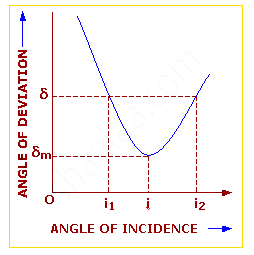
Draw an í- $\delta$ graph for a mono chromatic raY through a glass prism of a plane and mark
(i) $\delta \mathrm{m}$, the angle of mínimum devíation
(ii) Any two values of i for which value of $\delta$ is same.
Answer
Angle of íncídence vs angle of deviation graph for a prism
View full question & answer
Question 372 Marks
State two uses of a total reflecting prism as a reflector in place of a plane mirror.
Answer
Two advantages of using total reflecting prism as a reflector in place of a plane mirror are:
(i) When total internal reflection occurs, the entire light (100%) is reflected back into the denser medium, whereas in ordinary reflection from plane mirror, some light is refracted or absorbed (i.e. reflection is partial).
(ii) Total reflecting prism gives a much brighter image than that obtained by using the plane mirror.
View full question & answer
Question 382 Marks
What do you mean by the statement 'the critical angle for diamond is $24^0'?$
Answer
The critical angle for diamond is $24^o$​​​​​​​; this indicates that diamond has high refractive index of $2.42$. This low value of critical angle facilitates total internal reflection of each light ray entering the diamond at its multiple surfaces.
View full question & answer
Question 392 Marks
The critical angle for glass-air is $45^{\circ}$ for the light of yellow colour. State whether it will be less than, equal to, or more than $45^{\circ}$ for (i) red light, (ii) blue light?
Answer
The critical angle for a pair of media is:
(i) more than $45^o$​​​​​​​ for red light.
(ii) less than $45^o​​​​​​​$​​​​​​​ for blue light.
View full question & answer
Question 402 Marks
State two factors which affect the critical angle for a given pair of media.
Answer
Factors affecting the critical angle are:
(i) The colour (or wavelength) of light.
(ii) The temperature (on changing the temperature of medium, its refractive index changes).
View full question & answer
Question 412 Marks
Make the correct choices in the following items :
A lens used as a magnifying glass
(i) ls a diverging lens
(ii) Produces a virtual image
(iii) ls placed with the object nearer the lens than the principle focus
Answer

(ii) Produces a virtual image

(iii) ls placed with the object nearer the lens than the principle focus

View full question & answer
[2 Mark Question Answer] - Physics STD 10 Questions - Vidyadip