What type of lenses are used in spectacles worn by an old lady for knitting?
Question types
Light question types
121 questions across 6 question groups — pick any mix to generate a Physics paper with step-by-step answer keys.
121
Questions
6
Question groups
5
Question types
01
[1 Mark Question Answer]
34 Q→02[2 Mark Question Answer]
41 Q→03[3 Mark Question Answer]
23 Q→04[5 Mark Question Answer]
10 Q→05MCQ
12 Q→06fill in the blanks.
1 Q→Sample Questions
Light questions
One sample from each question group in this chapter. Select any group above to see the full set with answer keys.
View full solution →
What is meant by the power of accommodation produced?
Express nanometer (nm) in terms of Angstrom
If white light is used in same way what change is expected in the emergent beam?
If a monochromatic beam of light undergoes minimum deviation through an equiangular prism, how does the beam pass through the prism, with respect to its base?
Two waves A and B have wavelength 0.01 Å and 9000 Å respectively.
Name the two waves. compare the speeds of these waves when they travel in vacuum.
Name the two waves. compare the speeds of these waves when they travel in vacuum.
Give two properties of ultraviolet radiations which differ from the visible light.
In the following diagram , the object and the image formed by the respective lenses are shown. Complete the ray diagram, and locate the focus. Find the focal length of the lens.
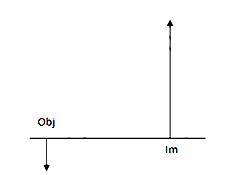
In the following diagram , the object and the image formed by the respective lenses are shown. Complete the ray diagram, and locate the focus. Find the focal length of the lens.
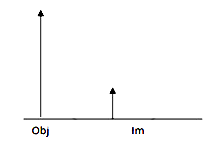
In the following diagram ., the object and the image formed by the respective lenses are shown. Complete the ray diagram, and locate the focus. Find the focal length of the lens.
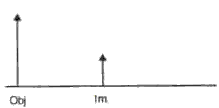
An electromagnetic wave has a frequency of 500 MHz and a wavelength of 60 cm. Calculate the velocity of the wave. Name the medium through which it is traveling.
Name three properties of ultraviolet radiations which are similar to visible light.
Mention three properties of infra red radiations similar to the visible light. Give two such properties of infrared radiations which are not true for visible light.
Fig. shows a ray of white light that passes through a prism and produces a spectrum.
(a) Name the phenomenon that is taking place.
(b) What colour would you see at X and Y?
(c) What radiation would you detect above X and below Y?
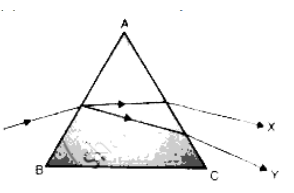
(a) Name the phenomenon that is taking place.
(b) What colour would you see at X and Y?
(c) What radiation would you detect above X and below Y?
Define critical angle and explain total internal reflection. What are the conditions necessary for total internal reflection?
What are ultraviolet radiations? How are they detected? State two properties and one use of ultraviolet radiations.
Fig shows part of the arrangement for obtaining pure spectrum.
(a) Complete thediagram and show how to obtain a pure spectrum.
(b) What are the conditions necessary for obtaining a pure spectrum?
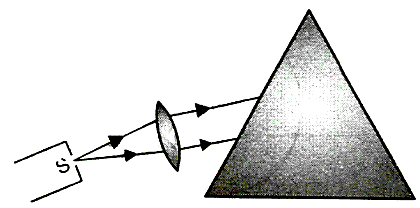
(a) Complete thediagram and show how to obtain a pure spectrum.
(b) What are the conditions necessary for obtaining a pure spectrum?
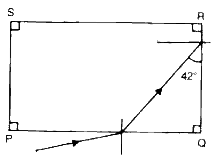
(a) A ray of monochromatic light enters glass $PQRS$ as shown in the fig. Complete the path of ray till it emerges from the glass. (Critical angle of glass is $42^0).$
(b) Draw diagram of a prism periscope.
(c) What are the advantages of total internal reflecting prism over plane mirror?
View full solution →(b) Draw diagram of a prism periscope.
(c) What are the advantages of total internal reflecting prism over plane mirror?
(a)A ray of light is incident at 45° on the face of
(i) A rectangular block of glass.
(ii) A $60^0$ glass prism.
(b) Draw a sketch showing how the ray of monochromatic ray of light passes through glass in each case.
(c) With the aid of a diagram, explain how the face of a right angled prism may totally reflect incident on it.
(d) A thick plane mirror produces several faint images in addition to a prominent one. Draw a ray diagram showing how reflection and refraction produce all these images.
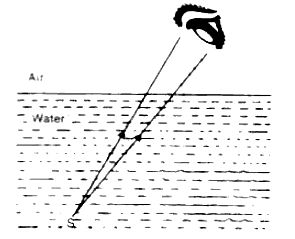
(e) Fig. represents a stone S at the bottom of a pond of water. Using the two rays, as shown, complete the ray diagram to show where the image of the stone appears when viewed from E.
(f) What is a''mirage'? Explain with the help of a diagram.
(g) A man observes the bottom of a swimming pool of $3 \ m$ depth. If the refractive index of water is $1.3,$ what is the apparent depth of water?
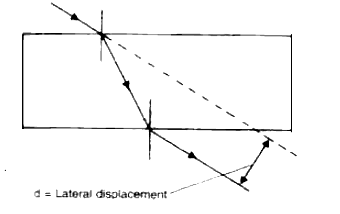
(h) When a ray of light undergoes refraction through a glass slab and when it emerges it is displaced laterally (Fig). What are the factors on which the lateral displacement depends?
(i) Fig. shows three rays of light $OA, OB$ and $OC$ passing from water to air, making angles $49^0, 41^0$ and $35^0$ with the horizontal surface respectively. Draw an approximate path of the emergent ray for each. (Critical angle of water is $49^0$.)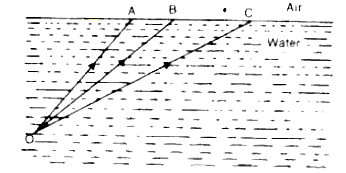
View full solution →(i) A rectangular block of glass.
(ii) A $60^0$ glass prism.
(b) Draw a sketch showing how the ray of monochromatic ray of light passes through glass in each case.
(c) With the aid of a diagram, explain how the face of a right angled prism may totally reflect incident on it.
(d) A thick plane mirror produces several faint images in addition to a prominent one. Draw a ray diagram showing how reflection and refraction produce all these images.
(e) Fig. represents a stone S at the bottom of a pond of water. Using the two rays, as shown, complete the ray diagram to show where the image of the stone appears when viewed from E.
(f) What is a''mirage'? Explain with the help of a diagram.
(g) A man observes the bottom of a swimming pool of $3 \ m$ depth. If the refractive index of water is $1.3,$ what is the apparent depth of water?
(h) When a ray of light undergoes refraction through a glass slab and when it emerges it is displaced laterally (Fig). What are the factors on which the lateral displacement depends?
(i) Fig. shows three rays of light $OA, OB$ and $OC$ passing from water to air, making angles $49^0, 41^0$ and $35^0$ with the horizontal surface respectively. Draw an approximate path of the emergent ray for each. (Critical angle of water is $49^0$.)
Fig. shows two rays of light Op and OQ coming from an object at the bottom of a pond, incident on the water surface.
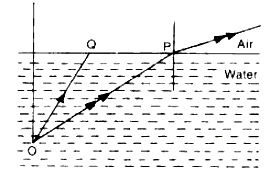
(a) Mark on the diagram
(i) The angle of incidence of ray OP,
(ii) The angle of refraction of ray Op,
(iii) The position of image of the object as seen from above.
(iv) An approximate path of the ray OQ.
(b) Explain, why do the rays of light change directions on passing from water to air.
(c) A fish in water sees everything outside the water by rays of light entering its eye in a small cone of light. Draw a diagram and explain how does this happen.
(a) Mark on the diagram
(i) The angle of incidence of ray OP,
(ii) The angle of refraction of ray Op,
(iii) The position of image of the object as seen from above.
(iv) An approximate path of the ray OQ.
(b) Explain, why do the rays of light change directions on passing from water to air.
(c) A fish in water sees everything outside the water by rays of light entering its eye in a small cone of light. Draw a diagram and explain how does this happen.
Make the correct choice for each of the following :Which one of the five diagrams represents the path of a ray of light through a periscope?
- A
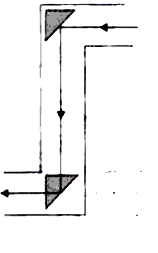
- B
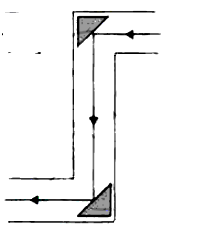
- ✓
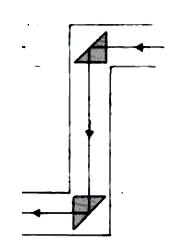
- D
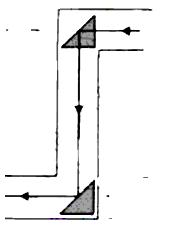
Answer: C.
View full solution →Make the correct choice for each of the following:
fig illustrates an experiment to determine the refractive index of glass. Which one of the following graphs would give a straight line through the origin?
fig illustrates an experiment to determine the refractive index of glass. Which one of the following graphs would give a straight line through the origin?
- A$\angle i$ plotted against $\angle r$.
- BSin i plotted against $\angle r$.
- ✓Sin i plotted against $\operatorname{Sin} r$
- D$\frac{1}{\angle \mathrm{i}}$ plotted against $\frac{1}{\angle \mathrm{r}}$
Answer: C.
View full solution →Make the correct for each of the following :
With reference to the fig, the refractive index of the glass block is
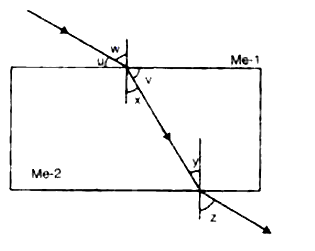
With reference to the fig, the refractive index of the glass block is
- A$\frac{\sin w}{\sin z}$
- B$\frac{\sin x}{\sin w}$
- C$\frac{\sin u}{\sin x}$
- ✓$\frac{\sin w}{\sin x}$
Answer: D.
View full solution →Make the correct choices for each of the following :
Total Internal reflection takes place when
(where ∠i = angle of incidence, ∠r = angle of refraction, ∠C = critical angle)
Total Internal reflection takes place when
(where ∠i = angle of incidence, ∠r = angle of refraction, ∠C = critical angle)
- ALight is going from glass to air and $\angle \mathrm{I}<\angle \mathrm{C}$
- BLight is going from air to glass and $\angle \mathrm{i}<\angle \mathrm{C}$
- ✓Light is going from glass to air and $\angle \mathrm{i}>\angle \mathrm{C}$
- DLight is going from air to glass and $\angle \mathrm{i}>\angle \mathrm{C}$
Answer: C.
View full solution →Make the correct choice for each of the following:
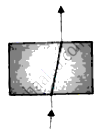
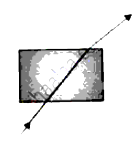
Which one of the following Fig correctly shows the path of the ray through the glass block?
Which one of the following Fig correctly shows the path of the ray through the glass block?
- A
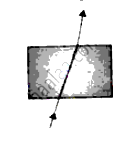
- B
- C
- ✓
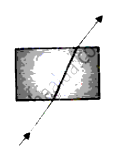
Answer: D.
View full solution →When light travels from a rarer to a denser medium, it bends ...........
Generate a Light paper free
Pick question groups from the list above, set marks and difficulty, and export a branded PDF with step-by-step answer keys. First 3 chapters free — no signup.