Questions

[5 Mark Question Answer]

🎯

Test yourself on this topic

10 questions · timed · auto-graded

Question 15 Marks
What are ultraviolet radiations? How are they detected? State two properties and one use of ultraviolet radiations.
Answer
The electromagnetic radiations of wavelength from 100 Å to 4000 Å are called the ultraviolet radiations.
Detection: If the different radiations from the red part of the spectrum to the violet end and beyond it are made incident on the silver-chloride solution, it is observed that from the red end to the violet, the solution remains almost unaffted. However just beyond the violet end, it first turns violet and finally it becomes dark brown (or black). thus, there exist certain radiations beyond the violet end of the spectrum, which are chemically more active than the visible light. Thses radiations are called the ultraviolet radiations.
Two properties of ultraviolet radiation:
1. Ultraviolet radiation can pass through quartz, but they are absorbed by glass.
2. They are usually scattered ny the dust particles present in the atmosphere.
one use of ultraviolet radiation:
in producing, Vitamin D, in food of plans and animals.
View full question & answer
Question 25 Marks
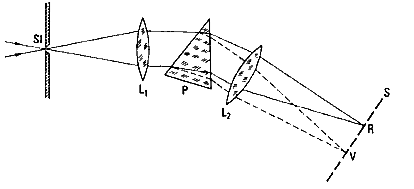
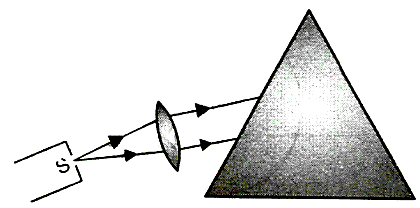
Fig shows part of the arrangement for obtaining pure spectrum.
(a) Complete thediagram and show how to obtain a pure spectrum.
(b) What are the conditions necessary for obtaining a pure spectrum?
Answer
(a)

(b)
A pure spectrum is that spectrum in which the different colours are distinctly seen without any overlapping. Following conditions must be satisfied to get a pure spectrum.
  1. The slit (placed in front of the source) must be narrow as possible. A wide slit is equivalent to a large number of narrow slits placed side by side. Each narrow slit will give its own spectrum. So, there will be overlapping of different spectra.
  2. The ray of light in the incident beam must be parallel to each other. This is achieved by using a convex lens. A convex lens should be so placed that the slit is at its focus.The convex lens used in this way is called collimating lens while the beam emerging out of this lens is called collimated beam.
    If the incident beam is parralel, Then in the refracted beam, all the rays of the same colour will be parallel and will be focussed seperately.
  3. The prism must be placed in the minimum deviation position. When the prism is placed in the position of minimum deviation, all the rays are deviated by equal amounts. This ensures freedom from overlappng.
  4. On emergence from the prism, all rays of one colour should form a parallel beam of their own. if a convex lens is suitably placed in the path of these rays, then each parallel beam will come to its own focus. In this way, a pure spectrum will be obtained.
View full question & answer
Question 35 Marks
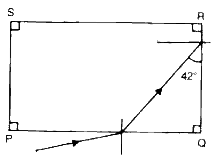
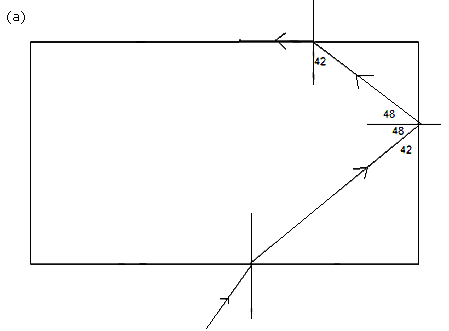
(a) A ray of monochromatic light enters glass $PQRS$ as shown in the fig. Complete the path of ray till it emerges from the glass. (Critical angle of glass is $42^0).$

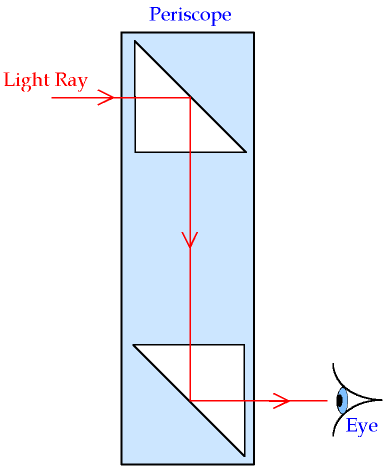
(b) Draw diagram of a prism periscope.
(c) What are the advantages of total internal reflecting prism over plane mirror?
Answer

Note : here that when the angle of incidence in the denser medium is more than the critical angle $(= 42),$ then the ray undergoes total internal reflection.
At angle of incidence equal to critical angle, the ray grazes the interface.
(b) Diagram of prism periscope:
Image
(c) In case of reflection from plane mirror, all of light in not reflected. In case of total reflecting prism, all rays failing beyond critical angle will be totally reflected. The intensity of reflected light is equal to the intensity of incident light in case of total internal ref;lection but not in case of reflection from plane mirror.
In addition, the reflection through a thick mirror causes multiple image formation as well as lateral inversion of image.
Due to the above two reasons, the total reflecting prisms are preferred over the plane mirrors.
View full question & answer
Question 45 Marks
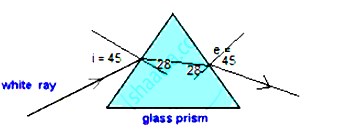
(a)A ray of light is incident at 45° on the face of
(i) A rectangular block of glass.
(ii) A $60^0$ glass prism.
(b) Draw a sketch showing how the ray of monochromatic ray of light passes through glass in each case.
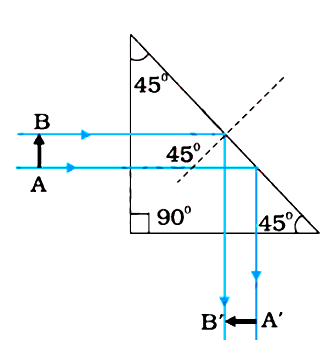
(c) With the aid of a diagram, explain how the face of a right angled prism may totally reflect incident on it.
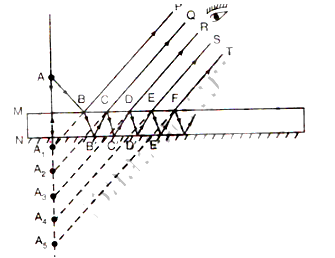
(d) A thick plane mirror produces several faint images in addition to a prominent one. Draw a ray diagram showing how reflection and refraction produce all these images.
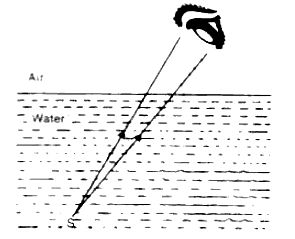
(e) Fig. represents a stone S at the bottom of a pond of water. Using the two rays, as shown, complete the ray diagram to show where the image of the stone appears when viewed from E.

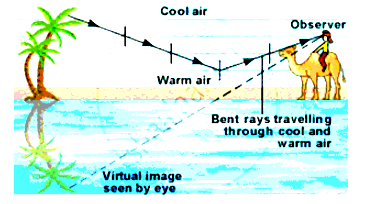
(f) What is a''mirage'? Explain with the help of a diagram.
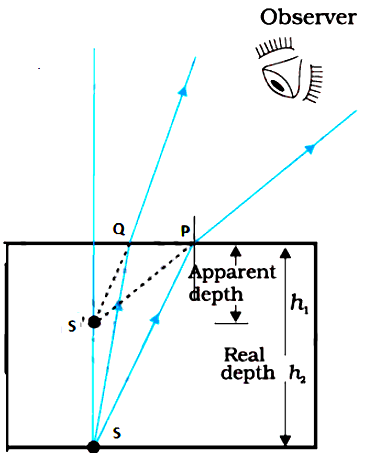
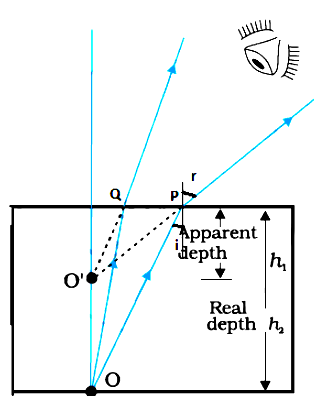
(g) A man observes the bottom of a swimming pool of $3 \ m$ depth. If the refractive index of water is $1.3,$ what is the apparent depth of water?
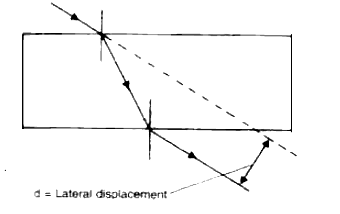
(h) When a ray of light undergoes refraction through a glass slab and when it emerges it is displaced laterally (Fig). What are the factors on which the lateral displacement depends?

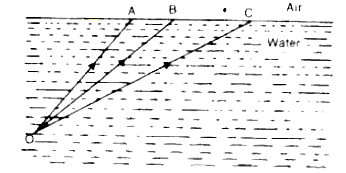
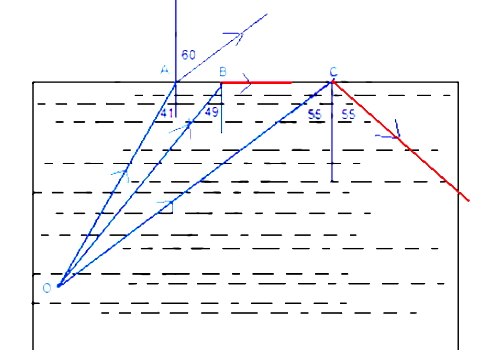
(i) Fig. shows three rays of light $OA, OB$ and $OC$ passing from water to air, making angles $49^0, 41^0$ and $35^0$​​​​​​​ with the horizontal surface respectively. Draw an approximate path of the emergent ray for each. (Critical angle of water is $49^0​​​​​​​$.)
Answer
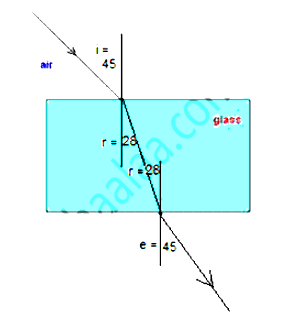
(a) For the glass block,
Given $i = 45$
Using $\mu =$ sin i / sin $r$
Taking $\mu = 1.5$ for a glass, we get $r = 28^\circ$
The ray diagram of parallel glass slab will look like this:

(b) For triangular glass prism:
Given $i = 45$
Using $\mu =$ sin i / sin r
Taking $\mu = 1.5$ for a glass, we get $r = 28^\circ$
The ray diagram of parallel glass slab will look like this:

(c)

In the above diagram, light rays from the object $A B$ are incident normally on a right angled glass prism and hence they pass undeviated. These rays fall on the other surface of the prism at $45^{\circ}$, Which is greater than the critical angle for the glss air interface $\left(42^{\circ}\right)$. Here, no refraction takes places but the ray of light is totally reflected back in the glass and finally it emerges out through the third surface of the prism normally forming the image $A^{\prime} B^{\prime}$ of the object $A B$.
(d)

(e)

(f)
Mirage is a naturally occuring optical phenomenon caused due to total internal reflection light wherein and image some distant object appears displaced from its true position often observed in deserts and coal tarred roads on hot summer days.
In the desert, the air is very hot. The air near the surface of the earth is hot and is less dense. Thus, air can be considered aslayers of medium with higher density in the vertical upward direction. Rays of light from an object, say, a tree bend away from the normal as successive layer. At a certain point, When the angle of incidence becomes greater than the critical angle, The rays of light will undergo total internal reflection. The ray now starts traveling from rarer to denser medium. When the light reaches the eye of a weary dese traveler,to him, the light will appear to emerge in a straight line in the backward direction. Thus creating an impression of water pool or oasis.

(g) $\mu=\frac{\text { Real depyh }}{\text { apparent depth }} \therefore \quad$ Apparent depth $=\frac{\text { Real depth }}{\mu}=\frac{3}{1.3}=2.3 \mathrm{~m}(\mathrm{h})$ Factors on which lateral displacement depends are: 1. Thickness of the slab 2. Angle of incidence 3. Refractive index of the glass (i) Given the angles with horizontal surface as: $\mathrm{OA}$ making an angle of $49^{\circ}$ with horizontal, hence iA = $90-49=41$ OB making an angle of 41 with horizontal, hence ig $=90-41=49 \mathrm{OC}$ making an angle of 35 with horizontal, hence ic $=90-35=55$ Given critical angle $=49$ So all incident angles is denser media, more than 49, will undergo total internal reflection, (Ray OC) i = critical angle will graze through the interface (Ray $\mathrm{Ob}$ ) $\mathrm{i}=$ less than critical angle will emergent out into rare meium due to refraction (Ray $O A$ ).
View full question & answer
Question 55 Marks
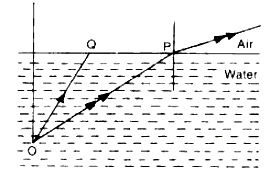
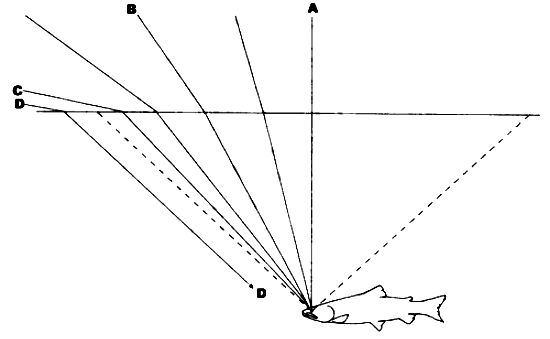
Fig. shows two rays of light Op and OQ coming from an object at the bottom of a pond, incident on the water surface.

(a) Mark on the diagram
(i) The angle of incidence of ray OP,
(ii) The angle of refraction of ray Op,
(iii) The position of image of the object as seen from above.
(iv) An approximate path of the ray OQ.
(b) Explain, why do the rays of light change directions on passing from water to air.
(c) A fish in water sees everything outside the water by rays of light entering its eye in a small cone of light. Draw a diagram and explain how does this happen.
Answer

(i) Angle of incidence (i) of ray OP is marked in the above diagram.
(ii) Angle of refraction (r) of ray OP is marked in the above diagram.
(iii) The position of image of the object (O') as seen from above is marked in the diagram.
(iv) An approximate path of ray OQ is shown in the above diagram.
(b) Water is a denser medium as compared to air; so on passing from water (denser) to air (rarer) the speed of light of light increases and it bends away from the normal.
(c)
Refraction is the bending of light as it passes from a medium of one optical density into a medium of a different optical density, as from air to water or water into air. The amount of bending is dependent upon the incident angle of the light. In the diagram below, a light ray, "A" strikes the water at right angles and passes through the surface without bending. But as the incident angle decreases (becomes less than 90 degrees) the light bends more and morerays "B" and "C." Light striking the surface parallel to the surface, bends downward.
Since light is coming into the water from all directions, refraction creates a cone of light with its base on the surface and its apex at the fish's eye. The base of the cone is a circular opening at the surface through which the fish sees the entire outside world. This opening is called the "Fish's Window". Only the light passing through the window enters the fish's eye. Notice line "D," It's a ray entering the water beyond the window; refraction bends it such that it cannot reach the fish's eye.
View full question & answer
Question 65 Marks
Gamma rays $D$ $C$ Visible light $B$ $A$
The above table shows different parts of the electromagnetic spectrum.
(a) Identify the parts of the spectrum marked as $A, B, C$ and $D.$
(b) Which of the radiations A or B has the higher frequency?
(c) State two properties which are common to all parts of the electromagnetic spectrum.
(d) Name one source of each of the radiation of electromagnetic spectrum.
(e) Name one detector for each of the radiation.
(f) Name one use of each of the radiation.
Answer
(a) A, B, C and D are microwaves, infrared waves, ultraviolet light and x-rays respectively.
(b) Radiations B (microwaves) have a higher frequency.
(c) Common properties of e-m spectrum:
(i) All electromagnetic waves travel with the same speed in vacuum (or air) which is equal to the speed of light i.e. $3 x 10^8$​​​​​​​ m/s.
(ii) These waves are unaffected by the electric and magnetic fields.
(d)
Name of wave Source
1. Gamma rays 1. cosmic rays
2. X rays 2. When highly energetic electrons are stopped by a heavy metal target of high melting point (x-ray tube)
3. Ultraviolet 3. Sunlight
4. visible light 4. White hot bodies
5. Infrared waves 5. Lamp with thoriated filament.
6. Microwaves 6. Electronic devices such as klystron tube.
7. Radio waves 7. Radio transmissions.
(e)
Name of waves Detector
1. Gamma rays 1. Geiger tube
2. X rays 2. Photographic film coated with zinc sulphide.
3. Ultraviolet 3. Photographic plate
4. visible light 4. Eye photo cells
5. Infrared waves 5. Thermopile
6. Microwaves 6. Wave guide tubes
7. Radio waves 7. Earphone
(f)
Name of waves Use
1. Gamma rays 1. Detecting flaws in metal casting.
2. X rays 2. Diffraction to find crystal structure
3. Ultraviolet 3. Burglar alarms
4. visible light 4. Photography
5. Infrared waves 5. Infra - red photography
6. Microwaves 6. Microwave cooking
7. Radio waves 7. Communication and navigation.
View full question & answer
Question 75 Marks
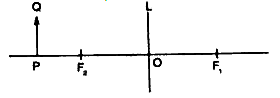
Fig shows an object PQ placed on the principle axis of a lens L. The two foci of the kens are F1 and f2. The image formed by the lens is erect, Virtual and dimnished.

(i) Draw the outline ofthe lens L used and Named it.
(ii) Draw a ray of light starting from Q and passing through O. show the same ray after refraction by the lens.
(iii) Draw another ray from Q Which is incident parallel to the principle axis and show how it emerges after refraction from the lens.
(iv) Locate the final image formed.
Answer

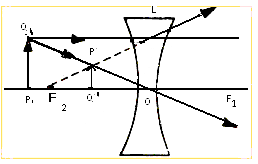
(i) Outline of lens is drawn in above diagram. It is a concave lens.
(ii) Shown in diagram above.
(iii) shown in diagram above.
View full question & answer
Question 85 Marks
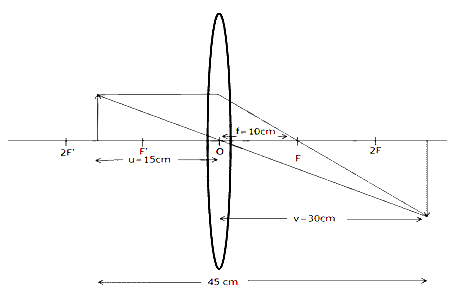
A convex lens produces an image on a screen twice the size of the object. The distance between the object and screen is 45 cm. Find the distance of the lens from the object and its focal length by drawing a ray diagram.
Answer


Magnification, $\mathrm{m}=\frac{\mathrm{I}}{\mathrm{O}}=\frac{\mathrm{u}}{\mathrm{v}}=2$ (given)
$ \begin{aligned} & \Rightarrow \mathrm{v}=2 \mathrm{u} \\ & \mathrm{u}+\mathrm{v}=45 \mathrm{~cm} \text { (given) } \\ & \mathrm{u}+2 \mathrm{u}=45 \mathrm{~cm} \\ & 3 \mathrm{u}=45 \mathrm{~cm} \\ & \therefore \mathrm{u}=15 \mathrm{~cm} \end{aligned} $
Distance of lens from the object is $15 \mathrm{~cm}$. $ \Rightarrow \mathrm{v}=2 \mathrm{u}=30 \mathrm{~cm} $
We know, $\frac{1}{\mathrm{f}}=\frac{1}{\mathrm{u}}+\frac{1}{\mathrm{v}}$ $ \begin{aligned} & =\frac{1}{15}+\frac{1}{30}=\frac{3}{10}=\frac{1}{10} \\ & \Rightarrow f=10 \mathrm{~cm} \end{aligned} $
Focal length is $10 \mathrm{~cm}$.
View full question & answer
Question 95 Marks
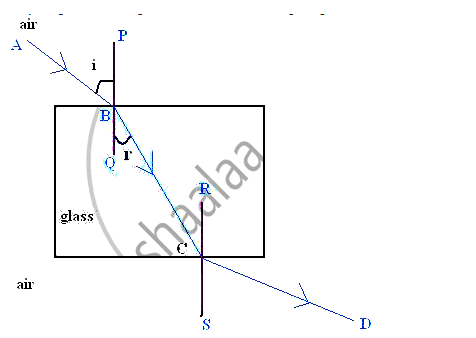
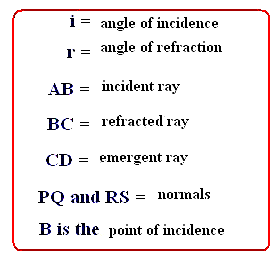
Explain the meaning of the term refraction. A ray of monochromatic light is incident from air on a glass slab. Draw a ray diagram indicating the change in its path till it emerges out of the slab.
Answer
Refraction is the bending of light at the surface of separation, which takes when it passes from one optical medium to another optical medium with different optical densities.
Ray diagram showing refraction of light through a glass slab:

View full question & answer
Question 105 Marks
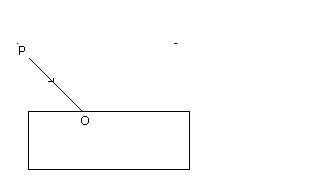
In the fig., PO is a ray of light incident on a rectangular glass block.
(a) Complete the path of the ray through the block.
(b) In the diagram, mark the angle of incidence (i) and the angle of refraction (r) at the first interface. How is the refractive index of glass related to the angles I and r?
(c) Mark angle of emergence by the letter e. How are the angles i and e related?
(d) Which two rays are parallel to each other? Name them.
(e) Indicate in the diagram the lateral displacement between the emergent ray and the incident ray.
Answer
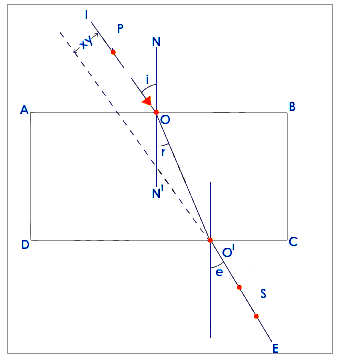
(a) Diagram showing complete path of light :

(b) Angle of incidence and angle of refraction marked in the above diagram. R.I $=\frac{\sin i}{\sin r}$
(c) Angle of emergence is marked in the above diagram. Angle of incidence = Angle of emergence
(d) Rays IO and O'E are parallel to each other. These are incident and emergent rays respectively.
(e) In the diagram above, the lateral displacement is indicated by XY.
View full question & answer
[5 Mark Question Answer] - Physics STD 10 Questions - Vidyadip