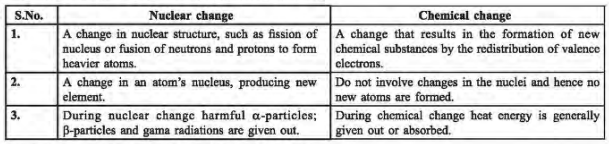
Question 13 Marks
(i) (a) Represent the change in the nucleus of a radioactive element when a $\beta$ particle is emitted.
(b) What is the name given to elements with same mass number and different atomic number?
(c) Under which conditions does the nucleus of an atom tend to be radioactive?
(ii) (a) State one harmful effect of the radioactivity.
(b) Name the radioactive radiations which have the least penetrating power.
(c) Give one use of radio isotopes.
(d) What is meant by background radiation?
(iii) The ore of Uranium found in nature contains ${ }_{92}^{238} U$ and ${ }_{92}^{235} U$. Although both the isotopes are fissionable, it is found out experimentally that one of the two isotopes is more easily fissionable.
(a) Name the isotope of Uranium which is easily fissionable.
(b) Give a reason for your answer
(c) Write a nuclear reaction when Uranium 238 emits an alpha particle to form a Thorium (Th) nucleus.
(b) What is the name given to elements with same mass number and different atomic number?
(c) Under which conditions does the nucleus of an atom tend to be radioactive?
(ii) (a) State one harmful effect of the radioactivity.
(b) Name the radioactive radiations which have the least penetrating power.
(c) Give one use of radio isotopes.
(d) What is meant by background radiation?
(iii) The ore of Uranium found in nature contains ${ }_{92}^{238} U$ and ${ }_{92}^{235} U$. Although both the isotopes are fissionable, it is found out experimentally that one of the two isotopes is more easily fissionable.
(a) Name the isotope of Uranium which is easily fissionable.
(b) Give a reason for your answer
(c) Write a nuclear reaction when Uranium 238 emits an alpha particle to form a Thorium (Th) nucleus.
Answer
View full question & answer→(i) (a) ${ }_Z X^A \longrightarrow{ }_{Z+1} X_1^A+{ }_{-1} e^0$.
(b) Isobars.
(c) The nucleus of an atom tend to be radioactive :
1. When its atomic number exceeds 82.
2. There is an imbalance of protons and neutrons as compared to normal stable atom.
(ii) (a) The radiations given out in the decay process can damage living tissues.
(b) Alpha radiations have least penetrating power.
(c) Radio isotopes are used in the cure of cancer.
(d) Radiation which is omnipresent and can be detected of Geiger Muller tube is called background radiation.
(iii) (a) ${ }_{92}^{235} U$ is easily fissionable.
(b) ${ }_{92}^{235} U$ fissions with low-energy thermal neutrons because the binding energy resulting from the absorption of a neutron is greater than the critical energy required for fission.
(c) ${ }_{92} U ^{2133} \rightarrow 90 Th ^{234}+$ Alpha particle $\left({ }_2 He ^4\right)$
(b) Isobars.
(c) The nucleus of an atom tend to be radioactive :
1. When its atomic number exceeds 82.
2. There is an imbalance of protons and neutrons as compared to normal stable atom.
(ii) (a) The radiations given out in the decay process can damage living tissues.
(b) Alpha radiations have least penetrating power.
(c) Radio isotopes are used in the cure of cancer.
(d) Radiation which is omnipresent and can be detected of Geiger Muller tube is called background radiation.
(iii) (a) ${ }_{92}^{235} U$ is easily fissionable.
(b) ${ }_{92}^{235} U$ fissions with low-energy thermal neutrons because the binding energy resulting from the absorption of a neutron is greater than the critical energy required for fission.
(c) ${ }_{92} U ^{2133} \rightarrow 90 Th ^{234}+$ Alpha particle $\left({ }_2 He ^4\right)$