Question types

Modern Physics question types

70 questions across 6 question groups — pick any mix to generate a Physics paper with step-by-step answer keys.

70
Questions
6
Question groups
5
Question types
Sample Questions

Modern Physics questions

One sample from each question group in this chapter. Select any group above to see the full set with answer keys.

(a) Which of the radioactive radiations can cause severe genetical disorders?
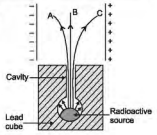
(b) Which of the radioactive radiations are deflected by an electric field?
(c) Name the radiation which is used in carbon dating.
View full solution
(a) What do you understand by the term nucleus?
(b) A radioactive nucleus undergoes a series of decays according to the sequence
$X \xrightarrow{\beta} X_1 \xrightarrow{\alpha} X_2 \xrightarrow{a} X_3 .$
If the mass number and atomic number of $X _3$ are 172 and 69 respectively, what is the mass number and atomic number of X ?
View full solution
The ore of Uranium found in nature contains ${ }_{92} U ^{238}$ and ${ }_{92} U ^{235}$. Although both the isotopes are fissionable, it is found out experimentally that one of the two isotopes is more easily fissionable.
(a) Name the isotope of Uranium which is easily fissionable.
(b) Give a reason for your answer.
(c) Write a nuclear reaction when Uranium 238 emits an alpha particle to form a Thorium (Th) nucleus.
View full solution
(a) What are
(i) beta particles, (ii) gamma radiations?
(b) Explain briefly what changes take place within the nuclei, when beta particle is emitted by a radioactive substance.
View full solution
(a) What are background radiations?
(b) Write an equation of an $\alpha$ emission from ${ }^{232} U$.
(c) What will be the change in the rate of radioactivity if the temperature of the radioactive substance is raised to four times the initial temperature?
View full solution
(i) (a) Represent the change in the nucleus of a radioactive element when a $\beta$ particle is emitted.
(b) What is the name given to elements with same mass number and different atomic number?
(c) Under which conditions does the nucleus of an atom tend to be radioactive?
(ii) (a) State one harmful effect of the radioactivity.
(b) Name the radioactive radiations which have the least penetrating power.
(c) Give one use of radio isotopes.
(d) What is meant by background radiation?
(iii) The ore of Uranium found in nature contains ${ }_{92}^{238} U$ and ${ }_{92}^{235} U$. Although both the isotopes are fissionable, it is found out experimentally that one of the two isotopes is more easily fissionable.
(a) Name the isotope of Uranium which is easily fissionable.
(b) Give a reason for your answer
(c) Write a nuclear reaction when Uranium 238 emits an alpha particle to form a Thorium (Th) nucleus.
View full solution
(i) An atomic nucleus A is composed of 84 protons and 128 neutrons. The nucleus A emits an alpha particle and is transformed into a nucleus B.
(a) What is the composition of B ?
(b) The nucleus B emits a beta particle and is transformed into a mucleus C. What is the composition of C?
(c) What is mass number of the nucleus A ?
(d) Does the composition of C change if it emits gamma radiations?
(ii) (a) Define fusion.
(b) Define fission.
(iii) (a) What is meant by Radioactivity?
(b) What is meant by nuclear waste?
(c) Suggest one effective way for the safe disposal of nuclear waste.
View full solution
(i) (a) Name the kind of reactions taking place :
(i) In the star
(ii) In muclear reactor
(iii) In our body.
(b) When an alpha particle gains two clectrons it becomes neutral and becomes an atom of an element which is rare gas. What is the name of this rare gas?
(ii) State three precautions in the handling of radioactive substances.
(iii) (a) Define radionctivity.
(b) What happens inside the mucleus that causes the emission of a beta particle?
(c) Express the above change in the form of an equation.
View full solution
(i) A mucleus ${ }_2^{ A } X$ emits an alpha particle followed by $\gamma$ emission; thereafter it emits two $\beta$ particles to form $X _3$.
(a) Copy and complete the values of A and Z for $X _3$ :
$\frac{Z}{Z} X \xrightarrow{-a} X_1 \xrightarrow{-y} X_2 \xrightarrow{-28} \underset{\ldots}{\cdots} X_3$
(b) Out of alpha ( $\alpha$ ), beta ( $\beta$ ) and gamma ( $\gamma$ ) radiations -
(i) Which radiation is the most penetrating?
(ii) Which radiations are negatively charged?
(ii) (a) What happens to the atomic number of an element, when it emits :
(i) an alpha particle;
(ii) a beta particle?
(b) Explain why alpha and beta particles are deflected in an electric or a magnetic field but gamma rays are not deflected in such a field.
(iii) A nucleus ${ }_{11} Na ^{24}$ emits a beta particle to change into magnesium ( Mg ).
(a) Write the symbolic equation for the process.
(b) What are numbers 24 and 11 called?
(c) What is the general name of ${ }_{12}^{24} Mg$ with respect to ${ }_{11}^{24} Na$ ?
View full solution
(a) Is it possible for a hydrogen ( ${ }^{( H )}$ ) nucleus to emit an alpha particle? Give a reason for your answer.
(b) (i) Define nuclear fission.
(ii) Rewrite and complete the following nuclear reaction by filling in the atomic number of Ba and mass number of Kr :
$\text { 238U }+bn \longrightarrow{ }_{144} Ba+{ }_{36} Kr+3 dn+\text { Energy }$
(c) (i) Why is a nuclear fusion reaction called a thermo nuclear reaction?
(ii) Complete the reaction:
${ }^3 He_2+{ }^2 H_1 \longrightarrow{ }^4 He_2+\ldots \ldots \ldots \ldots \ldots+\text { Energy }$
View full solution
Q 17MCQ1 Mark
Asertion (A): X-rays are emitted when there is a transition of electrons in the inner orbits of an atom.
Reason (R): Gamma radiations are given out from the nucleus.
  • A
    Both A and R are the true and R is a correct explanation of A .
  • Both A and R are the true but R is not a correct explanation of A .
  • C
    Assertion is false and Reason is true.
  • D
    Assertion is true and Reason is false.

Answer: B.

View full solution
Q 18MCQ1 Mark
Assertion (A): If an atom undergoes a chemical change occurring at a low energy, there is a change in the number of orbital electrons of the atom.
Reason (R): If the atom undergoes a nuclear change which occurs at a high energy, there is a change in the number of nucleons inside the nucleus of the atom.
  • A
    Both A and R are the true and R is a correct explanation of A .
  • Both A and R are the true but R is not a correct explanation of A .
  • C
    Assertion is false and Reason is true.
  • D
    Assertion is true and Reason is false.

Answer: B.

View full solution
Q 19MCQ1 Mark
The reaction which takes place in nuclear reactors is :
  • A
    nuclear fission
  • controlled nuclear fission
  • C
    nuclear fusion
  • D
    all of these

Answer: B.

View full solution
Q 20MCQ1 Mark
When the nucleus of a radioactive element, such as uranium is hit by a slow moving neutron, such that it splits into two almost equal nuclei with the release of more neutrons and energy, then the process is called :
  • A
    nuclear fusion
  • nuclear fission
  • C
    chemical reaction
  • D
    none of these

Answer: B.

View full solution
Q 21MCQ1 Mark
${ }_{92} U^{236} \longrightarrow 56 Ba^x+{ }_\gamma Kr^{92}+3 o^{n^1}+\text { energy }$
In the above nuclear equation, the values of $x$ and $y$ are :
  • A
    $x=141, y=34$
  • B
    $x=139, y=35$
  • $x=141, y=36$
  • D
    $x=142, y=37$

Answer: C.

View full solution
The atoms of different elements which bave the ___________[different/same] mass number, but ___________ [different / same] atomic number, are called isobars.
View full solution

Generate a Modern Physics paper free

Pick question groups from the list above, set marks and difficulty, and export a branded PDF with step-by-step answer keys. First 3 chapters free — no signup.
Download App