Questions

[5 Mark Question Answer]

🎯

Test yourself on this topic

13 questions · timed · auto-graded

Question 15 Marks
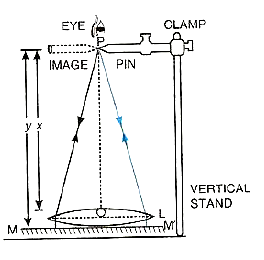
Describe how you would determine the focal length of a converging lens, using plane mirror and one pin. Draw a ray diagram to illustrate your answer.
Answer
To determine focal length by using plane mirror we need a vertical stand, a plane mirror, a lens and a pin.
Place the lens $L$ on a plane mirror $MM$ ' horizontally. Arrange a pin $P$ on the clamp of a vertical stand such that the tip of pin is vertically above the centre $O$ of the lens.
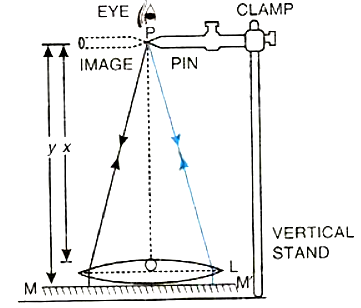


"Adjust the height of the pin until it has no parallax (i.e., when the pin and its image shift together) with its inverted image as seen from vertically above the pin.
Now measure the distance $x$ of the pin from the lens and the distance $y$ of the pin from the mirror, using a metre scale and a plumb line. Calculate the average of the two distances. This gives the focal length of the lens, i.e.,
$F=\frac{x+y}{2}$
View full question & answer
Question 25 Marks
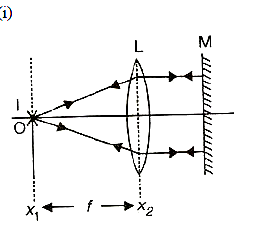
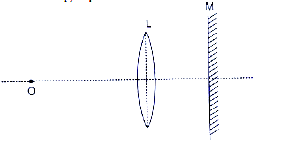
The following diagram shows the experimental set up for the determination of focal length of a lens using a plane mirror.


(i) draw two rays from the point O of the object to show the formation of image I at O itself.
(ii) What is the size of the image I?
(iii)State two more characteristics of the image I.
(iv) Name the distance of the objects O from the optical centre of the lens.
(v) To what point will the rays return if the mirror is moved away from the lens by a distance equal to the focal length of the lens ?
Answer


(ii) The size of the image will be same as that of object.
(iii) The image formed will be real and inverted.
(iv) The distance of object O from optical lens will be equal to the focal length of the lens.
(v) The position of the mirror from lens does not affect the formation of image as long as the rays from the lens fall normally on the plane mirror M.
View full question & answer
Question 35 Marks
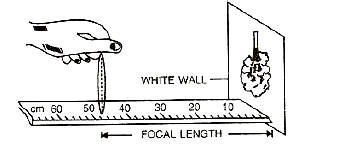
Describe in brief how would you determine the approximate focal length of a convex lens.
Answer
The approximate focal length of a convex lens can be determined by using the principle that a beam of parallel rays incident from a distant object is converged in the focal plane of the lens.
In an open space, against a white wall, a metre scale is placed horizontally with its 0 cm end touching the wall.


By moving the convex lens to and fro along the scale, focus a distant object on wall. The image which forms on the wall is very near to the focus of the lens and the distance of the lens from the image is read directly by the metre scale. This gives the approximate focal length of the lens.
View full question & answer
Question 45 Marks
An illuminated object lies at a distance 1.0 m from a screen. A convex lens is used to form the image of object on a screen placed at distance 75 cm from the lens . Find: (i) the focal length of lens, and (ii) the magnification.
Answer
Image distance, $v=75 cm$
Object distance, $u =-25 cm$
Lens formula is,
$\frac{1}{v}-\frac{1}{u}=\frac{1}{f}$
$\begin{aligned} & \therefore \frac{1}{75}-\frac{1}{-25}=\frac{1}{ f } \\ & \therefore \frac{1}{ f }=\frac{1}{75}+\frac{1}{25}=\frac{4}{75}\end{aligned}$
$\therefore f =\frac{75}{4}=18.75 cm$
For a lens, magnification is
$\begin{aligned} & m =\frac{ v }{ u } \\ & \therefore m =\frac{75}{-25} \\ & \therefore m =-3\end{aligned}$

View full question & answer
Question 55 Marks
Describe how you would determine the focal length of a converging lens, using a plane mirror and one pin. Draw a ray diagram to illustrate your answer.
Answer
To determine focal length by using plane mirror we need a vertical stand, a plane mirror, a lens and a pin.
Place the lens $L$ on a plane mirror MM' horizontally. Arrange a pin P on the clamp of a vertical stand such that the tip of pin is vertically above the centre $O$ of the lens.


Adjust the height of the pin until it has no parallax (i.e., when the pin and its image shift together) with its inverted image as seen from vertically above the pin.
Now measure the distance $x$ of the pin from the lens and the distance $y$ of the pin from the mirror, using a metre scale and a plumb line. Calculate the average of the two distances. This gives the focal length of the lens, i.e.,
$F =\frac{x+y}{2}$

View full question & answer
Question 65 Marks
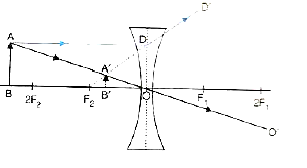
State the changes in the position, size and nature of the image of an object when brought from infinity up to a concave lens. Illustrate your answer by drawing ray diagrams.
Answer
(i) When object (AB) is situated at infinity then parallel rays from object appears to fall on concave lens. Due to which image forms at focus. This image is highly diminished in size and virtual and upright


(ii) When object (AB) is situated at any point between infinity and optical centre of the lens then image forms between focus and optical centre. This image is diminished in size and virtual and upright.

View full question & answer
Question 75 Marks
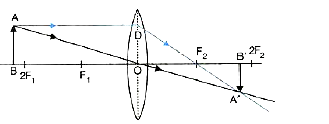
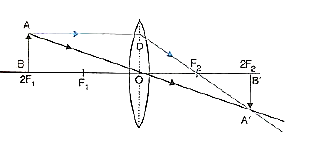
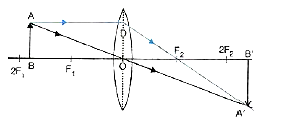
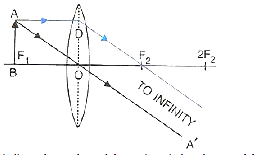
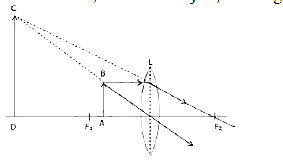
State the changes in the position, size and nature of the image of an object when brought from infinity up to a convex lens. Illustrate your answer by drawing ray diagrams.
Answer
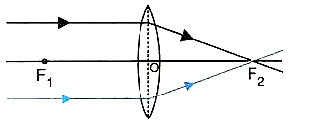
(i) When the object is situated at infinity, the position of image is at F2, it is very much diminished in size and it is real and inverted.


(ii) When the object (AB) is situated beyond 2F1, the position of image (A'B') is between F2 and 2F2, it is diminished in size and real and inverted.


(iii) When the object (AB) is situated at 2F1, the position of image (A'B') is at 2F2, it is of same size as the object and real and inverted.


(iv)When the object (AB) is situated between 2F1and F1, the position of image (A'B') is beyond 2F2, it is magnified in size and real and inverted.


(v) When the object (AB) is situated at F1, the position of image is at infinity; it is very much magnified in size and real and inverted.

"

(vi) When the object (AB) is situated between lens and F1, the position of image (CD) is on the same side, behind the object; it is magnified in size and virtual and upright.


View full question & answer
Question 85 Marks
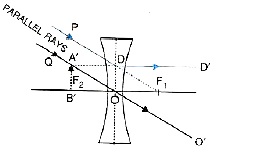
What are the three principal rays that are drawn to construct the ray diagram for the image formed by a lens? Draw diagrams to support your answer.
Answer
(i) A ray of light incident at the optical centre O of the lens passes undeviated through the lens.

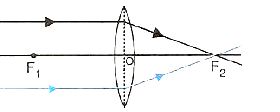
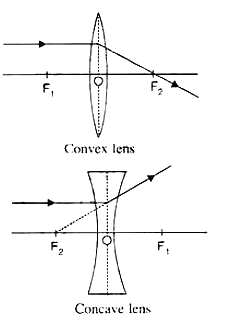
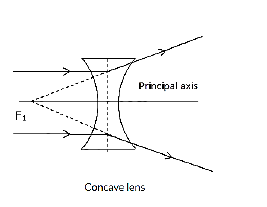
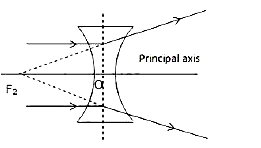
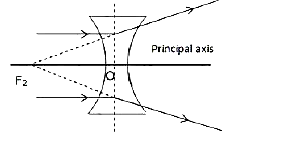
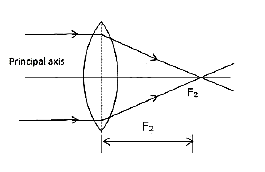
(ii) A ray of light incident parallel to the principal axis of the lens, after refraction passes through the second focus F2 (in a convex lens) or appears to come from the second focus F2 (in a concave lens).

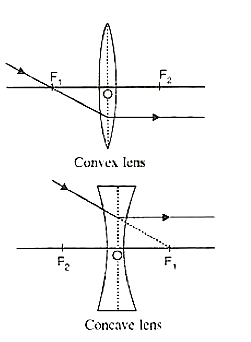
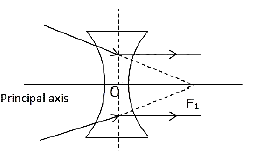
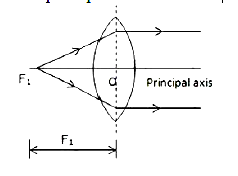
(iii) A ray of light passing through the first focus F1 (in a convex lens) or directed towards the first focus F1 (in a concave lens), emerges parallel to the principal axis after refraction.

View full question & answer
Question 95 Marks
Draw a ray diagram to show how a converging lens can form an image of the sun. Hence give a reason for the term ‘burning glass’ for a converging lens used in this manner.
Answer
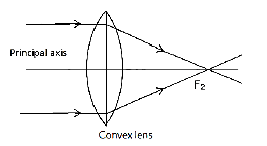
The sun is at infinity so convex lens forms its image at second focal point which is real and very much diminished in size.


While using the convex lens as burning glass, the rays of light from the sun (at infinity) are brought to focus on a piece of paper kept at the second focal plane of the lens. Due to sufficient heat of the sun rays, the paper burns. Hence this lens is termed as 'burning glass'.
View full question & answer
Question 105 Marks
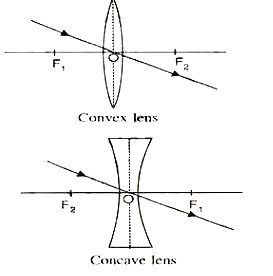
How does the action of a convex lens differ from that of a concave lens on a parallel beam of light incident on them? Draw diagram to illustrate your answer.
Answer
If a parallel beam of light is incident on a convex lens then the upper part of the lens bends the incident ray downwards. The lower part bens the ray upwards while the central part passes the ray undeviated.

But in case of a concave lens the upper part of the lens bends the incident ray upwards and lower part bends the ray downwards while the central part passes the ray undeviated.

View full question & answer
Question 115 Marks
Draw a diagram to represent the second focus of a concave lens.
Answer


Concave lens representing second focus


View full question & answer
Question 125 Marks
Define the term principal foci of a concave lens and show them with the help of proper diagrams.
Answer
A light ray can pass through a lens from either direction. Therefore, a lens has two principal foci.
For a concave lens, the first focal point is a point F1 on the principal axis of the lens such that the incident rays of light appearing to meet at it, after refraction from the lens become parallel to the principal axis of the lens.

The second focal point for a concave lens is a point F2 on the principal axis of the lens such that the rays of light incident parallel to the principal axis, after refraction from the lens, appear to be diverging from this point.
View full question & answer
Question 135 Marks
Define the term principal foci of a convex lens and illustrate your answer with the aid of proper diagrams.
Answer
A light ray can pass through a lens from either direction. Therefore, a lens has two principal foci.For a convex lens, the first focal point is a point F1 on the principal axis of the lens such that the rays of light starting from it or passing through it, after refraction through lens, become parallel to the principal axis of the lens

The second focal point for a convex lens is a point F2 on the principal axis such that the rays of light incident parallel to the principal axis, after refraction from the lens, pass through it.

View full question & answer
[5 Mark Question Answer] - Physics STD 10 Questions - Vidyadip