Question
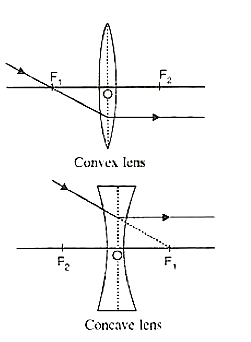
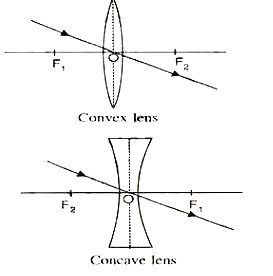
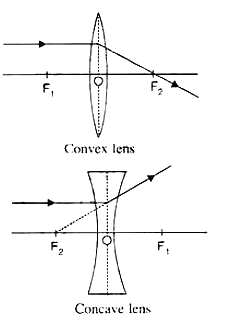
What are the three principal rays that are drawn to construct the ray diagram for the image formed by a lens? Draw diagrams to support your answer.
Answer

(i) A ray of light incident at the optical centre O of the lens passes undeviated through the lens.

(ii) A ray of light incident parallel to the principal axis of the lens, after refraction passes through the second focus F2 (in a convex lens) or appears to come from the second focus F2 (in a concave lens).

(iii) A ray of light passing through the first focus F1 (in a convex lens) or directed towards the first focus F1 (in a concave lens), emerges parallel to the principal axis after refraction.

Need a full question paper?

Generate a complete, print-ready paper with questions like this in minutes — across 16+ boards, with answer keys.
Start Generating Free

Similar questions

A uniform metre rule rests horizontally on a knife-edge at the 60 cm mark when a mass of 10 gram is suspended from one end. At which end must this mass be suspended? What is the mass of the rule?
How does the two sounds of same loudness and same pitch produced by different instruments differ? Draw diagrams to illustrate your answer.
What are the names of the three types of rays given off by a radioactive substance? Define the properties you know they possess. Why are the largest atoms radioactive?
Differentiate between heat capacity and specific heat capacity.
The following diagram shows a fixed coil of several turns connected to a
center zero galvanometer G and a magnet NS which can move.
(a) Describe the observation in the galvanometer if (i) The magnet is moved
rapidly in the direction of arrow, (ii ) The magnet is kept still after it has
moved into the coil, (iii ) The magnet~ then rapidly pulled out the coil.


(b) How would the observation alter if a more powerful magnet is used?
What is nuclear energy? Name the process used for producing electricity using the nuclear energy.
Describe the construction and working of a filament lamp. List the material used and state why they are suitable for their purpose in this lamp.
The temperature of 600 g of cold water rises by 15° C when 300 g of hot water at 50° C is added to it. What was the initial temperature of the cold water?
Will the value of specific heat’capacity and specific latent heat of a substance change if the scale is °F instead of °C?
In the circuit shown below, calculate the equivalent resistance between the points (i) A and B, (ii) C and D.