Questions

[3 Mark Question Answer]

🎯

Test yourself on this topic

11 questions · timed · auto-graded

Question 13 Marks
Give reasons:
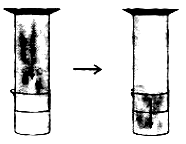
Why a solid does not flow, but a liquid flows?
Answer
In solids there is a strong force of attraction between the molecules and the space between them is very negligible. The molecules are therefore, not free to move. They merely vibrate about their mean positions. But in the case of liquids, the molecules are not very closely packed. They do not attract each other as strongly as the molecules of solids. Thus, the intermolecular spaces are larger and the molecules are able to move about more freely. This makes a liquid flow
View full question & answer
Question 23 Marks
Name the three states of matter and define them
Answer
The three states of matter are solid, liquid and gaseous.
Solid State : The molecules are very close to each other hence intermodular spaces are small and intermodular force is strong. Hence solids have definite volume, rigid, retain definite shape and are incompressible
Liquids: The molecules are less closely packed have more intermolecular spaces than solid, less stronger forces than solids. Hence liquids have definite volume but no definite shape. They take the shape of container in which they are put.
Gases : The molecules in the gases are far apart with weakest force of attraction. Hence gases have neither definite volume nor definite shape but easily compressible.
View full question & answer
Question 33 Marks
Describe simple experiments to prove that gases have no definite volume or shape.
Answer
Have no definite volume or shape
Experiment:
A gas takes up the volume of any enclosed space filling it up completely.
Conclusion: Gases take up any volume and hence all gases have no definite volume.
View full question & answer
Question 43 Marks
Describe simple experiments to prove that gases have mass.
Answer
Have mass
Experiment:
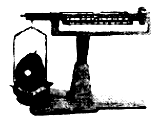
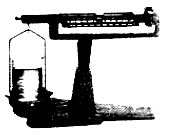
An inflated balloon placed on one side of the scale causes it to tilt towards one side.
Conclusion: The scale tilts due to the mass of the gas, hence all gases have mass.
View full question & answer
Question 53 Marks
Describe simple experiments to prove that gases occupy space.
Answer
occupy space
Experiment:
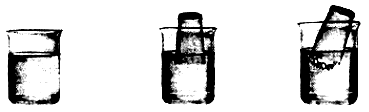
‘A’ – A glass beaker or bowl is half-filled with water.
‘B’ – An empty glass tumbler [which of course contains air] is inverted a lowered inside it.
‘C’ – On tilting the tumbler, the air is displaced and bubbles are seen coming out.
Conclusion: Air or gases occupy space.
View full question & answer
Question 63 Marks
Describe simple experiments to prove that liquids have no definite shape
Answer
have no definite shape
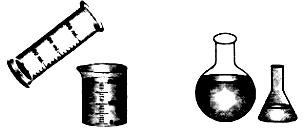
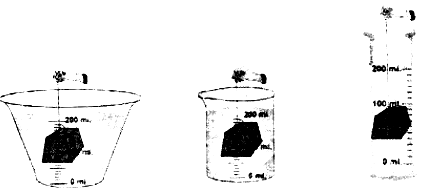
Experiment: A liquid poured into any container takes up the shape of each container.
Conclusion: All liquids have no definite shape.
View full question & answer
Question 73 Marks
Describe simple experiments to prove that liquids have a definite volume
Answer
have a definite volume
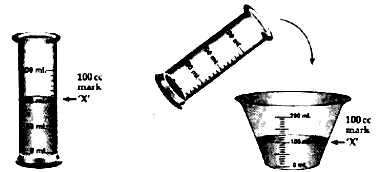
Experiment: A liquid in a measuring cylinder can be poured into any container. The volume of liquid in the container is the same as that in the measuring cylinder.
Observation: The volume of liquid in the container, is the same as that in the measuring cylinder. Hence, all liquids have a definite volume.
View full question & answer
Question 83 Marks
Describe simple experiments to prove that liquids have mass
Answer
have mass - a liquid occupies mass
Experiment: A liquid placed on one side of the scale, causes the scale to tilt towards one side.
Conclusion: The scale tilts due to the mass of the liquid, hence all liquids have mass.
View full question & answer
Question 93 Marks
Describe simple experiments to prove that solids have a definite volume
Answer
Have a definite volume: A solid placed in any container filled with water displaces the same amount of water.
Conclusion: Solid displace water and retain their own volume, hence all solids have a definite volume
View full question & answer
Question 103 Marks
Matter in any state is composed of particles. Compare the three states of matter i,e. solids, liquids, and gases with reference to:
(a) intermolecular space
(b) the intermolecular force of attraction
(c) movement of particles
Answer
Characteristics Solids Liquids Gases
Intermolecular space Minimum space More than solids Maximum space
Intermolecular force of attraction Very strong Less strong Very weak
movement of particles About their own position In continuous motion In any random direction
View full question & answer
Question 113 Marks
The three main states of matter are solids, liquids, and gases. Compare the three states with reference to the following characteristics of matter
(a) volume
(b) shape
(c) compressibility
(d) diffusion.
Answer
Characteristics Solids Liquids Gases
Volume Have a definite volume Have a definite volume Have no definite volume
Shape Have a definite shape Have no definite shape Have no definite shape
Compressibility Cannot be compressed Slightly compressible Highly compressible
Diffusion (Intermingling of Molecules) Cannot diffuse Shows Diffusion Diffuses very easily
View full question & answer