Questions

[5 Mark Question Answer]

🎯

Test yourself on this topic

8 questions · timed · auto-graded

Question 15 Marks
To identify materials of common use
Procedure – Just move around in your house – in the drawing room, sitting room, bedroom, kitchen, bathroom etc. Identify the things and All in the blanks in the table given below
No. Place Name of the thing Material used for making the thing
1 Study room
2 Drawing room
3 Kitchen
4 bathroom
5 Any other place
Answer
No. Place Name of the thing Material used for making the thing
1 Study room Table, chair, books pens, pencils, table lamp, computer, fan Wood, plastic, paper, glass, bakelite, connecting wires made of metal and plastics
2 Drawing room Sofa, table, chairs, fan, curtains, windows etc. Wood, cloth, coir, paint, plastics, aluminium, glass etc.
3 Kitchen Taps, wash basin, cupboards, utensils, heating vessels strainer, containers aqua pure etc Steel, aluminium, glass, china clay, iron, plastic, copper, stainless steel, brass etc
4 bathroom Taps, tubs, mugs, tooth brush, tooth paste, soap, pail etc. Iron, brass, stainless steel, plastics etc
5 Any other place Scooter, car, road, rooms, trucks, shops Iron, rubber, coaltar, bricks, wood, plastics, clothes.
View full question & answer
Question 25 Marks
Fill the following chart showing twelve solids, twelve liquids, four gases and eight materials.
Answer
Solids Liquids Gases Materials
1 Mobile Ink Oxygen Paper
2 Pen Water Hydrogen Wood
3 Pair of Shoes Cooking oil Nitrogen Iron nails
4 TV set Hair oil Carbon dioxide Cement
5 Chair Lemon juice Tiles
6 Telephone Cough syrup Plaster of paris
7 Remote control Mercury sand
8 Wood Thinner Iron rods
9 Ornaments Spirit Bricks
10 Scissors Kerosene
11 Eraser Petrol
12 Mirror Mouth wash
View full question & answer
Question 35 Marks
What happens to a metal ball when it is heated? What does this show?
Answer
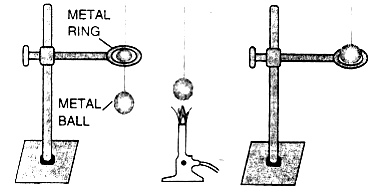
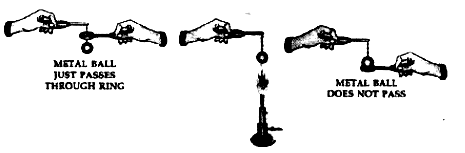
When metal ball is heated, it expands. This can be proved by following experiment:
ake a metallic ring and ball. Try to pass the metal ball through the ring. The ball is able to pass through the ring. Now heat the metal ball for 5-6 minutes. The hot ball is not be able to pass through the ring. This shows that a solid expands on heating. Now cool the ball, it again passes through the ring. This shows that a solid contacts on
cooling.
View full question & answer
Question 45 Marks
State what would you observe if
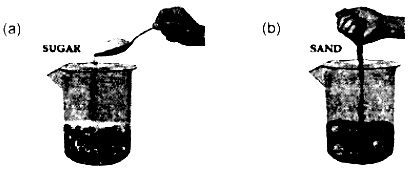
(a) sugar is added to pebbles take in a plastic beaker
(b) sand is added to glass balls in a beaker. What would you conclude from this imaginative demonstration?
Answer
Experiment: Add sugar to pebbles taken in a plastic beaker or sand to glass balls in a beaker.
Observation: The sugar or the sand goes into the space between the pebbles & the glass balls respectively.
Conclusion: An imaginative demonstration to show that intermolecular spaces between particles are occupied easily.
View full question & answer
Question 55 Marks
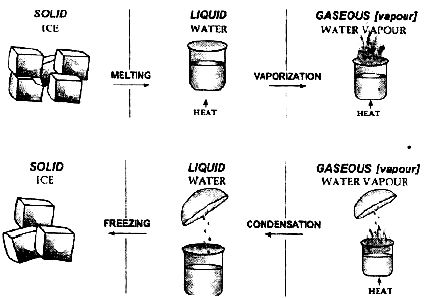
Explain the term ‘Interconversion of matter’. With reference to ice, water, and water vapour show diagrammatically the change of state of matter from solid to liquid to gaseous and back to the original state.
Answer
INTERCONVERSION OF MATTER:
“Change of state of matter from one state to another state and back to its original state is called inter-conversion of matter.”
The diagram showing the Change of State of Matter:

(a) ICE TO WATER (MELTING): Conversion of a solid into a liquid on heating
e.g. ice to water.
(b) WATER TO WATER VAPOUR (VAPORISATION):Conversion of a – liquid into vapours (or gas) on heating
e.g. water to water vapour.
(c) WATER VAPOUR TO WATER (LIQUEFACTION or CONDENSATION):Conversion of VAPOUR (or gas) into a LIQUID on cooling
e.g. water vapour to water.
(d) WATER TO ICE (SOLIDIFICATION OR FREEZING):Conversion of a LIQUID into a SOLID
e.g. water to ice.
View full question & answer
Question 65 Marks
Describe simple experiments to prove that solids have mass
Answer
Have mass – A solid has mass
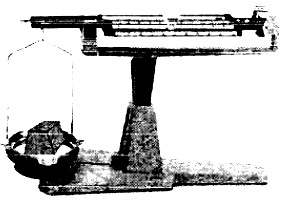
A: A simple scale– is taken, as shown below
B: A solid is placed– on one side of the scale, causes the scale tilts towards one side.
Conclusion– The scale tilts due to the mass of the solid hence all solids have mass.
View full question & answer
Question 75 Marks
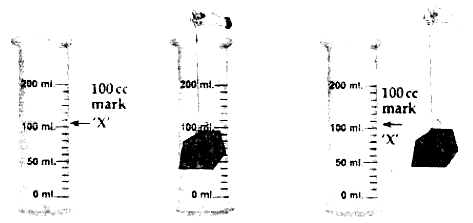
Describe simple experiments to prove that solids occupy space
Answer
occupy space: solid-occupies space
‘A’-A measuring cylinderis filled with water to a particular mark-‘A’.
‘B’-A piece of a wooden block- is immersed inside the measuring cylinder. The water level rises up.
‘C’-On removal of the block- the water level in the measuring cylinder falls down back to the mark- ‘A’
Conclusion: The block pushes the water out and occupies its space, hence all solids occupy space.
View full question & answer
Question 85 Marks
With the help of a simple diagram how would you show that – solids expand on heating
Answer
Solids expand on heating can be shown by two different experiments. The experiments are:
Experiment A: An iron bar is taken and its length measured accurately. The iron bar is then slowly heated for a certain period of time & measured accurately [with a vernier caliper or otherwise]
Observation: It is observed that the iron bar has increased in length on heating.
Experiment B: A simple ball & ring apparatus is taken, which consists of a metal ball which can just pass through the circular metal ring. The metal ball is then heated for a certain period of time.
Observation: After heating, the metal ball does not pass through the ring, since on heating it has expanded in size and hence cannot pass through the ring.
Conclusion: All solids expand on heating.
View full question & answer