Questions

[5 Mark Question Answer]

Take a timed test

10 questions · self-marked practice — reveal the answer and mark yourself.

Question 15 Marks
State two functions of a machine.
Answer
Various functions that a machine can perform are:
  1. Changing the direction of applied force – Example: When a flag is hoisted with the help of a pulley.
  2. Changing the magnitude of applied force – Example: Bottle opener multiplies the applied force and much less effort is required to open the cap.
  3. Applying force at a convenient point – Example: In a pair of scissors, the input force is applied at the handle of the scissors which cuts the paper at the other end of the blade.
  4. Changing the speed of an object – Example: While riding a bicycle, force is applied on pedals which multiplies the speed.
View full question & answer
Question 25 Marks
What care would you take to increase the life span of a machine which you use?
Answer
Taking care of machines: Some of the ways in which machines should be cared for are given below:
  1. Machines should be kept in a clean environment, which is free from dust and moisture.
  2. When not in use, machines should be kept covered to prevent the collection of dust on them.
  3. Machines made of iron should be protected from rust by coating them with paint.
  4. The moving parts of a machine should be regularly oiled with good-quality machine oil to reduce friction and wear and tear. The above care of machines increases their life.
View full question & answer
Question 35 Marks
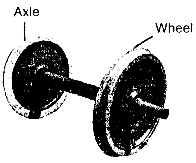
How does a wheel help in moving the axle?
Answer
The wheel-and-axle arrangement consists of two cylinders of different diameters joined together such that if one is made to rotate, the other also rotates. The axle is a cylindrical rod fixed to the centre of a circular disc-like object called the wheel.

This machine acts as a speed multiplier device.
In riding a bicycle, when we apply force on the wheel (by pedal), the fixed axle rotates with it easily. This force that turns the axle produces a much larger movement of the wheel.
View full question & answer
Question 45 Marks
State three differences between the three classes of levers.
Answer
Class I Class II Class III
1. It has the fulcrum between the load and effort. It has the load between the fulcrum and effort. It has an effort between the fulcrum and the load.
2. The effort arm can be shorter, equal to or longer than the load arm. The effort arm is bigger than the load arm. The effort arm is always shorter than the load arm.
3. The mechanical advantage can be less than, equal to, or greater than 1. The mechanical advantages are always greater than 1. The mechanical advantages are always less than 1.
4. The load and effort are in the same direction. The load and effort are in opposite directions. The load and effort are in opposite directions.
View full question & answer
Question 55 Marks
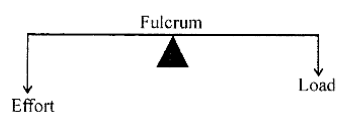
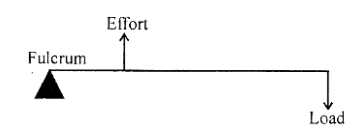
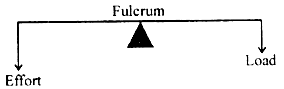
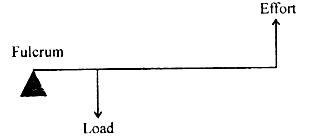
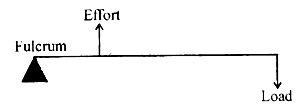
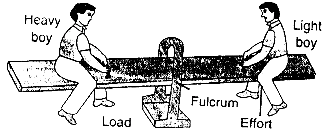
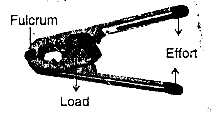
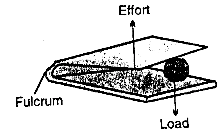
The diagram given below shows the three kinds of levers. Name the class of each lever and give one example of each class.
(a)

(b)

Image
(c)
Image
Answer
(a) Class I Lever

Examples: The examples of class I levers are: a see-saw, a pair of scissors, a pair of pliers, crowbar, common balance, spoon opening the lid of a tin can, handle of a hand pump.
(b) Class II Lever

Examples: The examples of the lever of class II are: nutcracker, wheelbarrow, paper cutter, mango, lemon squeezer, bottle opener.
(c) Class II Lever

Examples: The examples of levers of class III are: a pair of tongs, sugar tongs, knife, forceps,-forearm of a person holding a load, spade for lifting soil or coal.
View full question & answer
Question 65 Marks
Describe three orders of levers giving an example of each. Draw neat diagrams showing the positions of fulcrum, load, and effort in each kind of lever.
Answer
The levers are of three kinds :
Class I levers that have fulcrum in between the load and the effort.
Eg. See - Saw

Class II levers which have load in between the fulcrum and the effort
Eg. - Nut - Cracker

Class Ill levers which have effort in between the fulcrum and the Load
Eg. - Forceps.
View full question & answer
Question 75 Marks
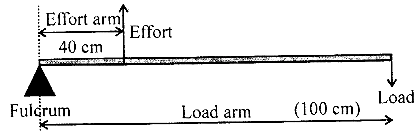
A lever of length 100 cm has the effort of 15 kgf at a distance of 40 cm from the fulcrum at one end. What load can be applied at its other end?
Answer

Given,
Effort $=15 kgf$
Load arm $=100 cm$
Effort $arm =40 cm$
Mechanical advantage $=\frac{\text { Effort arm }}{\text { Load arm }}=\frac{40}{100}=0.4$
By definition,
Mechanical advantage $=\frac{\text { Load }}{\text { Effort }}$
$\therefore 0.4=\frac{\text { Load }}{15 kgf }$
$\Rightarrow$ Load $=15 kgf \times 0.4$
$\therefore$ Load $=6 kgf$
View full question & answer
Question 85 Marks
Answer the following in detail.
Differentiate between a single fixed pulley and a single movable pulley.
Answer
Single fixed pulley Single movable pulley
(1) This pulley has a fixed axis of rotation. (1) The axis of rotation of this pulley is not fixed.
(2) The load is attached to one end of the rope. (2) The load is attached to the pulley.
(3) Only the direction of the force is changed, not the magnitude,[We can lift the object higher but the heaviness of load remains the same] (3) The direction of the force as well as the magnitude of force change.
(4) The mechanical advantage of this pulley is 1. (4) The mechanical advantage of this pulley is 2.
(5) Example: Used to draw water from wells. (5) Example: Used in construction cranes, Weight lifting, machines in the gym, etc.
View full question & answer
Question 95 Marks
Answer the following in detail.
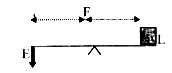
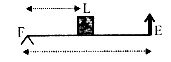
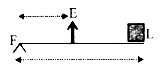
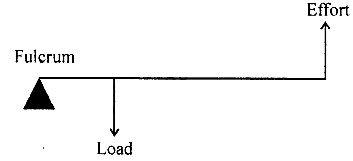
Draw simplified diagrams by clearly showing the position of load, effort, and fulcrum for Class I, Class II, and Class III levers.
Answer
Class I –

Class II –

Class III –
View full question & answer
Question 105 Marks
Answer the following in short.
Explain the various functions that a machine can perform.
Answer
Various functions that a machine can perform are :
  1. Changing the direction of applied force − Example: When a flag is hoisted with the help of a pulley.
  2. Changing the magnitude of applied force Example: Bottle opener multiplies the applied force and much less effort is required to open the cap.
  3. Applying force at a convenient point − Example: hi a pair of scissors, the input force is applied at the handle of the scissors which cuts the paper at the other end of the blade.
  4. Changing the speed of an object − Example: While riding a bicycle, force is applied on pedals which multiplies the speed.
View full question & answer
[5 Mark Question Answer] - PHYSICS STD 6 Questions - Vidyadip