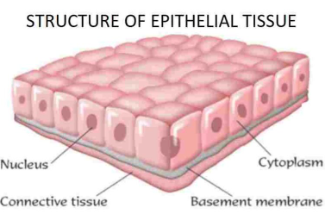
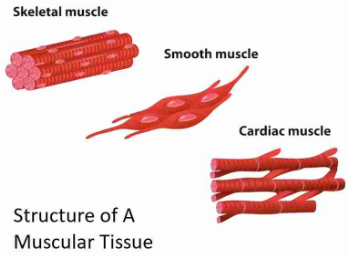
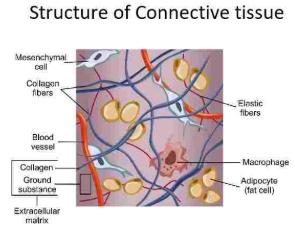
Question 14 MarksDescribe the structure and function of following tissuesEpithelial tissue, Muscular Tissue, Nervous Tissue, Connective tissue.AnswerThe structure and function of the following tissues are :-(a) Epithelial tissue: Epithelial tissue is a protective tissue. It forms a continuous outer layer all over the body as a part of the skin. It also forms a lining of all organs such as the stomach, oesophagus (food pipe), mouth, intestine, and trachea (windpipe).Structure: The structure of the cell may be flattened, cuboidal or columnar.Functions: Protection, Absorption, and Secretion (b) Muscular Tissue: The movement of body or its parts in most animals is brought about by a group of cells which show the property of contraction relaxation. These cells are called muscular cells.Structure: Cardiac, smooth, and skeletal are the structures of muscular tissue.Function: Muscular tissues helps our body in movement, posture, joint stability, and heat production.(c) Nervous Tissue: Nervous tissue is found in the brain, spinal cord, and nerves. It is responsible for coordinating and controlling many body activities.Structure: Nervous tissue is made up of different types of nerve cells, all of which have an axon. An axon is the long stem-like part of the cell that sends action potential signals to the next cell.Function: It is responsible for coordinating and controlling many body activities.(d) Connective tissue: Connective tissue are the type of tissues that binds and supports other tissues of the body. The types of connective tissue include cartilage, bone, tendon, adipose tissue.Structure: It is made up of a few cells present in the intercellular framework of protein fibres secreted by the cells.; Function: It connects different tissues of the body and provides shape and support to it. It also reserves food material in the form of fat.View full question & answer→