Question 12 Marks
By what rational number should we multiply $\frac{20}{-9}$, so that the product may be $\frac{-5}{9} ?$
Answer
$\begin{aligned} & \text { Required number }=\frac{-5}{9} \div\left(\frac{20}{-9}\right) \\ & \Rightarrow \frac{-5}{9} \times\left(\frac{-9}{20}\right)=\frac{1}{4} \\ & \therefore \text { Required number }=\frac{1}{4}\end{aligned}$
View full question & answer→Question 22 Marks
The product of two numbers is 14 . If one of the numbers is $\frac{-8}{7}$, find the other.
Answer$\because$ Product of two numbers $=14$
and one of these two numbers $=\frac{-8}{7}$
The other number $=14 \div \frac{-8}{7}$
$=14 \times-\frac{7}{8}=-\frac{98}{8}=\frac{-49}{4}$
View full question & answer→Question 32 Marks
Divide: $\frac{21}{44}$ by $-\frac{11}{9}$
Answer$\frac{21}{44}$ by $-\frac{11}{9}$
$ =\frac{21}{44} \div\left(-\frac{11}{9}\right) \Rightarrow \frac{21}{44} \times-\frac{9}{11} $
$ =\frac{21 \times(-9)}{44 \times 11}=-\frac{189}{484} $
View full question & answer→Question 42 Marks
Divide: -14 by $\frac{7}{-2}$
Answer
$\begin{aligned} & -14 \text { by } \frac{7}{-2} \\ & =-14 \text { by } \frac{7}{-2} \Rightarrow-14 \times \frac{-2}{7} \\ & =\frac{-2 \times(-2)}{1 \times 1}=4\end{aligned}$
View full question & answer→Question 52 Marks
Divide: $\frac{15}{28}$ by $\frac{3}{4}$
Answer
$\begin{aligned} & \frac{15}{28} \text { by } \frac{3}{4} \\ & =\frac{15}{28} \div \frac{3}{4} \Rightarrow \frac{15}{28} \times \frac{4}{3} \\ & =\frac{5}{7} \times \frac{1}{1}=\frac{5}{7}\end{aligned}$
View full question & answer→Question 62 Marks
Multiply: -24 and $\frac{5}{16}$
Answer
$\begin{aligned} & -24 \text { and } \frac{5}{16} \\ & =\frac{-24 \times 5}{16}=\frac{-3 \times 5}{2} \\ & =\frac{-15}{2}=-7 \frac{1}{2}\end{aligned}$
View full question & answer→Question 72 Marks
Multiply: $3 \frac{3}{5}$ and -10
Answer
$\begin{aligned} & 3 \frac{3}{5} \text { and }-10 \\ & =\frac{3 \times 5+3}{5} \times(-10) \\ & =\frac{18}{5} \times(-10)=18 \times(-2)=-36\end{aligned}$
View full question & answer→Question 82 Marks
Multiply: $6 \frac{2}{3}$ and $-\frac{3}{8}$
Answer
$6 \frac{2}{3}$ and $-\frac{3}{8}$
$ =\frac{20}{3} \times \frac{-3}{8}=\frac{20 \times(-3)}{3 \times 8} $
$ =\frac{5 \times(-1)}{1 \times 2}=\frac{-5}{2}=-2 \frac{1}{2} $
View full question & answer→Question 92 Marks
Multiply: 35 and $\frac{-18}{25}$
Answer
$\begin{aligned} & 35 \text { and } \frac{-18}{25} \\ & =35 \times \frac{-18}{25}=\frac{35 \times(-18)}{25}=\frac{7 \times(-18)}{5} \\ & =\frac{-126}{5}=-25 \frac{1}{5}\end{aligned}$
View full question & answer→Question 102 Marks
Multiply: $2 \frac{1}{14}$ and -7
Answer
$\begin{aligned} & 2 \frac{1}{14} \text { and }-7 \\ & =\frac{2 \times 14+1}{14} \times(-7)=\frac{29}{14} \times(-7) \\ & =\frac{29 \times(-1)}{2}=\frac{-29}{2}\end{aligned}$
View full question & answer→Question 112 Marks
Multiply: $\frac{-13}{15}$ and $\frac{-25}{26}$
Answer
$\begin{aligned} & \frac{-13}{15} \text { and } \frac{-25}{26} \\ & \frac{-13 \times-25}{15 \times 26}=\frac{-1 \times-5}{3 \times 2}=\frac{5}{6}\end{aligned}$
View full question & answer→Question 122 Marks
Multiply: $6 \frac{2}{3}$ and $\frac{-3}{8}$
Answer
$\begin{aligned} & 6 \frac{2}{3} \text { and } \frac{-3}{8} \\ & \frac{20}{3} \times \frac{-3}{8}=\frac{20 \times(-3)}{3 \times 8} \\ & =\frac{5 \times(-1)}{1 \times 2}=\frac{-5}{2}\end{aligned}$
View full question & answer→Question 132 Marks
Multiply: $1 \frac{1}{8}$ and $10 \frac{2}{3}$
Answer
$\begin{aligned} & 1 \frac{1}{8} \text { and } 10 \frac{2}{3} \\ & =\frac{9}{8} \times \frac{32}{3}=\frac{9 \times 32}{8 \times 3}=3 \times 4=12\end{aligned}$
View full question & answer→Question 142 Marks
Evaluate: $\frac{-45}{39} \times \frac{-13}{15}$
Answer
$\begin{aligned} & \frac{-45}{39} \times \frac{-13}{15} \\ & =\frac{(-45) \times(-13)}{39 \times 15}=\frac{(-3) \times(-1)}{3 \times 1} \\ & =\frac{3}{3}=1\end{aligned}$
View full question & answer→Question 152 Marks
If 6 identical articles can be bought for ₹ $2 \frac{6}{17}$. Find the cost of each article.
AnswerCost of 6 articles $=$ ₹ $2 \frac{6}{17}$
$=\frac{2 \times 17+6}{17}=$ ₹$\frac{40}{17}$
Cost of each article $=\frac{40}{17} \div 6$
$=\frac{40}{17} \times \frac{1}{6}=$ ₹$\frac{20}{51}$
View full question & answer→Question 162 Marks
Subtract: $\frac{-8}{15}$ from 0
Answer
$\begin{aligned} & \frac{-8}{15} \text { from } 0 \\ & =0-\left(\frac{-8}{15}\right) \\ & =0+\frac{8}{15}=\frac{8}{15}\end{aligned}$
View full question & answer→Question 172 Marks
Subtract: $\frac{-16}{21}$ from 1
Answer
$\begin{aligned} & \frac{-16}{21} \text { from } 1 \\ & =\frac{1}{1}-\left(\frac{-16}{21}\right) \\ & =\frac{1}{1}+\frac{16}{21}=\frac{1 \times 21+16}{21} \\ & =\frac{21+16}{21}=\frac{37}{21}\end{aligned}$
View full question & answer→Question 182 Marks
Subtract: $\frac{-4}{11}$ from -2
Answer
$\begin{aligned} & \frac{-4}{11} \text { from }-2 \\ & =\frac{-2}{1}-\left(\frac{-4}{11}\right)=\frac{-2 \times 11}{1 \times 11}+\frac{4 \times 1}{11 \times 1} \\ & =\frac{-22}{11}+\frac{4}{11} \\ & =\frac{-22+4}{11}=\frac{-18}{11}\end{aligned}$
View full question & answer→Question 192 Marks
Subtract: $\frac{-2}{15}$ from $\frac{-8}{15}$
Answer
$\begin{aligned} & \frac{-2}{15} \text { from } \frac{-8}{15} \\ & =\frac{-8}{15}-\left(\frac{-2}{15}\right) \\ & =\frac{-8}{15}+\frac{2}{15}=\frac{-8+2}{15}=\frac{-6}{15}=\frac{-2}{5}\end{aligned}$
View full question & answer→Question 202 Marks
Subtract: $\frac{-6}{11}$ from $\frac{-3}{-11}$
Answer
$\begin{aligned} & \frac{-6}{11} \text { from } \frac{-3}{-11} \\ & =\frac{3}{11}-\left(-\frac{6}{11}\right) \\ & =\frac{3}{11}+\frac{6}{11}=\frac{3+6}{11}=\frac{9}{11}\end{aligned}$
View full question & answer→Question 212 Marks
Add: $\frac{-2}{5}$ and $\frac{3}{7}$
Answer
$\begin{aligned} & \frac{-2}{5} \text { and } \frac{3}{7} \\ & =\frac{-2 \times 7}{5 \times 7}+\frac{3 \times 5}{7 \times 5} \\ & (\because \text { L.C.M. of } 5 \text { and } 7=35) \\ & =\frac{-14}{35}+\frac{15}{35} \\ & =\frac{-14+15}{35}=\frac{1}{35}\end{aligned}$
View full question & answer→Question 222 Marks
Compare: $\frac{-5}{8}$ and $\frac{7}{-12}$
Answer
$\begin{aligned} & \frac{-5}{8} \text { and } \frac{7}{-12} \\ & -5 \times-12 \text { and } 7 \times 8 \\ & 60>56 \\ & \therefore \frac{-5}{8}>\frac{7}{-12}\end{aligned}$
View full question & answer→Question 232 Marks
Compare: $\frac{2}{7}$ and $\frac{-3}{-8}$
Answer
$\begin{aligned} & \frac{2}{7} \text { and } \frac{-3}{8} \\ & 2 \times 8 \text { and } 7 \times-3 \\ & \left(\because \frac{a}{b} \text { and } \frac{c}{d} \Rightarrow a \times d \text { and } b \times c\right) \\ & 16>-21 \quad(\because a \times d>b \times c) \\ & \therefore \frac{2}{7}>\frac{-3}{8}\end{aligned}$
View full question & answer→Question 242 Marks
Compare: $\frac{-7}{8}$ and $\frac{5}{-6}$
Answer
$\begin{aligned} & \frac{-7}{8} \text { and } \frac{5}{-6} \\ & -7 \times-6 \text { and } 5 \times 8 \\ & \left(\therefore \frac{a}{b} \text { and } \frac{c}{d} \Rightarrow \mathrm{a} \times \mathrm{d} \text { and } \mathrm{b} \times \mathrm{c}\right) \\ & 42>40 \quad(\because \mathrm{a} \times \mathrm{d}>\mathrm{b} \times \mathrm{c}) \\ & \therefore \frac{-7}{8}>\frac{5}{-6}\end{aligned}$
View full question & answer→Question 252 Marks
Compare: $\frac{-5}{8}$ and $\frac{7}{-12}$
Answer
$\begin{aligned} & \frac{-5}{8} \text { and } \frac{7}{-12} \\ & \frac{-5}{8} \times 24, \frac{7}{-12} \times 24 \\ & \left(\therefore \frac{\mathrm{a}}{\mathrm{b}} \text { and } \frac{\mathrm{c}}{\mathrm{d}} \Rightarrow \mathrm{a} \times \mathrm{d} \text { and } \mathrm{b} \times \mathrm{c}\right) \\ & -15,-14 \\ & 15>14(\because \mathrm{a} \times \mathrm{d}>\mathrm{b} \times \mathrm{c}) \\ & \therefore \frac{-5}{8}>\frac{7}{-12}\end{aligned}$
View full question & answer→Question 262 Marks
Compare: $\frac{-3}{8}$ and $\frac{2}{5}$
Answer$\frac{-3}{8}$ and $\frac{2}{5}$
$-3 \times 5$ and $2 \times 8$
$\left(\therefore \frac{a}{b}\right.$ and $\frac{c}{d} \Rightarrow \mathrm{a} \times \mathrm{d}$ and $\left.\mathrm{b} \times \mathrm{c}\right)$
$-15<16 \quad(\because \mathrm{a} \times \mathrm{d}<\mathrm{b} \times \mathrm{c})$
$\therefore-\frac{3}{8}<\frac{2}{5}$
View full question & answer→Question 272 Marks
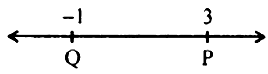
Answer3 and -1
Since, $P$ is on the right of $Q$.
$
\Rightarrow 3>-1
$
View full question & answer→Question 282 Marks
Compare: 0 and $\frac{3}{4}$
AnswerCompare: 0 and $\frac{3}{4}$
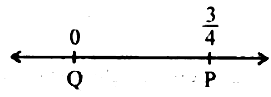
Since, $P$ is on the right of $Q$.
$
\Rightarrow \frac{3}{4}>0
$ View full question & answer→Question 292 Marks
Compare: $-1 \frac{1}{2}$ and 0 or $-\frac{3}{2}$ and 0
Answer$-1 \frac{1}{2}$ and 0 or $-\frac{3}{2}$ and 0
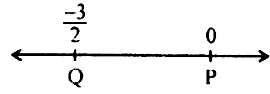
Since, $P$ is on the right of $Q$.
$
\Rightarrow 0>\frac{-3}{2}
$ View full question & answer→Question 302 Marks
Compare: -3 and $2 \frac{3}{4}$ or $\frac{11}{4}$
Answer$-3$ and $2 \frac{3}{4}$ or $\frac{11}{4}$
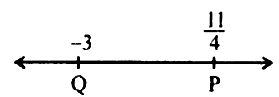
Since, $P$ is on the right of $Q$.
$\therefore \frac{11}{4}>-3 \text { or } 2 \frac{3}{4}>-3$ View full question & answer→Question 312 Marks
Compare: $\frac{-7}{2}$ and $\frac{5}{2}$
Answer$\frac{-7}{2}$ and $\frac{5}{2}$
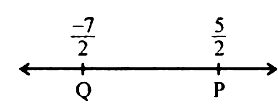
Since, $P$ is on the right of Q.
$\therefore \frac{5}{2}>\frac{-7}{2}$ View full question & answer→Question 322 Marks
Compare: $\frac{3}{5}$ and $\frac{5}{7}$
Answer$\frac{3}{5}$ and $\frac{5}{7}$
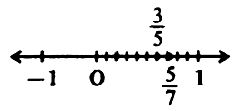
Since $\frac{5}{7}$ is on the right side of the number line.
$
\therefore \frac{5}{7}>\frac{3}{5}
$ View full question & answer→Question 332 Marks
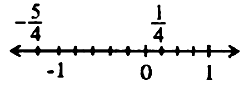
Mark the following pairs of rational numbers on the separate number lines: $\frac{1}{4}$ and $-\frac{5}{4}$
Answer$\frac{1}{4}$ and $-\frac{5}{4}$
View full question & answer→Question 342 Marks
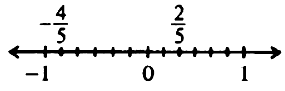
Mark the following pairs of rational numbers on the separate number lines: $\frac{2}{5}$ and $-\frac{4}{5}$
Answer$\frac{2}{5}$ and $-\frac{4}{5}$
View full question & answer→Question 352 Marks
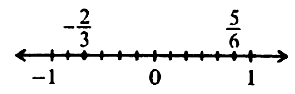
Mark the following pairs of rational numbers on the separate number lines: $\frac{5}{6}$ and $\frac{-2}{3}$
Answer$\frac{5}{6}$ and $\frac{-2}{3}$
View full question & answer→Question 362 Marks
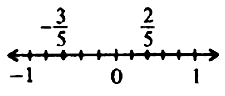
Mark the following pairs of rational numbers on the separate number lines: $\frac{2}{5}$ and $\frac{-3}{5}$
Answer$\frac{2}{5}$ and $\frac{-3}{5}$
View full question & answer→Question 372 Marks
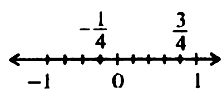
Mark the following pairs of rational numbers on the separate number lines: $\frac{3}{4}$ and $-\frac{1}{4}$
Answer$\frac{3}{4}$ and $-\frac{1}{4}$
View full question & answer→Question 382 Marks
Find three rational numbers equivalent to $\frac{8}{-15}$
Answer$ \frac{8}{-15}=\frac{8 \times 2}{-15 \times 2}=\frac{16}{-30}, \frac{8 \times 3}{-15 \times 3}=\frac{24}{-45} $
and $\frac{8 \times 4}{-15 \times 4}=\frac{32}{-60}$
Hence $\frac{16}{-30}, \frac{24}{-45}$ and $\frac{32}{-60}$ are rational numbers equivalent to given rational number $\frac{8}{-15}$.
View full question & answer→Question 392 Marks
Find three rational numbers equivalent to $\frac{4}{-7}$
Answer$ \frac{4}{-7}=\frac{4 \times 2}{-7 \times 2}=\frac{8}{-14}, \frac{4 \times 3}{-7 \times 3}=\frac{12}{-21} $
and $\frac{4 \times 4}{-7 \times 4}=\frac{16}{-28}$
Hence $\frac{8}{-14}, \frac{12}{-21}$ and $\frac{16}{-28}$ are rational numbers equivalent to given rational number $\frac{4}{-7}$.
View full question & answer→Question 402 Marks
Find three rational numbers equivalent to $\frac{3}{5}$
Answer
$ \begin{aligned} & \frac{3}{5}=\frac{3 \times 2}{5 \times 2}=\frac{6}{10}, \frac{3 \times 3}{5 \times 3}=\frac{9}{15} \\ & \text { and } \frac{3 \times 4}{5 \times 4}=\frac{12}{20} \end{aligned} $
Hence, $\frac{6}{10}, \frac{9}{15}$ and $\frac{12}{20}$ are rational numbers equivalent to the given rational number $\frac{3}{5}$.
View full question & answer→Question 412 Marks
Write down a rational number numerator (-5) x (-4) and denominator (28 – 27) x (8 – 5).
Answer
$\begin{aligned} & \text { Numerator }=(-5) \times(-4)=20 \\ & \text { Denominator }=(28-27) \times(8-5) \\ & =(1) \times(3)=3 \\ & \therefore \text { Rational number }=\frac{20}{3}\end{aligned}$
View full question & answer→