Questions

[5 Mark Question Answer]

🎯

Test yourself on this topic

11 questions · timed · auto-graded

Question 15 Marks
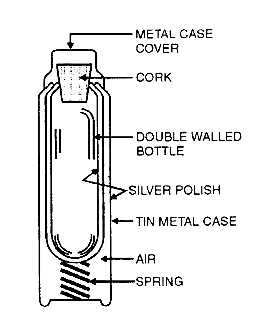
Draw a labelled diagram of a thermo flask. Explain how the transfer of heat by conduction, convection and radiation is reduced to a minimum in it.
Answer
Heat transfer is minimised because of:
(1) The vacuum between the two walls, rubber, glass, cork and air do not allow the loss of heat by conduction.
(2) Cork in the neck of flask and the cup over it prevent loss of heat by convection.
(3) Heat cannot be lost by conduction or convection because of vacuum between the two walls.
(4) Heat loss is also minimised by radiation, by making outer surface of inner wall and inner surface of outer wall silvered. The inner wall is a BAD RADIATOR and the outer wall is a GOOD REFLECTOR of radiation.
View full question & answer
Question 25 Marks
Name two scales of temperature. How are they inter-related?
Answer
Two scales of temperature are
(i) Celsius (ii) Fahrenheit Relation:
Water Freezes at $0^{\circ} \mathrm{C}$ or $32^{\circ} \mathrm{F}$ and boils at $100^{\circ} \mathrm{C}$ or $212^{\circ} \mathrm{F}$
$
\begin{aligned}
& \therefore(212-32)^{\circ} \mathrm{F}=(100-0)^{\circ} \mathrm{C} \\
& 180^{\circ} \mathrm{F}=100^{\circ} \mathrm{C} \\
& 1^{\circ} \mathrm{F}=\left(\frac{5}{9}\right){ }^{\circ} \mathrm{C}
\end{aligned}
$
or $1^{\circ} \mathrm{C}=\left(\frac{9}{5}\right){ }^{\circ} \mathrm{F}$
or $\frac{C-0}{100-0}=\frac{F-32}{212-32}$
or $\frac{C}{100}=\frac{F-32}{180}$
or $\frac{\mathrm{C}}{5}=\frac{\mathrm{F}-32}{9}$
View full question & answer
Question 35 Marks
Explain briefly the process of heat transfer by radiation.
Answer
RADIATION. “The transfer of heat energy from a hot body to cold body directly, without heating the medium between two bodies is called RADIATION.”
The radiant heat or thermal radiation is of the form of ELECTROMAGNETIC WAVES. These waves can travel even in vacuum in all directions in straight line with the speed of light. They do not heat the medium through which they pass. Heat radiations are also called INFRA-RED RADIATIONS because the wavelength of heat radiations is longer than that of visible light. These radiations can cause heating effect only if they are absorbed by some material
View full question & answer
Question 45 Marks
What are the land and sea breezes? Explain their formation.
Answer
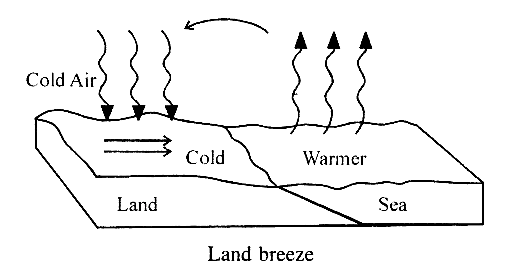
LAND BREEZE : Blowing of breeze (air) from land towards sea is called land breeze.
During night land and sea water both lose heat. Specific heat capacity of land being very low as compared to that of sea water, land loses heat energy fast and cools more rapidly as compared to sea. Sea water being at higher temperature, the air above it becomes lighter and rise up. Air from land being at higher pressure. So air from land starts blowing towards sea and gives rise to Land Breeze.

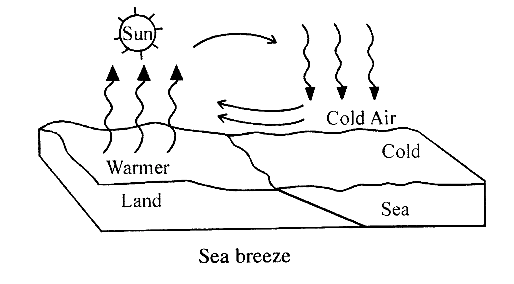
SEA BREEZE: Blowing of breeze (cold air) from the sea towards land during the day is called the SEA BREEZE. During day time land and sea both are heated equally by the sun, but land has very low specific heat capacity as compared to sea, is heated up more quickly. Thus air above land due to heat becomes lighter and rises up. Thus pressure decreases and cold and humid air above the sea starts blowing towards land, thereby giving rise to SEABREEZE.
View full question & answer
Question 55 Marks
Why is a ventilator provided in a room?
Answer
Ventilators and windows are provided in rooms for proper ventilation. The reason is that when we breathe out in a room, the air in the room becomes warm and impure. The warm air is less dense i.e. lighter, so it rises up and moves out through the ventilators. Then the cold fresh air comes in the room through the windows to take its place. Thus the continuous circulation of fresh air keeps the air in the room fresh.
View full question & answer
Question 65 Marks
State the direction of heat transfer by way of convection.
Answer
By the process of convection, heat is always transferred vertically upwards. The reason is that the medium particles near the source of heat absorb heat from the source and they start moving faster. As a result, the medium at this place becomes less dense so it rises up and the medium from above being denser, moves down to take its place. Thus, current is set up in the medium which is called a convection current. The current continues till the entire medium acquires the same temperature.
View full question & answer
Question 75 Marks
Describe an experiment to show that air expands on heating.
Answer
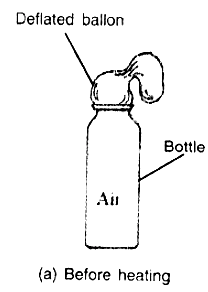
(i) Take an empty bottle. Actually the empty bottle contains air. Attach a rubber balloon to its neck as shown in the following figure. Initially, the balloon is deflated.
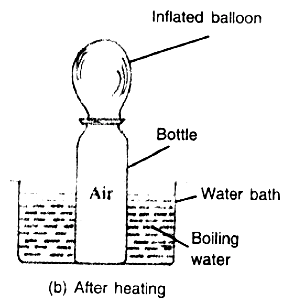
(ii) Place the bottle in a water bath containing boiling water. After some time you will notice that the balloon gets inflated as shown in the following figure. The reason is that the air inside the bottle expands on heating and it fills the balloon.
Thermal expansion of air


(iii) Take the bottle out of the water bath and 7 allow it to cool by itself. We will notice that the balloon gets deflated and it collapses. This is because the air inside the balloon and the bottle have contracted on cooling. The air from the balloon passes to the bottle, so the balloon gets deflated.
View full question & answer
Question 85 Marks
Describe one experiment to show that liquids expand on heating.
Answer
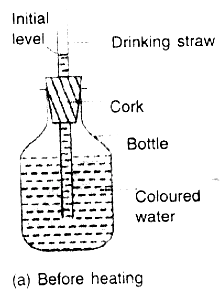
(i) Take an empty bottle with a tight-fitting cork having a hole drilled in its middle, a drinking straw, two bricks, a wire guaze and a burner.
(ii) Fill the bottle completely with water and add a few drops of ink in it to make it colored.
(iii) Fix the cork in the mouth of the bottle and pass the drinking straw through the cork. Put some molten wax around the hole so as to avoid the leakage of water.
(iv) Pour some more water into the drinking straw so that water level in the straw can be seen. Mark the water level in the straw as shown in the following figure.
Thermal expansion of a liquid


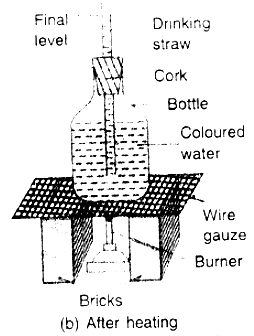
(v) Place the bottle on the wire gauze kept over the two bricks as shown in the following figure. Then heat the bottle by means of a burner.
(vi) Look at the level of water in the straw.
You will notice that as the water is heated more and more, the level of water in the drinking straw rises. This shows that water expands on heating.
View full question & answer
Question 95 Marks
Match the following
Column A Column B
1. mercury 1. insulator
2. wood 2. water from 0°C to 4°C
3. Aluminum 3.absorbs
4. contracts 4.conductor
5.black surface 5. Thermometer
Answer
Column A Column B
1. mercury 5. Thermometer
2. wood 1. insulator
3. Aluminum 4. conductor
4. contracts 2. water from 0°C to 4°C
5.black surface 3. absorbs
View full question & answer
Question 105 Marks
Convert 40°C to the (a) Fahrenheit scale (b) Kelvin Scale.
Answer
(a) Fahrenheit scale
C = 40°C
Substitute value of C = 40° in below equation
$
\begin{aligned}
& \frac{C}{5}=\frac{F-32}{9} \\
& \frac{40}{5}=\frac{F-32}{9} \\
& 8=\frac{F-32}{9} \\
& 8 \times 9=F-32 \\
& 72=F-32 \\
& F=72+32=104
\end{aligned}
$
Solution $=104^{\circ} \mathrm{F}$
(B) t° C = (273 + t ) K
Given t = 40° c
Substitute the value of t in above equation
40°C = (273 + 40) K
40° C = 313 K
Solution = 313 k
View full question & answer
Question 115 Marks
The temperature of a body rises by 1°C. What is the corresponding rise on the (a) Fahrenheit scale (b) Kelvin scale?
Answer
(a) Since 100 divisions on Celsius scale =180 divisions
on the Fahrenheit scale 1 division on Celsius scale
∴ 1 division on Celsius scale
= 1.80 / 1.00 × 1
= 1.8 divisions in the Fahrenheit scale.
For 1°C rise corresponding rise in Fahrenheit = 1.8°F
(b) Since 100 divisions in the Celsius scale = 100 divisions in the Kelvin scale
1 division on Celsius scale = 100 / 100 × 1
= 1 division on Kelvin scale
For 1°C rise corresponding rise in Kelvin is 1 K.
View full question & answer
[5 Mark Question Answer] - PHYSICS STD 7 Questions - Vidyadip