Question 14 Marks
Construct a square, if : each diagonal is $5.7\ cm.$
Answer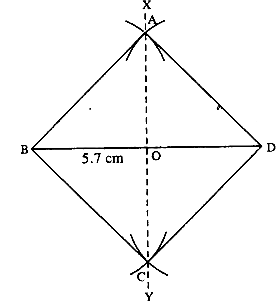
Steps :
- Draw $BD = 5.7 \ cm.$
- Draw perpendicular bisector $XY$ of $BD$.
- From $0$, draw arcs of radii equal to $OB$ which cuts $XY$ at $A$ and $C.$
- Join $AB, AD, BC$, and $CD.$
Thus $ABCD$ is the required square.
View full question & answer→Question 24 Marks
Construct a square, if : one diagonal is $6.2\ cm$.
Answer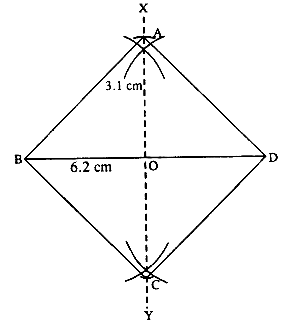
Steps :
- Draw $BD = 6.2 \ cm.$
- Draw perpendicular bisector $XY$ of $BD$.
- Cut $OA = OC = 3.1 \ cm ($half the diagonal$)$
- Join $AB, AD, BC$, and $CD$.
Thus $ABCD$ is the required square.
View full question & answer→Question 34 Marks
Construct a square, if : it's one side is $3.8\ cm.$
Answer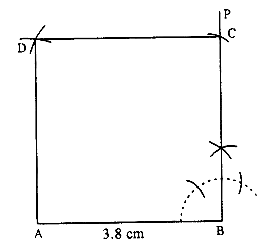
Steps :
- Draw $AB = 3.8 \ cm.$
- At $B$, draw $\angle PBA = 90^\circ .$
- Cut $BC = 3.8 \ cm$.
- From $A$ and $C$, draw arcs of radii $3.8 \ cm$ each which intersect at $D.$
- Join $AD$ and $CD$.
Thus $ABCD$ is the required square.
View full question & answer→Question 44 Marks
Construct a rhombus $ABCD$, if ;diagonal $AC = 6.6 \ cm$ and diagonal $BD = 5.3 \ cm.$
Answer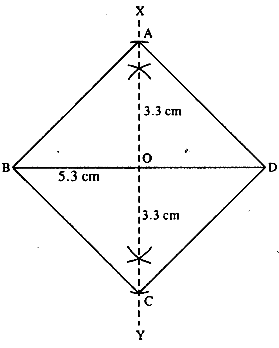
Steps :
- Draw $BD = 5.3 \ cm.$
- Draw perpendicular bisector $XY$ of $BD.$
- Cut $OA = OC = 3.3 \ cm ($half the diagonal $6.6 \ cm)$
- Join $AB, AD, BC$, and $CD$.
Thus $ABCD$ is the required rhombus.
View full question & answer→Question 54 Marks
Construct a rhombus $ABCD$, if ; diagonal $AC = 4.9\ cm$ and diagonal $BD = 6\ cm.$
Answer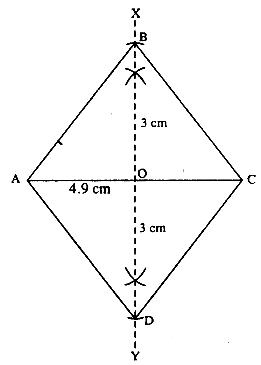
Steps :
- Draw $AC = 4.9 \ cm.$
- Draw perpendicular bisector $XY$ of $AC.$
- Cut $OB = OD = 3 \ cm ($half the diagonal $6 \ cm)$
- Join $AB, BC, AD$, and $CD.$
Thus $ABCD$ is the required rhombus.
View full question & answer→Question 64 Marks
Construct a rhombus $ABCD$, if ;diagonal $AC = 6 \ cm$ and diagonal $BD = 5.8\ cm.$
Answer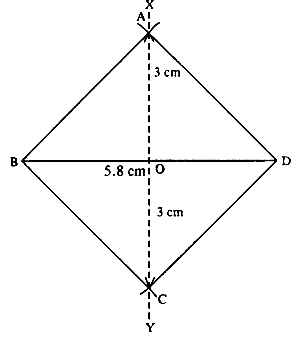
Steps :
- Draw $BD = 5.8 \ cm.$
- Draw perpendicular bisector $XY$ of $BD.$
- Cut $OA = OC = 3 \ cm ($half the diagonal $6 \ cm)$
- Join $AB, AD, BC$, and $CD.$
Thus $ABCD$ is the required rhombus.
View full question & answer→Question 74 Marks
Construct a rhombus $ABCD$, if ;$BC = 4.8\ cm,$ and diagonal $AC = 7\ cm$.
Answer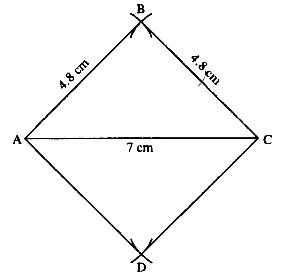
Steps :
- Draw $AC = 7 \ cm.$
- Draw arcs of radii $4.8 \ cm$ each from $A$ and $C$ which intersect at $B.$
- From $A C$ again draw arcs of radii $4.8 \ cm$ each which intersect at $D$.
- Join $AB, BC, AD$, and $CD$.
Thus $ABCD$ is the required rhombus.
View full question & answer→Question 84 Marks
Construct a rhombus $ABCD$, if ;$CD = 5\ cm$ and diagonal $BD = 8.5\ cm.$
Answer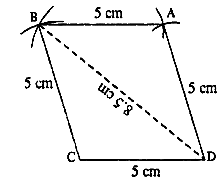
Steps :
- Draw $CD = 5 \ cm.$
- From $C D$ draw arcs of radii $5 \ cm$ and $8.5 \ cm$ respectively which intersect at $B$.
- From $B$ and $D$, draw arcs of radii $5 \ cm$ each which intersect at $A$.
- Join $AB$ and $AD$.
Thus $ABCD$ is the required rhombus.
View full question & answer→Question 94 Marks
Draw a line $AB = 6 cm$. Mark a point $P$ anywhere outside the line $AB$. Through point $P$, construct a line parallel to $AB.$
AnswerSteps of construction :
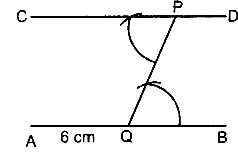
- Draw a line $AB = 6 \ cm$
- Take any point $Q$ on the line $AB$ and join it with the given point $P$.
- At point $P$, construct $\angle CPQ = \angle PQB$
- Produce $CP$ up to any point $D$.
Thus, $CPD$ is the required parallel line.
View full question & answer→Question 104 Marks
Draw a line segment $BC = 4 \ cm$. Construct angle $ABC = 60^\circ .$
AnswerSteps of Construction :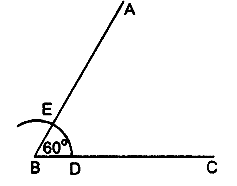
- Draw a line segment $BC = 4 \ cm$
- With $B$ as a centre, draw an arc of any suitable radius which cuts $BC$ at point $D$.
- With $D$ as a centre, and the same radius as in step $2$, draw one more arc which cuts the previous arc at point $E$.
- Join $BE$ and produce it to point $A.$
Thus $\angle ABC = 60^\circ$
View full question & answer→Question 114 Marks
Draw a parallelogram $ABCD$, with $AB = 6 \ cm, AD = 4.8 \ cm$ and $\angle DAB = 45^\circ $. Draw the perpendicular bisector of side $AD$ and let it meet $AD$ at point $P$. Also, draw the diagonals $AC$ and $BD$; and let them intersect at point $O$. Join $O$ and $P$. Measure $OP.$
Answer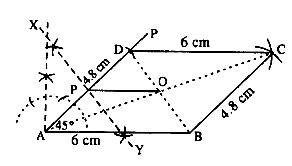
Steps :
- Draw $AB = 6 \ cm.$
- Draw $\angle PAB = 45^\circ .$
- Cut $AD = 4.8 \ cm.$
- From $D$, draw an arc of radius $6 \ cm.$
- From $B$, draw an arc of radius $4.8 \ cm$ which meets the first arc at $C.$
- Join $BC, CD, AD.$
Thus $ABCD$ is the required $||\ gm.$
- Draw perpendicular bisector $XY$ of $AD$ which cuts $AD$ at $P.$
- Join $AC$ and $BD$ which intersect at $O.$
- Join $OP$ and measure it. $OP = 3 \ cm.$
View full question & answer→Question 124 Marks
Using ruler and compasses only, construct a parallelogram $ABCD$, in which : $AB = 6 \ cm, AD = 3 \ cm$ and $\angle DAB = 60^\circ$ . In the same figure draw the bisector of angle $DAB$ and let it meet $DC$ at point $P$. Measure angle $APB.$
Answer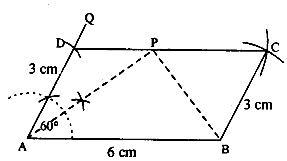
Steps :
- Draw $AB = 6 \ cm.$
- At $A$ draw $\angle QAB = 60^\circ $.
- From $AQ$ cut $AD = 3 \ cm.$
- From $D$, draw an arc of radius $6 \ cm.$
- From $B$, draw an arc of radius $3 \ cm$ which meets the first arc at $C$.
- Join $CD$ and $BC.$
Thus $ABCD$ is the required ||gm.
- Bisect $\angle DAB$, so that bisector meets $CD$ at $P$.
- Join $PB$ and measure $ZAPB.\therefore \angle APB = 90^\circ .$
View full question & answer→Question 134 Marks
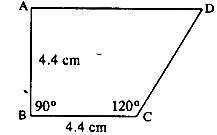
Construct a quadrilateral $ABCD$, such that $AB = BC = CD = 4.4 \ cm, \angle B = 90^\circ$ and $\angle C = 120^\circ .$
AnswerThe rough figure is as follow
The Actual figure is constructed as follow:
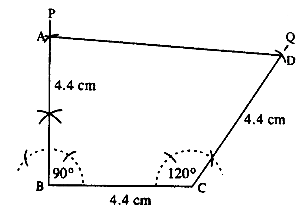
Steps :
- Draw $BC = 4.4 \ cm.$
- At $B$, draw $\angle PBC = 90^\circ$ .
- Cut $BA = 4.4 \ cm.$
- At $C$, draw $\angle QCB = 120^\circ .$
- Cut $CD = 4.4 \ cm.$
- Join $AD.$
Thus $ABCD$ is the required quadrilateral.
View full question & answer→Question 144 Marks
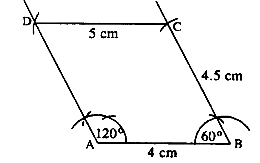
Construct a quadrilateral $ABCD$ in which ; $\angle A = 120^\circ , \angle B = 60^\circ , AB = 4 \ cm, BC = 4.5 \ cm$ and $CD = 5 \ cm.$
AnswerThe rough figure is as follow :
The Actual figure is constructed as follow
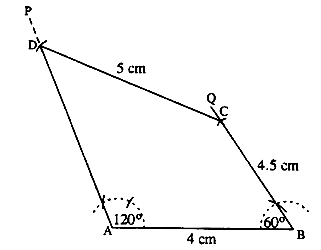
Steps :
- Draw $AB = 4 \ cm.$
- At $A$, draw $\angle PAB = 120^\circ .$
- At $B$, draw $\angle QBA = 60^\circ $.
- From $BQ$, cut $BC = 4.5 \ cm.$
- From $C$, draw an arc of radius $5 \ cm$ which meets $AP $ at $D.$
- Join $CD.$
Thus $ABCD$ is the required quadrilateral.
View full question & answer→Question 154 Marks
Construct a square, if : its each side is $4.3\ cm.$
Answer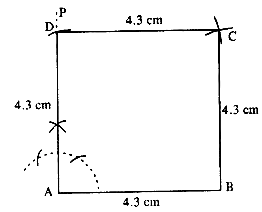
Steps :
- Draw $AB = 4.3 \ cm.$
- Draw $\angle PAB = 90^\circ$ at $A$.
- Cut $AD = 4.3 \ cm.$
- From $B$ and $D$, draw arcs of radii $4.3 \ cm$ each which intersect at $C.$
- Join $AD, BC$, and $CD.$
Hence $ABCD$ is the required square.
View full question & answer→Question 164 Marks
Construct a rhombus $ABCD$, if ; $ BC = 4.7 \ cm$ and $\angle B = 75^\circ .$
Answer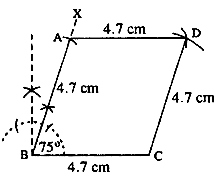
Steps :
- Draw $BC = 4.7 \ cm.$
- At $B$, draw $\angle XBC = 75^\circ$
- Cut $BA = 4.7 \ cm.$
- From $A$ and $C$, draw arcs of radii $4.7 \ cm$ each which intersect at D.
- Join $AD$ and $CD.$
Thus $ABCD$ is the rhombus.
View full question & answer→Question 174 Marks
Construct a rhombus $ABCD$, if ; $AB = 4 \ cm$ and $\angle B = 120^\circ .$
Answer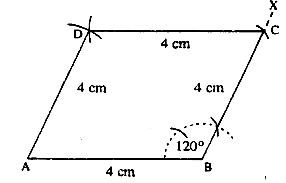
Steps :
- Draw $AB = 4 \ cm.$
- At $B$, draw $\angle XBA = 120^\circ$
- Cut $BC = 4 \ cm.$
- Draw arcs of radii $4 \ cm$ each from $A$ and $C$ which intersect at $D.$
- Join $CD$ and $AD.$
Thus $ABCD$ is the required rhombus.
View full question & answer→Question 184 Marks
Construct a rectangle $ABCD$; if :each diagonal is $5.5 \ cm$ and the angle between them is $60^\circ .$
Answer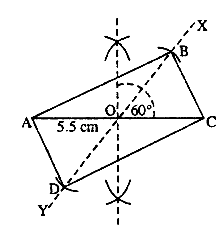
Steps :
- Draw $AC = 5.5 \ cm.$
- Bisect $AC$ at $O.$
- At $O$, draw $\angle XOC = 60^\circ$ and produce $XO$ to $ Y.$
- Cut $OB = OA$ and $OD = OA ($half the diagonal $AC).$
- Join $AB, BC, AD$, and $CD$.
Thus $ABCD$ is the required rectangle.
View full question & answer→Question 194 Marks
Construct a rectangle $ABCD$; if : each diagonal is $6 \ cm$ and the angle between them is $45^\circ .$
Answer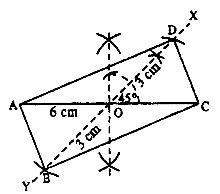
Steps :
- Draw $AC = 6 \ cm.$
- Bisect $AC$ at $O.$
- At $O$, draw $\angle XOC = 45^\circ $ and produce $XO$ to $Y.$
- Cut $OB = OD = 3 \ cm ($half the diagonal $6 \ cm)$
- Join $AB, CB, AD$, and $CD$.
Thus $ABCD$ is the required rectangle.
View full question & answer→Question 204 Marks
Construct a rectangle $ABCD$; if : $AD = 4.8 \ cm$ and diagonal $AC = 6.4 \ cm.$
Answer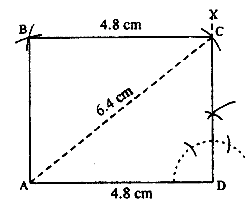
Steps :
- Draw $AD = 4.8 \ cm.$
- At $D$, draw $\angle XDA = 90^\circ .$
- From $A$, draw an arc of radius $6-4 \ cm$ which meets $DX$ at $C$.
- From $A$, draw an arc of radius equal to $DC$.
- From $C$, draw an arc of radius $4.8 \ cm$ which meets the first arc at $B.$
- Join $AB$ and $CB$. Thus $ABCD$ is the required rectangle.
View full question & answer→Question 214 Marks
Construct a rectangle ABCD; if :$AB = 5.0 \ cm$ and diagonal $AC = 6.7 \ cm.$
Answer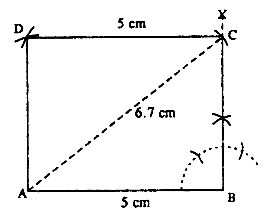
Steps :
- Draw $AB = 5 \ cm.$
- At $B$, draw $\angle XBA = 90^\circ .$
- From $A$, draw an arc of radius $6.7 \ cm$ which meets $XB$ at $C.$
- From $C$, draw an arc of a radius of $5 \ cm.$
- From $A$, draw an arc of radius equal to $BC$ which meets the first arc at $D$.
- Join $AD$ and $CD$. Thus $ABCD$ is the required rectangle.
View full question & answer→Question 224 Marks
Construct a rectangle $ABCD$ ; if : $BC = 6.1 \ cm$ and $CD = 6.8 \ cm.$
Answer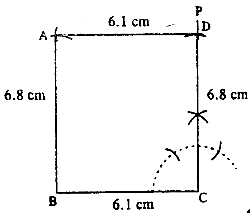
Steps:
- Draw $BC = 6.1 \ cm.$
- At $C$, draw $\angle PCB = 90^\circ .$
- Cut $CD = 6.8 \ cm.$
- Draw an arc of radius $6.8 \ cm$ from $B.$
- From $D$, draw an arc of radius $6.1 \ cm$ which meets the first arc at $A$.
- Join $AB$ and $AD.$
Thus $ABCD$ is the required rectangle.
View full question & answer→Question 234 Marks
Construct a rectangle $ABCD$; if : $AB = 4.5 \ cm$ and $BC = 5.5 \ cm.$
Answer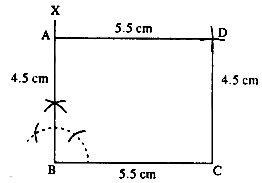
Steps :
- Draw $BC = 5.5 \ cm.$
- At $B$, draw $\angle XBC = 90^\circ$
- Cut $BA = 4.5 \ cm.$
- From $A$, draw an arc of radius $5.5 \ cm.$
- From $C$, draw an arc of radius $4 5 \ cm$ which meets the first arc at $D$.
- Join $AD$ and $CD$.
Thus $ABCD$ is the required rectangle.
View full question & answer→Question 244 Marks
Construct a parallelogram $ABCD$, if :lengths of diagonals $AC$ and $BD$ are $5.4 \ cm$ and $6.7 \ cm$ respectively and the angle between them is $60^\circ .$
Answer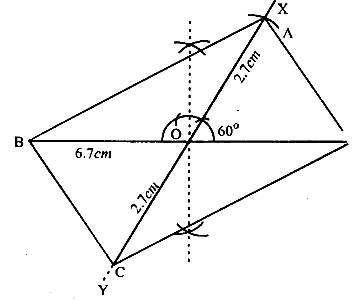
Steps :
- Draw $BD\ 6.7 \ cm.$
- Bisect $BD$ at $O.$
- At $O$, draw $\angle XOD = 60^\circ$ and produce $XO$ to $Y.$
- Cut $OA = OC = 2.7 \ cm ($half the diagonals $5.4 \ cm)$
- Join $AB$, $AD, BC$, and $CD.$
Thus $ABCD$ is the required $||\ gm.$
View full question & answer→Question 254 Marks
Construct a parallelogram $ABCD$, if : lengths of diagonals $AC$ and $BD$ are $6.3 \ cm$ and $7.0 \ cm$ respectively, and the angle between them is $45^\circ .$
Answer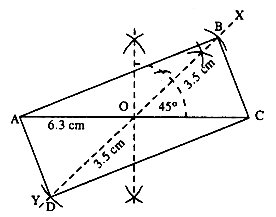
Steps :
- Draw $AC = 6.3 \ cm.$
- Bisect $AC$ at $O$.
- At $O$, draw $\angle XOC = 45^\circ$ and produce $XO$ to $Y.$
- Cut $OB = OD = 3.5 \ cm ($half the diagonal $7 \ cm.)$
- Join $AB, CB, AD$, and $CD$. Thus $ABCD$ is the required $\ || gm.$
View full question & answer→Question 264 Marks
Construct a parallelogram $ABCD$, if :diagonal $AC = 6.4 \ cm$, diagonal $BD = 5.6 \ cm$ and angle between the diagonals is $75^\circ .$
AnswerThe rough figure is as follows.
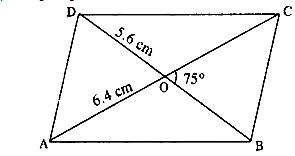
Diagonals of $|| gm$ bisect each other.
$\therefore OB = OD = `1/2`BD = 2.8 \ cm.$
The actual figure is constructed with the help of the above figure as follows
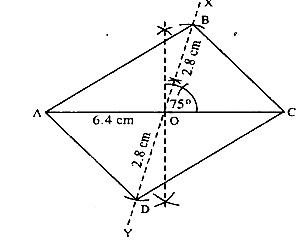
Steps :
- Draw $AC = 6.4 \ cm.$
- Bisect $AC$ at $O.$
- Draw$ \angle XOC = 75^\circ$ and produce $XO$ to $Y.$
- Cut $OB = OD = 2 8 \ cm.$
- Join $AB, BC, AD$, and $CD$.
Thus $ABCD$ is the required $||\ gm.$
View full question & answer→Question 274 Marks
Construct a parallelogram $ABCD$, if :$AB = 5.8\ cm, AD = 4.6 cm$ and diagonal $AC = 7.5\ cm.$
AnswerThe rough figure is as follow :
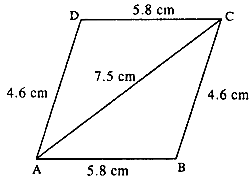
opposite sides of $||gm$ are equal
$BC = AD = 4.6 \ cm.$
The actual figure is constructed as follow :
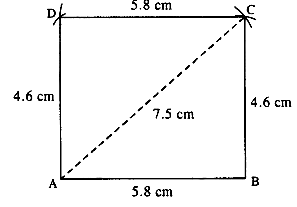
Steps:
- Draw $AB = 5.8 \ cm.$
- Draw an arc of radius $4.6 \ cm$ with centre $B.$
- Draw an arc of radius $7.5 \ cm$ from $A$ which intersects the first arc at $C.$
- From $A$, draw an arc of radius $4.6 \ cm.$
- From $C$, draw an arc of radius $5.8 \ cm$ which intersects the first arc at $D.$
- Join $AD, CD, BC,$ and $AC$.
Thus $ABCD$ is the required $||\ gm.$
View full question & answer→Question 284 Marks
Construct a parallelogram $ABCD$, if : $AD = 4 \ cm, DC = 5 \ cm$ and diagonal $BD = 7 \ cm.$
AnswerThe rough figure is as follow :
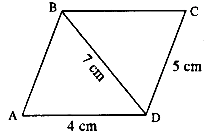
$\because$ opposite sides of $||\ gm$ are equal
$\therefore AB = DC = 5 \ cm$
Actual $||\ gm$ is constructed as follow
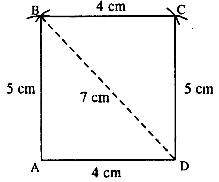
Steps :
- Draw $AD = 4 \ cm$.
- From $A$, draw an arc of radius $5 \ cm.$
- From $B$, draw an arc of radius $4 \ cm.$
- From $D$, draw an arc of radius $5 \ cm$ which intersects the first arc at $C.$
- Join $AB, BD, BC$, and $CD.$
Thus $ABCD$ is the required $||\ gm.$
View full question & answer→Question 294 Marks
Construct a parallelogram $ABCD$, if : $BC = 4.5 \ cm, CD = 5.2 \ cm$ and $\angle ADC = 75^\circ .$
AnswerThe rough figure is as follow :
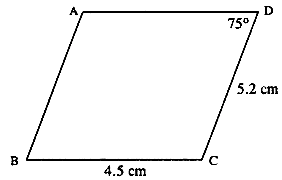
$\because$ opposite sides of $||\ gm$ are equal
$\therefore AD = BC = 4.5 \ cm.$
$\therefore$ Actual construction is as follow:
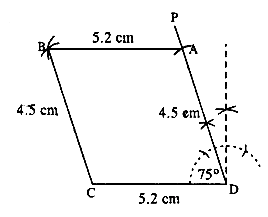
Steps :
- Draw $CD = 5.2 \ cm.$
- Draw $ZCDP = 75^\circ$
- Cut $DA = 4.5 \ cm.$
- A drawn arc of radius $5.2 \ cm.$
- From $C$, draw an arc of radius $4.5 \ cm$ which meets the first arc at $B$.
- Join $AB$ and $CB.$
Thus $ABCD$ is the required $||\ gm.$
View full question & answer→Question 304 Marks
Construct a parallelogram $ABCD$, if : $AB = 3.6 \ cm, BC = 4.5 \ cm$ and $\angle ABC = 120^\circ .$
AnswerThe rough figure is as follow :
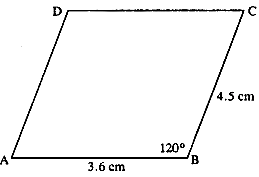
The above rough figure is used to construct the actual $||\ gm$ as follow :
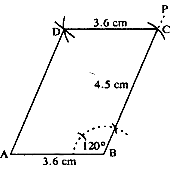
Steps :
- Draw $AB = 3.6 \ cm.$
- Draw $BP$ such that $\angle B = 120^\circ .$
- Cut $BC = 4.5 \ cm.$
- From $A$, draw an arc of radius $4.5 \ cm.$
- From $C$, draw an arc of radius $3.6 \ cm$. Which intersects the first arc at $D.$
- Join $AD$ and $CD.$
Hence $ABCD$ is the required $||\ gm.$
View full question & answer→Question 314 Marks
Construct a quadrilateral $ABCD$; if : $AB = AD = 5\ cm, BD = 7 \ cm$ and $BC = DC = 5.5 \ cm$
AnswerThe rough figure is as follow :
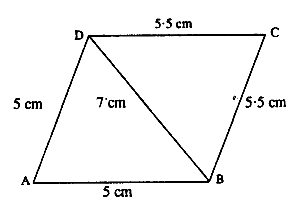
Actual construction is as follows $($using the above rough fig.$)$
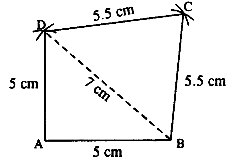
Steps :
- Draw $AB = 5 \ cm.$
- From$ A B$ draw arcs of radii $5 \ cm$ and $7\ cm$ which intersect at $D.$
- From $B D$ draw arcs of radii $5.5 \ cm$ each which intersect at $C.$
- Join $AD, BD, DC$, and $BC$.
Thus $ABCD$ is the required quadrilateral.
View full question & answer→Question 324 Marks
Construct a quadrilateral $ABCD$; if : $AB = 6 \ cm = AC, BC = 4 \ cm, CD = 5 \ cm$ and $AD = 4.5 \ cm$.
AnswerThe rough figure is as shown below.
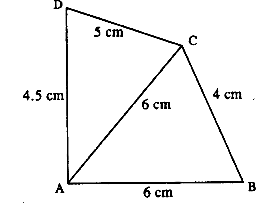
The actual quadrilateral is constructed as follows with the help of the above rough figure.
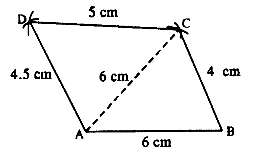
Steps :
- Draw $AB = 6 \ cm.$
- From $A$ and $B$, draw arcs of radii $6 \ cm$ and $4 \ cm$ which cut at $C.$
- From $A$ and $C$, draw arcs of radii $4.5 \ cm$ and $5 \ cm$ respectively which intersect at $D$.
- Join $BC, CD$, and $DA.$ Thus $ABCD$ is the required quadrilateral.
View full question & answer→Question 334 Marks
Construct a quadrilateral $ABCD$; if : $AB = 5 \ cm, BC = 6.5 \ cm, CD =4.8 \ cm, \angle B = 75^\circ$ and $\angle C = 120^\circ .$
AnswerThe rough figure is as shown below.
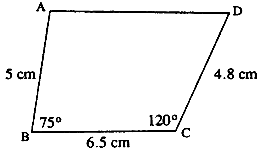
Actual construction is as follows $($using rough fig.$)$
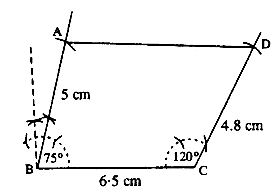
Steps :
- Draw $BC = 6-5 \ cm.$
- Draw $\angle B = 75^\circ$ and cut $BA = 5 \ cm.$
- Draw $\angle C = 120^\circ$ and cut $CD = 4.8 \ cm.$
- Join $AD.$
Thus $ABCD$ is the required quadrilateral.
View full question & answer→Question 344 Marks
Construct a quadrilateral $ABCD;$ if : $AB = 8 \ cm, BC = 5.4 \ cm, AD = 6 \ cm, \angle A = 60^\circ$ and $\angle B = 75^\circ .$
AnswerThe rough figure is as follow :
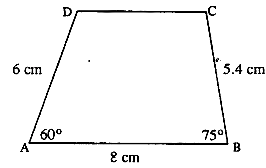
The actual quadrilateral is constructed with the help of the above rough figure.
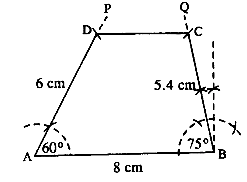
Steps :
- Draw $AB = 8 \ cm.$
- At $A$, draw $\angle PAB = 60^\circ$ and cut $DA = 6 \ cm.$
- At $B$, draw $\angle QBA = 75^\circ$ and cut $BC = 5.4 \ cm$.
- Join $DC$.
Thus $ABCD$ is the required quadrilateral.
View full question & answer→Question 354 Marks
Construct a quadrilateral $ABCD$; if : $AB = 6 \ cm, CD = 4.5 \ cm, BC = AD = 5 \ cm$ and $\angle BCD = 60^\circ .$
AnswerThe rough figure is as follow :
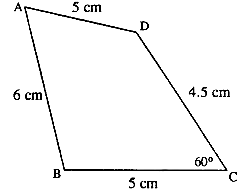
The Actual figure is constructed as follows.
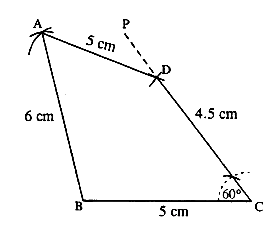
Steps :
- Draw $BC = 5 \ cm.$
- Draw $\angle PCB = 60^\circ$ and cut $CD = 4.5 \ cm.$
- From $B$ and $D$, draw arcs of radii $6 \ cm$ and $5 \ cm$ respectively which intersect at $A.$
- Join $AB$ and $AD.$
Thus $ABCD$ is the required quadrilateral.
View full question & answer→Question 364 Marks
Construct a quadrilateral $ABCD$ ; if : $AB = 4.3 \ cm, BC = 5.4, CD = 5 \ cm, DA = 4.8 \ cm$ and angle $ABC = 75^\circ .$
AnswerThe rough figure is as follow :
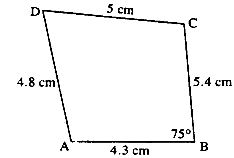
The actual figure is as follow:
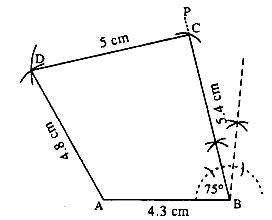
Steps :
- Draw $AB = 4.3 \ cm.$
- At $B$, draw $\angle PBA = 75^\circ$
- Cut $BC = 5.4 \ cm.$
- From $C A$, draw arcs of radii $5 \ cm$ and $4.8 \ cm$ respectively which intersect at $D.$
- Join $AD$ and $DC.$
$ABCD$ is the required quadrilateral.
View full question & answer→Question 374 Marks
Using a ruler and compasses only, construct a rhombus whose diagonals are $8 \ cm$ and $6 \ cm$. Measure the length of its one side.
Answer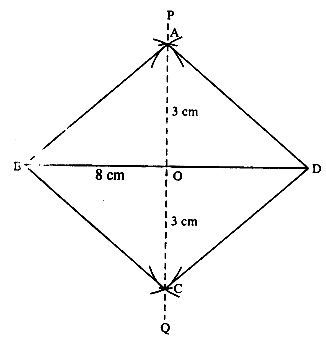
Steps :
- Draw $BD = 8 \ cm.$
- Draw perpendicular bisector $PQ$ of $BD.$
- Cut $OA = OC = 3 \ cm [$half the diagonal $6 \ cm]$
- Join $AB, AD, BC$, and $CD$.
- Measure side $AB$ which is $5 \ cm.$
Thus $ABCD$ is the required rhombus.
View full question & answer→Question 384 Marks
Construct an angle $ABC = 90^\circ$ . Locate a point $P$ which is $2.5 \ cm$ from $AB$ and $3.2 \ cm$ from $BC$.
AnswerSteps of construction :
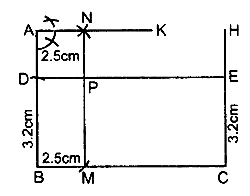
- Draw $\angle ABC = 90^\circ$
- From $AB$, cut $BD = 3.2 \ cm.$
- Through point $C$, draw $CH\perp BC$. From $CH$, cut $CE = 3.2$. Join $DE$. Now $DE$ is a line parallel to $BC$ and at a distance of $3.2 \ cm$ from $BC.$
- From $BC$ cut $BM = 2.5 \ cm.$
- Through point $A,$ draw $AK \perp AB$. From $AK$ cut $AN = 2.5 \ cm$. Join $NM$. Therefore $NM$ is parallel to $AB$ and at a distance of $2.5 \ cm$ from $AB.$
- $DE$ and $MN $ intersect each other at $P$. Thus $P$ is the required point which is $2.5 \ cm$ from $AB$ and $3.2 \ cm$ from $BC.$
View full question & answer→Question 394 Marks
Draw an angle $ABC = 60^\circ$ . Draw the bisector of it. Also, draw a line parallel to $BC$ a distance of $2.5 \ cm$ from it. Let this parallel line meet $AB$ at point $P$ and angle bisector at point $Q$. Measure the length of $BP$ and $PQ$. Is $BP = PQ$?
AnswerSteps of construction :
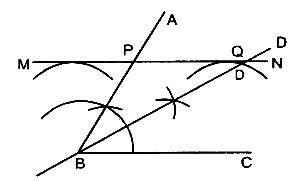
- Draw, $\angle ABC = 60^\circ$
- Draw $BD$, the bisector of $\angle ABC.$
- Taking $B$ as centre, draw an arc of radius $2.5 \ cm.$
- Taking $C$ as a centre, draw another arc of radius $2.5 \ cm.$
- Draw a line $MN$ that touches these two arcs drawn. Then MN is the required line parallel to $BC.$
- Let this line $MN$ meets $AB$ at $P$ and bisector $BD$ at $Q$.
- Measure $BP$ and $PQ.$
By measurement, we see $BP = PQ.$
View full question & answer→Question 404 Marks
Construct an angle $PQR = 80^\circ$ . Draw a line parallel to $PQ$ at a distance of $3 \ cm$ from it and another line parallel to $QR$ at a distance of $3.5 \ cm$ from it. Mark the point of intersection of these parallel lines as $A.$
AnswerSteps of construction :
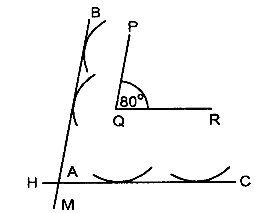
- Draw $\angle PQR = 80^\circ$
- With $P$ as centre draw an arc of radius $2 \ cm.$
- Again with $Q$ as a centre, draw another arc of radius $2 \ cm$. Then $BM$ is a line which touches the two arcs. Then $BM$ is a line parallel to $PQ$.
- With $Q$ as a centre, draw an arc of radius $3.5 \ cm$. With $R$ as centre draw another arc of radius $3.5 \ cm$. Draw a line $HC$ which touches these two arcs. Let these two parallel lines intersect at $A.$
View full question & answer→Question 414 Marks
Draw a straight line $AB = 6.5 \ cm$. Draw another line which is parallel to $AB$ at a distance of $2.8 \ cm$ from it.
AnswerSteps of construction :
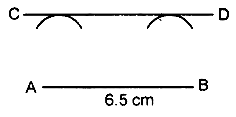
- Draw a straight line $AB = 6.5 \ cm$
- Taking point $A$ as a centre, draw an arc of radius $2.8 \ cm.$
- Taking $B$ as centre, drawn another arc of radius $2.8 \ cm.$
- Draw a line $CD$ that touches the two arcs drawn.
Thus $CD$ is the required parallel line.
View full question & answer→Question 424 Marks
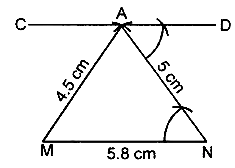
Draw a line $MN = 5.8 \ cm$. Locate a point A which is $4.5 \ cm$ from $M$ and $5 \ cm$ from $N$. Through A draw a line parallel to line $MN.$
AnswerSteps of construction :
- Draw a line $MN = 5.8 \ cm$
- With $M$ as centre and radius $= 4.5 \ cm$, draw an arc.
- With $N$ as centre draw another arc of radius $5 \ cm$. These arcs intersect each other at A.
- Join $AM$ and $AN.$
- At point $A$, draw $\angle DAN = \angle ANM$
- Produce $DA$ to any point $C$.
Thus $CAD$ is the required parallel line.
View full question & answer→Question 434 Marks
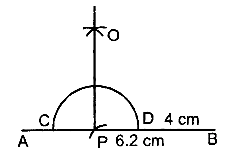
Draw a line segment $AB = 6.2 \ cm$. Mark a point $P$ in $AB$ such that $BP = 4 \ cm$. Through point $P$ draw perpendicular to $AB$.
AnswerSteps of Construction :
- Draw a line segment $AB = 6.2 \ cm$
- Cut off $BP = 4 \ cm$
- With $P$ as the centre and some radius draw arc meeting $AB$ at the points $C, D.$
- With $C, D$ as centres and equal radii $[$each is more than half of $CD]$ draw two arcs, meeting each other at the point $O.$
- Join $OP$. Then $OP$ is perpendicular for $AB.$
View full question & answer→Question 444 Marks
Draw a line segment $AB = 5.5 \ cm$. Mark a point $P$, such that $PA = 6 \ cm$ and $PB = 4.8 \ cm$. From point $P$, draw a perpendicular to $AB.$
AnswerStep of Construction :
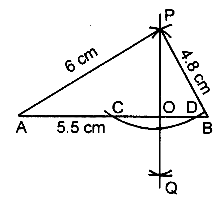
- Draw a line segment $AB = 5.5 \ cm$
- With $A$ as centre and radius $= 6 \ cm$, draw an arc.
- With $B$ as centre and radius $= 4.8 \ cm$ draw another arc.
- Let these arcs meet each other at point $P. PA = 6 \ cm, PB = 4.8$
- With $P$ as a centre and some suitable radius draw an arc meeting $AB$ at points $C$ and $D$.
- With $C$ as centre and radius more than half of $CD,$ draw an arc.
- With $D$ as a centre and same radius as in step $6$, draw an arc.
- Let these arcs meet each other at point $Q.$
- Join $PQ.$
- The $PQ$ meet $AB$ at point $O$.
Then $PO \perp AB$ i.e; $\angle AOP = 90^\circ = \angle POB.$
View full question & answer→Question 454 Marks
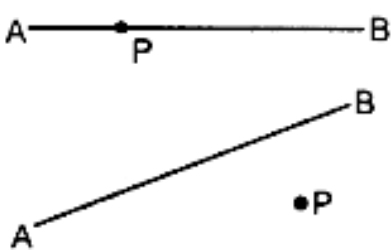
In each of the following, draw perpendicular through point $P$ to the line segment $AB :$
$(i)$

$(ii)$

$(iii)$
Answer$(i)$ Steps of $C$onstruction :
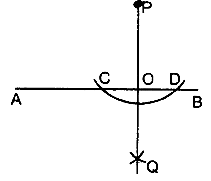
With $P$ as a centre, draw an arc of a suitable radius which cuts $AB$ at points $C$ and $D$.
With $C$ and $D$ as centres, draw arcs of equal radii and let these arcs intersect each other at point $Q$.
$[$The radius of these arcs must be more than half of $CD$ and both the arcs must be drawn on the other side$]$
Join $P$ and $Q$
Let $P$$Q$ cut $AB$ at the point $O$.
Thus, $OP$ is the required perpendicular clearly, $\angle AOP = \angle BOP = 90^\circ $
$(ii)$ Steps of $C$onstruction :
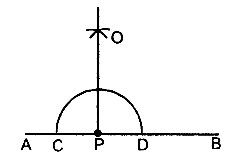
With $P$ as a centre, draw an arc of any suitable radius which cuts $AB$ at points $C$ and $D$.
With $C$ and $D$ as centres, draw arcs of equal radii. Which intersect each other at point $A$.
$[$This radius must be more than half of $C$$D$ and let these arc intersect each other at the point $0]$
Join $P$ and $O$. Then $OP$ is the required perpendicular.
$\angle OPA = \angle OPB = 90^\circ $
$(iii)$ Steps of $C$onstruction :
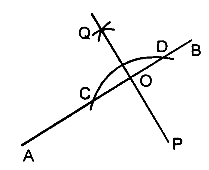
With $P$ as a centre, draw an arc of any suitable radius which cuts $AB$ at points $C$ and $D$.
With $C$ and $D$ as a centre, draw arcs of equal radii
$[$The radius of these arcs must be more than half of $C$$D$ and both the arcs must be drawn on the other side.$]$
and let these arcs intersect each other at the point $Q$.
Join $Q$ and $P$. Let $Q$$P$ cut $AB$ at the point $O$. Then $OP$ is the required perpendicular.
$C$ learly, $\angle AOP = \angle BOP = 90^\circ $ View full question & answer→Question 464 Marks
Draw a line segment $PQ = 4.8 \ cm$. Construct the perpendicular bisector of $PQ.$
AnswerSteps of Construction :
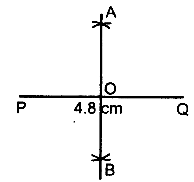
Draw a line segment $PQ = 4.8 \ cm.$
With $P$ as centre and radius equal than half of $PQ$, draw an arc on both the $PQ.$
With $Q$ as the centre and the same radius as taken in step $2$, draw arcs on both sides of $PQ.$
Let the arcs intersect each other at point $A$ and $B$
Join $A$ and $B$.
The line $AB$ cuts the line segment $PQ$ at the point $O$. Here $OP = OQ$ and $\angle AOQ = 90^\circ $. Then the line $AB$ is a perpendicular bisector of $PQ.$ View full question & answer→Question 474 Marks
Draw a line segment $AB$ of length $5.3 \ cm$. Using two different methods bisect $AB.$
AnswerSteps of Construction :
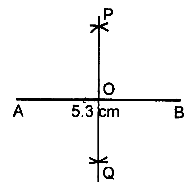
Draw a line segment $AB = 5.3 \ cm$
With $A$ as centre and radius equal to more than half of $AB$, draw arcs on both sides of $AB$.
With $B$ as the centre and with the same radius as taken in step $2$, draw arcs on both sides of $AB$.
Let the arcs intersect each other at points $P$ and $Q$.
Join $P$ and $Q$.
The line $PQ$ cuts the given line segment $AB$ at point $O$.
Thus, $PQ$ is a bisector of $AB$ such that
$\mathrm{OA}=\mathrm{OB}=\frac{1}{2} \mathrm{AB}$
Second Method
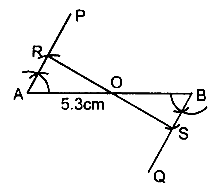
Steps of Construction :
Draw the given line segment $AB = 5.3 \ cm$.
At $A$, construct $\angle PAB$ of any suitable measure. Then $\angle PAB = 60^\circ $ construct $\angle QBA = 60^\circ $
$3$. From $AP,$ cut $AR$ of any suitable length and from $BQ;$ cut $BS = AR.$
Join $R$ and $S$
Let $RS$ cut the given line segment $AB$ at the point $O.$
Thus $R S$ is a bisector of $A B$ such that $O A=O B=\frac{1}{2} A B$ View full question & answer→Question 484 Marks
Draw angle $ABC$ of any suitable measure.$(i)$ Draw $BP$, the bisector of angle $ABC.(ii)$ Draw $BR$, the bisector of angle $PBC$ and draw $BQ$, the bisector of angle $ABP.(iii)$ Are the angles $ABQ, QBP, PBR$ and $RBC$ equal?$(iv)$ Are the angles $ABR$ and $QBC$ equal?
AnswerSteps of Construction :
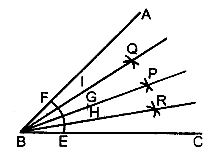
Construct any angle $ABC$
With $B$ as a centre, draw an arc $EF$ meeting $BC$ at $E$ and $AB$ at $F$.
With $E, F$ as centres draws two arcs of equal radii meeting each other at the point $P$.
Join $BP$. Then $BP$ is the bisector of $\angle ABC$
$\angle ABP = \angle PBC = \frac{1}{2} \angle ABC$
Similarly draw $BR,$ the bisector of $\angle PBC$ and draw $BQ$ as the bisector of $\angle ABP [$With the same method as in steps $2, 3]$
Then $\angle ABQ = \angle QBP = \angle PBR = \angle RBC$
$\angle ABR = \frac{3}{4} \angle ABC$ and $\angle QBC = \frac{3}{4} \angle ABC$
$\angle ABR = \angle QBC.$ View full question & answer→Question 494 Marks
Construct angle $ABC = 45^\circ$ in which $BC = 5 \ cm$ and $AB = 4.6 \ cm.$
AnswerSteps of Construction :
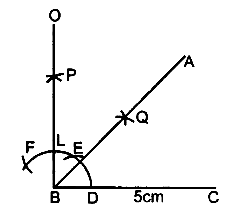
Draw a line segment $BC = 5 \ cm$
Taking $B$ as centre, draw an arc of any suitable radius, which cuts $BC$ at the point $D.$
With $D$ as the centre and the same radius, as taken in step $2$, draw an arc which cuts the previous arc at point $E$.
With $E$ as the centre and the same radius, draw one more arc which cuts the first arc at point $F$.
With $E$ and $F$ as centres and radii equal to more than half the distance between $E$ at $F$, draw an arc which cut each other at point $P$.
Join $BP$ to meet $EF$ at $L$ and produce to point $O$. Then$ \angle OBC = 90^\circ$
Draw $BA$, the bisector of angle $OBC. [$With $D, L $ as centres and suitable radius draw two arc meeting each other at $Q$ produced it to $R]$
$=> \angle ABC = 45^\circ [\therefore BA$ is bisector of $\angle OBC \therefore \angle ABC = = 45^\circ ]$
From $BR$ cut arc $AB = 4.6 \ cm$ View full question & answer→Question 504 Marks
Given below are the angles $ x, y,$ and $z.$
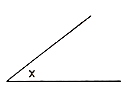
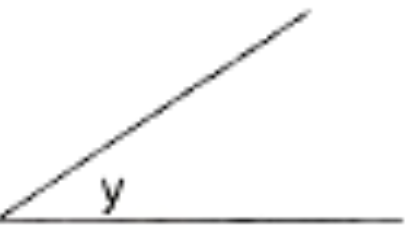
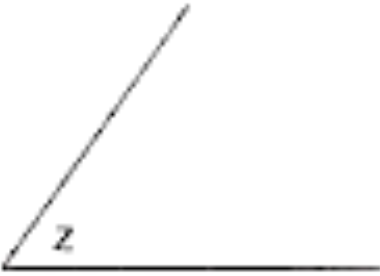
Without measuring these angles construct :
$(i)\ (ii)\ (iii)$ Answer$(i)$ Steps of Construction :
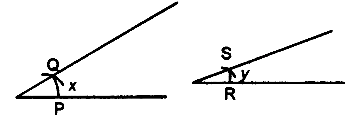
Draw line segment $BC$ of any suitable length.
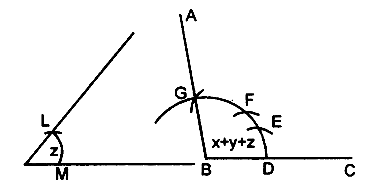
With $B$ as a centre, draw an arc of any suitable radius. With the same radius, draw arcs with the vertices of given angles as centres. Let these arcs cut arms of the angle $x$ at the points $P$ and $Q$ and arms of the angle $y$ at points $R$ and $S$ and arms of the angle $z$ at the points $L$ and $M$.
From the arc, with centre $B$, cut
$DE = PQ =$ arc of $x, EF = RS =$ arc of $y$ and $FG = LM =$ arc of $z$.
Join $BG$ and produce it up to $A.$
Then $\angle ABC = x + y + z$
$(ii)$ Proceed as in part $(i)$ up to step $2$.
$3$. From the arc, with centre $B$, cut
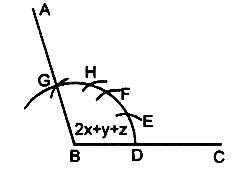
$DE = 2PQ = 2 $ arc of $x$
$EF = RS =$ arc of $y$
$FG = LM =$ arc of $z$
$4$. Join $BG$ and produce it up to point $A$
Then $\angle ABC = 2x + y + z$
$(iii)$ proceed as in $(i)$ up to step $2$
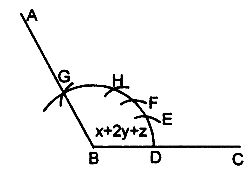
$3$. Here cut arc $DE =$ arc $PQ =$ arc of $x$ arc $EF = 2$ arc $RS = 2$ arc of $y$ arc $FG =$ arc $LM =$ arc of $z.$
$4$. Join $BG$ and produce it up to $A$
$5$. Then $\angle ABC = x + 2y + z$ View full question & answer→