Question 14 Marks
The sum of two numbers is $4500$. If $10\%$ of one number is $12.5\%$ of the other, find the numbers.
AnswerLet the first number $=x$
and the second number $=\mathrm{y}$
According to question,
$x+y=4500$
and $10\ \% x=12.5 \%\ y$
i.e. $10\ x=12.5\ y$
$x=\frac{12.5}{10}\ y$
Substitute the value of $x$ in equation $(i),$
$\frac{12.5}{10} y+y=45000$
$ 12.5 y+10 y=45000$
$22.5 y=45000$
$y=\frac{45000}{22.5}=2000$
Now, put the value of $y$ in equation $(ii)$
$x=\frac{12.5}{10} \times 2000$
$ x=2500$
Hence, the numbers are $2500$ and $2000$
View full question & answer→Question 24 Marks
Solve: $\frac{x+2}{3}-\frac{x+1}{5}=\frac{x-3}{4}-1$
Answer$ \frac{x+2}{3}-\frac{x+1}{5}=\frac{x-3}{4}-1 \ldots(\text { L.C.M}$. of $3$ and $5=15)$
$ \Rightarrow \frac{5(\mathrm{x}+2)-3(\mathrm{x}+1)}{15}=\frac{\mathrm{x}-3-4}{4}$
$ \Rightarrow \frac{5 x+10-3 x-3}{15}=\frac{x-7}{4}$
$ \Rightarrow \frac{2 x+7}{15}=\frac{x-7}{4}$
$ \Rightarrow 4(2 x+7)=15(x-7)$
$ \Rightarrow 8 x+28=15 x-105$
$ \Rightarrow 8 \mathrm{x}-15 \mathrm{x}=-105-28$
$ \Rightarrow-7 \mathrm{x}=-133$
$ x=\frac{-133}{-7}$
$ \therefore \mathrm{x}=19$
View full question & answer→Question 34 Marks
Solve: $\frac{6 \mathrm{x}+1}{2}+1=\frac{7 \mathrm{x}-3}{3}$
Answer$ \frac{6 x+1}{2}+1=\frac{7 x-3}{3}$
$ \Rightarrow \frac{(6 x+1)+1 \times 2}{2}=\frac{7 x-3}{3}$
$ \Rightarrow \frac{6 x+1+2}{2}=\frac{7 x-3}{3}$
$ \Rightarrow \frac{6 x+3}{2}=\frac{7 x-3}{3}$
$ \Rightarrow 3(6 x+3)=2(7 x-3)$
$ \Rightarrow 18 x+9=14 x-6$
$ \Rightarrow 18 x-14 x=-6-9$
$ \Rightarrow 4 x=-15$
$ \therefore x=\frac{-15}{4}$
View full question & answer→Question 44 Marks
Solve: $\mathrm{x}-\frac{\mathrm{x}-1}{2}=1-\frac{\mathrm{x}-2}{3}$
Answer$ x-\frac{x-1}{2}=1-\frac{x-2}{3}$
$ \Rightarrow \frac{2(x)-1(x-1)}{2}=\frac{3(1)-1(x-2)}{3}$
$ \Rightarrow \frac{2 x-x+1}{2}=\frac{3-x+2}{3}$
$ \Rightarrow \frac{1 x+1}{2}=\frac{5-x}{3}$
$ \Rightarrow 3(x+1)=2(5-x)$
$ \Rightarrow 3 x+3=10-2 x$
$ \Rightarrow 3 x+2 x=10-3$
$ \Rightarrow 5 x=7$
$ \therefore x=\frac{7}{5}$
View full question & answer→Question 54 Marks
Solve: $\frac{3 x-2}{3}+\frac{2 x+3}{2}=x+\frac{7}{6}$
Answer$ \frac{3 x-2}{3}+\frac{2 x+3}{2}=x+\frac{7}{6}$
$ \Rightarrow \frac{2(3 x-2)+3(2 x+3)}{6}=x+\frac{7}{6}$
$ \Rightarrow \frac{6 x-4+6 x+9}{6}=\frac{6 x+7}{6}$
$ \Rightarrow \frac{12 x+5}{6}=\frac{6 x+7}{6}$
$ \Rightarrow 6(12 x+5)=6(6 x+7)$
$ \Rightarrow 72 x+30=36 x-42$
$ \Rightarrow 72 x-36 x=42-30$
$ \Rightarrow 36 x=12$
$ x=\frac{12}{36}$
$ \therefore \frac{1}{3}$
View full question & answer→Question 64 Marks
The numerator of a fraction is $5$ less than its denominator. If $3$ is added to the numerator, and denominator both, the fraction becomes $\frac{2}{3}$. Find the original fraction.
AnswerLet denominator of the original fraction $=x$
Then numerator $=x-5$
and fraction $=\frac{\mathrm{x}-5}{\mathrm{x}}$
According to the condition,
$\frac{x-5+3}{x+3}=\frac{4}{5}$
$ \Rightarrow \frac{x-2}{x+3}=\frac{4}{5}$
$ \Rightarrow 5(x-2)=4 x+12$
$ \Rightarrow 5 x-10=4 x+12$
$ \Rightarrow x=22$
$\therefore$ Original fraction $=\frac{\mathrm{x}-5}{\mathrm{x}}$
$=\frac{22-5}{22}$
$=\frac{17}{22}$
View full question & answer→Question 74 Marks
Solve : $x+7-\frac{8 x}{3}=\frac{17 x}{6}-\frac{5 x}{8}$
Answer$ x+7-\frac{8 x}{3}=\frac{17 x}{6}-\frac{5 x}{8}$
$ \Rightarrow \frac{3(x+7)-8 x}{3}=\frac{17 x \times 4-5 x \times 3}{24}$
$ \Rightarrow \frac{3 x+21-8 x}{3}=\frac{68 x-15 x}{24}$
$ \Rightarrow \frac{-5 x+21}{3}=\frac{53 x}{24}$
$ \Rightarrow 3 \times 53 x=24(-5 x+21)$
$ \Rightarrow 159 x=-120 x+504$
$ \Rightarrow 159 x+120 x=504$
$ \Rightarrow 279 x=504$
$ \Rightarrow x=\frac{504}{279}=\frac{168}{93}=\frac{56}{61}$
$ \therefore x=1 \frac{25}{31}$
View full question & answer→Question 84 Marks
Solve : $13(x - 4) - 3(x - 9) - 5(x + 4) = 0$
Answer$13(x-4)-3(x-9)-5(x+4)=0$
$ \Rightarrow 13 x-52-3 x+27-5 x-20=0$
$ \Rightarrow 13 x-3 x-5 x-52+27-20=0$
$ \Rightarrow 13 x-8 x-72+27=0$
$ \Rightarrow 5 x-45=0$
Dividing by $5$ ,
$\frac{5 x}{5}-\frac{45}{5}=0 $
$\Rightarrow \mathrm{x}-9=0 $
$\Rightarrow x=9$
Verification:
$\text { L.H.S. }=13(x-4)-3(x-9)-5(x+4)$
$ =13(9-4)-3(9-9)-5(9+4)$
$ =13 \times 5-3 \times 0-5 \times 13$
$ =65-0-65=0=\text { R.H.S. }$
View full question & answer→Question 94 Marks
Solve: $\frac{1}{10}-\frac{7}{\mathrm{x}}=35 \mathrm{C}$
Answer$\frac{1}{10}-\frac{7}{x}=35$
$\frac{-7}{\mathrm{x}}=35-\frac{1}{10}$
$\Rightarrow \frac{-7}{\mathrm{x}}=\frac{35 \times 10}{1 \times 10}-\frac{1 \times 1}{10 \times 1}$
$\Rightarrow \frac{-7}{\mathrm{x}}=\frac{350-1}{10}$
$\Rightarrow \frac{1}{\mathrm{x}}=\frac{350-1}{10 \times(-7)}$
$\Rightarrow \mathrm{x}=\frac{349}{-70}=\frac{-70}{349}$
View full question & answer→Question 104 Marks
Solve : $\frac{1}{3} x-6=\frac{5}{2}$
Answer$\frac{1}{3} x-6=\frac{5}{2}$
$\Rightarrow \frac{1}{3} \mathrm{x}=\frac{5}{2}+\frac{6}{1}$
$\Rightarrow \frac{1}{3} \mathrm{x}=\frac{5 \times 1}{2 \times 1}+\frac{6 \times 2}{1 \times 2}$
$\Rightarrow \frac{1}{3} \mathrm{x}=\frac{5}{2}+\frac{12}{2}$
$\Rightarrow \frac{1}{3} \mathrm{x}=\frac{5+12}{2}$
$=\frac{1}{3} \mathrm{x}=\frac{17}{2}$
$=\mathrm{x}=\frac{17 \times 3}{2 \times 1}=\frac{51}{2}=25 \frac{1}{2}$
View full question & answer→Question 114 Marks
$A’s$ salary is same as $4$ times $B’s$ salary. If together they earn $Rs.3,750$ a month, find the salary of each.
AnswerLet $B’s$ salary $= Rs. xA’s $ salary $= Rs. 4x$
According to the statement :
$x + 4x = 3750$
$⇒ 5x = 3750$
$⇒ x = 750$
$4x = 750 \times 4 = 3000$
$A’s$ salary $= Rs. 3000$
$B’s$ salary $= Rs. 750$
View full question & answer→Question 124 Marks
A number decreased by $30$ is the same as $14$ decreased by $3$ times the number; Find the number.
AnswerLet the required number $= x$ The number decreased by $30 = x – 30$
$14$ decreased by $3$ times the number $= 14 – 3x$
According to the statement :
$x – 30 = 14 – 3x$
$\Rightarrow x + 3x = 14 + 30$
$\Rightarrow 4x = 44$
$x = 11$
Required number $=11$
View full question & answer→Question 134 Marks
Fifteen more than $3$ times Neetu’s age is the same as $4$ times her age. How old is she ?
AnswerLet Neetu’s age $= x$ years $3$ times Neetu’s age $= 3x$ years
Fifteen more than $3$ times Neetu’s age $= (3x + 15)$ years
$4$ times Neetu’s age $= 4x$
According to the statement :
$4x = 3x + 15$
$\Rightarrow 4x – 3x = 15$
$\Rightarrow x = 15$
Neetu’s age $= 15$ years
View full question & answer→Question 144 Marks
Five less than $3$ times a number is $-20$. Find the number.
AnswerLet the required number $= x3$ times the number $= 3x$
$5$ less than $3$ times the number $= 3x – 5$
According to statement :
$3x – 5 = -20$
$\Rightarrow 3x = -20 + 5$
$\Rightarrow 3x = -15$
$\Rightarrow x = -5$
Required number $= -5$
View full question & answer→Question 154 Marks
$28$ is $12$ less than $4 $ times a number. Find the number.
AnswerLet the required number be $x^4$ times the number $= 4x$
$12$ less than $4$ times the number $= 4x – 12$
According to the statement
$4x – 12 = 28$
$=> 4x = 28 + 12$
$=> 4x = 40$
$x = 10$
Required number $= 10$
View full question & answer→Question 164 Marks
The present age of a man is twice that of his son. Eight years hence, their ages will be in the ratio $7 : 4$. Find their present ages
AnswerLet present age of son $=x$ year
Then age of his father $=2 x$
$8$ years hence,
Age of son $=(x+8)$ years and age of father $=(2 x+8)$ years
According to the condition,
$\frac{2 x+8}{x+8}=\frac{7}{4}$
$ \Rightarrow 8 x+32=7 x+56$
$ \Rightarrow 8 x-7 x=56-32$
$ \Rightarrow x=24$
Present age of son $=24$ years
and age of father $=2 x=2 \times 24=48$ years
Hence age of man $=48$ years and age of his son $=24$ years
View full question & answer→Question 174 Marks
A man is $42$ years old and his son is $12$ years old. In how many years will the age of the son be half the age of the man at that time?
AnswerMan's age $=42$ years
Son's age $=12$ years
Let after $x$ years the age of the son will be half the age of the man.
Man's age after $x$ years $=(42+x)$ years
Son's age after $\mathrm{x}$ years $=(12+\mathrm{x})$ years
According to the statement :
$12+\mathrm{x}=\frac{42+\mathrm{x}}{2}$
$\Rightarrow 2(12+x)=42+x$
$...($by cross multiplying$)$
$\Rightarrow 24+2 x=42+x$
$\Rightarrow 2 \mathrm{x}-\mathrm{x}=42-24$
$\Rightarrow x=18$
Hence after $18$ years, the age of the son will be half the age of the man
View full question & answer→Question 184 Marks
A man’s age is three times that of his son, and in twelve years he will be twice as old as his son would be. What are their present ages.
AnswerLet present age of the son $= x$ years present age of the man $= 3x$ years
In $12$ years :
Son’s age will be $= (x + 12)$ years
The man’s age will be $= (3x + 12)$ years
According to the statement :
$3x + 12 = 2(x + 12)$
$\Rightarrow 3x + 12 = 2x + 24$
$\Rightarrow 3x – 2x = 24 – 12$
$\Rightarrow x = 12$
$3x = 3 \times 12 = 36$
Hence, present age of the man $= 36$ years
Present age of the son $= 12$ years.
View full question & answer→Question 194 Marks
A rectangle’s length is $5 \ cm$ less than twice its width. If the length is decreased by $5 \ cm$ and width is increased by $2 \ cm$; the perimeter of the resulting rectangle will be $74 \ cm$. Find the length and width of the origi¬nal rectangle.
AnswerLet width of the original rectangle $= x \ cm$ Length of the original rectangle $= (2x – 5)cm$
Now, new length of the rectangle $= 2x – 5 – 5 = (2x – 10) \ cm$
New width of the rectangle $= (x + 2) \ cm$
New perimeter $= 2[$Length+Width$] = 2[2x – 10 + x + 2] = 2[3x – 8] = (6x – 16) \ cm$
Given; new perimeter $= 74 \ cm$
$6x – 16 = 74$
$\Rightarrow 6x = 74 + 16$
$\Rightarrow 6x = 90$
$\Rightarrow x = 15$
Length of the original rectangle $= 2x – 5 = 2 \times 15 – 5 = 30 – 5 = 25 \ cm$
Width of the original rectangle$ = x = 15 \ cm$
View full question & answer→Question 204 Marks
Solve the following equation : $\frac{1}{x-1}-\frac{1}{x}=\frac{1}{x+3}-\frac{1}{x+4}$
Answer$ \frac{1}{x-1}-\frac{1}{x}=\frac{1}{x+3}-\frac{1}{x+4}$
$ \Rightarrow \frac{x-(x-1)}{(x-1) x}=\frac{(x+4)-(x+3)}{(x+3)(x+4)}$
$ =\frac{1}{(x-1) x}=\frac{1}{(x+3)(x+4)}$
$ =(x+3)(x+4)=x(x-1)$
$ \Rightarrow x^2+4 x+3 x+12=x^2-x$
$ \Rightarrow x^2+7 x-x^2+x=-12$
$ 8 x=-12$
$ x=-\frac{12}{8}=-\frac{3}{2}=-1 \frac{1}{2}$
View full question & answer→Question 214 Marks
Solve the following equation : $(x - 1 )(x + 6) - (x - 2)(x - 3) = 3$
Answer$(x-1)(x+6)-(x-2)(x-3)=3$
$x^2-x+6 x-6-\left(x^2-3 x-2 x+6\right)=3$
$\Rightarrow \mathrm{x}^2-\mathrm{x}+6 \mathrm{x}-6-\mathrm{x}^2+3 \mathrm{x}+2 \mathrm{x}-6=3$
$\Rightarrow-\mathrm{x}+6 \mathrm{x}+3 \mathrm{x}+2 \mathrm{x}-6-6=3$
$\Rightarrow x+11 x-6-6=3$
$10 x=15$
$x=\frac{15}{10}=\frac{3}{2}=1 \frac{1}{2}$
View full question & answer→Question 224 Marks
Solve the following equation : $(x – 5)^2 – (x + 2)^2 = -2$
Answer$ (x-5)^2-(x+2)^2=-2$
$ \Rightarrow\left(x^2-10 x+25\right)-\left(x^2+4 x+4\right)=-2$
$ \Rightarrow x^2-10 x+25-x^2-4 x-4=-2$
$ \Rightarrow-10 x-4 x+25-4=-2$
$ \Rightarrow-14 x=4-2-25=-23$
$ \Rightarrow x=\frac{-23}{-14}=\frac{23}{14}=1 \frac{9}{14}$
View full question & answer→Question 234 Marks
Solve the following equation : $6(6x - 5) - 5(7x - 8) = 12(4 - x) + 1$
Answer$ 6(6 x-5)-5(7 x-8)=12(4-x)+1$
$ 36 x-30-35 x+40=48-12 x+1$
$ \Rightarrow x+10=49-12 x$
$ \Rightarrow x+12 x=49-10$
$ \Rightarrow 13 x=39$
$ \Rightarrow x=\frac{39}{13}$
$ \Rightarrow x=3$
View full question & answer→Question 244 Marks
Solve the following equation : $\frac{a+5}{6}-\frac{a+1}{9}=\frac{a+3}{4}$
AnswerSince, $\text{L.C.M}$. of denominators $6,9$ and $4=36$
$\therefore \frac{\mathrm{a}+5}{6} \times 36-\frac{\mathrm{a}+1}{9} \times 36=\frac{\mathrm{a}+3}{4} \times 36$
$...($Multiplying each term by $36 )$
$\Rightarrow 6(a+5)-4(a+1)=9(a+3)$
$ \Rightarrow 6 a+30-4 a-4=9 a+27$
$ \Rightarrow 6 a-4 a-9 a=27-30+4$
$ \Rightarrow 6 a-13 a=1$
$ \Rightarrow-7 a=1$
$ \Rightarrow a=-\frac{1}{7}$
View full question & answer→Question 254 Marks
Solve the following equation : $\frac{4(y+2)}{5}=7+\frac{5 y}{13}$
Answer$\Rightarrow \frac{4 y+8}{5}=7+\frac{5 y}{13}$
$\Rightarrow \frac{4 y+8}{5}=\frac{91+5 y}{13} \ldots ($by cross multiplying$)$
$\Rightarrow 13(4 y+8)=5(91+5 y)$
$\Rightarrow 52 y+104=455+25 y$
$\Rightarrow 52 y-25 y=455-104$
$\Rightarrow 27 y=351$
$\Rightarrow \mathrm{y}=\frac{351}{27}$
$\Rightarrow \mathrm{y}=13$
View full question & answer→Question 264 Marks
Solve the following equation : $\frac{\mathrm{x}}{3}-2 \frac{1}{2}=\frac{4 \mathrm{x}}{9}-\frac{2 \mathrm{x}}{3}$
Answer$\Rightarrow \frac{x}{3}-\frac{5}{2}=\frac{4 x}{9}-\frac{2 x}{3}$
Since, $\text{L.C.M}$. of denominators $3, 2, 9$ and $3=18$
$\Rightarrow \frac{\mathrm{x}}{3} \times 18-\frac{5}{2} \times 18=\frac{4 \mathrm{x}}{9} \times 18-\frac{2 \mathrm{x}}{3} \times 18$
$.....[$Multiplying each term by $18]$
$\Rightarrow 6 x-45=8 x-12 x$
$\Rightarrow 6 x+12 x-8 x=45$
$\Rightarrow 18 x-8 x=45$
$\Rightarrow 10 \mathrm{x}=45$
$\Rightarrow x=\frac{45}{10}$
$\Rightarrow x=4.5$
View full question & answer→Question 274 Marks
Solve the following equation : $3 a-\frac{1}{5}=\frac{a}{5}+5 \frac{2}{5}$
Answer$\Rightarrow 3 a-\frac{a}{5}=5 \frac{2}{5}+\frac{1}{5}$
$ \Rightarrow 3 a-\frac{a}{5}=\frac{27}{5}+\frac{1}{5}$
$ \Rightarrow 3 a \times 5-\frac{a}{5} \times 5=\frac{27}{5} \times 5+\frac{1}{5} \times 5$
$.....($Multiplying each term by $5 )$
$\Rightarrow 15 a-a=27+1$
$ \Rightarrow 14 a=28$
$ \Rightarrow a=\frac{28}{14}$
$ \Rightarrow a=2$
View full question & answer→Question 284 Marks
The ages of $A$ and $B$ are in the ratio $7 : 5$. Ten years hence, the ratio of their ages will be $9 : 7$. Find their present ages.
AnswerRatio in the present ages of $A$ and $B = 7 : 5$ Let age of $A = 7x$ years
Let age of $B = 5x$ years
$10$ years hence,
Then age of $A = 7x + 10$ years
and age of $B = 5x + 10$ years
According to the condition,
By crossing multiplication
$7(7x + 10) = 9(5x + 10)$
$⇒ 49x + 70 = 45x + 90$
$⇒ 49x – 45x = 90 – 70$
$⇒ 4x = 20$
$⇒ x = 5$
Present age of $A = 7x = 7 \times 5 = 35$ years
and present age of $B = 5x = 5 \times 5 = 25$ years
View full question & answer→Question 294 Marks
The sum of two numbers is $405$ and their ratio is $8 : 7$. Find the numbers.
AnswerLet the first number $=x$
and the second number $=7$
According to the question, $x+y=405$
and the numbers are in the ratio $8: 7$
i.e. $\frac{8 x}{7 y}=1$
$\Rightarrow 8 \mathrm{x}=7 \mathrm{y}$
$\Rightarrow \mathrm{x}=\frac{7}{8} \mathrm{y}$
Now, substitute the value of $x$ in equation
$(i)\frac{7}{8} y+y=405$
$7 y+8 y=405 \times 8$
$15 y=3240$
$y=\frac{3240}{15}$
$y=216$
Now, put the value of $y$ in equation
$(ii)x=\frac{7}{8} \times 216$
$x = 189$
Hence, the numbers are $189$ and $216$
View full question & answer→Question 304 Marks
Solve : $\frac{9 \mathrm{x}+7}{2}-\left(\mathrm{x}-\frac{\mathrm{x}-2}{7}\right)=36$
Answer$ \frac{9 \mathrm{x}+7}{2}-\left(\mathrm{x}-\frac{\mathrm{x}-2}{7}\right)=36$
$ \Rightarrow \frac{9 \mathrm{x}+7}{2}-\left(\frac{7 \times x-1(\mathrm{x}-2)}{7}\right)=36$
$ \Rightarrow \frac{9 \mathrm{x}+7}{2}-\left(\frac{7 \mathrm{x}-\mathrm{x}-2}{7}\right)=36$
$ \Rightarrow \frac{9 \mathrm{x}+7}{2}-\left(\frac{6 \mathrm{x}-2}{7}\right)=36$
$ \Rightarrow \frac{7(9 \mathrm{x}+7)+2(-6 \mathrm{x}+2)}{14}=36$
$ \Rightarrow \frac{63 \mathrm{x}+49-12 \mathrm{x}+4}{14}=36$
$ \Rightarrow \frac{51 \mathrm{x}+53}{14}=36$
$ \Rightarrow 51 \mathrm{x}+53=14 \times 36$
$ \Rightarrow 51 \mathrm{x}=504-53$
$ \Rightarrow 51 \mathrm{x}=451$
$ \mathrm{x}=\frac{451}{51}$
$\therefore x = 8.8$ i.e., $x = 9$
View full question & answer→Question 314 Marks
Solve : $\frac{x+2}{6}-\left(\frac{11-x}{3}-\frac{1}{4}\right)=\frac{3 x-4}{12}$
Answer$x+\frac{2}{6}-11-\frac{x}{3}-\frac{1}{4}=3 x-\frac{4}{12}$
$\Rightarrow \frac{x+2}{6}-\frac{4(11-x)-1 \times 3}{12}=\frac{3 x-4}{12}$
$\Rightarrow \frac{x+2}{6}-\frac{44+4 x+3}{12}=\frac{3 x-4}{12}$
$\Rightarrow \frac{2(x+2)-41+4 x}{12}=\frac{3 x-4}{12}$
$\Rightarrow \frac{2 x+4-41+4 x}{12}=\frac{3 x-4}{12}$
$\Rightarrow \frac{6 x-37}{12}=\frac{3 x-4}{12}$
$\Rightarrow 12(6x - 37) = 12(3x - 4)$
$\Rightarrow 72x - 444 = 36x - 48$
$\Rightarrow 72x - 36x = -48 + 444$
$\Rightarrow 36x = 396$
$\Rightarrow x=\frac{396}{36}=11$
$\therefore x = 11$
View full question & answer→Question 324 Marks
Solve : $\frac{3 x-2}{4}-\frac{2 x+3}{3}=\frac{2}{3}-x$
Answer$\frac{3 \mathrm{x}-2}{4}-\frac{2 \mathrm{x}+3}{3}=\frac{2}{3}-\mathrm{x}$
$ =\frac{3 \mathrm{x}-2}{4}-\frac{2 \mathrm{x}+3}{3}=\frac{2}{3}-\frac{\mathrm{x}}{1}$
$ =\frac{3(3 \mathrm{x}-2)-4(2 \mathrm{x}+3)}{12}=\frac{2 \times 1}{3 \times 1}-\frac{\mathrm{x} \times 3}{1 \times 3}$
$=\frac{9 x-6-8 x-12}{12}=\frac{2-3 x}{3}$
$ =\frac{x-18}{12}=\frac{2-3 x}{3}$
$ =3(x-18)=12(2-3 x)$
$ =3 x-54=24-36 x$
$ =3 x+36 x=24+54$
$ =39 x=78$
$\mathrm{x}=\frac{78}{39}=2$
$\therefore x=2$
View full question & answer→Question 334 Marks
Solve : $\frac{2 x}{3}-\frac{3 x}{8}=\frac{7}{12}$
Answer$\frac{2 x}{3}-\frac{3 x}{8}=\frac{7}{12}$
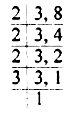
$\text{L.C.M}$. of $3$ and $8=2 \times 2 \times 2 \times 3=24$
$\therefore \frac{2 \mathrm{x} \times 8}{3 \times 8}-\frac{3 \mathrm{x} \times 3}{8 \times 3}=\frac{7}{12}$
$=\frac{16 \mathrm{x}}{24}-\frac{9 \mathrm{x}}{24}=\frac{7}{12}$
$=\frac{16 x}{24}-\frac{9 x}{24}=\frac{7}{12}$
$=\frac{16 x-9 x}{24}=\frac{7}{12}$
$=\frac{7 \mathrm{x}}{24}=\frac{7}{12}$
$=\mathrm{x}=\frac{7 \times 24}{12 \times 7}=2$
$\therefore x=2$ View full question & answer→Question 344 Marks
Six more than one-fourth of a number is two$-$fifth of the number. Find the number.
AnswerLet the required number $= x\therefore$ One$-$fourth of the number $= "x"4 `$
Two$-$fifth of the number $= `"2x"5`$
According to the statement :
$`"2x"5 = 6 + "x"4`$
$=> "2x"5 - "x" = 61`$
$=> "2x"5 x\times 20 - "x"4 x\times 20 = 6 x\times 20`$
$....[$Multiplying each term by $20$ because $\text{L.C.M}$. of $5,4$ and $1 = 20]$
$\Rightarrow 8x- 5x = 120$
$\Rightarrow 3x = 120$
$\Rightarrow x = `120/3`$
$x = 40$
Required number $= 40$
View full question & answer→Question 354 Marks
Separate $178$ into two parts so that the first part is $8$ less than twice the second part.
AnswerLet first part $= x$ Second part $= 178 – x$
According to the problem :
First Part $= 8$ less than twice the second part
$x = 2(178 – x) – 8$
$⇒ x = 356 – 2x – 8$
$⇒ x+2x = 356 – 8$
$⇒ 3x = 348$
$⇒ x = 116$
First Part $= 116$
$⇒$ Second Part $= 178 – x = 178 – 116 = 62$
First Part $= 116$
$⇒$ Second Part $= 62$
Alternative Method :
Let Second part $= x$
First part $= 2x – 8$
According to the problem :
$x + 2x – 8 = 178$
$⇒ x + 2x = 178 + 8$
$⇒ 3x = 186$
$⇒ x = 62$
First part $= 2x – 8 = 2 \times 62 – 8 = 124 – 8 = 116$
First part $= 116$
Second part $= 62$
View full question & answer→Question 364 Marks
If the same number be added to the numbers $5, 11, 15$ and $31,$ the resulting numbers are in proportion. Find the number.
AnswerLet $\mathrm{x}$ be added to each number, then the numbers will be $5+x, 11+x, 15+x$ and $31+x$
According to the condition
$\frac{5+x}{11+x}=\frac{15+x}{31+x}$
By cross multiplication,
$(5+x)(31+x)=(15+x)(11+x)$
$ \Rightarrow 155+5 x+31 x+x^2=165+11 x+15 x+x^2$
$ \Rightarrow 155+36 x+x^2=165+26 x+x^2$
$ \Rightarrow 36 x+x^2-26 x-x^2=165-155$
$ \Rightarrow 10 x=10 $
$\Rightarrow x=\frac{10}{10}=1$
$1$ should be added
View full question & answer→Question 374 Marks
Three consecutive whole numbers are such that if they be divided by $5, 3$ and $4$ respectively; the sum of the quotients is $40$. Find the numbers.
AnswerLet the three consecutive whole numbers be $x, x+1$ and $x+2$
According to the statement:
$\frac{x}{5}+\frac{x+1}{3}+\frac{x+2}{4}=40$
$\Rightarrow \frac{\mathrm{x}}{5} \times 60+\frac{\mathrm{x}+1}{3} \times 60+\frac{\mathrm{x}+2}{4} \times 60=40 \times 60 \ldots [$Multiplying each term by $60$ because $\text{L.C.M}.$ of denominators $=60]$
$\Rightarrow 12 x+20(x+1)+15(x+2)=2400$
$\Rightarrow 12 x+20 x+20+15 x+30=2400$
$ \Rightarrow 12 x+20 x+15 x=2400-20-30$
$\Rightarrow 47 x=2350$
$\Rightarrow \mathrm{x}=\frac{2350}{47}$
$x=50$
$x+1=50+1=51$
$x+2=50+2=52$
Three consecutive whole numbers are $50, 51$ and $52$
View full question & answer→Question 384 Marks
Two consecutive natural numbers are such that one$-$fourth of the smaller exceeds one$-$fifth of the greater by $1$. Find the numbers.
AnswerLet two consecutive natural numbers $=x, x+1$
$\therefore$ One$-$fourth of the smaller $=\frac{\mathrm{x}}{4}$
one$-$fifth of the greater $=\frac{x+1}{5}$
According to the statement :
$\frac{x}{4}=\frac{x+1}{5}+1 $
$\Rightarrow \frac{x}{4}-\frac{x+1}{5}=1$
$\Rightarrow \frac{5 x-4(x+1)}{20}=1 $
$\Rightarrow \frac{5 x-4 x-4}{20}=1$
$\Rightarrow \frac{x-4}{20}=1$
$\Rightarrow x-4=20 \ldots ($Cross multiplying$)$
$\Rightarrow x=20+4 \Rightarrow x=24$
$\therefore x+1=24+1=25$
Two consecutive numbers are $24$ and $25$
View full question & answer→Question 394 Marks
The difference of two numbers is $3$ and the difference of their squares is $69$. Find the numbers.
AnswerLet one number $=x$
Second number $=x+3 [$Difference of two numbers is $3 ]$
According to the statement :
$(x+3)^2-(x)^2=69$
$\Rightarrow(x)^2+(3)^2+2 \times x \times 3-x^2=69$
$\Rightarrow x^2+9+6 x-x^2=69$
$\Rightarrow 6 x=69-9$
$\Rightarrow 6 \mathrm{x}=60$
$\Rightarrow x=\frac{60}{6}$
$\Rightarrow x=10$
One number $=10$
Second number $=x+3=10+3=13$
View full question & answer→Question 404 Marks
A man completed a trip of $136\ km$ in $8$ hours. Some part of the trip was covered at $15\ km/hr$ and the remaining at $18\ km/hr$. Find the part of the trip covered at $18\ km/hr.$
AnswerTotal distance of the trip $=136 \mathrm{~km}$
Let part of the trip covered at $18 \mathrm{~km} / \mathrm{hr}=\mathrm{x} \mathrm{km}$
$\therefore$ Distance of the trip covered at $15 \mathrm{~km} / \mathrm{hr}=(136-\mathrm{x}) \mathrm{km}$
Time taken by the man to cover $\mathrm{xm}=\frac{\text { Distance }}{\text { speed }}=\frac{\mathrm{x}}{18}$ hours
Time taken by the man to cover $(136-\mathrm{x}) \mathrm{km}=\frac{136-\mathrm{x}}{15}$ hours
Time taken by the man to cover a trip of $136 \mathrm{~km}=8$ hours
$\therefore \frac{\mathrm{x}}{18}+\frac{136-\mathrm{x}}{15}=8$
$ \Rightarrow \frac{\mathrm{x}}{18} \times 90+\frac{136-\mathrm{x}}{15} \times 90=8 \times 90$
$....[$Multiplying each term by $90$ becuase $\text{L.C.M}$. of denominatorsn $= 90]$
$\Rightarrow 5 x+6(136-x)=720$
$ \Rightarrow 5 x+816-6 x=720$
$ \Rightarrow 5 x-6 x=720-816$
$ \Rightarrow-x=-96$
$ \Rightarrow x=96$
$\therefore$ Part of the trip covered at $18 \mathrm{~km} / \mathrm{hr}=96 \mathrm{~km}$
View full question & answer→Question 414 Marks
Solve : $\frac{4-3 x}{5}+\frac{7-x}{3}+4 \frac{1}{3}=0$ Hence, find the value of ' $p$ ', if $3 p-2 x+1=0$
Answer$\Rightarrow \frac{4-3 x}{5}+\frac{7-x}{3}+4 \frac{1}{3}=0$
$ \Rightarrow \frac{4-3 x}{5}+\frac{7-x}{3}+\frac{13}{3}=0$
$ \frac{12-9 x+35-5 x+65=0}{15} \ldots(\text { L.C.M. of } 5,3,3=15)$
$ -14 x+112=0$
$ \Rightarrow-14 x=-112$
$ \Rightarrow x=\frac{-112}{-14}=8
$ Hence $x=8$ Now, $3 p-2 x+1=0$
$\Rightarrow 3 p-2 \times 8+1=0$
$ \Rightarrow 3 p-16+1=0$
$ \Rightarrow 3 p-15=0$
$ \Rightarrow 3 p=15$
$ \Rightarrow p=5$
View full question & answer→Question 424 Marks
Solve : $\frac{2 \mathrm{x}}{3}-\frac{\mathrm{x}-1}{6}+\frac{7 \mathrm{x}-1}{4}=2 \frac{1}{6}$ Hence, find the value of $\ 'a\ '$, if $\frac{1}{\mathrm{a}}+5 \mathrm{x}=8$
Answer$\frac{2 \mathrm{x}}{3}-\frac{\mathrm{x}-1}{6}+\frac{7 \mathrm{x}-1}{4}=2 \frac{1}{6}$
$ \Rightarrow \frac{2 \mathrm{x}}{3}-\frac{\mathrm{x}-1}{6}+\frac{7 \mathrm{x}-1}{4}=\frac{13}{6}$
$ \frac{8 \mathrm{x}-2 \mathrm{x}+2+21 \mathrm{x}-3=26}{12} \ldots(\text { L.C.M}$. of $3,6,4,6=12)$
$ \Rightarrow 27 \mathrm{x}-1=26$
$ \Rightarrow 27 \mathrm{x}=26+1$
$ \Rightarrow x=\frac{27}{27}=1$
Now, $\frac{1}{\mathrm{a}}+5 \mathrm{x}=8$
$\Rightarrow \frac{1}{a}+5 \times 1=8$
$ \Rightarrow \frac{1}{a}+5=8$
$ \Rightarrow \frac{1}{a}=8-5=3$
$ \because 3 a=1$
$ \Rightarrow a=\frac{1}{3}$
$\therefore \mathrm{x}=1$ and $\mathrm{a}=\frac{1}{3}$
View full question & answer→Question 434 Marks
Solve the following equation : $\frac{1}{x-1}+\frac{2}{x-2}=\frac{3}{x-3}$
Answer$ \frac{1}{x-1}+\frac{2}{x-2}=\frac{3}{x-3}$
$ =\frac{1(x-2)+2(x-1)}{(x-1)(x-2)}=\frac{3}{x-3}$
$ \Rightarrow \frac{x-2+2 x-2}{x^2-2 x-x+2}=\frac{3}{x-3}$
$ \Rightarrow \frac{3 x-4}{x^2-3 x+2}=\frac{3}{x-3}$
$ \Rightarrow(x-3)(3 x-4)=\left(x^2-3 x+2\right)$
$ \Rightarrow 3 x^2-4 x-9 x+12=3 x^2-9 x+6$
$ \Rightarrow 3 x^2-13 x-3 x^2+9 x=6-12$
$ x=\frac{-6}{-4}=\frac{3}{2}=1 \frac{1}{2}$
View full question & answer→Question 444 Marks
Solve the following equation : $\frac{3 x}{x+6}-\frac{x}{x+5}=2$
Answer$ \frac{3 \mathrm{x}}{\mathrm{x}+6}-\frac{\mathrm{x}}{\mathrm{x}+5}=2$
$ \Rightarrow \frac{3 \mathrm{x}(\mathrm{x}+5)-\mathrm{x}(\mathrm{x}+6)}{(\mathrm{x}+6)(\mathrm{x}+5)}=2$
$ \Rightarrow \frac{3 \mathrm{x}^2+15 \mathrm{x}-\mathrm{x}^2-6 \mathrm{x}}{\mathrm{x}^2+5 \mathrm{x}+6 \mathrm{x}+30}=2$
$ \Rightarrow \frac{2 \mathrm{x}^2+9 \mathrm{x}}{\mathrm{x}^2+11 \mathrm{x}+30}=2$
$ \Rightarrow 2 \mathrm{x}^2+9 \mathrm{x}=2\left(\mathrm{x}^2+11 \mathrm{x}+30\right)$
$ \Rightarrow 2 \mathrm{x}^2+9 \mathrm{x}=2 \mathrm{x}^2+22 \mathrm{x}+60$
$ \Rightarrow 2 \mathrm{x}^2-2 \mathrm{x}^2+9 \mathrm{x}-22 \mathrm{x}=60$
$ \Rightarrow-13 \mathrm{x}=60$
$ \mathrm{x}=-\frac{60}{13}=-4 \frac{8}{13}$
View full question & answer→Question 454 Marks
Solve the following equation : $\frac{2 x-13}{5}-\frac{x-3}{11}=\frac{x-9}{5}+1$
Answer$\frac{2 x-13}{5}-\frac{x-3}{11}=\frac{x-9}{5}+\frac{1}{1}$
Since, $\text{L.C.M}$. of denominators $5, 11, 5 $ and $1=55$
$\therefore \frac{2 x-13}{5} \times 55-\frac{x-3}{11} \times 55=\frac{x-9}{5} \times 55+\frac{1}{1} \times 55$
$ \Rightarrow 11(2 x-13)-5(x-3)=11(x-9)+55$
$ \Rightarrow 22 x-143-5 x+15=11 x-99+55$
$ \Rightarrow 22 x-5 x-11 x=-99+55+143-15$
$ \Rightarrow 6 x=198-114$
$ \Rightarrow 6 x=84$
$ \Rightarrow x=\frac{84}{6}$
$ \Rightarrow x=14$
View full question & answer→