Questions

[5 marks sum]

🎯

Test yourself on this topic

10 questions · timed · auto-graded

Question 15 Marks
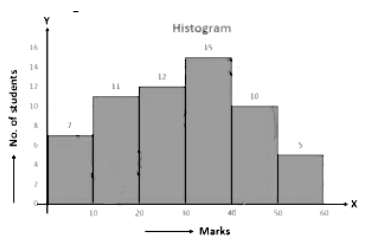
Draw a histogram for the following cumulative frequency table:
Marks Less than
$10$
Less than
$20$
Less than
$30$
Less than
$40$
Less than
$50$
Less than
$60$
Number
of
student
$7$ $18$ $30$ $45$ $55$ $60$
Answer
Marks $0 - 10$ $10 - 20$ $20 - 30$ $30 - 40$ $40 - 50$ $50 - 60$
Number of students $7$ $11$ $12$ $15$ $10$ $5$
The histogram is as follows:
Image
View full question & answer
Question 25 Marks
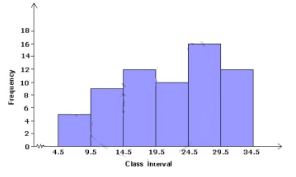
Draw a histogram for the following frequency table:
Class interval $5 - 9$ $10 - 14$ $15 - 19$ $20 - 24$ $25 - 29$ $30 - 34$
Frequency $5$ $9$ $12$ $10$ $16$ $12$
Answer
We see that the class intervals are in inclusive manner.
We first need to convert them into exclusive manner.
Class interval Frequency
$4.5 - 9.5$ $5$
$9.5 - 14.5$ $9$
$14.5 - 19.5$ $12$
$19.5 - 24.5$ $10$
$24.5 - 29.5$ $16$
$29.5 - 34.5$ $12$
We take the true class limit on the $x-$axis on a suitable scale and the frequencies on the $y-$axis on suitable scales.
Taking class intervals as bases and the corresponding frequencies as heights, we consrtuct rectangles to obtain a histogram of the given frequency distribution.
​​​​​​​Here as the class limits do not start from $0$, we put a kink between $0$ and the true lower boundary of the first class.
Image
View full question & answer
Question 35 Marks
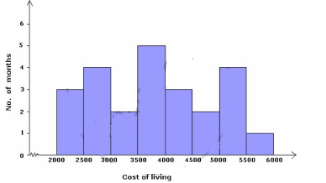
The following frequency distribution table shows the cost of living in a city in a period of $2$ years. Draw histogram for this frequency distribution:
Cost of living $2000 - 2500$ $2500 - 3000$ $3000 - 3500$ $3500 - 4000$ $4000 - 4500$ $4500 - 5000$ $5000 - 5500$ $5500 - 6000$
No. of months $3$ $4$ $2$ $5$ $3$ $2$ $4$ $1$
Answer
We represent the class limits on the $x-$axis on a suitable scale and the frequencies on the $y-$axis on a suitable scale.
Taking class intervals as bases and the corresponding frequencies as heights, we construct rectangles to obtain a histogram of the given frequency distribution.
Here as the class limits do not start from $0$, we put a kink between $0$ and the lower boundary of the first class.
Image ​​​​​​​
View full question & answer
Question 45 Marks
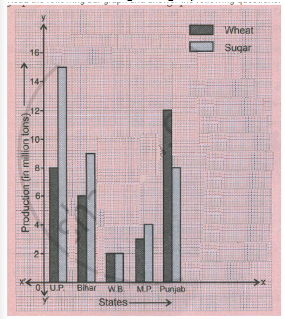
Read the following bar graph and answer the following questions:
Image
$a$. What information is given by the graph?$b$. Which state is the largest producer of wheat?$c$. Which state is the largest producer of sugar?$d$. Which state has total production of wheat and sugar as its maximum?$e$. Which state has the total production of wheat and sugar minimum?
Answer
$a$. The information about Production of wheat and sugar $($in million tons$)$ in five different states $($U.P., Bihar, W.B., M.P., Punjab$)$ is given in the graph.
$b$. Punjab is the largest producer of wheat.
$c.$ U.P. is the largest producer of sugar.
$d$. U.P. has total production of wheat and sugar as its maximum.
$e$. W.B. has the total production of wheat and sugar minimum.
View full question & answer
Question 55 Marks
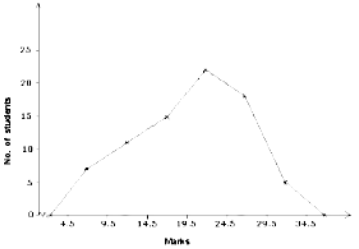
Draw a frequency polygon for the following data:
Marks $5 - 9$ $10 - 14$ $15 - 19$ $20 - 24$ $25 - 29$ $30 - 39$
No. of students $7$ $11$ $15$ $22$ $18$ $5$
Answer
We see that the class intervals are in an inclusive manner. We first need to convert them into exclusive manner.
Marks No. of students
$4.5 - 9.5$ $7$
$9.5 - 14.5 $11$
$14.5 - 19.5$ $15$
$19.5 - 24.5$ $22$
$24.5 - 29.5$ $18$
$29.5 - 34.5$ $5$
We take the class limits on the $x-$axis and the frequencies on the $y-$axis on suitable scales.
Now, find class marks of all the class intervals. Locate the points $(x_1, y_1)$ on the graph, where $x_1$ denotes the class mark and $y_1$ denotes the corresponding frequency.
Join all the points plotted above with straight line segments.
Join the first point and the last point to the points representing class marks of the class intervals before the first class interval and after the last class interval of the given frequency distribution.
Here as the class limits do not start from $0$, we put a kink between $0$ and the lower boundary of the first class.
Image
View full question & answer
Question 65 Marks
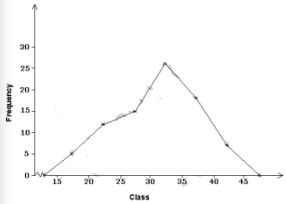
Draw a frequency polygon for the following data:
Class $15 - 20$ $20 - 25$ $25 - 30$ $30 - 35$ $35 - 40$ $40 - 45$
Frequency $5$ $12$ $15$ $26$ $18$ $7$
Answer
We take the class limits on the $x-$axis and the frequencies on the y-axis on suitable scales.
Now, find class marks of all the class intervals. Locate the points $(x_1, y_1)$ on the graph, where $x_1$ denotes the class mark and $y_1$ denotes the corresponding frequency.
Join all the points plotted above with straight line segments.
Join the first point and the last point to the points representing class marks of the class intervals before the first class interval and after the last class interval of the given frequency distribution.
Here as the class limits do not start from $0$, we put a kink between $0$ and the lower boundary of the first class.
Image ​​​​​​​
View full question & answer
Question 75 Marks
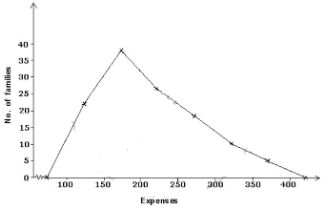
Draw a frequency polygon for the following data:
Expenses $100 - 150$ $150 - 200$ $200 - 250$ $250 - 300$ $300 - 350$ $350 - 400$
No. of families $22$ $37$ $26$ $18$ $10$ $5$
Answer
We take the class limits on the $x-$axis and the frequencies on the $y-$axis on suitable scales.
Now, find class marks of all the class intervals.
Locate the points $(x _1, y _1)$ on the graph, where $x _1$ denotes the class mark and $y_1$ denotes the corresponding frequency.
Join all the points plotted above with straight line segments.
Join the first point and the last point to the points representing class marks of the class intervals before the first class interval and after the last class interval of the given frequency distribution.
Here as the class limits do not start from $0$ , we put a kink between $0$ and the lower boundary of the first class.
Image ​​​​​​​
View full question & answer
Question 85 Marks
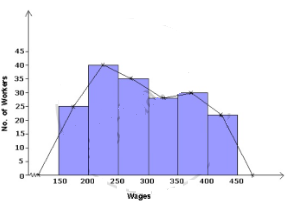
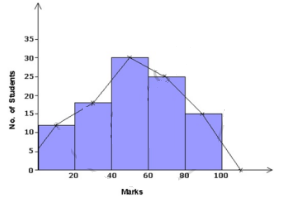
Draw a histogram and a frequency polygon for the following data:
Wages $150 - 200$ $200 - 250$ $250 - 300$ $300 - 350$ $350 - 400$ $400 - 450$
No. of workers $25$ $40$ $35$ $28$ $30$ $22$
Answer
We represent the class limits on the $x-$axis on a suitable scale and the frequencies on the $y-$axis on a suitable scale.
Taking class intervals as bases and the corresponding frequencies as heights, we construct rectangles to obtain a histogram of the given frequency distribution.
Now, we take the mid$-$point of the upper horizontal side of each rectangle.
oin the mid$-$points of two imaginary class intervals, one on either side of the histogram, by line segments one after the other.
Here as the class limits do not start from $0$, we put a kink between $0$ and the lower boundary of the first class.
Image
View full question & answer
Question 95 Marks
Draw a histogram and a frequency polygon for the following data:
Marks $0 - 20$ $20 - 40$ $40 - 60$ $60 - 80$ $80 - 100$
No. of students $12$ $18$ $30$ $25$ $15$
Answer
We represent the class limits on the $x-$axis on a suitable scale and the frequencies on the $y-$axis on a suitable scale.
Takin class intervals as bases and the corresponding frequencies as heights, we construct rectangles to obtain a histogram of the given frequency distribution.
Now, we take the mid$-$points of the upper horizontal side of each rectangle.
Join the mid$-$points of two imaginary class intervals, one on either side of the histogram, by line segments one after the other.
Image ​​​​​​​
View full question & answer
Question 105 Marks
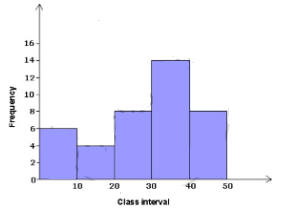
Draw a histogram for the following cumulative frequency table:
Class interval $0 - 10$ $10 - 20$ $20 - 30$ $30 - 40$ $40 - 50$
Cumulative frequency $6$ $10$ $18$ $32$ $40$
Answer
We first convert the cumulative frequency table to an exclusive frequency distribution table.
Class interval $0 - 10$ $10 - 20$ $20 - 30$ $30 - 40$ $40 - 50$
Frequency $6$ $4$ $8$ $14$ $8$
We take the class limits on the $x-$axis and the frequencies on the $y-$axis on suitable scales.
We draw rectangles with the class intervals as bases and the corresponding frequencies as heights.
Image
View full question & answer
[5 marks sum] - MATHEMATICS STD 9 Questions - Vidyadip