Question 15 Marks
If $x=\frac{(2+\sqrt{5})}{(2-\sqrt{5})}$ and $y=\frac{(2-\sqrt{5})}{(2+\sqrt{5})}$, show that $\left(x^2-y^2\right)=144 \sqrt{5}$.
Answer$x=\frac{(2+\sqrt{5})}{(2-\sqrt{5})} $
$ =\frac{(2+\sqrt{5})}{(2-\sqrt{5})} \times \frac{(2+\sqrt{5})}{(2+\sqrt{5})}$
$ =\frac{(2+\sqrt{5})^2}{4-5}$
$=-(4+5+4 \sqrt{5}) $
$=-9-4 \sqrt{5} $
$ y=\frac{(2-\sqrt{5})}{(2+\sqrt{5})}$
$=\frac{(2-\sqrt{5})}{(2+\sqrt{5})} \times \frac{(2-\sqrt{5})}{(2-\sqrt{5})} $
$=\frac{(2-\sqrt{5})^2}{4-5} $
$ =-(4+5-4 \sqrt{5}) $
$=-9+4 \sqrt{5} $
$ \therefore x^2-y^2=(x+y)(x-y) $
$=(-9-4 \sqrt{5}-9+4 \sqrt{5})(-9-4 \sqrt{5}+9-4 \sqrt{5}) $
$=(-18)(-8 \sqrt{5})$
$=144 \sqrt{5}$
View full question & answer→Question 25 Marks
If $x=(4-\sqrt{15})$, find the values of :$\left(x+\frac{1}{x}\right)^2$
Answer$x =4-\sqrt{15} $
$ \therefore \frac{1}{x}=\frac{1}{4-\sqrt{15}} $
$=\frac{1}{4-\sqrt{15}} \times \frac{4+\sqrt{15}}{4+\sqrt{15}} $
$ =\frac{4+\sqrt{15}}{4^2-(\sqrt{15})^2} $
$ =\frac{4+\sqrt{15}}{16-15}$
$ =\frac{4+\sqrt{15}}{1}$
$=4+\sqrt{15} $
$ \therefore x+\frac{1}{x}=(4-\sqrt{15})+(4+\sqrt{15})$
$=4-\sqrt{15}+4+\sqrt{15} $
$=8$
Hence,$\left(x+\frac{1}{x}\right)^2 $
$ =(8)^2$
$ =64$
View full question & answer→Question 35 Marks
If $x=(4-\sqrt{15})$, find the values of $x^3+\frac{1}{x^3}$
Answer$x^3+\frac{1}{x^3} $
$\left(x^3+\frac{1}{x^3}\right)=\left(x+\frac{1}{x}\right)^3-3\left(x+\frac{1}{x}\right) \dots......(1)$
we will first find the value of $x+\frac{1}{x}$
$x+\frac{1}{x}=(4-\sqrt{15})+\frac{1^x}{(4-\sqrt{15})} $
$=\frac{(4-\sqrt{15})^2+1}{(4-\sqrt{15})} $
$=\frac{16+15-8 \sqrt{15}+1}{(4-\sqrt{15})} $
$=\frac{8(4-\sqrt{15})}{(4-\sqrt{15})} $
$=8$
substituting the valuesin $(1)$
$\left(x^3+\frac{1}{x^3}\right)=\left(x+\frac{1}{x}\right)^3-3\left(x+\frac{1}{x}\right)$
$=8^3-24 $
$=488 $
$\left(x^3+\frac{1}{x^3}\right)=488$
View full question & answer→Question 45 Marks
If $x = (4-\sqrt{15})$, find the values of $x^2+\frac{1}{x^2}$
Answer$x^2+\frac{1}{x^2} $
$\left(x^2+\frac{1}{x^2}\right)=\left(x+\frac{1}{x}\right)^2-2\dots ......(1)$
we will first find the value of $x+\frac{1}{x}$
$x+\frac{1}{x}=(4-\sqrt{15})+\frac{1^x}{(4-\sqrt{15})} $
$=\frac{(4-\sqrt{15})^2+1}{(4-\sqrt{15})} $
$=\frac{16+15-8 \sqrt{15}+1}{(4-\sqrt{15})} $
$=\frac{8(4-\sqrt{15})}{(4-\sqrt{15})} $
$=8$
substituting the valuesin $(1)$
$\left(x^2+\frac{1}{x^2}\right)=\left(x+\frac{1}{x}\right)^2-2 $
$=8^2-2 $
$=64-2 $
$=62 $
$\left(x^2+\frac{1}{x^2}\right)=62$
View full question & answer→Question 55 Marks
If $x = (7+4 \sqrt{3})$, find the values of :$\left(x+\frac{1}{x}\right)^2$
Answer$ x =7+4 \sqrt{3} $
$\therefore \frac{1}{x}=\frac{1}{7+4 \sqrt{3}} $
$=\frac{1}{7+4 \sqrt{3}} \times \frac{7-4 \sqrt{3}}{7-4 \sqrt{3}} $
$ =\frac{7-4 \sqrt{3}}{7^2-(4 \sqrt{3})^2} $
$ =\frac{7-4 \sqrt{3}}{49-48} $
$ =\frac{7-4 \sqrt{3}}{1} $
$ =7-4 \sqrt{3} $
$ \therefore x+\frac{1}{x} $
$=(7+4 \sqrt{3})+(7-4 \sqrt{3}) $
$=7+4 \sqrt{3}+7-4 \sqrt{3} $
$ =14 $
Hence,$\left(x+\frac{1}{x}\right)^2 $
$=(14)^2 $
$=19$
View full question & answer→Question 65 Marks
If $x = (7+4 \sqrt{3})$, find the values of $x^3+\frac{1}{x^3}$
Answer$x^3+\frac{1}{x^3} $
$\left(x^3+\frac{1}{x^3}\right)=\left(x+\frac{1}{x}\right)^3-3\left(x+\frac{1}{x}\right)\dots.... (1)$
we will first find out $x+\frac{1}{x}$
$x+\frac{1}{x}=(7+4 \sqrt{3})+\frac{1}{(7+4 \sqrt{3})} $
$=\frac{(7+4 \sqrt{3})^2+1}{(7+4 \sqrt{3})} $
$=\frac{49+48+56 \sqrt{3}+1}{(7+4 \sqrt{3})} $
$=\frac{98+56 \sqrt{3}}{(7+4 \sqrt{3})} $
$=\frac{14(7+4 \sqrt{3})}{(7+4 \sqrt{3})} $
$=14$
substitutingin $(1)$
$\left(x^3+\frac{1}{x^3}\right)=\left(x+\frac{1}{x}\right)^3-3\left(x+\frac{1}{x}\right) $
$=(14)^3-3 \times 14 $
$=2744-42 $
$=2702 $
$\therefore\left(x^3+\frac{1}{x^3}\right)=2702$
View full question & answer→Question 75 Marks
If $x =(7+4 \sqrt{3})$, find the value of $x^2+\frac{1}{x^2}$
Answer$ x^2+\frac{1}{x^2}$
$\left(x^2+\frac{1}{x^2}\right)=\left(x+\frac{1}{x}\right)^2-2 \dots..... (1) $
We first find out $x+\frac{1}{x}$
$x+\frac{1}{x}=(7+4 \sqrt{3})^x+\frac{1}{(7+4 \sqrt{3})}$
$=\frac{(7+4 \sqrt{3})^2+1}{(7+4 \sqrt{3})}$
$=\frac{49+48+56 \sqrt{3}+1}{(7+4 \sqrt{3})}$
$=\frac{98+56 \sqrt{3}}{(7+4 \sqrt{3})}$
$=\frac{14(7+4 \sqrt{3})}{(7+4 \sqrt{3})}$
$=14 $
substitutingin $(1)$
$ \left(x^2+\frac{1}{x}\right)^2=\left(x+\frac{1}{x}\right)^2-2$
$=196-2$
$=194$
$\therefore\left(x^2+\frac{1}{x^2}\right)=194$
View full question & answer→Question 85 Marks
If x = $(7+4 \sqrt{3})$, find the value of $\sqrt{x}+\frac{1}{\sqrt{x}}$
Answer$\sqrt{x}+\frac{1}{\sqrt{x}}$
Squaring Both sides we get
$\left(\sqrt{x}+\frac{1}{\sqrt{x}}\right)^2=x+\frac{1}{x}+2\dots ......(1)$
We will first find out $x+\frac{1}{x}$
$x+\frac{1}{x}=(7+4 \sqrt{3})+\frac{1}{(7+4 \sqrt{3})} $
$=\frac{\left(7+4 \sqrt{3}^2+1\right)}{(7+4 \sqrt{3})} $
$=\frac{49+48+56 \sqrt{3}+1}{(7+4 \sqrt{3})} $
$=\frac{98+56 \sqrt{3}}{(7+4 \sqrt{3})} $
$=\frac{14(7+4 \sqrt{3})}{(7+4 \sqrt{3})} $
$=14$
substitutingin $(1)$
$\left(\sqrt{x}+\frac{1}{\sqrt{x}}\right)^2=x+\frac{1}{x}+2 $
$=14+2 $
$=16 $
$\therefore \sqrt{x}+\frac{1}{\sqrt{x}}=4$
View full question & answer→Question 95 Marks
In the following, find the value of $a$ and $b:\frac{\sqrt{3}-1}{\sqrt{3}+1}+\frac{\sqrt{3}+1}{\sqrt{3}-1}=a+b \sqrt{3}$
Answer$\frac{\sqrt{3}-1}{\sqrt{3}+1}+\frac{\sqrt{3}+1}{\sqrt{3}-1} $
$=\frac{\sqrt{3}-1}{\sqrt{3}+1} \times \frac{\sqrt{3}-1}{\sqrt{3}-1}+\frac{\sqrt{3}+1}{\sqrt{3}-1}+\frac{\sqrt{3}+1}{\sqrt{3}+1} $
$=\frac{(\sqrt{3}-1)^2}{(\sqrt{3})^2-1}+\frac{(\sqrt{3}+1)^2}{(\sqrt{3})^2-1} $
$=\frac{(\sqrt{3})^2-2 \times \sqrt{3} \times 1+1^2}{3-1}+\frac{(\sqrt{3})^2+2 \times \sqrt{3} \times 1+1^2}{3-1}$
$=\frac{3-2 \sqrt{3}+1}{2}+\frac{3+2 \sqrt{3}+1}{2} $
$=\frac{4-2 \sqrt{3}}{2}+\frac{4+2 \sqrt{3}}{2} $
$=\frac{2(2-\sqrt{3})}{2}+\frac{2(2+\sqrt{3})}{2} $
$=2-\sqrt{3}+2+\sqrt{3} $
$=4+0$
Hence, $a=4$ and $b=0$
View full question & answer→Question 105 Marks
In the following, find the value of $a$ and $b:\frac{7+\sqrt{5}}{7-\sqrt{5}}-\frac{7-\sqrt{5}}{7+\sqrt{5}}=a+b \sqrt{5}$
Answer$\frac{7+\sqrt{5}}{7-\sqrt{5}}-\frac{7-\sqrt{5}}{7+\sqrt{5}} $
$=\frac{7+\sqrt{5}}{7-\sqrt{5}} \times \frac{7+\sqrt{5}}{7+\sqrt{5}}-\frac{7-\sqrt{5}}{7+\sqrt{5}} \times \frac{7-\sqrt{5}}{7-\sqrt{5}} $
$=\frac{(7+\sqrt{5})^2}{7^2-(\sqrt{5})^2}-\frac{(7-\sqrt{5})^2}{7^2-(\sqrt{5})^2} $
$=\frac{7^2+2 \times 7 \times \sqrt{5}+(\sqrt{5})^2}{49-5}-\frac{7^2-2 \times 7 \times \sqrt{5}+(\sqrt{5})^2}{49-5} $
$=\frac{49+14 \sqrt{5}+5}{44}-\frac{49-14 \sqrt{5}+5}{44} $
$=\frac{54+14 \sqrt{5}}{44}-\frac{54-14 \sqrt{5}}{44} $
$=\frac{2(27+7 \sqrt{5})}{2(22-7 \sqrt{5})} $
$=\frac{27+7 \sqrt{5}}{22}-\frac{27-7 \sqrt{5}}{22} $
$=\frac{27}{22}+\frac{7 \sqrt{5}}{22}-\frac{27}{22}+\frac{7 \sqrt{5}}{22} $
$=\frac{14 \sqrt{5}}{22} $
$=\frac{7 \sqrt{5}}{11} $
$=0+\frac{7 \sqrt{5}}{11} $
$= a + b \sqrt{5}$
Hence, $a =0$ and $b =\frac{7}{11}$.
View full question & answer→Question 115 Marks
In the following, find the values of $a$ and $b:\frac{\sqrt{2}+\sqrt{3}}{3 \sqrt{2}-2 \sqrt{3}}=a-b \sqrt{6}$
Answer$\frac{\sqrt{2}+\sqrt{3}}{3 \sqrt{2}-2 \sqrt{3}} $
$=\frac{\sqrt{2}+\sqrt{3}}{3 \sqrt{2}-2 \sqrt{3}} \times \frac{3 \sqrt{2}+2 \sqrt{3}}{3 \sqrt{2}+2 \sqrt{3}} $
$=\frac{(\sqrt{2}+\sqrt{3})(3 \sqrt{2}+2 \sqrt{3})}{(3 \sqrt{2})^2-(2 \sqrt{3})^2} $
$=\frac{\sqrt{2}(3 \sqrt{2}+2 \sqrt{3})+\sqrt{3}(3 \sqrt{2}+2 \sqrt{3})}{(9 \times 2)-(4 \times 3)} $
$=\frac{(3 \times 2+2 \sqrt{6})+(3 \sqrt{6}+2 \times 3)}{18-12} $
$=\frac{6+2 \sqrt{6}+3 \sqrt{6}+6}{6} $
$=\frac{12+5 \sqrt{6}}{6} $
$=2-\left(-\frac{5}{6}\right) \sqrt{6} $
$= a - b \sqrt{6} $
Hence, $a =2$ and $b =-\frac{5}{6}$.
View full question & answer→Question 125 Marks
In the following, find the values of $a$ and $b:\frac{7 \sqrt{3}-5 \sqrt{2}}{4 \sqrt{3}+3 \sqrt{2}}=a-b \sqrt{6}$
Answer$\frac{7 \sqrt{3}-5 \sqrt{2}}{4 \sqrt{3}+3 \sqrt{2}} $
$=\frac{7 \sqrt{3}-5 \sqrt{2}}{4 \sqrt{3}+3 \sqrt{2}} \times \frac{4 \sqrt{3}-3 \sqrt{2}}{4 \sqrt{3}-3 \sqrt{2}} $
$=\frac{7 \sqrt{3}(4 \sqrt{3}-3 \sqrt{2})-5 \sqrt{2}(4 \sqrt{3}-3 \sqrt{2})}{(4 \sqrt{3})^2-(3 \sqrt{2})^2} $
$=\frac{84-21 \sqrt{6}-20 \sqrt{6}+30}{48-18} $
$=\frac{110-41 \sqrt{6}}{30} $
$=\frac{110}{30}-\frac{41 \sqrt{6}}{30} $
$=\frac{11}{3}-\frac{41}{30} \sqrt{6} $
$= a - b \sqrt{6}$
Hence, $a =\frac{11}{3}$ and $b =\frac{41}{30}$.
View full question & answer→Question 135 Marks
In the following, find the values of $a$ and $b:\frac{\sqrt{11}-\sqrt{7}}{\sqrt{11}+\sqrt{7}}= a - b \sqrt{77}$
Answer$\frac{\sqrt{11}-\sqrt{7}}{\sqrt{11}+\sqrt{7}} $
$=\frac{\sqrt{11}-\sqrt{7}}{\sqrt{11}+\sqrt{7}} \times \frac{\sqrt{11}-\sqrt{7}}{\sqrt{11}-\sqrt{7}} $
$=\frac{(\sqrt{11}-\sqrt{7})^2}{(\sqrt{11})^2-(\sqrt{7})^2} $
$=\frac{(\sqrt{11})^2+(\sqrt{7})^2-2 \times \sqrt{11} \times \sqrt{7}}{11-7} $
$=\frac{11+7-2 \sqrt{77}}{4} $
$=\frac{18-2 \sqrt{77}}{4} $
$=\frac{18}{4}-\frac{2}{4} \sqrt{77} $
$=\frac{9}{2}-\frac{1}{2} \sqrt{77} $
$= a - b \sqrt{77}$
Hence, $a =\frac{9}{2}$ and $b =\frac{1}{2}$.
View full question & answer→Question 145 Marks
In the following, find the values of $a$ and $b:\frac{\sqrt{3}-2}{\sqrt{3}+2}=a \sqrt{3}+b$
Answer$\frac{\sqrt{3}-2}{\sqrt{3}+2} $
$=\frac{\sqrt{3}-2}{\sqrt{3}+2} \times \frac{\sqrt{3}-2}{\sqrt{3-2}} $
$=\frac{\sqrt{3}(\sqrt{3}-2)-2(\sqrt{3}-2)}{(\sqrt{3})^2-(\sqrt{2})^2} $
$=\frac{3-2 \sqrt{3}-2 \sqrt{3}+4}{3-4} $
$=\frac{7-4 \sqrt{3}}{-1} $
$=-(7-4 \sqrt{3}) $
$=-7+4 \sqrt{3} $
$=4 \sqrt{3}-7 $
$=4 \sqrt{3}+(-7) $
$= a \sqrt{3}+ b$
Hence, $a =4$ and $b =-7$.
View full question & answer→Question 155 Marks
In the following, find the values of $a$ and $b:\frac{1}{\sqrt{5}-\sqrt{3}}=a \sqrt{5}-b \sqrt{3}$
Answer$\frac{1}{\sqrt{5}-\sqrt{3}} $
$= \frac{1}{\sqrt{5}-\sqrt{3}} \times \frac{\sqrt{5}+\sqrt{3}}{\sqrt{5}+\sqrt{3}} $
$= \frac{\sqrt{5}+\sqrt{3}}{(\sqrt{5})^2-(\sqrt{3})^2} $
$= \frac{\sqrt{5}+\sqrt{3}}{5-3} $
$= \frac{\sqrt{5}+\sqrt{3}}{2} $
$= \frac{1}{2} \sqrt{5}+\frac{1}{2} \sqrt{3} $
$= \frac{1}{2} \sqrt{5}-\left(-\frac{1}{2}\right) \sqrt{3} $
$= a \sqrt{5}- b \sqrt{3}$
Hence, $a =\frac{1}{2}$ and $b =-\frac{1}{2}$.
View full question & answer→Question 165 Marks
In the following, find the values of $a$ and $b:\frac{5+2 \sqrt{3}}{7+4 \sqrt{3}}=a+b \sqrt{3}$
Answer$\frac{5+2 \sqrt{3}}{7+4 \sqrt{3}} $
$=\frac{5+2 \sqrt{3}}{7+4 \sqrt{3}} \times \frac{7-4 \sqrt{3}}{7-4 \sqrt{3}} $
$=\frac{5(7-4 \sqrt{3})+2 \sqrt{3}(7-4 \sqrt{3})}{(7)^2-(4 \sqrt{3})^2} $
$=\frac{35-20 \sqrt{3}+14 \sqrt{3}-24}{49-48} $
$=\frac{11-6 \sqrt{3}}{1} $
$=11+(-6) \sqrt{3} $
$= a + b \sqrt{3} $
Hence, $a=11$ and $b=-6$
View full question & answer→Question 175 Marks
In the following, find the values of $a$ and $b:\frac{3+\sqrt{7}}{3-\sqrt{7}}=a+b \sqrt{7}$
Answer$\frac{3+\sqrt{7}}{3-\sqrt{7}} $
$=\frac{3+\sqrt{7}}{3-\sqrt{7}} \times \frac{3+\sqrt{7}}{3+\sqrt{7}} $
$=\frac{(3+\sqrt{7})^2}{(3)^2-(\sqrt{7})^2} $
$=\frac{9+6 \sqrt{7}+7}{9-7} $
$=\frac{16+6 \sqrt{7}}{2} $
$=8+3 \sqrt{7} $
$= a + b \sqrt{7}$
Hence, $a=8$ and $b=3$.
View full question & answer→Question 185 Marks
In the following, find the values of $a$ and $b.\frac{\sqrt{3}-1}{\sqrt{3}+1}=a+b \sqrt{3}$
Answer$\frac{\sqrt{3}-1}{\sqrt{3}+1}$
$= \frac{\sqrt{3}-1}{\sqrt{3}+1} \times \frac{\sqrt{3}-1}{\sqrt{3}-1}$
$= \frac{(\sqrt{3}-1)^2}{(\sqrt{3})^2-(1)^2}$
$= \frac{3-2 \times \sqrt{3} \times 1+1}{3-1}$
$= \frac{4-2 \sqrt{3}}{2}$
$= 2-\sqrt{3}$
$= 2+(-1) \sqrt{3}$
$= a + b \sqrt{3}$
Hence, $a=2$ and $b=-1$.
View full question & answer→Question 195 Marks
If ($\frac{\sqrt{2.5}-\sqrt{0.75}}{\sqrt{2.5}+\sqrt{0.75}})=p+q \sqrt{30}$, find the values of $p$ and $q.$
Answer$\frac{\sqrt{2.5}-\sqrt{0.75}}{\sqrt{2.5}+\sqrt{0.75}}$
$= \frac{\sqrt{2.5}-\sqrt{0.75}}{\sqrt{2.5}+\sqrt{0.75}} \times \frac{\sqrt{2.5}-\sqrt{0.75}}{\sqrt{2.5}-\sqrt{0.75}}$
$= \frac{(\sqrt{2.5}-\sqrt{0.75})^2}{(\sqrt{2.5})^2-(\sqrt{0.75})^2}$
$= \frac{2.5-2 \times \sqrt{2.5} \times \sqrt{0.75}+0.75}{2.5-0.75}$
$= \frac{3.25-2 \times \sqrt{0.25 \times 10} \times \sqrt{0.25 \times 3}}{1.75}$
$= \frac{3.25-2 \times 0.25 \sqrt{30}}{1.75}$
$= \frac{3.25-0.5 \sqrt{30}}{1.75}$
$= \frac{3.25}{1.75}-\frac{0.5}{1.75} \sqrt{30}$
$= \frac{325}{175}-\frac{15}{175} \sqrt{30}$
$= \frac{13}{7}-\frac{2}{7} \sqrt{30}$
$= \frac{13}{7}+\left(-\frac{2}{7}\right) \sqrt{30}$
$= p + q \sqrt{30}$
Hence, $p =\frac{13}{7}$ and $q =-\frac{2}{7}$.
View full question & answer→Question 205 Marks
Simplify the following :$\frac{4 \sqrt{3}}{(2-\sqrt{2})}-\frac{30}{(4 \sqrt{3}-3 \sqrt{2})}-\frac{3 \sqrt{2}}{(3+2 \sqrt{3})}$
Answer$\frac{4 \sqrt{3}}{(2-\sqrt{2})}-\frac{30}{(4 \sqrt{3}-3 \sqrt{2})}-\frac{3 \sqrt{2}}{(3+2 \sqrt{3})}$
Rationalizing the denominator of each term, we have
$=\frac{4 \sqrt{3}(2+\sqrt{2})}{(2-\sqrt{2})(2+\sqrt{2})}-\frac{30(4 \sqrt{3}+3 \sqrt{2})}{(4 \sqrt{3}-3 \sqrt{2})(4 \sqrt{3}+3 \sqrt{2})}-\frac{3 \sqrt{2}(3-2 \sqrt{3})}{(3+2 \sqrt{3})(3-2 \sqrt{3})} $
$=\frac{8 \sqrt{3}+4 \sqrt{6}}{4-2}-\frac{120 \sqrt{3}+90 \sqrt{2}}{48-18}-\frac{9 \sqrt{2}-6 \sqrt{6}}{9-12} $
$=\frac{8 \sqrt{3}+4 \sqrt{6}}{2}-\frac{120 \sqrt{3}+90 \sqrt{2}}{30}-\frac{9 \sqrt{2}-6 \sqrt{6}}{-3} $
$=\frac{8 \sqrt{3}+4 \sqrt{6}}{2}-\frac{120 \sqrt{3}+90 \sqrt{2}}{30}-\frac{9 \sqrt{2}-6 \sqrt{6}}{3} $
$=4 \sqrt{3}+2 \sqrt{6}-4 \sqrt{3}-3 \sqrt{2}+3 \sqrt{2}-2 \sqrt{6} $
$=0$
View full question & answer→Question 215 Marks
Simplify the following :$\frac{7 \sqrt{3}}{\sqrt{10}+\sqrt{3}}-\frac{2 \sqrt{5}}{\sqrt{6}+\sqrt{5}}-\frac{3 \sqrt{2}}{\sqrt{15}+3 \sqrt{2}}$
Answer$\frac{7 \sqrt{3}}{\sqrt{10}+\sqrt{3}}-\frac{2 \sqrt{5}}{\sqrt{6}+\sqrt{5}}-\frac{3 \sqrt{2}}{\sqrt{15}+3 \sqrt{2}}$
Rationalizing the denominator of each term, we have
$=\frac{7 \sqrt{3}(\sqrt{10}-\sqrt{3})}{(\sqrt{10}+\sqrt{3})(\sqrt{10}-\sqrt{3})}-\frac{2 \sqrt{5}(\sqrt{6}-\sqrt{5})}{(\sqrt{6}+\sqrt{5})(\sqrt{6}-\sqrt{5})}-\frac{3 \sqrt{2}(\sqrt{15}-3 \sqrt{2})}{(\sqrt{15}+3 \sqrt{2})(\sqrt{15}-3 \sqrt{2})} $
$=\frac{7 \sqrt{30}-21}{10-3}-\frac{2 \sqrt{30}-10}{6-5}-\frac{3 \sqrt{30}-18}{15-18} $
$=\frac{7 \sqrt{30}-21}{7}-\frac{2 \sqrt{30}-10}{1}-\frac{3 \sqrt{30}-18}{-3} $
$=\frac{7 \sqrt{30}-21}{7}-\frac{2 \sqrt{30}-10}{1}+\frac{3 \sqrt{30}-18}{3} $
$=\sqrt{30}-3-2 \sqrt{30}+10+\sqrt{30}-6 $
$=-1$
View full question & answer→Question 225 Marks
Simplify the following :$\frac{6}{2 \sqrt{3}-\sqrt{6}}+\frac{\sqrt{6}}{\sqrt{3}+\sqrt{2}}-\frac{4 \sqrt{3}}{\sqrt{6}-\sqrt{2}}$
Answer$\frac{6}{2 \sqrt{3}-\sqrt{6}}+\frac{\sqrt{6}}{\sqrt{3}+\sqrt{2}}-\frac{4 \sqrt{3}}{\sqrt{6}-\sqrt{2}}$
Rationalizing the denominator of each term, we have
$=\frac{6(2 \sqrt{3}+\sqrt{6})}{(2 \sqrt{3}-\sqrt{6})(2 \sqrt{3}+\sqrt{6})}+\frac{\sqrt{6}(\sqrt{3}-\sqrt{2})}{(\sqrt{3}+\sqrt{2})(\sqrt{3}-\sqrt{2})}-\frac{4 \sqrt{3}(\sqrt{6}+\sqrt{2})}{(\sqrt{6}-\sqrt{2})(\sqrt{6}+\sqrt{2})} $
$=\frac{12 \sqrt{3}+6 \sqrt{6}}{12-6}+\frac{\sqrt{18}-\sqrt{12}}{3-2}-\frac{4 \sqrt{18}+4 \sqrt{6}}{6-2} $
$=\frac{12 \sqrt{3}+6 \sqrt{6}}{6}+\frac{\sqrt{18}-\sqrt{12}}{1}-\frac{4 \sqrt{18}+4 \sqrt{6}}{4} $
$=2 \sqrt{3}+\sqrt{6}+\sqrt{18}-\sqrt{12}-\sqrt{18}-\sqrt{6} $
$=2 \sqrt{3}-\sqrt{12} $
$=2 \sqrt{3}-2 \sqrt{3} $
$=0$
View full question & answer→Question 235 Marks
Simplify the following :$\frac{3 \sqrt{2}}{\sqrt{6}-\sqrt{3}}-\frac{4 \sqrt{3}}{\sqrt{6}-\sqrt{2}}+\frac{2 \sqrt{3}}{\sqrt{6}+2}$
Answer$\frac{3 \sqrt{2}}{\sqrt{6}-\sqrt{3}}-\frac{4 \sqrt{3}}{\sqrt{6}-\sqrt{2}}+\frac{2 \sqrt{3}}{\sqrt{6}+2}$
Rationalizing the denominator of each term, we have
$=\frac{3 \sqrt{2}(\sqrt{6}+\sqrt{3})}{(\sqrt{6}-\sqrt{3})(\sqrt{6}+\sqrt{3})}-\frac{4 \sqrt{3}(\sqrt{6}+\sqrt{2})}{(\sqrt{6}-\sqrt{2})(\sqrt{6}+\sqrt{2})}+\frac{2 \sqrt{3}(\sqrt{6}-2)}{(\sqrt{6}+2)(\sqrt{6}-2)} $
$=\frac{3 \sqrt{12}+3 \sqrt{6}}{\frac{6}{3}-3}-\frac{4 \sqrt{18}+4 \sqrt{6}}{6-2}+\frac{2 \sqrt{18}-4 \sqrt{3}}{2} $
$=\frac{3 \sqrt{12}+3 \sqrt{6}}{3}-\frac{4 \sqrt{18}+4 \sqrt{6}}{4}+\frac{2 \sqrt{18}-4 \sqrt{3}}{2} $
$=\sqrt{12}+\sqrt{6}-\sqrt{18}-\sqrt{6}+\sqrt{18}-2 \sqrt{3} $
$=\sqrt{12}-2 \sqrt{3} $
$=2 \sqrt{3}-2 \sqrt{3} $
$=0$
View full question & answer→Question 245 Marks
Simplify the following :$\frac{\sqrt{6}}{\sqrt{2}+\sqrt{3}}+\frac{3 \sqrt{2}}{\sqrt{6}+\sqrt{3}}-\frac{4 \sqrt{3}}{\sqrt{6}+\sqrt{2}}$
Answer$\frac{\sqrt{6}}{\sqrt{2}+\sqrt{3}}+\frac{3 \sqrt{2}}{\sqrt{6}+\sqrt{3}}-\frac{4 \sqrt{3}}{\sqrt{6}+\sqrt{2}}$
Rationalizing the denominator of each term, we have
$=\frac{\sqrt{6}(\sqrt{2}-\sqrt{3})}{(\sqrt{2}+\sqrt{3})(\sqrt{2}-\sqrt{3})}+\frac{3 \sqrt{2}(\sqrt{6}-\sqrt{3})}{(\sqrt{6}+\sqrt{3})(\sqrt{6}-\sqrt{3})}-\frac{4 \sqrt{3}(\sqrt{6}-\sqrt{2})}{(\sqrt{6}+\sqrt{2})(\sqrt{6}-\sqrt{2})} $
$=\frac{\sqrt{12}-\sqrt{18}}{2-3}+\frac{3 \sqrt{12}-3 \sqrt{6}}{6-3}-\frac{4 \sqrt{18}-4 \sqrt{6}}{6-2} $
$=\frac{\sqrt{12}-\sqrt{18}}{-1}+\frac{3 \sqrt{12}-3 \sqrt{6}}{3}-\frac{4 \sqrt{18}-4 \sqrt{6}}{4} $
$=\sqrt{18}-\sqrt{12}+\sqrt{12}-\sqrt{6}-\sqrt{18}+\sqrt{6} $
$=0$
View full question & answer→Question 255 Marks
Simplify by rationalising the denominator in the following.$\frac{\sqrt{12}+\sqrt{18}}{\sqrt{75}-\sqrt{50}}$
Answer$\frac{\sqrt{12}+\sqrt{18}}{\sqrt{75}-\sqrt{50}}$
$ =\frac{\sqrt{12}+\sqrt{18}}{\sqrt{75}-\sqrt{50}} \times \frac{\sqrt{75}+\sqrt{50}}{\sqrt{75}+\sqrt{50}}$
$ =\frac{(2 \sqrt{3}+3 \sqrt{2})(5 \sqrt{3}+5 \sqrt{2})}{(\sqrt{75})^2-(\sqrt{50})^2} $
$ =\frac{30+10 \sqrt{6}+15 \sqrt{6}+30}{75-50} $
$=\frac{60+25 \sqrt{6}}{25} $
$=\frac{12+5 \sqrt{6}}{5}$
View full question & answer→Question 265 Marks
Simplify by rationalising the denominator in the following.$\frac{5 \sqrt{3}-\sqrt{15}}{5 \sqrt{3}+\sqrt{15}}$
Answer$ \frac{5 \sqrt{3}-\sqrt{15}}{5 \sqrt{3}+\sqrt{15}}$
$= \frac{5 \sqrt{3}-\sqrt{15}}{5 \sqrt{3}+\sqrt{15}} \times \frac{5 \sqrt{3}-\sqrt{15}}{5 \sqrt{3}-\sqrt{15}}$
$= \frac{(5 \sqrt{3}-\sqrt{15})^2}{(5 \sqrt{3})^2-(\sqrt{15})^2}$
$= \frac{75+15-10 \sqrt{45}}{75-15}$
$= \frac{90-10 \sqrt{45}}{60}$
$= \frac{9-1 \sqrt{45}}{6}$
$= \frac{9-3 \sqrt{5}}{6}$
$= \frac{3-\sqrt{5}}{2}$
View full question & answer→Question 275 Marks
Simplify by rationalising the denominator in the following.$\frac{2 \sqrt{3}-\sqrt{6}}{2 \sqrt{3}+\sqrt{6}}$
Answer$\frac{2 \sqrt{3}-\sqrt{6}}{2 \sqrt{3}+\sqrt{6}} $
$=\frac{2 \sqrt{3}-\sqrt{6}}{2 \sqrt{3}+\sqrt{6}} \times \frac{2 \sqrt{3}-\sqrt{6}}{2 \sqrt{3}-\sqrt{6}} $
$=\frac{(2 \sqrt{3}-\sqrt{6})^2}{(2 \sqrt{3})^2-(\sqrt{6})^2} $
$=\frac{12+6-4 \sqrt{18}}{12-6} $
$=\frac{18-4 \sqrt{18}}{6} $
$=\frac{9-2 \sqrt{18}}{3}$
$=\frac{9-6 \sqrt{2}}{3}$
$ =3-2 \sqrt{2}$
View full question & answer→Question 285 Marks
Simplify by rationalising the denominator in the following.$\frac{3 \sqrt{5}+\sqrt{7}}{3 \sqrt{5}-\sqrt{7}}$
Answer$\frac{3 \sqrt{5}+\sqrt{7}}{3 \sqrt{5}-\sqrt{7}} $
$ =\frac{3 \sqrt{5}+\sqrt{7}}{3 \sqrt{5}-\sqrt{7}} \times \frac{3 \sqrt{5}+\sqrt{7}}{3 \sqrt{5}+\sqrt{7}}$
$=\frac{(3 \sqrt{5}+\sqrt{7})^2}{(3 \sqrt{5})^2-(\sqrt{7})^2} $
$ =\frac{45+7+6 \sqrt{35}}{45-7} $
$ =\frac{5+6 \sqrt{35}}{38}$
$ =\frac{26+3 \sqrt{35}}{19}$
View full question & answer→Question 295 Marks
Simplify by rationalising the denominator in the following.$\frac{\sqrt{7}-\sqrt{5}}{\sqrt{7}+\sqrt{5}}$
Answer$\frac{\sqrt{7}-\sqrt{5}}{\sqrt{7}+\sqrt{5}} $
$=\frac{\sqrt{7}-\sqrt{5}}{\sqrt{7}+\sqrt{5}} \times \frac{\sqrt{7}-\sqrt{5}}{\sqrt{7}-\sqrt{5}} $
$ =\frac{(\sqrt{7}-\sqrt{5})^2}{(\sqrt{7})^2-(\sqrt{5})^2} $
$=\frac{7+5-2 \sqrt{35}}{7-5} $
$=\frac{12-2 \sqrt{35}}{2} $
$=6-\sqrt{35}$
View full question & answer→Question 305 Marks
Simplify by rationalising the denominator in the following.$\frac{\sqrt{15}+3}{\sqrt{15}-3}$
Answer$\frac{\sqrt{15}+3}{\sqrt{15}-3}$
$=\frac{\sqrt{15}+3}{\sqrt{15}-3} \times \frac{\sqrt{15}+3}{\sqrt{15}+3}$
$ =\frac{(\sqrt{15}+3)^2}{(\sqrt{15})^2-(3)^2} $
$ =\frac{15+9+6 \sqrt{15}}{15-9}$
$=\frac{24+6 \sqrt{15}}{6} $
$ =4+\sqrt{15}$
View full question & answer→Question 315 Marks
Simplify by rationalising the denominator in the following.$\frac{\sqrt{3}+1}{\sqrt{3}-1}$
Answer$\frac{\sqrt{3}+1}{\sqrt{3}-1} $
$=\frac{\sqrt{3}+1}{\sqrt{3}-1} \times \frac{\sqrt{3}+1}{\sqrt{3}+1}$
$ =\frac{(\sqrt{3}+1)^2}{(\sqrt{3})^2-(1)^2} $
$ =\frac{(\sqrt{3})^2+2 \times \sqrt{3} \times 1+(1)^2}{3-1} $
$=\frac{3+2 \sqrt{3}+1}{2} $
$ =\frac{4+2 \sqrt{3}}{2} $
$=2+\sqrt{3}$
View full question & answer→Question 325 Marks
Simplify by rationalising the denominator in the following.$\frac{42}{2 \sqrt{3}+3 \sqrt{2}}$
Answer$\frac{42}{2 \sqrt{3}+3 \sqrt{2}} $
$ =\frac{42}{2 \sqrt{3}+3 \sqrt{2}} \times \frac{2 \sqrt{3}-3 \sqrt{2}}{2 \sqrt{3}-3 \sqrt{2}} $
$ =\frac{42(2 \sqrt{3}-3 \sqrt{2})}{(2 \sqrt{3})^2-\left(3 \sqrt{2}^2\right)} $
$ =\frac{84 \sqrt{3}-126 \sqrt{2}}{12-18} $
$ =\frac{84 \sqrt{3}-126 \sqrt{2}}{-6} $
$ =-14 \sqrt{3}+21 \sqrt{2} $
$ =21 \sqrt{2}-14 \sqrt{3} $
$ =7(3 \sqrt{2}-2 \sqrt{3})$
View full question & answer→Question 335 Marks
Simplify by rationalising the denominator in the following.$\frac{5}{\sqrt{7}-\sqrt{2}}$
Answer$ \frac{5}{\sqrt{7}-\sqrt{2}}$
$= \frac{5}{\sqrt{7}-\sqrt{2}} \times \frac{\sqrt{7}+\sqrt{2}}{\sqrt{7}+\sqrt{2}}$
$= \frac{5(\sqrt{7}+\sqrt{2})}{(\sqrt{7})^2+(\sqrt{2})^2}$
$= \frac{5(\sqrt{7}+\sqrt{2})}{7-2}$
$= \frac{5(\sqrt{7}+\sqrt{2})}{5}$
$= \sqrt{7}+\sqrt{2}$
View full question & answer→Question 345 Marks
If $x=\frac{1}{(3-2 \sqrt{2})}$ and $y=\frac{1}{(3+2 \sqrt{2})}$, find the values of $x^3+y^3$
Answer$x^3+y^3$
$\left(x^3+y^3\right)=(x+y)^3-3 x y(x+y) \dots.....(1)$
Now, $x+y=\frac{1}{(3-2 \sqrt{2})}+\frac{1}{(3+2 \sqrt{2})}$
$=\frac{(3+2 \sqrt{2})+(3-2 \sqrt{2})}{(3-2 \sqrt{2})(3+2 \sqrt{2})}$
$=\frac{6}{9-8}$
$=6$
and $x y=\frac{1}{(3-2 \sqrt{2})} \times \frac{1}{(3+2 \sqrt{2})}$
$=\frac{1}{9-8}$
$=1$
substituting the valuesin $(1),$ we get
$ \left(x^3+y^3\right)$
$=(x+y)^3-3 x y(x+y)$
$=216-3 x^6$
$=198$
View full question & answer→Question 355 Marks
If $x=\frac{1}{(3-2 \sqrt{2})}$ and $y=\frac{1}{(3+2 \sqrt{2})}$, find the values of $x^2+y^2$
Answer$x^2+y^2$
$\left(x^2+y^2\right)=(x+y)^2-2 x y$
Now, $x+y=\frac{1}{(3-2 \sqrt{2})}+\frac{1}{(3+2 \sqrt{2})}$
$=\frac{(3+2 \sqrt{2})+(3-2 \sqrt{2})}{(3-2 \sqrt{2})(3+2 \sqrt{2})}$
$=\frac{6}{9-8}$
$=6$
and $x y=\frac{1}{(3-2 \sqrt{2})} \times \frac{1}{(3+2 \sqrt{2})}$
$=\frac{1}{9-8}$
$=1 $
substituting the valuesin $(1),$ we get
$ \left(x^2+y^2\right)$
$=(x+y)^2-2 x y$
$=36-2$
$=34$
$\left(x^2+y^2\right)$
$=34 $
View full question & answer→Question 365 Marks
If $x=\frac{(\sqrt{3}+1)}{(\sqrt{3}-1)}$ and $y=\frac{(\sqrt{3}-1)}{(\sqrt{3}-1)}$, find the values of $x^2-y^2+x y$
Answer$x^2-y^2+x y $
$x^2-y^2+x y=(x+y)(x-y)+x y-\cdots(1) $
$\therefore(x+y)=\frac{(\sqrt{3}+1)}{(\sqrt{3}-1)}+\frac{(\sqrt{3}-1)}{(\sqrt{3}+1)} $
$=\frac{(\sqrt{3}+1)^2+(\sqrt{3}-1)^2}{3-1} $
$=\frac{3+1+2 \sqrt{3}+3+1-2 \sqrt{3}}{2} $
$=\frac{8}{2} $
$=4 $
$(x-y)=\frac{(\sqrt{3}+1)}{(\sqrt{3}-1)} \times \frac{(\sqrt{3}-1)}{(\sqrt{3}+1)} $
$=\frac{(\sqrt{3}+1)^2-(\sqrt{3}-1)^2}{3-1} $
$=\frac{3+1+2 \sqrt{3}-3-1+2 \sqrt{3}}{2} $
$=2 \sqrt{3} $
and $x y=\frac{(\sqrt{3}+1)}{(\sqrt{3}-1)} \times \frac{(\sqrt{3}-1)}{(\sqrt{3}+1)} $
$=\frac{3-1}{3-1} $
$=1$
substitutingin $(1),$ we get
$x 2-y 2+x y$
$=(x+y)(x-y)+x y$
$=4 \times 2 \sqrt{3}+1 $
$=8 \sqrt{3}+1$
View full question & answer→Question 375 Marks
If $x=\frac{(\sqrt{3}+1)}{(\sqrt{3}-1)}$ and $y=\frac{(\sqrt{3}-1)}{(\sqrt{3}+1)}$, find the values of $x^3+y^3$
Answer$x^3+y^3 $
$x^3+y^3=(x+y)^3-3 x y(x+y) \cdots-(1) $
$\therefore(x+y)=\frac{(\sqrt{3}+1)}{(\sqrt{3}-1)}+\frac{(\sqrt{3}-1)}{(\sqrt{3}+1)} $
$=\frac{(\sqrt{3}+1)^2+(\sqrt{3}-1)^2}{3-1} $
$=\frac{3+1+2 \sqrt{3}+3+1-2 \sqrt{3}}{2} $
$=\frac{8}{2} $
$=4$
and $x y=\frac{(\sqrt{3}+1)}{(\sqrt{3}-1)} \times \frac{(\sqrt{3}-1)}{(\sqrt{3}+1)}$
$=\frac{3-1}{3-1}$
$=1$
substitutingin $(1),$ we get
$x^3+y^3 $
$=(x+y)^3-3 x y(x+y) $
$=64-3 \times 4 $
$=64-12 $
$=52$
View full question & answer→Question 385 Marks
If $x =\frac{(\sqrt{3}+1)}{(\sqrt{3}-1)}$ and $y =\frac{(\sqrt{3}-1)}{(\sqrt{3}+1)}$, find the values of $x^2+y^2$
Answer$x^2+y^2 $
$x^2+y^2=(x+y)^2-2 x y-\cdots(1) $
$\therefore(x+y)=\frac{(\sqrt{3}+1)}{(\sqrt{3}-1)}+\frac{(\sqrt{3}-1)}{(\sqrt{3}-1)} $
$=\frac{(\sqrt{3}+1)^2+(\sqrt{3}-1)^2}{3-1} $
$=\frac{3+1+2 \sqrt{3}+3+1-2 \sqrt{3}}{2} $
$=\frac{8}{2}=4 $
$=4 x y=\frac{(\sqrt{3}+1)}{(\sqrt{3}-1)} \times \frac{(\sqrt{3}-1)}{(\sqrt{3}+1)} $
$=1$
substituting in $(1),$ we get
$x^2+y^2 $
$=(x+y)^2-2 x y $
$=16-2 $
$=14$
View full question & answer→Question 395 Marks
Write the following in descending order:$\sqrt{6}, \sqrt[3]{8}$ and $\sqrt[4]{3}$
AnswerSince $\sqrt{6}=6^{\frac{1}{2}}$ has power $\frac{1}{2}$,
$\sqrt[3]{8}=2$
$\sqrt[4]{3}=3^{\frac{1}{4}}$ has power $\frac{1}{4}$
Now,$\text{L.C.M}.$ of $2, 1$ and $4=4$
$\therefore \sqrt{6}=6^{\frac{1}{2}}=6^{\frac{2}{4}}=\left(6^2\right)^{\frac{1}{4}}=(36)^{\frac{1}{4}} $
$\sqrt[3]{8}=2=2^{\frac{4}{4}}=\left(2^4\right)^{\frac{1}{4}}=(16)^{\frac{1}{4}}$
$\sqrt[4]{3}=3^{\frac{1}{4}}=\left(3^1\right)^{\frac{1}{4}}=(3)^{\frac{1}{12}}$
Since, $36>16>3$,
we have $(36)^{\frac{1}{4}}>(16)^{\frac{1}{4}}>(3)^{\frac{1}{12}}$.
Hence, $\sqrt{6}>\sqrt[3]{8}>\sqrt[4]{3}$
View full question & answer→Question 405 Marks
Without using division method show that $\sqrt{7}$ is an irrational numbers.
AnswerLet $\sqrt{7}$ be a raised number.
$\therefore \sqrt{7}=\frac{a}{b}$
$\Rightarrow 7=\frac{ a ^2}{ b ^2}$
$\Rightarrow a ^2=7 b ^2$
Since $a^2$ is divisible by $7 , a$ is also divisible by $7 .$
Let $a =7 c$
$\Rightarrow a^2=49 c^2$
$\Rightarrow 7 b^2=49 c^2$
$\Rightarrow b^2=7 c^2$
Since $b^2$ is divisible by $7 , b$ is also divisible by $7 .$
From $(I)$ and $(II)$, we get $a$ and $b$ both divisible by $7 .$
i.e., $a$ and $b$ have a common factor $7 .$
This contradicts our assumption that $\frac{ a }{ b }$ is rational.
i.e. $a$ and $b$ do not have any common factor other than unity $(1).$
$\Rightarrow \frac{ a }{ b }$ is not rational
$\Rightarrow \sqrt{7}$ is not rational, i.e. $\sqrt{7}$ is irrational.
View full question & answer→Question 415 Marks
Show that $\sqrt{5}$ is an irrational numbers. $[$Use division method$]$
Answer
| $2.23606...$ |
| $2$ |
$5.0000000000...
-4$ |
| $42$ |
$100
-84$ |
| $443$ |
$1600
-1329$ |
| $4466$ |
$27100
-26796$ |
| $447206$ |
$3040000
-2683236$ |
$
$ |
$356764 ...$ |
Clearly, $\sqrt{5}=2.23606 \ldots . . . ;$
which is an irrational number.
Hence, $\sqrt{5}$ is an irrational number. View full question & answer→Question 425 Marks
Represent the number $\sqrt{7}$ on the number line.
AnswerLet us find $\sqrt{5}$.
Draw a number line.
Mark a point $O$ representing zero.
Take point $A$ on number line such that $O A=2$
Construct $A B \perp O A$ such that $A B=1$ unit.
$\therefore \triangle OAB$ is a right triangle.
In $\triangle OAB ,( OB )^2=( OA )^2+( AB )^2 ($Pythagoras' Theorem$)$
$\therefore(O B)^2=2^2+1^2$
$\therefore( OB )^2=5$
$\Rightarrow OB =\sqrt{5}$
Now, let us find $\sqrt{6}$.
Construct $BC \perp OB$, such that $BC =1$ unit.
$\therefore \triangle OBC$ is a right triangle.
In $\triangle OBC , OC ^2= OB ^2+ BC ^2 ($Pythagoras' Theorem$)$
$\therefore O C^2=(\sqrt{5})^2+1^2$
$\therefore O C^2=6$
$\Rightarrow O C=\sqrt{6}$
Now, let us find $\sqrt{7}$.
Construct $C D \perp O C$,
such that $C D=1$ unit.
In $\triangle O C D, O D^2=O C^2+C D^2 ($Pythagoras' Theorem$)$
$\therefore O D^2=(\sqrt{6})^2+1^2$
$\therefore OD ^2=7$
$\Rightarrow \sqrt{7}$
Draw an arc of radius $O D$ and centre $O$ and let it intersect the number line at point $E$.
$\therefore \sqrt{7}$ is thus marked at point $E$ on the number line.
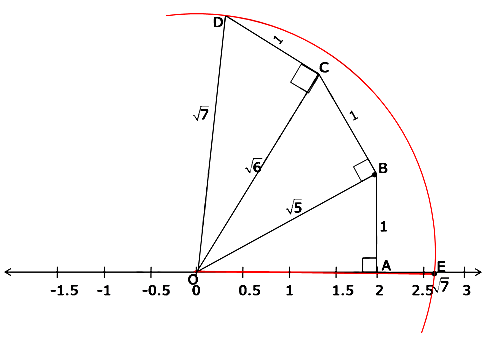
View full question & answer→Question 435 Marks
Find the greatest and the smallest rational number among the following.$\frac{-2}{3}, \frac{-7}{9}$ and $\frac{-5}{6}$
AnswerGiven numbers : $\frac{-2}{3}, \frac{-7}{9}$ and $\frac{-5}{6}$
The $\text{L.C.M.}$ of $3,9$ and $6$ is $18 .$
Thus, numbers are :
$\frac{-2}{3}=\frac{-2 \times 6}{3 \times 6} $
$=\frac{-12}{18} ; \frac{-7}{9} $
$=\frac{-7 \times 2}{9 \times 2} $
$=\frac{-14}{18} ; \frac{-5}{6} $
$=\frac{-5 \times 3}{6 \times 3} $
$=\frac{-15}{18}$
Since $-12>-14>-15$, we have $\frac{-2}{3}>\frac{-7}{9}>\frac{-5}{6}$.
Hence, the greatest rational number is $\frac{-2}{3}$ and the smallest rational number is $\frac{-5}{6}$.
View full question & answer→Question 445 Marks
Insert five rational number between:$-\frac{3}{4}$ and $-\frac{2}{5}$
AnswerSince, $-\frac{3}{4}$ and $-\frac{2}{5}$
Let $a =-\frac{2}{5}, b =-\frac{3}{4}$ and $n =5$
$\therefore d=\frac{b-a}{n+1} $
$=\frac{-\frac{3}{4}-\left(-\frac{2}{5}\right)}{5+1} $
$=\frac{\frac{-3}{4}+\frac{2}{5}}{6} $
$=\frac{\frac{-15+8}{20}}{6} $
$=-\frac{7}{120}$
Hence, required rational numbers are:
$a + d =-\frac{2}{5}+\left(-\frac{7}{120}\right) $
$=-\frac{2}{5}-\frac{7}{120} $
$=\frac{-48-7}{120} $
$=-\frac{5}{120} $
$=-\frac{11}{24} $
$a +2 d =\frac{2}{5}+2 \times\left(-\frac{7}{120}\right) $
$=\frac{2}{5}+\frac{4}{45} $
$=\frac{18+4}{45} $
$=\frac{22}{45}$
$a +2 d =\frac{2}{5}+2 \times\left(-\frac{7}{120}\right)$
$=\frac{2}{5}+\frac{4}{45}$
$=\frac{18+4}{45}$
$=\frac{22}{45}$
$a +3 d =\frac{2}{5}+3 \times\left(-\frac{7}{120}\right)$
$=\frac{2}{5}+\frac{2}{15}$
$=\frac{6+2}{15}$
$=\frac{8}{15}$
$a +4 d =\frac{2}{5}+4 \times\left(-\frac{7}{120}\right)$
$=\frac{2}{5}+\frac{8}{45}$
$=\frac{18+8}{45}$
$=\frac{26}{45}$
$a+5 d=\frac{2}{5}+5 \times\left(-\frac{7}{120}\right) $
$=\frac{2}{5}+\frac{2}{9} $
$=\frac{18+10}{45} $
$=\frac{28}{45}^4$
Thus, five rational numbers between $\frac{2}{5}$ and $\frac{2}{3}$ are $\frac{4}{9}, \frac{22}{45}, \frac{8}{15}, \frac{26}{45}$ and $\frac{28}{45}$.
View full question & answer→Question 455 Marks
Insert five rational number between:$\frac{2}{5}$ and $\frac{2}{3}$
AnswerSince, $\frac{2}{5}<\frac{2}{3}$
Let $a =\frac{2}{5}, b =\frac{2}{3}$ and $n =5$
$ \therefore d =\frac{b-a}{ n +1} $
$ =\frac{\frac{2}{3}-\frac{2}{5}}{5+1}$
$ =\frac{\frac{10-6}{15}}{6} $
$ =\frac{4}{90} $
$ =\frac{2}{45} $
Hence, required rational numbers are:
$a+d=\frac{2}{5}+\frac{2}{45} $
$ =\frac{18+2}{45}$
$ =\frac{20}{45}$
$ =\frac{4}{9} $
$a+2 d=\frac{2}{5}+2 \times \frac{2}{45} $
$ =\frac{2}{5}+\frac{4}{45} $
$=\frac{18+4}{45} $
$ =\frac{22}{45} $
$ a+3 d=\frac{2}{5}+3 \times \frac{2}{45} $
$ =\frac{2}{5}+\frac{2}{15} $
$ =\frac{6+2}{15} $
$=\frac{8}{15} $
$ a+4 d=\frac{2}{5}+4 \times \frac{2}{45}$
$=\frac{2}{5}+\frac{8}{45} $
$ =\frac{18+8}{45}$
$ =\frac{26}{45}$
$a+5 d=\frac{2}{5}+5 \times \frac{2}{45} $
$ =\frac{2}{5}+\frac{2}{9}$
$ =\frac{18+10}{45} $
$ =\frac{28}{45} $
Thus, five rational numbers between $\frac{2}{5}$ and $\frac{2}{3}$ are
$\frac{4}{9}, \frac{22}{45}, \frac{8}{15}, \frac{26}{45}$ and $\frac{28}{45}$
View full question & answer→Question 465 Marks
Insert three rational number between:$-5$ and $-4$
AnswerA rational number lying between $-5$ and $-4$
$=\frac{-5+(-4)}{2} $
$=-\frac{9}{2}$
A rational number lying between -5 and $-\frac{9}{2}$
$=\frac{-5+\left(-\frac{9}{2}\right)}{2} $
$=\frac{-\frac{19}{2}}{2} $
$=-\frac{19}{4}$
A rational number lying between $-\frac{9}{2}$ and $-4$
$=\frac{-\frac{9}{2}+(-4)}{2} $
$=\frac{-\frac{17}{2}}{2} $
$=-\frac{17}{4} $
$-5<-\frac{19}{4}<-\frac{9}{2}<-\frac{17}{4}<-4$
Hence, three rational numbers between $-5$ and $-4$ are
$-\frac{19}{4},-\frac{9}{2}$ and $-\frac{17}{4} \text {. }$
View full question & answer→Question 475 Marks
Insert three rational number between:$-3$ and $3$
AnswerA rational number lying between $- 3$ and $3$
$=\frac{-3+3}{2} $
$=\frac{0}{2} $
$=0$
A rational number lying between $-3$ and $0$
$=\frac{-3+0}{3^2} $
$=-\frac{3^2}{2}$
A rational number lying between $0$ and $3$
$=\frac{0+3}{2} $
$=\frac{3}{2} $
$-3<-\frac{3}{2}<0<\frac{3}{2}<3$
Hence, three rational numbers between $-3$ and $3$ are $-\frac{3}{2}, 0$ and $\frac{3}{2}$.
View full question & answer→Question 485 Marks
Insert three rational number between:$6$ and $7$
AnswerA rational number lying between $6$ and $7$
$=\frac{6+7}{2} $
$=\frac{13^2}{2}$
A rational number lying between $6$ and $\frac{13}{2}$
$=\frac{6+\frac{13}{2}}{2} $
$=\frac{\frac{25}{2}}{2} $
$=\frac{25}{4}$
A rational number lying between $\frac{13}{2}$ and $7$
$=\frac{\frac{13}{2}+7}{2} $
$=\frac{\frac{27}{2}}{2} $
$=\frac{27}{4} $
$6<\frac{25}{4}<\frac{13}{2}<\frac{27}{4}<7$
Hence, three rational numbers between $6$ and $7$ are $\frac{25}{4}, \frac{13}{2}$ and $\frac{27}{4}$
View full question & answer→Question 495 Marks
Insert three rational numbers between:$0$ and $1$
AnswerA rational number lying between $0$ and $1$
$=\frac{0+1}{2} $
$=\frac{1}{2}$
A rational number lying between $0$ and $\frac{1}{2}$
$=\frac{0+\frac{1}{2}}{2} $
$=\frac{1}{4}^2$
A rational number lying between $0$ and $\frac{1}{4}$
$=\frac{0+\frac{1}{4}}{2} $
$=\frac{1}{8} $
$0<\frac{1}{8}<\frac{1}{4}<\frac{1}{2}<1$
Hence, three rational numbers between $0$ and $1$ are $\frac{1}{8}, \frac{1}{4}$ and $\frac{1}{2}$.
View full question & answer→Question 505 Marks
Express the following decimal as a rational number.$17.027$
AnswerLet $x =17.02 \overline{7}$
$=17.027777 \text {. }$
Here, only number $7$ is being repeated, so first we need to remove $02$ which proceeds $7 .$
We multiply by $100$ so that only the recurring digits remain after decimal.
$\therefore 100 x =1702.7777 \ldots$
The number of digits recurring in equation $(1)$ is $1$ ,
so we multiply both sides of the equation $(1)$ by $10 .$
$\therefore 1000 x=10 \times 1702.7777 \ldots$
$=17027.7774 \ldots . \ldots(2)$
On subtracting $(1)$ from $(2)$, we get
$900 x=15325$
$\therefore x=\frac{15325}{900}$
$=\frac{613}{26}$
$\therefore 17.02 \overline{7}=\frac{613}{36}$
View full question & answer→