Questions

[3 marks sum]

🎯

Test yourself on this topic

16 questions · timed · auto-graded

Question 13 Marks
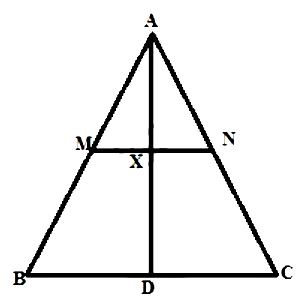
In $\triangle ABC; M$ is mid$-$point of $\text{AB}, N$ is mid$-$point of $\text{AC}$ and $D$ is any point in base $\text{BC}.$ Use the intercept Theorem to show that $\text{MN}$ bisects $\text{AD}.$
Answer
The figure is shown below

Since $M$ and $N$ are the mid$-$point of $\text{AB}$ and $\text{AC}, \text{MN} \| \text{BC}$
According to intercept theorem Since $\text{MN} \| \text{BC}$ and $\text{AM}=\text{BM}$,
Therefore $\text{AX} = \text{DX}.$ Hence proved
View full question & answer
Question 23 Marks
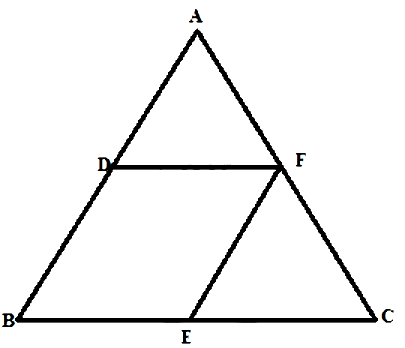
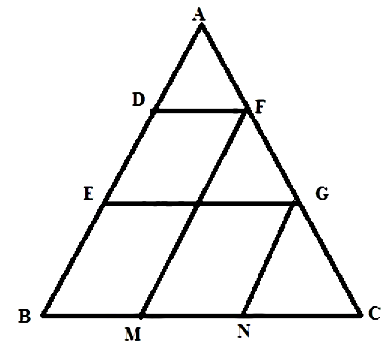
In $\triangle ABC, D$ and $E$ are points on side $\text{AB}$ such that $\text{AD} = \text{DE} = \text{EB}.$ Through $D$ and $E,$ lines are drawn parallel to $\text{BC}$ which meet side $\text{AC}$ at points $F$ and $G$ respectively. Through $F$ and $G,$ lines are drawn parallel to $\text{AB}$ which meets side $\text{BC}$ at points $M$ and $N$ respectively. Prove that: $\text{BM} =\text{ MN} = \text{NC}.$
Answer
The figure is shown below

For triangle $AEG$
$D$ is the mid$-$point of $\text{AE}$ and $\text{DF}\|\text{EG}\|\text{ BC}$
Therefore $F$ is the midpoint of $\text{AG}$.
$\text{AF} = \text{GF} \ldots . .(1)$
Again $\text{DF} \| \text{EG} \| \text{BC}\| \text{DE} = \text{BE},$
$\therefore \text{GF} = \text{GC} .....(2)$
$(1), (2)$ we get $\text{AF}=\text{GF}=\text{GC}$
Similarly Since $\text{GN} \| \text{FM} \|\text{AB}$ and $ \text{AF} = \text{GF} ,$
$\therefore \text{BM}=\text{MN}=\text{NC}$
Hence proved
View full question & answer
Question 33 Marks
In $\triangle ABC,$ angle $B$ is obtuse. $D$ and $E$ are mid$-$points of sides $\text{AB}$ and $\text{BC}$ respectively and $F$ is a point on side $\text{AC}$ such that $\text{EF}$ is parallel to $\text{AB}.$ Show that $\text{BEFD}$ is a parallelogram.
Answer
The figure is shown below

From figure $\text{EF} \| \text{AB}$ and $E$ is the mid$-$point of $\text{BC}$.
Therefore $F$ is the midpoint of $\text{AC}$.
Here $\text{EF} \| \text{BD} , \text{EF} = \text{BD}$ as $D$ is the midpoint of $\text{AB}$
$\text{BE} \| \text{DF} , \text{BE} = \text{DF}$ as $E$ is the midpoint of $\text{BC}$.
Therefore $\text{BEFD}$ is a parallelogram.
View full question & answer
Question 43 Marks
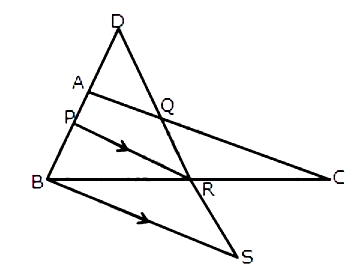
In the figure, give below, $2\text{AD}=\text{AB}, P$ is mid$-$point of $\text{AB}, Q$ is mid$-$point of $\text{DR}$ and $\text{PR} \| \text{BS}.$ Prove that:$(i) \text{AQ} \| \text{BS},(ii) \text{DS} =3 Rs.$
Answer
Given that $AD = AP = PB$ as $2AD = AB$ and $p$ is the midpoint of $AB$
$(i)$ From triangle $DPR, A$ and $Q$ are the mid$-$point of $DP$ and $DR.$
Therefore $AQ \| PR$
Since $PR \| BS$ ,hence $AQ \| BS$
$(ii)$ From $\triangle ABC, P$ is the midpoint and $PR \| BS$
Therefore $R$ is the mid$-$point of $BC$
From $\triangle BRS$ and $\triangle QRC$
$\angle BRS = \angle QRC$
$BR = RC$
$\angle RBS + \angle RCQ$
$\therefore \triangle BRS ≅ \triangle QRC$
$\therefore QR =RS$
$DS = DQ + QR + RS = QR + QR + RS = 3RS$
View full question & answer
Question 53 Marks
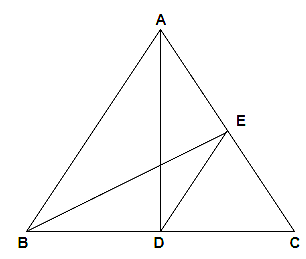
In $\triangle ABC, AD$ is the median and $DE$ is parallel to $BA,$ where $E$ is a point in $AC.$ Prove that $BE$ is also a median.
Answer


Since $AD$ is the median of $\triangle ABC$, then $BD=DC$.
Given, $DE \| AB$ and $DE$ are drawn from the midpoint of $BC$ i.e. $D$,
then
by the converse of mid$-$point theorem,
it bisects the third side which in this case is $AC$ at $E$.
Therefore, $E$ is the mid point of $AC$.
Hence, $BE$ is the median of $\triangle ABC$.
View full question & answer
Question 63 Marks
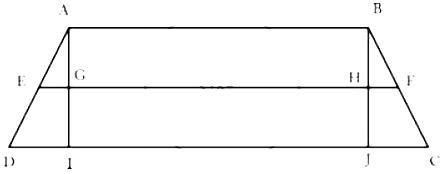
In trapezium $\text{ABCD},$ sides $AB$ and $DC$ are parallel to each other.$E$ is mid$-$point of $AD$ and $F$ is mid$-$point of $BC.$Prove that$: AB + DC = 2EF.$
Answer
Consider trapezium $\text{ABCD}$.
Given $E$ and $F$ are midpoints on sides $AD$ and $BC$, respectively.

We know that $AB=GH=IJ$
From midpoint theorem,
$EG =\frac{1}{2} DI , HF =\frac{1}{2} JC$
Consider $\text{LHS},$
$AB + CD = AB + CJ + J + ID = AB +2 HF + AB +2 EG$
So, $AB+CD=2(AB+HF+EG)=2(EG+GH+HF)=2 EF$
$AB + CD =2 EF$
Hence Proved.
View full question & answer
Question 73 Marks
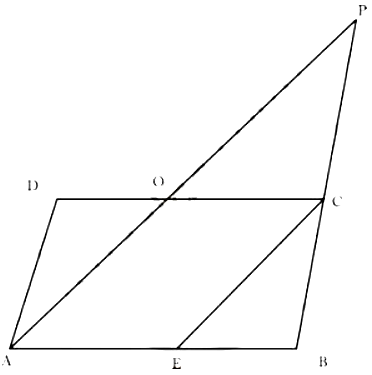
In parallelogram $\text{ABCD,E}$ is the mid$-$point of $AB$ and $AP$ is parallel to $EC$ which meets $DC$ at point $O$ and $B C$ produced at $P$.Prove that$:(i) BP =2 AD,(ii) O$ is the mid$-$point of $AP.$
​​​​​​​
Answer
Given $\text{ABCD}$ is parallelogram, so $AD = BC, AB = CD.$
Consider triangle $\text{APB},$ given $EC,$ is parallel to $AP$ and $E$ is the midpoint of side $AB.$
So by midpoint theorem,
$C$ has to be the midpoint of $BP.$
So $BP = 2BC,$ but $BC = AD$ as $\text{ABCD}$ is a parallelogram.
Hence $BP = 2AD$
Consider $\triangle APB, AB \| OC$ as $\text{ABCD}$ is a parallelogram.
So by midpoint theorem,
$O$ has to be the midpoint of $AP.$
Hence Proved.
View full question & answer
Question 83 Marks
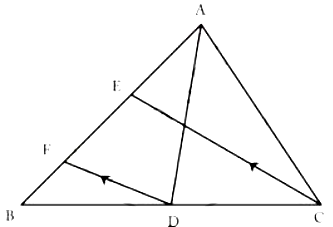
In the given figure, $AD$ and $CE$ are medians and $DF \| CE$.Prove that: $FB =\frac{1}{4} AB$.

 
Answer
Given $AD$ and $CE$ are medians and $DF \| CE$.
We know that from the midpoint theorem,
If two lines are parallel and the starting point of the segment is at the midpoint on one side, then the other point meets at the midpoint of the other side.
Consider $\triangle BEC.$ Given $DF \| CE$ and
$D$ is the midpoint of $BC$.
So $F$ must be the midpoint of $BE$.
So, $FB=\frac{1}{2} BE$ but $BE=\frac{1}{2} AB$
Substitute value of $BE$ in the first equation, we get
$FB =\frac{1}{4} AB$
Hence Proved.
View full question & answer
Question 93 Marks
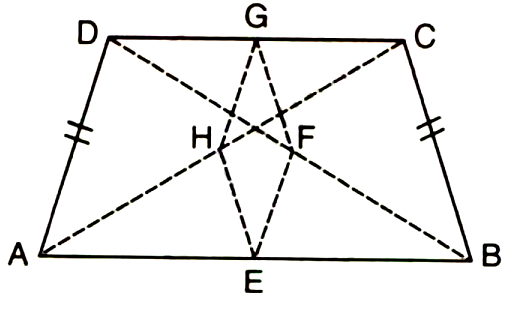
$\text{ABCD}$ is a quadrilateral in which $AD=BC . E, F, G$ and $H$ are the mid-points of $AB, BD, CD$ and $AC$ respectively. Prove that $\text{EFGH}$ is a rhombus.
Answer
Given that $AD = BC …..(1)$
From the figure,
For $\triangle ADC$ and $\triangle ABD$
$2GH = AD$ and $2EF = AD,$
$\therefore 2GH = 2EF = AD …..(2)$
For $\triangle BCD$ and $\triangle ABC$
$2GF = BC$ and $2EH=BC,$
$\therefore 2GF= 2EH = BC …..(3)$
From $(1), (2) ,(3)$ we get,
$2GH = 2EF = 2GF = 2EH$
$GH = EF = GF = EH$
Therefore $\text{EFGH}$ is a rhombus.
Hence proved.
View full question & answer
Question 103 Marks
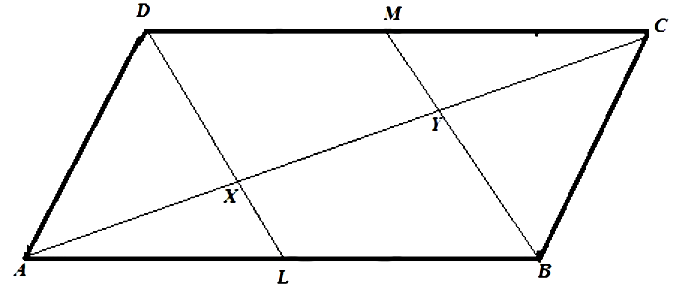
$L $and $M$ are the mid$-$point of sides $AB$ and $DC$ respectively of parallelogram $\text{ABCD}.$ Prove that segments $DL$ and $BM$ trisect diagonal $AC.$
Answer
The required figure is shown below


From figure,
$BL = DM$ and $BL \| DM$ and $\text{BLMD}$ is a parallelogram, therefore $BM \| DL$ From $\triangle ABY$
$L$ is the midpoint of $A B$ and $XL \| BY$, therefore $x$ is the midpoint of $AY.$
ie $A X=X Y$ $\ldots . .(1)$
Similarly for $\triangle CDX$
$CY=XY \ldots . .(2)$
From $(1)$ and $(2)$
$AX=XY=CY$ and $AC=AX+XY+CY$ Hence proved.
View full question & answer
Question 113 Marks
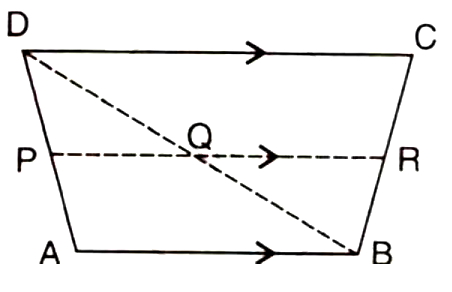
The following figure shows a trapezium $ABCD$ in which $AB \| DC$. $P$ is the mid$-$point of $AD$ and $PR\| AB$. Prove that:$PR=\frac{1}{2}(AB+CD)$
Answer
Here from the triangle,
$\text{ABDP}$ is the midpoint of $AD$ and $PR \| AB$,
therefore $Q$ is the midpoint of $BD$
Similarly, $R$ is the midpoint of $BC$ as $P R\|CD\| AB$
From $\triangle ABD$,
$PQ=\frac{1}{2} AB \ldots(1) \ldots[$ by Mid$-$point theorem$]$
From $\triangle BCD$,
$QR =\frac{1}{2} CD \quad...(2) ...[$by Mid$-$point theorem $]$
Now $(1) +(2)$
$PQ + QR =\frac{1}{2} AB +\frac{1}{2} CD$
$ PR =\frac{1}{2}( AB + CD )$
Hence proved.
View full question & answer
Question 123 Marks
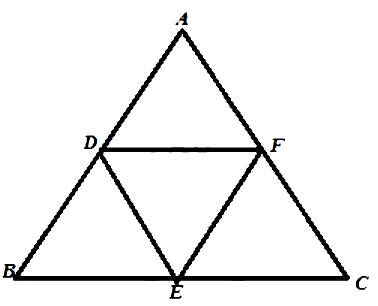
$D, E,$ and $F$ are the mid$-$points of the sides $AB, BC$ and $CA$ of an isosceles$ \triangle ABC$ in which $AB = BC.$Prove that $\triangle DEF$ is also isosceles.
Answer
The figure is shown below


Given that $ABC$ is an isosceles triangle where $AB=C$.
Since $D, E, F$ are the mid$-$point of $AB, BC, CA$
Therefore, $2DE = AC$ and $2EF = AB$ this means $DE = EF$
Therefore $\text{DEF}$ is an isosceles triangle a $DF =EF$.
Hence proved.
View full question & answer
Question 133 Marks
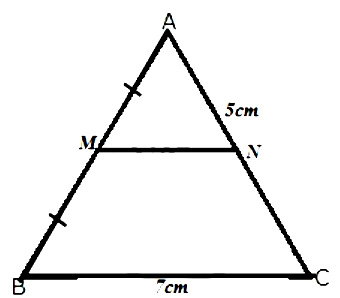
In $\triangle ABC, M$ is mid$-$point of $AB$ and a straight line through $M$ and parallel to $BC$ cuts $AC$ in $N.$ Find the lengths of $AN$ and $MN$ if $Bc = 7 \ cm$ and $Ac = 5 \ cm.$
Answer
The triangle is shown below,


Since $M$ is the midpoint of $A B$ and $M N \| B C$
hence $N$ is the midpoint of $AC.$
Therefore,$MN =\frac{1}{2} BC =\frac{1}{2} \times 7=3.5 cm$
And
$AN=\frac{1}{2} A zC=\frac{1}{2} \times 5=2.5 cm$
View full question & answer
Question 143 Marks
In the given figure, $M$ is mid$-$point of $AB$ and $DE$, whereas $N$ is mid$-$point of $BC$ and $DF.$Show that: $EF = AC$.
Answer
In $\triangle EDF,$
$M$ is the mid$-$point of $AB$ and $N$ is the mid$-$point of $DE$.
$\Rightarrow MN =\frac{1}{2} EF ...($ Mid$-$point theorem $)$
$\Rightarrow EF =2 MN \ldots (i)$
In $\triangle ABC$,
$M$ is the mid$-$point of $AB$ and $N$ is the mid-point of $BC$,
$\Rightarrow MN =\frac{1}{2} AC ....($ Mid$-$point theorem$)$
$\Rightarrow AC =2 MN ....(ii)$
From $(i)$ and $(ii),$ we get
$\Rightarrow EF = AC$
View full question & answer
Question 153 Marks
In $\triangle ABC, AD$ is the median and $DE,$ drawn parallel to side $BA,$ meets $AC$ at point $E.$
Show that $BE$ is also a median.
Answer


In $\triangle ABC$
$AD$ is the median of $BC$.
$\Rightarrow D$ is the mid$-$point of $BC$.
Given at $DE \| BA$
By the Converse of the Mid-point theorem,
$\Rightarrow D$E bisects $AC$
$\Rightarrow E$ is the mid$-$point of $AC$
$\Rightarrow BE$ is the median of $AC$
that is $BE$ is also a median.
View full question & answer
Question 163 Marks
In a $\triangle ABC, AD$ is a median and $E$ is mid$-$point of median $AD$. A line through $B$ and $E$ meets $AC$ at point $F.$
Prove that$: AC = 3AF.$
Answer
The required figure is shown below

For help, we draw a line $DG \| BF$
Now from triangle $ADG, DG \| BF$ and $E$ is the midpoint of $AD$
Therefore $F$ is the midpoint of $AG$,
i.e; $AF = GF\ldots(1)$
From triangle $BCF , DG \| BF$ and $D$ is the midpoint of $BC$
Therefore $G$ is the midpoint of $CF$,
i.e; $GF = CF\ldots(2)$
$AC=AF+GF+CF$
$AC=3 AF$
$\ldots($ From $(1)$ and $(2) )$
Hence proved.
View full question & answer
[3 marks sum] - MATHEMATICS STD 9 Questions - Vidyadip