Question 15 Marks
The sum of diameters of two circles is $112\ cm$ and the sum of their areas is $5236\ cm^2.$ Find the radii of the two circles.
AnswerLet one of two circles touching externally have a radius of $R$ and the other have radius $r$
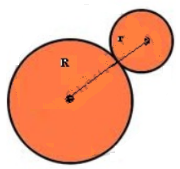
Given $2 R +2 r $
$=112 \ cm R + r $
$=56 \ cm .$
So, $R=56-r$
The Area of a Circle with radius $r=\pi r^2$
The Area of a Circle with radius $R=\pi R^2$
Sum of the areas of the two circles
$ =\pi r^2+\pi R^2$
$=\pi\left(r^2+R^2\right)$
$=5236$
$\Rightarrow r^2+R^2=1666$
$\Rightarrow r^2+56$
$\Rightarrow 2 r^2-112 r+1470=0$
$\Rightarrow r^2-56 r+735=0$
$\Rightarrow r^2-35 r-21 r+735=0$
$\Rightarrow r(r-35)-21(r-35)=0$
$\Rightarrow(r-35)(r-21)=0$
$\Rightarrow r=35,21$
So, one of the two circles touching externally has a radius of $35 \ cm$ and the other has radius $21 \ cm$. View full question & answer→Question 25 Marks
Two circles touch each other externally. The sum of their areas is $58\pi \ cm^2$ and the distance between their centres us $10\ cm$. Find the radii of the two circles.
AnswerLet one of the two circles touching externally have a radius of $R$ and the other have radius $r$
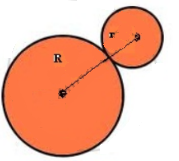
Given $R+r=10 \ cm$.
So, $R=10-r$
The Area of a Circle with radius $r=\pi r^2$
The Area of a Circle with radius $R=\pi R^2$
Sum of the areas of the two circles
$=\pi r^2+\pi R$
$=\pi\left(r^2+R^2\right)$
$=58 \pi$
$\Rightarrow r^2+R^2=58$
$\Rightarrow r^2+(10-r)^2=58$
$\Rightarrow r^2+100+r^2-20 r=58$
$\Rightarrow 2 r^2-20 r+42=0$
$\Rightarrow r^2-10 r+21=0$
$\Rightarrow r^2-7 r-3 r+21=0$
$\Rightarrow r(r-7)-3(r-7)=0$
$\Rightarrow(r-7)(r-3)=0$
$\Rightarrow r=7,3$
So, one of the two circles touching externally has a radius of $7 \ cm$ and the other have radius $3 \ cm$. View full question & answer→Question 35 Marks
A $4.2\ m$ wide road surrounds a circular plot whose circumference is $176\ m.$ Find the cost of paving the road at $Rs.75$ per $m^2.$
AnswerWe know,
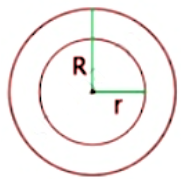
The area of the ring between two concentric circles equals the area of the larger circle minus the area of smaller circle.
Let the radius of the outer and inner ring be $R$ and $r$ respectively.
Here the circular garden is the inner circle and the $7\ m$ wide road is the ring
The Circumference of a Circle with radius $r=2 \pi r$
Here,
$2 \pi r=176$
$\Rightarrow r=\frac{176}{2 \pi}$
$=\frac{176 \times 7}{2 \times 22}$
$=28$
$\Rightarrow r=28\ m$
$\Rightarrow R=28+4.2$
$=32.2\ m $
inner Circle has radius $r$
$=28 m$ and outer Circle has radius $R$
$=32.2\ m$
$ \pi\left(32.2^2-28^2\right)$
$=\frac{22}{7} \times(1036.84-784)$
$=\frac{22}{7} \times 252.84 $
$=794.64\ m ^2$
The cost of paving the road at the rate of $Rs. 150$ per $m ^2$
$=794.64 \times 75$
$=\text { Rs. } 59,598 .$ View full question & answer→Question 45 Marks
A $7\ m$ wide road surrounds a circular garden whose area is $5544\ m^2$. Find the area of the road and the cost of tarring it at the rate of $Rs.150$ per $m^2.$
Answerwe know,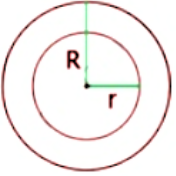
The area of the ring between two concentric circles equals the area of the larger circle minus the area of smaller circle.
Let the radius of the outer and inner ring be $R$ and $r$ respectively.
Here the circular garden is the inner circle and the $7\ m$ wide road os the ring area of the ring between two concentric circles $=\pi\left(R^2-r^2\right)$
The Area of a Circle with radius $r=\pi r^2$
Here,
$\pi r^2=5544\ m^2$
$\Rightarrow r=42$
$\Rightarrow R=42+7$
$=49$
inner Circle has radius $r$
$=42$ and outer Circle has radius $R$
$=49$
$\pi\left(49^2-42^{2)}\right.$
$=\frac{22}{7} \times(2401-1764)$
$=\frac{22}{7} \times 637$
$=2002\ m ^2$
The cost of paying the road at the rate of $Rs. 150$ per $m ^2$
$=2002 \times 150$
$=\text { Rs. } 3,00,300 .$ View full question & answer→Question 55 Marks
Find the area and perimeter of the following semicircles: Diameter $= 5.6\ cm$
AnswerThe radius of a Circle with diameter $d$ is $r=\frac{d}{2}$
The Area of a Semi$-$circle with radius $r=\frac{\pi r^2}{2}$
The Perimeter of a Semi$-$circle with radius $r$
$ =\pi r+2 r$
$=r(\pi+2)$
$=r\left(\frac{22}{7}+2\right)$
$=\frac{36}{7} \times r $
The radius of a Circle with diameter $5.6$ is $r$
$=\frac{5.6}{2}$
$=2.8 \ cm$
The Area of a Semi$-$circle with radius $2.8$
$=\frac{\pi(2.8)^2}{2}$
$=12.32 \ cm ^2$
The Perimeter of a Semi$-$circle with radius $r$
$ =\pi \times 2.8+2 \times 2.8$
$=2.8(\pi+2)$
$=2.8\left(\frac{22}{7}+2\right)$
$=\frac{36}{7} \times 2.8$
$=14.4 \ cm .$
View full question & answer→Question 65 Marks
Find the area and perimeter of the following semicircles: Diameter $= 7\ cm$
AnswerThe radius of a Circle with diameter $d$ is $r=\frac{d}{2}$
The Area of a Semi$-$circle with radius $r=\frac{\pi r^2}{2}$
The Perimeter of a Semi$-$circle with radius $r$
$ =\pi r+2 r$
$=r(\pi+2)$
$=r\left(\frac{22}{7}+2\right)$
$=\frac{36}{7} \times r$
The radius of a Circle with diameter $7$ is $r$
$ =\frac{7}{2}$
$=3.5 \ cm$
The Area of a Semi$-$circle with radius $3.5$
$=\frac{\pi(3.5)^2}{2}$
$=19.25 \ cm ^2 $
The Perimeter of a Semi$-$circle with radius $r$
$ =\pi \times 3.5+2 \times 3.5$
$=3.5(\pi+2)$
$=3.5\left(\frac{22}{7}+2\right)$
$=\frac{36}{7} \times 3.5$
$=25 \ cm . $
View full question & answer→Question 75 Marks
The diameters of three wheels are in the ratio $2 : 4 : 8.$ If the sum of the circumferences of these circles be $132\ cm,$ find the difference between the areas of the largest and the smallest of these wheels.
AnswerLet the diameters of three wheel be
$d_1=2 x$
$ \Rightarrow r_1=x$
$d_2=4 x$
$ \Rightarrow r_2=2 x$
$d_3=8 x $
$\Rightarrow r_3=4 x$
Now,
$ 2 \pi r_1+2 \pi r_2+2 \pi r_3=132$
$\Rightarrow 2 \pi\left(r_1+r_2+r_3\right)=132$
$\Rightarrow x +2 x +4 x =66 \times \frac{7}{22}$
$\Rightarrow 7 x =21$
$\Rightarrow x =3 \ cm$
$\therefore$ Difference between the areas of the largest and the smallest wheels
$ =\pi r_3^2-\pi r_1{ }^2$
$=\pi(4 \times 3)^2-\pi(3)^2$
$=144 \pi-9 \pi$
$=135 \pi$
$=135 \times \frac{22}{7}$
$=424.29\ cm ^2 . $
View full question & answer→Question 85 Marks
Find the area of each of the following figure:
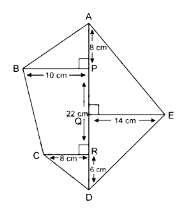
AnswerArea of given figure
$=$Area of $\triangle AED +$Area of $\triangle ABP +$ Area of trapezium $\text{BPRC} +$ Area of $\triangle CRD$
$=\frac{1}{2} \times AD \times EQ +\frac{1}{2} \times AP \times BP +\frac{1}{2} \times( BP + CR ) \times PR +\frac{1}{2} \times RD \times CR$
$=\frac{1}{2}[( AD \times EQ )+( AP \times BP )+( BP + CR ) \times PR +( RD \times CR )]$
$=\frac{1}{2}[( AP + PR + RD ) \times EQ +( AP \times BP )+( BP + CR ) \times PR +( RD \times CR )]$
$=\frac{1}{2}[(8+22+6) \times 14+(8 \times 10)+(10+8) \times 22+(6 \times 8)]$
$=\frac{1}{2}[504+80+396+48]$
$=\frac{1}{2} \times 1028$
$=514 \ cm ^2$
View full question & answer→Question 95 Marks
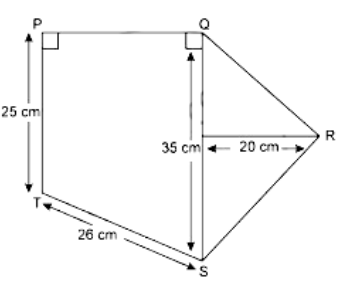
Find the area of each of the following figure:
Answer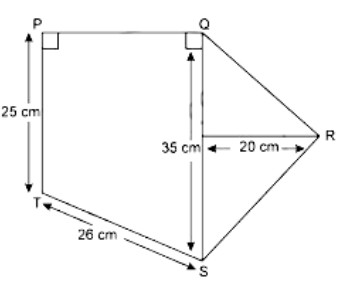
Construction: Draw $TM \perp QS$
Area of $\triangle RQS$
$ =\frac{1}{2} \times QS \times RN$
$=\frac{1}{2} \times 35 \times 20$
$=350 \ cm ^2 $
Now,
$S= QM + MS$
$\Rightarrow 35=25+ MS$
$\Rightarrow MS =10 \ cm$
In $\triangle S T M,$
$MS ^2+ TM ^2= ST ^2$
$\Rightarrow TM ^2= ST ^2- MS ^2$
$=(26) 2-(10)^2$
$=676-100$
$=576$
$\Rightarrow TM$
$=24 \ cm$
$= PQ$
Area of trapezium $\text{PQST}$
$=\frac{1}{2} \times( PT + QS ) \times PQ $
$=\frac{1}{2} \times(25+35) \times 24 $
$=720 \ cm ^2$
Thus, area of given figure
$=$ Area of $\triangle R Q S+$ Area of trapezium $\text{PQST}$
$=350 \ cm ^2+720 \ cm ^2 $
$=1070 \ cm ^2 .$ View full question & answer→Question 105 Marks
Find the area of a quadrilateral field whose sides are $12\ m , 9\ m , 18\ m$ and $21\ m$ respectively and the angle between the first two sides is a right angle. Take the value of $\sqrt{6}$ as $2.5.$
Answer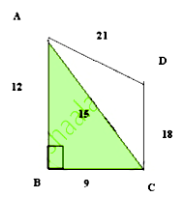
In the given quadrilateral $\text{ABCD}$, join diagonal $A C$
$\text{ABC}$ is a right triangle
We know that, Area of a Triangle $=\frac{1}{2} b \cdot h$
i.e $\frac{1}{2}($ Base $\times$ Height $)$
Area of a Triangle $A B C=\frac{1}{2} 9.12=54\ m ^2$
$A C$ is the hypotenuse, $A C$
$=\sqrt{12^2+9^2} $
$=\sqrt{225} $
$=15\ m$
Triangle $\text{ACD}$ has sides $15\ m , 18\ m , 21\ m$
We know that, Area of a Triangle whose sides are $a, b$, and $c$ and semiperimeter is $s$ is given by
$\sqrt{ s ( s - a )( s - b )( s - c )} ; s =\frac{ a + b + c }{2}$
For a triangle whose sides are $cm _t \ cm$ and $cm$
i.e $a=15, b=18$ and $c=21 $
$s=\frac{15+18+21}{2} $
$=\frac{54}{2} $
$=27$
Area
$=\sqrt{27(27-15)(27-18)(27-21)} $
$=\sqrt{27(12)(9)(6)} $
$=\sqrt{9 \times 3(6 \times 2)(9)(6)} $
$=9 \times 6 \sqrt{6} $
$=54 \sqrt{6} $
$=54(2.5)$
Area $($Quad $\text{ABCD}=\operatorname{Ar}($ Triangle $A B C)+\operatorname{Ar}($ Triangle $A D C))$
$54+54(2.5) $
$=54(1+2.5) $
$=54(3.5) $
$=189\ m ^2$ View full question & answer→Question 115 Marks
The perimeter of a rectangular plot is $300\ m$ . It has an area of $5600\\ m^2$. Taking the length of the plot as $x m$ , calculate the breadth of the plot in terms of $x$, form an equation and solve it to find the dimensions of the plot.
AnswerThe length of the rectangle $= x m$
Let the breadth of the rectangle $= b m$
The perimeter of a rectangle with length $l$ and breadth $b = P = 2(l + b)$
The perimeter of a triangle with length $x$ and breadth $b = 2(x + b) = 300$
$\Rightarrow (x + b) = 150$
$\Rightarrow b = 150 - x$
The area of a rectangle with length $l$ and breadth $b = A = l \times b$
The area of a rectangle with length $x$ and breadth $(150 - x)$
$= X \times (150 - x)$
$= 5600$
$\Rightarrow 150x - x^2 = 5600$
$\Rightarrow x^2 - 150x + 5600 = 0$
$\Rightarrow x^2 - 80x - 70x + 5600 = 0$
$\Rightarrow x(x - 80) - 70(x - 80) = 0$
$\Rightarrow (x - 80)(x - 70) = 0$
$\Rightarrow x = 70\ m, 80\ m$
When breadth $= 70\ m$, then the length
$= 150 - 70$
$= 80\ m$
When breadth $= 80\ m$, then the length
$= 150 - 80$
$= 70\ m.$
View full question & answer→Question 125 Marks
Find the area and perimeter of the given figure.
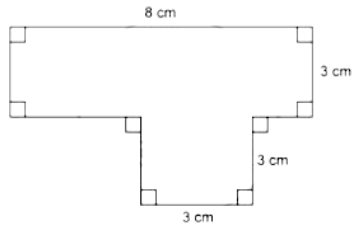
Answer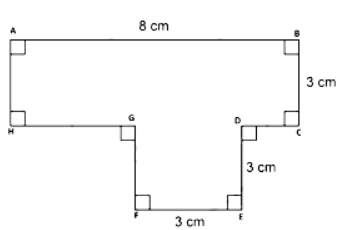
Area of given figure
$ =$Area of rectangle $\text{ABCH}+$Area $+$Area of square $\text{DEFG}$
$=A B \times B C+(D E)^2$
$=8 \ cm \times 3 \ cm +(3 \ cm)^2$
$=24 \ cm ^2+9 \ cm ^2$
$=33 \ cm ^2$
Perimeter of given figure
$ =A B+B C+C D+D E+E F+F G+G H+H A$
$=A B+B C+(C D+E F+G H)+D E+F G+H A$
$=8+3+8+3+3+3$
$=28 \ cm .$ View full question & answer→Question 135 Marks
Inside a square field of side $44\ m,$ a square flower bed is prepared leaving a graved path all round the flower bed. The total cost of laying the flower bed at $Rs.25$ per $sq\ m$. and gravelling the path at $Rs.120$ per $sq\ m$. is $Rs.80320.$ Find the width of the gravel path.
Answer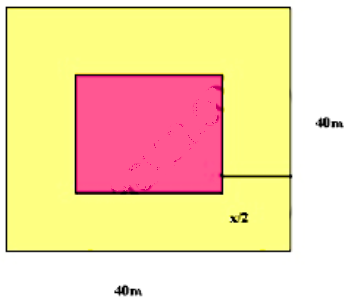
Let the width of the gravel path $=\frac{x}{2} m$
Now, Area of flower bed $($shown in Pink$) \times 25+$ Area of gravel path$($Shown in Yellow$)= Rs. 80320$
i.e$(44-x)^2 \times 25+\left[44^2-(44-x)^2 \times 120=80320\right.$
$(44-x)^2 \times 25+442 \times 120-(44-x)^2 \times 120=80320$
$(44-x)^2 \times(25-120)+44^2 \times 120=80320$
$(44-x)^2 \times(-95)+1936 \times 120=80320$
$(44-x)^2 \times(-19)+1936 \times 24=16064$
$46464-1664=19(44-x)^2$
$30400=19(44-x)^2$
$(44-x)^2=16000$
$44-x=40$
$x=4 $
the width of the grave path $=\frac{x}{2}=2\ m$. View full question & answer→Question 145 Marks
A rectangular field is $240\ m$ long and $180\ m$ broad. In one corner a farm house is built on a square plot of side $40\ m$. Find the area of the remaining portion and the cost of fencing the open sides$ Rs.25$ per $m.$
Answer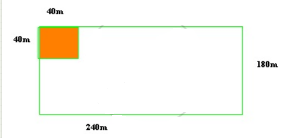
The area of a rectangle with length $I$ and breadth $b = A = I \times b$
The area of a rectangle with length $240\ m$ and breadth $180\ m$
$= 240 \times 180$
$= 43200\ m^2$
The area of a square plot with side 40m on which the farmhouse is made
$= 402$
$= 1600\ m^2$
The area of the remaining plot
$= 43200 - 1600$
$= 41600\ m^2$
The perimeter of a rectangle with length $I$ and breadth $b=P=2(I+b)$
The perimeter of a rectangle with length $240\ m$ and breadth $180\ m$
$= P$
$= 2(240 + 180)$
$= 840$
The boundary to be fenced
$= 840 - 2 \times 40$
$= 760$
The cost of fencing $1\ m = Rs.25$
$\Rightarrow$ The cost of fencing $760\ m$
$= Rs.25 \times 760$
$= Rs.19000.$ View full question & answer→Question 155 Marks
The floor of a room is of size $6\ m \times 5\ m$. Find the cost of covering the floor of the room with $50 \ cm$ wide carpet at the rate of $Rs.24.50$ per metre. Also, find the cost of carpeting the same hall if the carpet, $60 \ cm$, wide, is at the rate of $Rs.26$ per metre.
AnswerArea of floor of a room
$=6\ m \times 5\ m$
$=30\ m ^2$
Let the length of the carpet that is $50 \ cm$ wide be $1\ m$.
$\therefore$ Area of carpet
$=$ length $\times$ breadth
$=1\ m \times 50 \ cm$
$=1 \times 0.5\ m ^2$
Since area of carpet
$=$ Area of floor of a room
$\Rightarrow 1 \times 0.5=30$
$\Rightarrow \frac{30}{0.5}$
$=60\ m$
$\therefore$ Cost of carpet at $Rs.24.50$ per mate
$=\text { Rs. } 60 \times 24.50$
$=\text { Rs. } 1470$
Let the length of the carpet that is $60 \ cm$ wide be $L\ m$.
$\therefore$ Area of carpet
$=$ length $\times$ breadth
$=1\ m \times 60 \ cm$
$=1 \times 0.6\ m ^2$
Since area of carpet
$=$ Area of floor of a room
$\Rightarrow 1 \times 0.6=30$
$\Rightarrow \frac{30}{0.6}$
$=50\ m$
$\therefore$ Cost of carpet at $Rs.26$ per mate
$=R s .50 \times 26$
$=Rs. 1300 .$
View full question & answer→Question 165 Marks
A rectangular field is $80\ m$ long and $50\ m$ wide. A $4\ m$ wide runs through the centre of the field parallel to the length and breadth of the field. Find the total area of the roads.
Answer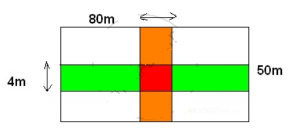
The road that run parallel to the length of the rectangular field $($Shown in Green and Red$)$ is a rectangle with length $80\ m$ and breadth $4\ m$
Area
$= 80 \times 4$
$= 320\ m^2$
The road that run parallel to the breadth of the rectangular field $($Shown in Orange and Red$)$ is a rectangle with length $80\ m$ and breadth $4\ m$
Area
$= 50 \times 4$
$= 200\ m^2$
The area in Red is include in both the rectangular roads is included in both the roads
$3$ Required area
$= 320 + 200 - 4 \times 4$
$= 320 + 200 - 16$
$= 504\ m^2.$ View full question & answer→Question 175 Marks
Find the area of a rhombus whose perimeter is $260\ cm$ and the length of one of its diagonal is $66\ cm.$
AnswerThe perimeter of the Rhombus $=260 \ cm$
Each side of the Rhombus $=\frac{1}{4}(260)=65 \ cm$
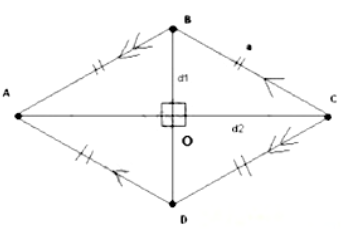
In the given, Rhombus, $A B=65 \ cm$, diagonal $A C=66 \ cm$
We know that, diagonals of a Rhombus bisect at right angles.
In Triangle $AOB$,
$\angle A O B=90^{\circ}, A B$ is the hypotensue
$AO =33 \ cm \left(\frac{1}{2}(66 \ cm )\right)$
$A B^2=O B^2+O A^2$
$\Rightarrow O B$
$=\sqrt{ AB ^2- OA ^2}$
$=\sqrt{65^2-33^2}$
$=\sqrt{4225-1089}$
$=\sqrt{3136}$
$=56$
$\Rightarrow AB =112 \ cm$
We know that the area of a rhombus whose diagonals are $d_1$ and $d_2$, is
$A=\frac{1}{2} \times d_1 \times d_2$
$\therefore$ the area of a rhombus whose diagonals are $112$ and $66 ,$ is
$A=\frac{1}{2} \times 112 \times 66 $
$=3696 \ cm ^2$ View full question & answer→Question 185 Marks
The area of a rhombus is $234\ cm^2.$ If its one diagonal is $18\ cm,$ find the lengths of its side and the other diagonal. Also, find perimeter of the rhombus.
AnswerArea of a rhombus $=234 \ cm ^2$
Length of one diagonal $=d_1=18 \ cm$
Let the side of rhombus be $' a\ ' \ cm$ and length of other diagonal be $d_2 \ cm$.
Now, area of rhombus $=\frac{1}{2} \times$ Product of diagonal
$ \Rightarrow 243=\frac{1}{2} \times d _1 \times d _2$
$234=\frac{1}{2} \times 18 \times d _2$
$\Rightarrow 234=9 \times d _2$
$\Rightarrow d _2=\frac{234}{9}$
$=26 \ cm$
Now,
$($Side$)^2=\left(\frac{ d }{2}\right)^2+\left(\frac{ d _2}{2}\right)^2$
$=\left(\frac{18}{2}\right)^2+\left(\frac{26}{2}\right)^2$
$=81+169$
$=250$
$\Rightarrow$ Side$=5 \sqrt{10} \ cm$
Hence, perimeter of a rhombus
$ =4 \times$ Side
$=4 \times 5 \sqrt{10}$
$=20 \sqrt{10} \ cm $
View full question & answer→Question 195 Marks
The side of a square exceeds the side of another square by $4\ cm$ and the sum of the areas of the squares is $400\ cm^2$. Find the dimensions of the squares.
AnswerLet the side of the smaller square $= x$
$\therefore $ the side of the larger square $= x + 4$
We know, The area of a square with side $s = s^2$
$\therefore $ The area of a square with side $x = x^2$
and, The area of a square with side $x + 4 = (x + 4)^2$
Now, the sum of the two area $= 400$
$\Rightarrow x^2 + (x+ 4)^2 = 400$
$\Rightarrow x^2 + x^2 + 16 + 8x = 400$
$\Rightarrow 2x^2 + 8x + 16 = 400$
$\Rightarrow 2(x^2 + 4x + 8) = 2(200)$
$\Rightarrow x^2 + 4x + 8 = 200$
$\Rightarrow x^2 + 4x - 192 = 0$
Splittting the middle term, we have
$x^2 + 16x - 12x - 192 = 0$
$\Rightarrow x(x + 16) - 12(x + 16) = 0$
$\Rightarrow (x + 16)(x - 12) = 0$
$\Rightarrow x = -16, x = 12$
But $x$ is the length of the side of a square,
$\therefore x \neq -16$
$\therefore x = 12$
$\Rightarrow$ the side ofthe smaller square $= 12\ cm$
$\therefore $ the side of the larger square
$= 12 + 4$
$= 16\ cm.$
View full question & answer→Question 205 Marks
The perimeter of a square is $128\ cm$ and that of another is $96\ cm$. Find the perimeter and the diagonal of a square whose area is equal to the sum of the areas of these two squares.
AnswerThe perimeter of a square with side $s=p=4 s$
$\therefore$ Here, the perimeter of the square are $128 \ cm$ and $96 \ cm$
$\therefore$ the sides of the two squares are $32 \ cm$ and $24 \ cm$
We know, The area of a square with side $s=s^2$
$\therefore$ the areas of the two squares are $=32 \ cm ^2=1024 \ cm ^2$ and $24 \ cm ^2=576 \ cm ^2$
$\therefore$ the combined area
$=$ area of the new square
$=1024 \ cm ^2+576 \ cm ^2$
$=1600 \ cm ^2$
the side of the square
$=\sqrt{1600}$
$=40 \ cm$
The perimeter of a square with side $40$
$=4 \times 40$
$=160 \ cm$
The sides and diagonal of a square from a right triangle as each angle of a square is a right angle.
Diagonal is the side opposite to the right angle, therefore it is the hypotenuse
Here, diagonal of the square
$=\sqrt{40^2+40^2}$
$=40 \sqrt{2}$
$=40(1.414)$
$=56.57 \ cm .$
View full question & answer→Question 215 Marks
The perimeter of a triangle is $72\ cm$ and its sides are in the ratio $3:4:5.$ Find its area and the length of the altitude corresponding to the longest side.
AnswerPerimeter $P$ of the triangle $= P =72 \ cm$
Ratio of the sides $=3: 4: 5$
Let the constant of proportionality be $k$
$\Rightarrow 3 k +4 k +5 k =72$
$\Rightarrow 12 k =72$
$\Rightarrow k =\frac{72}{12}$
$=6 $
$\therefore$ the sides are: $3 \times 6,4 \times 6$ and $5 \times 6$
l.e. $18 \ cm , 24 \ cm$ and $30 \ cm$
We know that, Area of a Triangle whose sides $a r e, b$, and $c$ and semiperimeter is $s$ given by
$\sqrt{ s ( s - a )( s - b )( s - c )} ; s =\frac{ a + b + c }{2}$
For a triangle whose sides are $18 \ cm , 24 \ cm$ and $30 \ cm$
i.e. $a=18 b=24$ and $c=30, s=\frac{72}{2}=36$
Area
$=\sqrt{36(36-18)(36-24)(36-30)}$
$=\sqrt{36(18)(12)(6)}$
$=21.6 \ cm ^2 $
Let the length of the perpendicular of the triangle to the side $15 \ cm$ be $hcm$
i.e. height $= h \ cm$
We also know that, Area of a Triangle $=\frac{1}{2} b.h$
i.e. $\frac{1}{2}($Base $\times$ Height$)$
Area of a Traingle with base $=30 \ cm$ and height $= hcm$
$ \Rightarrow \frac{1}{2} 15 . h =216 \ cm ^2$
$\Rightarrow h =\frac{216 \times 2}{30}$
$=14.4 \ cm . $
View full question & answer→Question 225 Marks
Find the area of a triangle whose sides are in the ratio $5:12:13$ and whose perimeter is $36\ cm.$
AnswerPerimeter $P$ of the triangle $=P=36 \ cm$
Ratio of the sides $=5: 12: 13$
Let the constant of proportionality be $k$
$\Rightarrow 5 k +12 k +13 k =36$
$\Rightarrow 30 k =36$
$\Rightarrow k =\frac{36}{30}$
$=1.2 $
$\therefore$ the sides are: $5 \times 1.2,12 \times 1.2$ and $13 \times 1.2$
i.e. $6 \ cm , 14.4 \ cm$ and $15.6 \ cm$
We know that, Area of a Triangle whose sides are $a, b$, and $c$ and semiperimeter is $s$ is given by
$\sqrt{ s ( s - a )( s - b )( s - c )} ; s =\frac{ a + b + c }{2}$
For a triangle whose sides are $6 \ cm , 2.4 \ cm$ and $15.6 \ cm$
i.e. $a =6 b =14.4 \ cm$ and $c =15.6, s =\frac{36}{2}=18$
Area
$=\sqrt{18(18-6)(18-14.4)(18-15.6)}$
$=\sqrt{18(12)(3.6)(2.4)}$
$=\sqrt{1866.24}$
$=43.2 \ cm ^2$.
View full question & answer→Question 235 Marks
Find the area of an isosceles $\triangle ABC$ in which $AB = AC = 6\ cm, \angle A = 90^\circ.$ Also, find the length of perpendicular from $A$ to $BC.$
Answer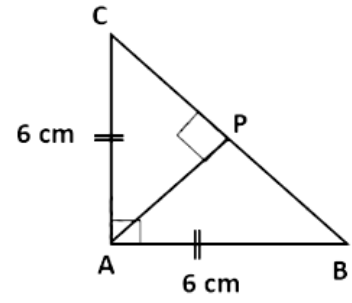
Area of $\triangle A B C$
$=\frac{1}{2} \times AB \times AC$
$=\frac{1}{2} \times 6 \times 6$
$=18 \ cm ^2 . $
In right$-$angled $\triangle B A C$,
$BC ^2$
$=A B^2+A C^2$
$=6^2+6^2$
$=36+36$
$=72$
$\Rightarrow BC =6 \sqrt{2} \ cm$
Now,
area of $\triangle A B C$ is also
$=\frac{1}{2} \times BC \times AP$
$\Rightarrow 18=\frac{1}{2} \times 6 \sqrt{2} \times AP$
$\Rightarrow 18=3 \sqrt{2} \times AP$
$\Rightarrow AP$
$=\frac{18}{3 \sqrt{2}}$
$=\frac{6}{\sqrt{2}}$
$=\frac{6}{\sqrt{2}} \times \frac{\sqrt{2}}{\sqrt{2}}$
$=\frac{6 \sqrt{2}}{2}$
$=3 \sqrt{2} \ cm$. View full question & answer→Question 245 Marks
Each equal side of an isosceles triangle is $3\ cm$ less than the unequal side. The height of the perpendicular from the vertex to the unequal side is $3\ cm$ less than the equal side. If the area of the isosceles triangle is $108\ cm^2,$ find the perimeter of the triangle.
AnswerLet the unequal side of the lsosceles triangle $=x$
Then the equal side of the Isosceles triangle $=x-3$
And the perpendicular to the unequal side from the opposite vertex $=x-6$
We know that, Area of a Triangle
$=\frac{1}{2}$ b.h i.e $\frac{1}{2} ($Base $\times$ Height $)$
$\therefore$ Area of the Isosceles Triangle
$=\frac{1}{2} \times(x-6)$
$=108$
$\Rightarrow x ^2-6 x =216$
$\Rightarrow x ^2-6 x -216=0$
$\Rightarrow x ^2-6 x +9-9-216=0$
$\Rightarrow( x -3)^2=225$
$\Rightarrow x -3=15 $
$\Rightarrow x =18$
$\Rightarrow x -3=15$
$\Rightarrow$ Perimeter
$=18+15+15$
$=48 \ cm \text {. }$
View full question & answer→Question 255 Marks
Find the base of an isosceles triangle whose area is $192\ cm^2$ and the length of one of the equal sides is $20\ cm.$
AnswerArea of an isosceles triangle $= 192\ cm^2$
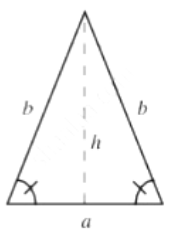
An isosceles triangle is a triangle with $($at least$)$ two equal sides.
In the figure above, the two equal sides have length $b$ and the remaining side has length $a$.
This property is equivalent to two angles of the triangle being equal.
An isosceles triangle therefore has both two equal sides and two equal angles.
Let $h$ be the height of the isosceles triangle as illustrated.
So, $h=\sqrt{b^2-\frac{a^2}{4}}$
We know that, Area of a Triangle
$ =\frac{1}{2}($Base $\times$ Height$)$
$=\frac{1}{2} \times a \times h$
$=\frac{1}{2} \times a \times \sqrt{ b ^2-\frac{ a ^2}{4}}$
$=\frac{1}{2} \times a ^2 \times \sqrt{\frac{ b ^2}{ a ^2}-\frac{1}{4}}$
Here, The area is therefore given by
$ =\frac{1}{2} \times x^2 \times \sqrt{\frac{20^2}{x^2}-\frac{1}{4}}$
$=\frac{x^2}{2} \sqrt{\frac{1600-x^2}{4 x^2}}$
$\Rightarrow 192=\frac{x^2}{2} \sqrt{\frac{1600-x^2}{4 x^2}}$
$\Rightarrow 192^2=\frac{x^4}{4} \times \frac{1600-x^2}{4 x^2}$
$\Rightarrow 192^2 \times 16=x^2\left(1600-x^2\right)$
$\Rightarrow x^4-1600 x^2+589824=0$
$\Rightarrow t^2-1600 t+589824=0 ;$ wherex $x^2 t$
$\Rightarrow t^2-1024 t-576 t+589824=0$
$\Rightarrow t(t-1024)-576(t-1024)=0$
$\Rightarrow t =1024$ or $576$
$\Rightarrow x^2=1024$ or $576$
$\Rightarrow x =32 \ cm$ or $24 \ cm . $ View full question & answer→Question 265 Marks
The cost of fencing a triangular field at the rate of $Rs.15$ per m is $Rs.900$. If the lengths of the triangle are in the ratio $3:4:5$, find the area of the triangle and the cost of cultivating it at $Rs.48$ per $kg\ sq.m.$
AnswerLet the Perimeter of the triangular plot of land $=P$
$\therefore P \times 15=900$
$\Rightarrow P=\frac{900}{15}$
$=60$
Let the sides of the triangular plot of land $=3 x , 4 x$ and $5 x$
So,
$3 x+4 x+5 x$
$=60$
$\Rightarrow x=5$
So, the sides of the triangular plot of land
$=3 \times 5,4 \times 5$ and $5 \times 5$
$=15\ m , 20\ m , 25\ m$
We know that, Area of a Triangle whose sides are $a, B$ and $c$ and semiperimeter is $s$ given by
$\sqrt{ s ( s - a )( s - b )( s - c )} ; s =\frac{ a + b + c }{2}$
For a triangle whose sides are $cm , \ cm$ and $cm$
$i.e. a=15 b=20$ and $c=25, s=\frac{60}{2}=30$
Area
$=\sqrt{30(30-15)(30-15)(30-20)(30-25)}$
$=\sqrt{30(15)(10)(5)}$
$=\sqrt{22500}$
$=150 \ cm ^2$
Cost of cultivating $1\ m ^2= Rs. 48$
Cost of cultivating $150\ m ^2$
$=\text { Rs. } 48 \times 150$
$=\text { Rs. } 7200 .$
View full question & answer→Question 275 Marks
Find the area of an isosceles triangle whose perimeter is $72\ cm$ and the base is $20\ cm.$
AnswerThe sum of the equal sides of the given Isosceles triangle
$=72-20$
$=52$
So, each the equal sides of the given Isosceles triangle $=$
$\frac{1}{2}(52)$
$=26 \ cm$
We know that, Area of a Triangle whose sides are $a, b$, and $c$ and semiperimeter is $s$ is given by
$\sqrt{ s ( s - a )( s - b )( s - c )} ; s =\frac{ a + b + c }{2}$
Here, sides are $26 \ cm , 26 \ cm$ and $20 \ cm$
$s=\frac{P}{2}$
$=\frac{72}{2}$
$=36$
Area
$=\sqrt{36(36-26)(36-26)(36-20)}$
$=\sqrt{36(10)(10)(16)}$
$=6 \times 10 \times 4$
$=240 \ cm ^2 .$
View full question & answer→Question 285 Marks
In a right$-$angled $\triangle ABC$, if $\angle B = 90^\circ , AB - BC = 2 \ cm; AC - BC = 4$ and its perimeter is $24 \ cm,$ find the area of the triangle.
AnswerGiven, Perimeter of $\triangle A B C=24 \ cm$
$\Rightarrow A B+B C+A C=24 \ cm$
$A B-B C=2 \ cm$
$A C-B C=4 \ cm$
Adding $(ii)$ and $(iii)$, we get
$A B+A C-2 B C=6 \ cm$
$\Rightarrow A B+A C=6+2 B C$
Substituing $(iv)$ un $(i)$, we get
$6+2 B C+B C=24$
$\Rightarrow 3 B C=18$
$\Rightarrow B C=6 \ cm$
$\Rightarrow A B=2+B C$
$=2+6$
$=8 \ cm$
$\therefore$ Area of right$-$angled $\triangle A B C$
$=\frac{1}{2} \times BC \times AB$
$=\frac{1}{2} \times 8 \times 6$
$=24 \ cm ^2 .$
View full question & answer→Question 295 Marks
In a right$-$angled $\triangle PQR$ right$-$angled at $Q, QR = x\ cm, PQ = (x + 7)\ cm$ and area $= 30\ cm^2.$ Find the sides of the triangle.
AnswerArea of right$-$angled $\triangle PQR =\frac{1}{2} \times QR \times PQ$
$\Rightarrow 30=\frac{1}{2} \times x \times(x+7)$
$\Rightarrow 60= x ^2+7 x$
$\Rightarrow x ^2+7 x -60=0$
$\Rightarrow x ^2+12 x -5 x -60=0$
$\Rightarrow x ( x +12)-5( x +12)=0$
$\Rightarrow( x +12)( x -5)=0$
$\Rightarrow x +12=0, x -5=0$
$\Rightarrow x =-12$ or $ x =5$
But, length of a side cannot be negatice.
Hence,
$ x=5 \ cm =Q R$
$x+7$
$=5+7$
$=12 \ cm$
$=P Q $
In right$-$angled $\triangle PQR$, by Pythagoras theorem,
$P^2=P Q^2+Q R^2$
$=12^2+5^2$
$=144+25$
$=169$
$\Rightarrow P R=13 \ cm$
Hence, $P Q=12 \ cm , Q R=5 \ cm$ and $P R=13 \ cm$.
View full question & answer→Question 305 Marks
Find the area of the shaded region in the figure as shown, in which $\text{DPQS}$ is an equilateral triangle and $\angle PQR = 90^\circ.$
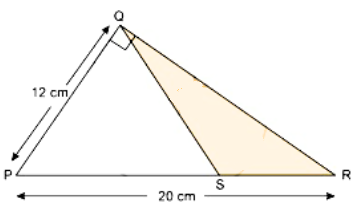
Answer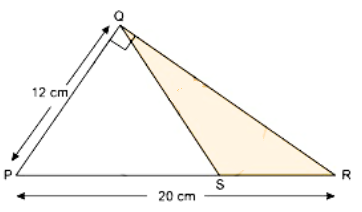
In right$-$angled $\triangle PPQR$,
$ P^2=P Q^2+R Q^2$
$\Rightarrow R Q^2=P R^2-P Q^2$
$=20^2-12^2$
$=400-144$
$=256$
$\Rightarrow R Q=16 \ cm$
Area of $\triangle PQR$
$=\frac{1}{2} \times PQ \times RQ$
$=\frac{1}{2} \times 12 \times 16$
$=96 \ cm ^2$
Area of equilateral $\triangle PQS$
$ =\frac{\sqrt{3}}{4} \times($side$)^2$
$=\frac{\sqrt{3}}{4} \times 12 \times 12$
$=36 \sqrt{3} \ cm ^2$
Now,
area of shaded region
$=$ Area of $\triangle P Q R -$ Area of equilateral $\triangle P Q S$
$=96-36 \sqrt{3}$
$=12(8-3 \sqrt{3}) \ cm ^2 .$ View full question & answer→