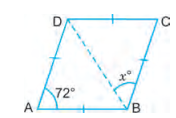
If a diagonal of a parallelogram bisects one of the angles of the parallelogram, prove that it also bisects the second angle and then the two diagonals are perpendicular to each other.
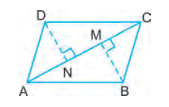
In the adjoining figure, ABCD is a parallelogram. $BM \perp AC$ and $DN \perp AC$. Prove that : (i) $\triangle BMC \equiv \triangle DNA$. (ii) $BM = DN$.
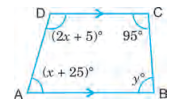
In the given figure, ABCD is a trapezium in which $\angle A =(x+25), \angle B =y, \angle C =95$ and $\angle D =(2 x+5)$. Find the values of $x$ and $y$.
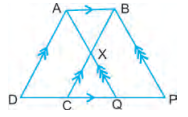
In the adjoining figure, ABCD is a parallelogram and X is the mid-point of $B C$. The line $A X$ produced meets DC produced at $Q$. The parallelogram AQPB is completed. Prove that: (i) $\triangle ABX \cong \triangle QCX$. (ii) $DC = CQ = QP$.
In the adjoining figure, $A B C D$ is a parallelogram. $BM \perp AC$ and $DN \perp AC$. Prove that: (i) $\triangle$ BIC $\cong \triangle D N A$. (ii) $BM = DN$.
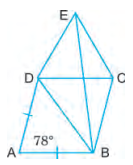
In the given figure, ABCD is a rhombus and $\triangle EDC$ is equilateral. If $\angle BAD =78^{\circ}$, calculate : (i) $\angle CBE$ (ii) $\angle DBE$.
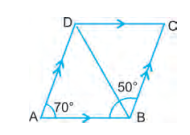
In the adjoining figure, ABCD is a parallelogram in which $\angle BAD =70^{\circ}$ and $\angle CBD =50^{\circ}$. Calculate : (i) $\angle ADB$ (ii) $\angle CDB$.
Answer
(i) $\angle ADB =50^{\circ}$ (ii) $\angle CDB =60^{\circ}$