Questions

[3 marks sum]

🎯

Test yourself on this topic

10 questions · timed · auto-graded

Question 13 Marks
$\text{ABCD}$ is a rectangle with $\angle ADB = 55^\circ ,$ calculate $\angle ABD.$
Answer
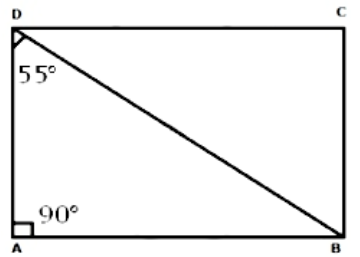
Image
In $\triangle ABD,$
$\angle ADB = 55^\circ $
$\angle DAB = 90^\circ ...($in rectangle angle between two sides is $90^\circ )$
$\angle ADB + \angle DAB + \angle ABD = 180^\circ $
$55^\circ + 90^\circ + \angle ABD = 180^\circ $
$\angle ABD = 180^\circ - 145^\circ $
$\angle ABD = 35^\circ .$
View full question & answer
Question 23 Marks
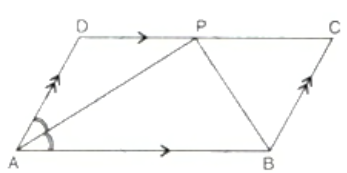
$\text{ABCD}$ is a parallelogram. The bisector of $\angle BAD$ meets $DC$ at $P,$ and $AD$ is half of $AB.$
Image
Prove that: $\angle APB$ is a right angle.
Answer
$ \angle DAP =\angle PAB$
$\angle CBP =\angle PBA$
$\angle DAB +\angle CBA =180^{\circ} \quad \ldots($ adjacent angles of $\| gm$ are supplementary $)$
Multipying by  $\frac{1}{2}$
$\frac{1}{2} \angle DAB +\frac{1}{1} \angle CBA =\frac{1}{2} \times 180^{\circ}$
$\angle PAB +\angle PBA =90^{\circ}$
In $\triangle APB ,$
$\angle PAB +\angle PBA +\angle APB =180^{\circ}$
$90^{\circ}+\angle APB =180^{\circ}$
$\angle APB =90^{\circ} $
Therefore, $\angle A P B$ is a right angle.
View full question & answer
Question 33 Marks
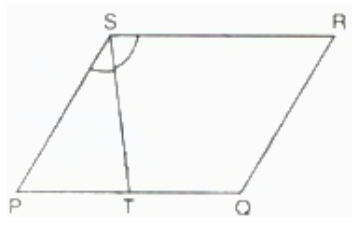
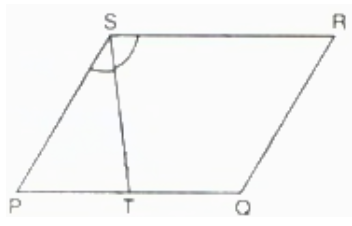
$\text{PQRS}$ is a parallelogram. $T$ is the mid$-$point of $PQ$ and $ST$ bisects $\angle PSR.$
Image
Prove that: $RT$ bisects angle $R$
Answer
Image
Since $QT = QR$
$\angle QTR = \angle QRT$
But $\angle QTR = \angle TRS ...($alternate angles $\because SR \| PQ)$
$\Rightarrow \angle QRT = \angle TRS$
Therefore, $RT$ bisects $\angle R.$
View full question & answer
Question 43 Marks
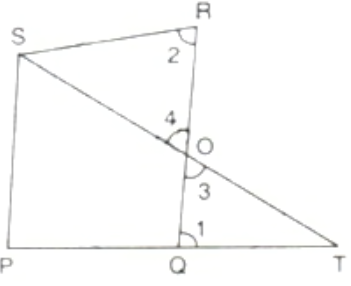
$\text{PQRS}$ is a parallelogram. $PQ$ is produced to $T$ so that $PQ = QT.$ Prove that $PQ = QT$. Prove that $ST$ bisects $QR$.
Image
Answer
$PQ = QT$
But $PQ = SR ...(\text{PQRS}$ is a parallelogram$)$
Therefore, $QT = SR$
In $\triangle SOR$ and $\triangle QAT$
$QT = SR$
$\angle 3 = \angle 4 ...($vertically opposite angles$)$
$\angle 1 = \angle 2 ...($alternate angles since $PQ \| SR)$
Therefore, $\triangle SOR ≅ \triangle QAT$
Hence, $OS = OT$ and $OR = OQ$
Therefore, $ST$ bisects $QR.$
View full question & answer
Question 53 Marks
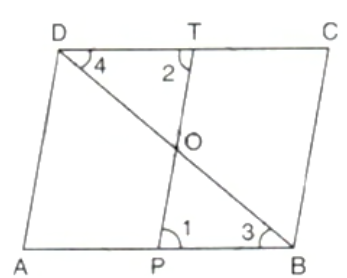
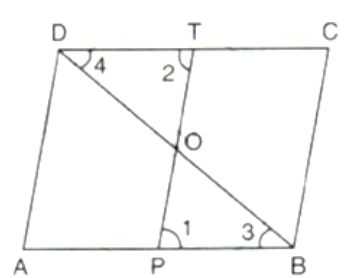
$\text{ABCD}$ is a parallelogram. $P$ and $T$ are points on $AB$ and $DC$ respectively and $AP = CT.$ Prove that $PT$ and $BD$ bisect each other.
Image
Answer
Join $AC$
Image
Since $AC$ and $BD$ are diagonals of a parallelogram, $AC$ and $BD$ bisect each other.
$\Rightarrow OA = OC$ and $OD = OB ........(i)$
$AP = CT$
But $AB = CD$
$\Rightarrow PB = DT$
In $\triangle DOT$ and $\triangle POB,$
$PB = DT$
$\angle 1 =\angle 2 ...($alternate angles since $AB \| CD)$
$\angle 3 = \angle 4 ...($alternate angles since $AB \| CD)$
Therefore, $\triangle DOT ≅ \triangle POB$
Hence, $OT = OP ........(ii)$
From $(i)$ and $(ii)$
$OD = OB$ and $OT = OP$
Therefore, $PT$ and $BD$ bisect each other.
View full question & answer
Question 63 Marks
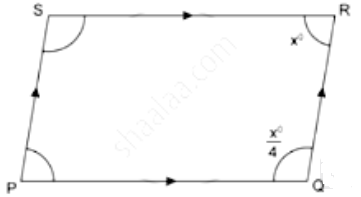
In the following figures, find the remaining angles of the parallelogram
Image
Answer
$\text{PQRS}$ is a parallelogram.
$ \angle R +\angle Q =180^{\circ} \ldots ($Interior angles$)$
$\Rightarrow x^{\circ}+\frac{x^{\circ}}{4}=180^{\circ}$
$\Rightarrow 4 x ^{\circ}+ x ^{\circ}=180^{\circ} \times 4$
$\Rightarrow 5 x ^{\circ}=180^{\circ} \times 4$
$\Rightarrow x ^{\circ}=\frac{180^{\circ} \times 4}{5}$
$\Rightarrow x ^{\circ}=144^{\circ}=\angle R$
$\Rightarrow x \frac{144^{\circ}}{4}=36^{\circ}=\angle Q$
$\Rightarrow \angle P =\angle R =144 \ldots . ($Opposite angles of a parallelogram are equal$)$
$\angle S =\angle Q =36^{\circ} . $
View full question & answer
Question 73 Marks
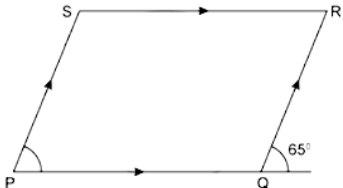
In the following figures, find the remaining angles of the parallelogram
Image
Answer
$\angle PQR + 65^\circ = 180^\circ ....($Linear pair angles$)$
$\Rightarrow \angle PQR = 115^\circ $
$\text{PQRS}$ is a parallelogram.
$\angle S = \angle Q = \angle 115^\circ ....($Opposite angles of a parallelogram are equal$)$
And, $\angle P + \angle S = 180^\circ ....($Interior angles$)$
$\Rightarrow \angle P + 115^\circ = 180^\circ $
$\Rightarrow \angle P = 65^\circ $
$\Rightarrow \angle R = \angle P = 65^\circ ....($Opposite angles of a parallelogram are equal$)$
Thus, we have
$\angle P = 65^\circ , \angle Q = 115^\circ , \angle R = 65^\circ$ and $\angle S = 115^\circ .$
View full question & answer
Question 83 Marks
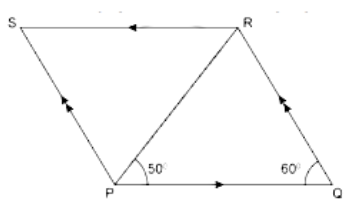
In the following figures, find the remaining angles of the parallelogram
Image
Answer
$PQRS$ is a parallelogram.
$\angle Q = 60^\circ $
$\Rightarrow \angle S = 60^\circ ....($Opposite angles of a parallelogram are equal$)$
In $\triangle PQR,$
$\angle RPQ + \angle PQR + \angle PRQ = 180^\circ ....($Angle sum property of a triangle$)$
$\Rightarrow 50^\circ + 60^\circ + \angle PRQ = 180^\circ $
$\Rightarrow 110^\circ + \angle PRQ = 180^\circ $
$\Rightarrow \angle PRQ = 70^\circ $
And, $\angle SPR = \angle PRQ = 70^\circ ....($Alternate angles$)$
$\Rightarrow \angle SPQ$
$= \angle SPR + \angle RPQ$
$= 70^\circ + 50^\circ $
$= 120^\circ $
$\Rightarrow \angle SRQ = 120^\circ ....($Opposite angles of a parallelogram are equal$)$
Thus, we have
$\angle P = 120^\circ , \angle S = 60^\circ $ and $\angle R =120^\circ .$
View full question & answer
Question 93 Marks
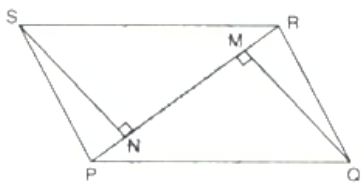
$SN$ and $QM$ are perpendiculars to the diagonal $PR$ of parallelogram $\text{PQRS}.$
Image
Prove that:
$(i) \triangle SNR ≅ \triangle QMP$
$(ii) SN = QM$
Answer
$(i)$ In $\triangle SNR$ and $\triangle QMP$
$\angle SNR = \angle QMP ...($right angles$)$
$\angle SRN = \angle MPQ ...($alternate angles since $PQ || SR)$
$\therefore \triangle SNR \sim \triangle QMP$
$\angle RSN = \angle PQM .........(i)$
In $\triangle SNR$ and $\triangle QMP$
$\angle SRN = \angle MPQ$
$\angle RSN = \angle PQM ...($from$ (i))$
$PQ = SR ...(\text{PQRS}$ is a parallelogram$)$
Therefore, $\triangle SNR \cong \triangle QMP ...(\text{ASA}$ axiom$)$
$(ii)$ Since $\triangle SNR \cong \triangle QMP$
Hence, $SN = QM.$
View full question & answer
Question 103 Marks
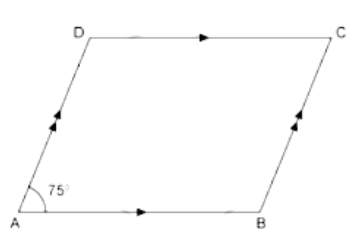
In the following figures, find the remaining angles of the parallelogram
Image
Answer
$\text{ABCD}$ is a parallelogram.
$\angle A = 75^\circ $
$\Rightarrow \angle C = 75^\circ ....($Opposite angles of a parallelogram are eequal$)$
Now,$\angle A + \angle D = 180^\circ ....($Interior angles$)$
$\Rightarrow \angle 75^\circ + \angle D = 180^\circ $
$\Rightarrow \angle D = 105^\circ $
$\Rightarrow \angle B = \angle D = 105^\circ ....($Opposite angles of a parallelogram are equal$)$
Thus, we have
$\angle B = 105^\circ , \angle C = 75^\circ$ and $\angle D = 105^\circ .$
View full question & answer
[3 marks sum] - MATHEMATICS STD 9 Questions - Vidyadip