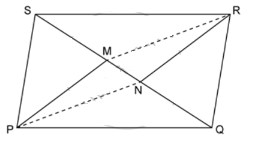
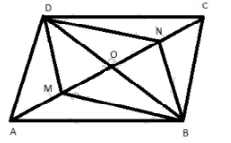
Questions

[4 marks sum]

🎯

Test yourself on this topic

17 questions · timed · auto-graded

Question 14 Marks
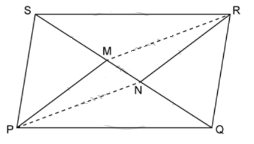
$\text{PQRS}$ is a parallelogram. $T$ is the mid$-$point of $R S$ and $M$ is a point on the diagonal $P R$ such that $M R=\frac{1}{4} PR. TM$ is joined and extended to cut $QR$ at $N$. Prove that $QN = RN$.
Answer
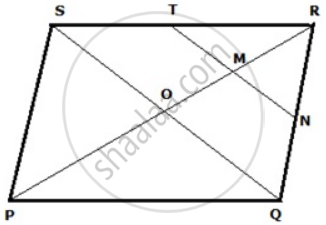
Join $P R$ to intersect $Q S$ at $O$
Diagonals of a parallelogram bisect each other.
Therefore, $O P=O R$
But $MR =\frac{1}{4} PR$
$ \therefore MR =\frac{1}{4}(2 \times QR )$
$\Rightarrow MR =\frac{1}{2} OR $
Hence, $M$ is the mid$-$point of $O R$.
In $\triangle ROS, T$ and $M$ are the mid$-$points of $RS$ and $OR$ respectively.
Therefore,$ TM \| OS$
$\Rightarrow TN \| QS$
Also in $\triangle R Q S, T$ is the mid$-$point of $RS$ and $TN \| QS$
Therefore, $N$ is the mid$-$point of $Q R$ and $T N=\frac{1}{2} Q S$
$\Rightarrow QN = RN \text {. }$
View full question & answer
Question 24 Marks
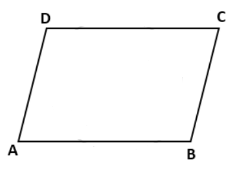
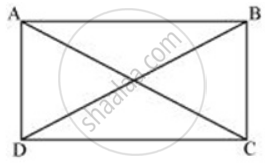
Prove that if the diagonals of a parallelogram are equal then it is a rectangle.
Answer

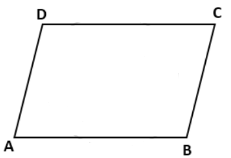
Let $\text{ABCD}$ be a parallelogram.
In $\triangle ABC$ and $\triangle DCB,$
$AB = DC ...($Opposite sides of a parallelogram are equal$)$
$BC = BC ...($Common$)$
$AC = DB ...($Given$)$
$\therefore \triangle ABC ≅ \triangle DCB ...($By $\text{SSS}$ Congruence rule$)$
$\Rightarrow \angle ABC = \angle DCB$
It is known that the sum of the measures of angles on the same side of transversal is $180^\circ .$
$\angle ABC + \angle DCB = 180^\circ ...(AB \| CD)$
$\Rightarrow \angle ABC + \angle ABC = 180^\circ $
$\Rightarrow 2\angle ABC = 180^\circ $
$\Rightarrow \angle ABC = 90^\circ $
Since $\text{ABCD}$ is a parallelogram and one of its interior angles is $90^\circ , \text{ABCD}$ is a rectangle.
View full question & answer
Question 34 Marks
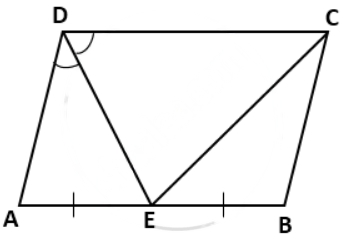
In a parallelogram $\text{ABCD}, E$ is the midpoint of $AB$ and $DE$ bisects angle $D$. Prove that:$CE$ is the bisector of $\angle C$ and $\angle DEC$ is a right angle.
Answer

Since $B C=B E$
$\Rightarrow \angle B E C=\angle B C E \quad\dots...($Angles opposite to equal sides are equal$)$
$\angle B E C=\angle E C D \quad\dots...($Alternate angles$)$
$\Rightarrow \angle B C E=\angle E C D$
$\Rightarrow CE$ is the bisector of $\angle C\dots....($proved$)$
$\angle DCE =\frac{1}{2} \angle C \quad\dots... ($Given $CE$ bisects $\left.\angle D \right)$
$\angle CDE =\frac{1}{2} \angle D \ldots($Given $DE$ bisects $\angle D)$
$\angle DCE +\angle CDE$
$=\frac{1}{2}(\angle C +\angle D)$
$=\frac{1}{2} \times 180^{\circ}=90^{\circ}$
Thus, in $\triangle DCE$,
$ \angle DEC =180^{\circ}-\angle DCE +\angle CDE =180^{\circ}-90^{\circ}$
$\Rightarrow \angle DEC =90^{\circ} .$
View full question & answer
Question 44 Marks
In a parallelogram $\text{ABCD}, E$ is the midpoint of $AB$ and $DE$ bisects $\angle D$. Prove that: $BC = BE.$
Answer
Image
$\angle CDE = \angle DEA ...($ALternate angles$)$
$\angle CDE = \angle EDA ...$(Given $DE$ bisects $\angle D)$
$\angle DEA = \angle EDA$
$\Rightarrow AD = AE ....(i)$(Sides opposite to equal angles are equal$)$
Now, $AD = BE ....(ii)($Opposite to equal angles are equal$)$
And, $AE = BE ....(iii)(E$ is the mid$-$point of $AB)$
$\Rightarrow BC = BE. ....($proved$)$
View full question & answer
Question 54 Marks
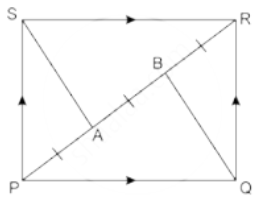
In the given figure,$\text{PQRS}$ is a parallelogram in which $PA = AB$ Prove that: $\text{SAQB}$ is a parallelogram.
Image
Answer
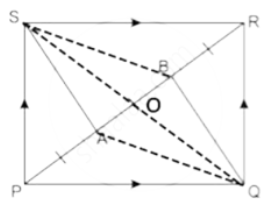
Construction:
Join $BS$ and $AQ.$
Join diagonal $QS.$
Image
Since diagonals of a parallelogram bisect each other.
$\therefore OP = OR$ and $OQ = OS$
Also, $PA = AB = BR$
Now, $OP = OR$ and $PA = PB$
$\Rightarrow OP - PA = OR - PB$
$\Rightarrow OA = OB$
Thus, in quadrilateral $\text{SAQB}$, we have
$OQ = OS$ and $OA = OB$
$\Rightarrow $ Diagonals of a quadrilateral $\text{SAQB}$ bisect each other.
$\Rightarrow \text{SAQB}$ is a parallelogram.
View full question & answer
Question 64 Marks
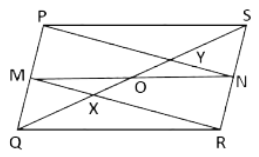
In a parallelogram $\text{PQRS}, M$ and $N$ are the midpoints of the opposite sides $PQ$ and $RS$ respectively. Prove that
$MN$ bisects $QS.$
Answer
Image
$M$ and $N$ are the mid$-$points of $P Q$ and $R S$ respectively.
$\Rightarrow MN \| QR$
Let $MN$ intersect $QS$ at point $O$.
We know that the segment drawn through the mid$-$point of one side of a triangle and parallel to the other sides bisects the third side.
In $\triangle S R Q N$ is the mid$-$point of $R S$ and $O N \| Q R$
$\therefore O$ is the mid$-$point of $S Q$
$\Rightarrow O Q=O S$
$\Rightarrow ON$ bisects $QS$
$\Rightarrow MN$ bisects $QS$.
View full question & answer
Question 74 Marks
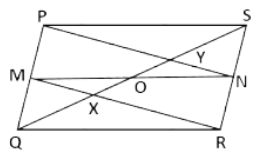
In a parallelogram $\text{PQRS}, M$ and $N$ are the midpoints of the opposite sides $PQ$ and $RS$ respectively. Prove that
$\text{PMRN}$ is a parallelogram.
Answer
Image
Since $M$ and $N$ are the mid$-$points of $P Q$ and $RS$ respectively.
$\therefore PM =\frac{1}{2} PQ$ and $RN =\frac{1}{2} RS \dots. . . \text { (i) }$
But $\text{PQRS}$ is a parallelogram,
$\therefore PQ = RS$ and $PQ \| RS $
$\Rightarrow \frac{1}{2} PQ =\frac{1}{2} RS$ and $PQ \| RS $
$\Rightarrow PM = RN$ and $PM \| RN $
$\Rightarrow \text{PMRN}$ is a parallelogram.
View full question & answer
Question 84 Marks
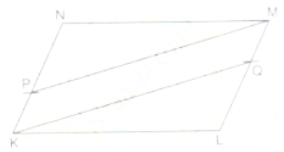
$P$ is a point on side $KN$ of a parallelogram $\text{KLMN}$ such that $KP : PN$ is $1 : 2.$ Q is a point on side $LM$ such that $LQ$ : MQ is $2 : 1.$ Prove that $\text{KQMP}$ is a parallelogram.
Image
Answer
$KP =\frac{1}{3} KN \ldots($since $KP : PN =1: 2)$
$MQ =\frac{1}{3} LM \ldots($ since $LQ : MQ =1: 2)$
But $KN = LM \ldots($opposite sides of parallelogram $\text{KLMN})$
$\Rightarrow \frac{1}{3} KN =\frac{1}{3} LM$
$\therefore KP = MQ \ldots \ldots . . \text { (i) }$
Also, $KN \| \text { LM }$
$\Rightarrow KN \| MQ \dots. . . . \text { (ii) }$
From and $(ii)$
$KP = MQ$ and $KP \| MQ$
Hence, $\text{KQMP}$ is a parallelogram.
View full question & answer
Question 94 Marks
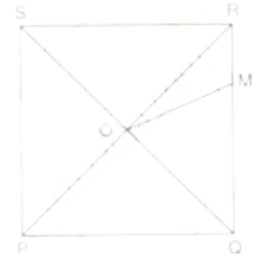
$\text{PQRS}$ is a square whose diagonals $PR$ and $QS$ intersect at $O.M$ is a point on $QR$ such that $OQ = MQ.$ Find the measures of $\angle MOR$ and $\angle QSR.$
Image
Answer
In $\triangle QOM,$
$\angle OQM = 45^\circ \dots...($In square diagonals make $45^\circ $ with the sides$)$
$OQ = MQ$
$\Rightarrow \angle QOM = \angle QMO (i) \dots...($equal sides have equal angles opposite to them$)$
$\angle QOM + \angle QMO + \angle OQM = 180^\circ $
$\angle QOM + \angle QOM + 45^\circ = 180^\circ $
$2\angle QOM = 180^\circ - 45^\circ $
$\angle QOM = 67.5^\circ $
In $\triangle QOR,$
$\angle QOR = 90^\circ \dots...($diagonals bisect at right angles$)$
$\angle QOM + \angle MOR = 90^\circ $
$67.5^\circ + \angle MOR = 90^\circ $
$\angle MOR = 22.5^\circ $
In $\triangle ROS,$
$\angle OSR = 45^\circ \dots...($In square diagonals make $45^\circ $ with the sides$)$
$\Rightarrow \angle QSR = 45^\circ .$
View full question & answer
Question 104 Marks
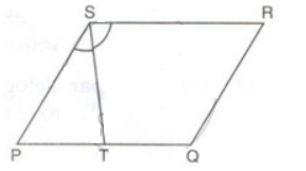
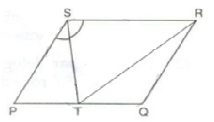
$\text{PQRS}$ is a parallelogram. $T$ is the mid$-$point of $PQ$ and $ST$ bisects $\angle PSR.$
Image
Prove that: $\angle RTS = 90^\circ$
Answer
Image
$\angle PST =\angle TSR$
$ \angle QRT =\angle TRS$
$\angle QRS +\angle PSR =180^{\circ} \ldots($adjacent angles of $\| gm$ are supplementary$)$
Multiplying by $\frac{1}{2}$
$\frac{1}{2} \angle QRS +\frac{1}{2} \angle PSR =\frac{1}{2} \times 180^{\circ}$
$\angle TSR +\angle TRS =90^{\circ}$
In $\triangle STR$
$\angle TSR +\angle RTS +\angle TRS =180^{\circ}$
$90^{\circ}+\angle RTS =180^{\circ}$
$\angle RTS =90^{\circ} $
View full question & answer
Question 114 Marks
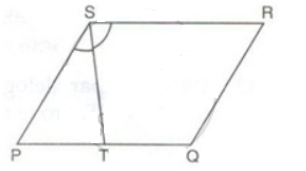
$\text{PQRS}$ is a parallelogram. $T$ is the mid$-$point of $PQ$ and $ST$ bisects $\angle PSR.$
Image
Prove that: $QR = QT$
Answer
Image
$\angle PST = \angle TSR \dots.......(i)$
$\angle PTS = \angle TSR \dots.......(ii)($alternate angles $\because SR \| PQ)$
From $(i)$ and $(ii)$
$\angle PST = \angle PTS$
Therefore,
$PT = PS$
But $PT = QT \dots...(T$ is midpoint of $PQ)$
And $PS = QR \dots...(PS$ and $QR$ are opposite and equal sides of a parallelogram$)$
Hence,
$QT = QR.$
View full question & answer
Question 124 Marks
Find the measures of all the angles of the parallelogram shown in the figure:
Image
Answer
In $\triangle BDC,$
$\angle BDC + \angle DCB + \angle CBD = 180^\circ $
$2a + 5a + 3a = 180^\circ $
$10a = 180^\circ $
$\Rightarrow a = 18^\circ $
$\angle BDC = 2a = 2 \times 18^\circ = 36^\circ $
$\angle DCB = 5a = 5 \times 18^\circ = 90^\circ $
$\angle CBD = 3a = 3 \times 18^\circ = 54^\circ $
$\angle DAB =\angle DCB = 90^\circ ...($opposite angles of parallelogram are equal$)$
$\angle DBA = \angle BDC = 36^\circ ...($alternate angles since $AB \| CD)$
$\angle BDA = \angle CBD = 54^\circ ...($alternate angles since $AB \| CD)$
Therefore,
$\angle DAB =\angle DCB = 90^\circ ,$
$\angle DBA + \angle CBD = 90^\circ ,$
$\angle BDA + \angle BDC = 90^\circ .$
View full question & answer
Question 134 Marks
The consecutive angles of a parallelogram are in the ratio $3:6$. Calculate the measures of all the angles of the parallelogram.
Answer
Image
Let $\text{ABCD}$ is a parallelogram in which $AD \| BC.$
$\angle A$ and $\angle B$ are consecutive angles:
$\angle A : \angle B = 3 : 6$
$\therefore \angle A = 3x$ and $\angle B = 6x$
$AD \| BC$ and $AB$ is the transversal.
$\Rightarrow \angle A + \angle B = 180^\circ ....($Co$-$interior angles are supplementary$)$
$\Rightarrow 3x + 6x = 180^\circ $
$\Rightarrow 9x = 180^\circ $
$\Rightarrow x = 20$
$\therefore \angle A = 3 \times 20^\circ = 60^\circ $ and $\angle B = 6 \times 20^\circ = 120^\circ $
Since opposite angles of a parallelogram are equal.
$\therefore \angle C =\angle A = 60^\circ $ and
$\angle D = \angle B = 120^\circ .$
View full question & answer
Question 144 Marks
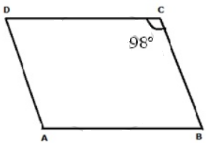
In a parallelogram $\text{ABCD} ,\angle C = 98^\circ $. Find $\angle A$ and $\angle B.$
Answer
Image
$\text{ABCD}$ is a parallelogram
$\angle C = 98^\circ $
$\therefore \angle A = \angle C = 98^\circ ....($opposite angles of a parallelogram are equal$)$
$\angle A + \angle B +\angle C + \angle D = 360^\circ ....($Sum of all angles of a quadrilateral $= 360^\circ )$
$98^\circ + \angle B + 98^\circ + \angle D = 360^\circ $
$\angle B + 196 + \angle D = 360^\circ $
$\angle B + \angle D = 360^\circ - 196^\circ $
$\angle B +\angle D = 164^\circ $
But $\angle B = \angle D ....($opposite angles of a parallelogram are equal$)$
$\Rightarrow 2\angle B = 164^\circ $
$\Rightarrow \angle B = 82^\circ = \angle D$
Therefore,
$\angle B = 82^\circ , \angle A = 98^\circ .$
View full question & answer
Question 154 Marks
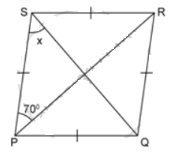
In the following figures, find the remaining angles of the parallelogram
Image
Answer
$\text{PQRS}$ is a parallelogram with all sides equal and opposite sides parallel.
Hence, $\text{PQRS}$ is a Rhombus.
Diagonals of a Rhombus bisect each other.
In $\triangle POS,$
$\angle OSP + \angle SPO + \angle POS = 180^\circ $
$\Rightarrow x + 70^\circ + 90^\circ = 180^\circ $
$\Rightarrow x = 20^\circ $
In $\triangle QSP,$
$PS = PQ$
$\Rightarrow \angle QSP = \angle PQS = x = 20^\circ $
And,
$\angle QSP + \angle PQS + \angle SPQ = 180^\circ $
$\Rightarrow 20^\circ + 20^\circ + \angle SPQ = 180^\circ $
$\Rightarrow \angle SPQ = 140^\circ $
$\Rightarrow \angle SPQ = 140^\circ \dots....($Opposite angles are equal$)$
Now,
$\angle SPQ + \angle SR = 180^\circ $
$\Rightarrow 140^\circ + PSR = 180^\circ $
$\Rightarrow \angle PSR = 40^\circ $
$\Rightarrow \angle PQR = 40^\circ \dots....($Opposite angles are equal$)$
Hence,
$\angle P =\angle R = 140^\circ $ and $\angle S = \angle Q = 40^\circ .$
View full question & answer
Question 164 Marks
In the given figure, $MP$ is the bisector of $\angle P$ and $RN$ is the bisector of $\angle R$ of parallelogram $\text{PQRS}$. Prove that $\text{PMRN}$ is a parallelogram.
Image
Answer
Construction: Join $PR.$
Image
Proof:
$\angle QPM =\frac{1}{2} \angle P \quad\dots.... (AP$ is the bisector of $\angle P)$
$\angle SRN =\frac{1}{2} \angle R \quad\dots.... (RN$ is the bisector of $\left.\angle R \right)$
$\Rightarrow \angle QPM =\angle SRN (i) \ldots[\angle P =\angle R ($Opposite angles of a parallelogram$)]$
Now, $\angle Q P R=\angle S R N (ii)\dots.... [$Alternate angles since $PQ \| SR)$
Subtracting $(ii)$ from $(i)$, we get
$\angle QPM -\angle QPR =\angle SRN -\angle SRP$
$\Rightarrow \angle R P M=\angle P R N$
$\Rightarrow PM \| RN\dots...($Alternate angles are equal$)$
Similarly, $RM \| PN$
Hence, $\text{PMPN}$ is a parallelogram.
View full question & answer
Question 174 Marks
Points $M$ and $N$ are taken on the diagonal $AC$ of a parallelogram $\text{ABCD}$ such that $AM = CN$. Prove that $\text{BMDN}$ is a parallelogram.
Answer
Points $M$ are $N$ taken on the diagonal $AC$ of a parallelogram $\text{ABCD}$ such that.
Prove that $\text{BMDN}$ is a parallelogram
Image
construction: Join $B$ to $D$ to meet $AC$ in $O$.
Proof: We know that the diagonals of a parallelogram bisect each other.
Now, $AC$ and $BD$ bisect each other at $O.$
$OC = OA$
$AM = CN$
$OA - AM = OC - CN$
$OM = ON$
Thus in a quadrilateral $\text{BMDN}$,
diagonal $BD$ and $MN$ are such that $OM = ON$ and $OD = OB$
Therefore the diagonals $AC$ and $PQ$ bisect each other.
Hence $\text{BMDN}$ is a parallelogram
View full question & answer
[4 marks sum] - MATHEMATICS STD 9 Questions - Vidyadip