Questions

[3 marks sum]

🎯

Test yourself on this topic

15 questions · timed · auto-graded

Question 13 Marks
Draw a line segment of length $\sqrt{3} \mathrm{~cm}$.
Answer
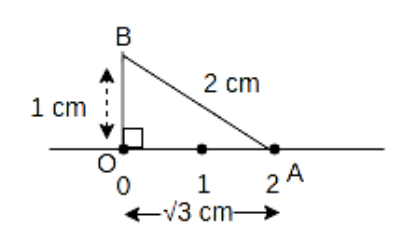
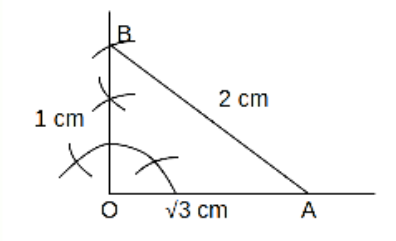
Construct a right angled $\triangle \mathrm{OAB}$, in which
Image

$\angle A=90^{\circ}, \text{OB}=2 \mathrm{~cm}$  and $\text{AB}=1 \mathrm{~cm}$
Using $\text{OA}^2+\text{AB}^2=\text{OB}^2$
we get: $\text{OA}=\sqrt{3} \mathrm{~cm}$
Image
View full question & answer
Question 23 Marks
Show that the product of a non$-$zero rational number and an irrational number is an irrational number.
Answer
Let $\mathrm{x}$ is an irrational number and $\mathrm{y}$ is non zero rational number.
Let us assume that $\text{xy}$ is rational.
Since $y$ is rational then $y=\frac{a}{b}$ where $a$ and $b$ are integers and $b \neq 0$
Since $\mathrm{x}$ is irrational so $\mathrm{x}$ can be written as fraction form.
$\because \mathrm{xy}$ is rational. Let $\mathrm{xy}=\frac{\mathrm{c}}{\mathrm{d}}$ where $\mathrm{c}$ and dare integers and
$ \Rightarrow x \times \frac{\mathrm{a}}{\mathrm{b}}=\frac{\mathrm{c}}{\mathrm{d}}$
$ \Rightarrow x=\frac{\mathrm{c}}{\mathrm{d}} \times \frac{\mathrm{a}}{\mathrm{b}}=\frac{\mathrm{ac}}{\mathrm{bd}}$
Since $a, b, c$ and $d$ are integers so $\text{ac}$ and $\text{bd}$ are also integers and $\text{bd}$
$\neq 0$
$\Rightarrow \mathrm{x}$ is rational number.
It contradicts our assumptions.
The product of $x$ and $y$ is irratioanl.
View full question & answer
Question 33 Marks
Simplify$:\frac{\sqrt{x^2+y^2}-y}{x-\sqrt{x^2-y^2}} \div \frac{\sqrt{x^2-y^2}+x}{\sqrt{x^2+y^2}+y}$
Answer
$\frac{\sqrt{x^2+y^2}-y}{x-\sqrt{x^2-y^2}} \div \frac{\sqrt{x^2-y^2}+x}{\sqrt{x^2+y^2}+y}$
$\Rightarrow \frac{\sqrt{x^2+y^2}-y}{x-\sqrt{x^2-y^2}} \times \frac{\sqrt{x^2+y^2}+y}{\sqrt{x^2-y^2}+x}$
$\Rightarrow \frac{\left(\sqrt{x^2+y^2}-y\right)\left(\sqrt{x^2+y^2}+y\right)}{\left(x-\sqrt{x^2-y^2}\right)\left(x+\sqrt{x^2-y^2}\right)}$
$\Rightarrow \frac{\left(\sqrt{x^2+y^2}\right)^2-y^2}{x^2-\left(\sqrt{x^2-y^2}\right)^2}$
$\Rightarrow \frac{x^2+y^2-y^2}{x^2-\not x^2+y^2}$
$\Rightarrow \frac{x^2}{y^2}$
View full question & answer
Question 43 Marks
Show that$: x^2+\frac{1}{x^2}=34$, if $\mathrm{x}=3+2 \sqrt{2}$
Answer
Given: $x=3+2 \sqrt{2}$
$\frac{1}{x}=\frac{1}{3+2 \sqrt{2}} \times \frac{3-2 \sqrt{2}}{3-2 \sqrt{2}}$
$\frac{1}{x}=\frac{3-2 \sqrt{2}}{(3)^2-(2 \sqrt{2})^2}$
$\frac{1}{x}=\frac{3-2 \sqrt{2}}{9-8}$
$\frac{1}{x}=3-2 \sqrt{2}$
Now, $x+\frac{1}{x}=3+2 \sqrt{2}+3-2 \sqrt{2}$
$x+\frac{1}{x}=6$
Squaring on both sides
$\left(x+\frac{1}{x}\right)^2=(6)^2$
$\Rightarrow x^2+\frac{1}{x^2}+2 \times \not x^{\prime} \times \frac{1}{\not x}=36$
$=x^2+\frac{1}{x^2}=36-2$
$=x^2+\frac{1}{x^2}=34$
View full question & answer
Question 53 Marks
Show that: $\frac{3 \sqrt{2}-2 \sqrt{3}}{3 \sqrt{2}+2 \sqrt{3}}+\frac{2 \sqrt{3}}{\sqrt{3}-\sqrt{2}}=11$
Answer
$\frac{3 \sqrt{2}-2 \sqrt{3}}{3 \sqrt{2}+2 \sqrt{3}}+\frac{2 \sqrt{3}}{\sqrt{3}-\sqrt{2}}$
$\Rightarrow \frac{3 \sqrt{2}-2 \sqrt{3}}{3 \sqrt{2}+2 \sqrt{3}} \times \frac{3 \sqrt{2}-2 \sqrt{3}}{3 \sqrt{2}-2 \sqrt{3}}+\frac{2 \sqrt{3}}{\sqrt{3}-\sqrt{2}} \times \frac{\sqrt{3}+\sqrt{2}}{\sqrt{3}+\sqrt{2}}$
$\Rightarrow \frac{(3 \sqrt{2}-2 \sqrt{3})^2}{(3 \sqrt{2})^2-(2 \sqrt{3})^2}+\frac{2 \sqrt{3}(\sqrt{3}+\sqrt{2})}{(\sqrt{3})^2-(\sqrt{2})^2}$
$\Rightarrow \frac{(3 \sqrt{2})^2+(2 \sqrt{3})^2-2 \times 3 \sqrt{2} \times 2 \sqrt{3}}{(9 \times 2)-(4 \times 3)}+\frac{6+2 \sqrt{6}}{3-2}$
$\Rightarrow \frac{18+12-12 \sqrt{6}}{18-12}+6+2 \sqrt{6}$
$\Rightarrow \frac{30-12 \sqrt{6}}{6}+6+2 \sqrt{6}$
$\Rightarrow \frac{6(5-2 \sqrt{6})}{\not 0}+6+2 \sqrt{6}$
$\Rightarrow 5-2 \sqrt{6}+6+2 \sqrt{6}$
$=5+6$
$=11$
View full question & answer
Question 63 Marks
If $m=\frac{1}{3-2 \sqrt{2}}$ and $n=\frac{1}{3+2 \sqrt{2}}$, find $n^2$
Answer
$ n=\frac{1}{3+2 \sqrt{2}}$
$ n=\frac{1}{3+2 \sqrt{2}} \times \frac{3-2 \sqrt{2}}{3-2 \sqrt{2}}$
$ n=\frac{3-2 \sqrt{2}}{(3)^2-(2 \sqrt{2})^2}$
$ n=\frac{3+2 \sqrt{2}}{9-8}$
$ n=3-2 \sqrt{2}$
$ \Rightarrow \mathrm{n}^2=(3-2 \sqrt{2})^2$
$ =(3)^2-2 \times 3 \times 2 \sqrt{2 } +(2 \sqrt{2 } )^2$
$ =9-12 \sqrt{2 } +8$
$ =17-12 \sqrt{2 } $
$ $
View full question & answer
Question 73 Marks
If $m=\frac{1}{3-2 \sqrt{2}}$ and $n=\frac{1}{3+2 \sqrt{2}}$, find $m^2$
Answer
$ m=\frac{1}{3-2 \sqrt{2}}$
$ m=\frac{1}{3-2 \sqrt{2}} \times \frac{3+2 \sqrt{2}}{3+2 \sqrt{2}}$
$ m=\frac{3+2 \sqrt{2}}{(3)^2-(2 \sqrt{2})^2}$
$ m=\frac{3+2 \sqrt{2}}{9-8}$
$ m=3+2 \sqrt{2}$
$ \Rightarrow m^2 =(3+2 \sqrt{2} )^2$
$ =(3)^2+2 \times 3 \times 2 \sqrt{2} +(2 \sqrt{2 } )^2$
$ =9+12 \sqrt{2} +8$
$ =17+12 \sqrt{2}$
 
View full question & answer
Question 83 Marks
If $x=\frac{\sqrt{5}-2}{\sqrt{5}+2}$ and $y=\frac{\sqrt{5}+2}{\sqrt{5}-2} ;$ find $: y^2$
Answer
$ y^2=\left[\frac{\sqrt{5}+2}{\sqrt{5}-2}\right]^2=\frac{5+4+4 \sqrt{5}}{5+4-4 \sqrt{5}}=\frac{9+4 \sqrt{5}}{9-4 \sqrt{5}}$
$ =\frac{9+4 \sqrt{5}}{9-4 \sqrt{5}} \times \frac{9+4 \sqrt{5}}{9+4 \sqrt{5}}=\frac{(9+4 \sqrt{5})^2}{(9)^2-(4 \sqrt{5})^2}=\frac{81+80+72 \sqrt{5}}{81-80}$
$ =161+72 \sqrt{5}$
View full question & answer
Question 93 Marks
Rationalise the denominators of $: \frac{2 \sqrt{5} +3 \sqrt{2} }{2 \sqrt{5} -3 \sqrt{2} }$
Answer
$ \frac{2 \sqrt{5} +3 \sqrt{2} }{2 \sqrt{5} -3 \sqrt{2} } \times \frac{2 \sqrt{5} +3 \sqrt{2} }{2 \sqrt{5} +3 \sqrt{2} }$
$ =\frac{(2 \sqrt{5}+3 \sqrt{2})^2}{(2 \sqrt{5})^2-(3 \sqrt{2})^2}$
$ =\frac{4 \times 5+9 \times 2+12 \sqrt{10}}{20-18}$
$ =\frac{20+18+12 \sqrt{10}}{2}$
$ =\frac{38+12 \sqrt{10}}{2}$
$ =\frac{2(19+6 \sqrt{10})}{2}$
$ =19+6 \sqrt{10} $
 
View full question & answer
Question 103 Marks
Evaluate : $\frac{4-\sqrt{5} }{4+\sqrt{5} }+\frac{4+\sqrt{5} }{4-\sqrt{5} }$
Answer
$ \frac{4-\sqrt{5}}{4+\sqrt{5 }}+\frac{4+\sqrt{5}}{4-\sqrt{5}}$
$ =\frac{4-\sqrt{5}}{4+\sqrt{5}} \times \frac{4-\sqrt{5}}{4-\sqrt{5}}+\frac{4+\sqrt{5}}{4-\sqrt{5}} \times \frac{4+\sqrt{5}}{4+\sqrt{5}}$
$ =\frac{(4-\sqrt{5})^2}{(4)^2-(\sqrt{5})^2}+\frac{(4+\sqrt{5})^2}{(4)^2-(\sqrt{5})^2}$
$ =\frac{16+5-8 \sqrt{5}}{16-5}+\frac{16+5+8 \sqrt{5}}{16-5}$
$ =\frac{21-8 \sqrt{5}}{11}+\frac{21+8 \sqrt{5}}{11}$
$ =\frac{21-8 \sqrt{5}+21+8 \sqrt{5 }}{11}$
$ =\frac{42}{11}=3 \frac{9}{11}$
View full question & answer
Question 113 Marks
Given universal set $=\left\{-6,-5 \frac{3}{4},-\sqrt{4},-\frac{3}{5},-\frac{3}{8}, 0, \frac{4}{5}, 1,1 \frac{2}{3}, \sqrt{8}, 3.01, \pi, 8.47\right\}$
From the given set, find : set of irrational numbers
Answer
Given universal set $=$
$\left\{-6,-5 \frac{3}{4},-\sqrt{4},-\frac{3}{5},-\frac{3}{8}, 0, \frac{4}{5}, 1,1 \frac{2}{3}, \sqrt{8}, 3.01, \pi, 8.47\right\}$
We need to find the set of irrational numbers.
Irrational numbers are numbers which are not rational. From the above subpart, the set of rational Numbers is $\mathrm{Q}$,
and $Q=\left\{-6,-5 \frac{3}{4},-\frac{3}{5},-\frac{3}{8}, 0, \frac{4}{5}, 1,1 \frac{2}{3}, 3.01,8.47\right\}$
Set of irrational numbers is the set of complement of the rational numbers over real numbers.
Here the set of irrational numbers is $U-Q=\{\sqrt{8}, \pi\} Z$
View full question & answer
Question 123 Marks
Write three rational numbers between $\sqrt{3}$ and $\sqrt{5}.$
Answer
Consider some rational numbers between $3$ and $5$ such that they are perfect squares.
Let us take, $3.24,3.61,4,4.41$ and $4.84$ as $\sqrt{3.24}$
$=1.8, \sqrt{3.61} =1.9, \sqrt{4}=2, \sqrt{4.41} =2.1$ and $\sqrt{4.84} =2.2$
Thus we have,
$\sqrt{3} <\sqrt{3.24 } <\sqrt{ 3.61} <\sqrt{ 4} <\sqrt{ 4.41}<\sqrt{4.84 } <\sqrt{ 5} $
$ \Rightarrow \sqrt{ 3} <1.8<1.9<2<2.1<2.2<\sqrt{ 5} $
$ \Rightarrow \sqrt{3 } <\frac{18}{10}<\frac{19}{10}<2<\frac{21}{10}<\frac{22}{10}<\sqrt{ 5}$
$ \Rightarrow \sqrt{3} <\frac{9}{5}<\frac{19}{10}<2<\frac{21}{10}<\frac{11}{5}<\sqrt{ 5}$
Therefore, any three rational numbers between $\sqrt{3 } $ and $\sqrt{5 } $ are :
$\frac{9}{5}, \frac{19}{10}$ and $\frac{21}{10}$
View full question & answer
Question 133 Marks
Write two rational numbers between $\sqrt{2}$ and $\sqrt{3}.$
Answer
We want rational numbers $\mathrm{a} / \mathrm{b}$ and $\mathrm{c} / \mathrm{d}$ such that
$: \sqrt{2}<\frac{a}{b}<\frac{c}{d}<\sqrt{3}$ Consider any two rational numbers between $2$ and $3$ such that they are perfect squares.
Let us take $2.25$ and $2.56$ as $\sqrt{2.25 } =1.5$ and $\sqrt{ 2.56} =1.6$
Thus we have,
$\sqrt{ 2}<\sqrt{ 2.25} <\sqrt{ 2.56} <\sqrt{3 } $
$ \Rightarrow \sqrt{ 2} <1.5<1.6<\sqrt{ 3} $
$\Rightarrow \sqrt{ 2}<\frac{15}{10}<\frac{16}{10}<\sqrt{3 } $
$ \Rightarrow \sqrt{ 2} <\frac{3}{2}<\frac{8}{5}<\sqrt{3 } $
Therefore any two rational numbers between $\sqrt{2 } $ and $\sqrt{3 } $ are :
$\frac{3}{2}$ and $\frac{8}{5}$
View full question & answer
Question 143 Marks
Compare :$ \sqrt[6]{15}$ and $\sqrt[4]{12}$
Answer
$\sqrt[6]{15}=(15)^{\frac{1}{6}}$ and $\sqrt[4]{12}=(12)^{\frac{1}{4}}$
Make powers $\frac{1}{6}$ and $\frac{1}{4}$ same
$\text{L.C.M.}$ of $6,4$ is $12$
$\frac{1}{6} \times \frac{2}{2}=\frac{2}{12}$ and $\frac{1}{4} \times \frac{3}{3}=\frac{3}{12}$
$\Rightarrow \sqrt[6]{15}=15^{\frac{1}{6}}=15^{\frac{2}{12}}=\left(15^2\right)^{\frac{1}{12}}=225^{\frac{1}{12}}$
and $\sqrt[4]{12}=12^{\frac{1}{4}}=12^{\frac{3}{12}}=\left(12^3\right)^{\frac{1}{12}}=(1728)^{\frac{1}{12}}$
$ \Rightarrow 1272>225$
$ \Rightarrow(1728)^{\frac{1}{12}}>225^{\frac{1}{12}}$
$ \Rightarrow \sqrt[4]{12}>\sqrt[6]{15}$
View full question & answer
Question 153 Marks
Are the following statement true or false ? Give reason for your answer.
  1. Every whole number is a natural number.
  2. Every whole number is a rational number.
  3. Every integer is a rational number.
  4. Every rational number is a whole number.
Answer
$(i)$ False, zero is a whole number but not a natural number.
$(ii)$ True, Every whole can be written in the form of, where $p$ and $q$ are integers and $\mathrm{q} \neq 0$.
$(iii)$ True, Every integer can be written in the form of, where $p$ and $q$ are integers and $q \neq 0$.
$(iv)$ False, Every rational number is may or may not be a whole number.
Let us consider some rational numbers,
$\frac{1}{4}, \frac{2}{4}, \frac{4}{4} \ldots \ldots$
If you consider
$\frac{4}{4}=1$
It is a whole number.
If you consider
$\frac{2}{4}=0.5$
It is not a whole number.
So, every rational number is may or may not be a whole number but every whole number is a rational number.
View full question & answer