Question 15 Marks
The cross section of a tunnel perpendicular to its length is a trapezium $\text{ABCD}$ as shown in the figure. $AM = BN; AB = 4.4\ m, CD = 3\ m$ The height of a tunnel is $2.4\ m$. The tunnel is $5.4\ m$ long.Calculate the cost of painting the internal surface of the tunnel $($excluding the floor$)$ at the rate of $Rs. 5$ per $m^2$.
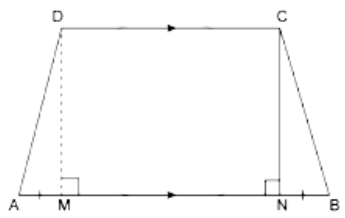
AnswerThe internal surface area will consist of faces formed by $1$ side as length and other sides as $A D, C D$ and $B C$.
$ AM =\frac{1}{2}( AB - CD )$
$=\frac{1}{2}(4.4-3)$
$AM =0.7 $
In $\triangle A M D$, by Pythagoras theorem,
$ A D^2=A M^2+D M^2$
$A D^2=(0.7)^2+(2.4)^2$
$A D=2.5\ m$
$A D=B C=2.5\ n $
Total surface area
$ =($length $\times A D)+($length $\times C D)+($length $\times B C)$
$=5.4(A D+C D+B C)$
$=5.4(2.5+3+2.5)$
$=43.2\ m ^2 $
Cost of painting
$ =43.2 \times 5$
$=R s, 216 $
$\therefore$ The cost of painting the internal surface is $Rs. 216 .$
View full question & answer→Question 25 Marks
The figure shows the cross section of $0.2\ m$ a concrete wall to be constructed. It is $0.2\ m$ wide at the top,$ 2.0\ m$ wide at the bottom and its height is $4.0\ m$, and its length is $40\ m.$ If the whole wall is to be painted, find the cost of painting it at $2.50$ per sq $m.$
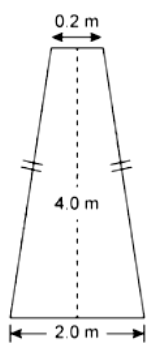
AnswerCost for painting will depend on the total surface area which includes $5$ faces $(2$ cross sectional, $2$ lateral rectangles and $1$ top face$)$
Area of $1$ cross section $= 4.4\ m^2 ....$from $(a)$
Area of $4$ cross section
$= 2 \times 4.4$
$= 8.8\ m^2$
To find the area of the rectangles, we need to first find length of side $PQ.$
$PQ = AQ - AP$
By applying Pythagoras theorems in $\triangle ABQ$ and $\triangle APD$
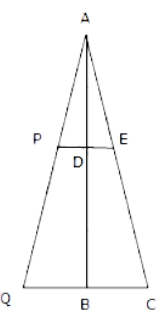
In $\triangle A B Q$
$A Q^2=A B^2+Q B^2$
$=\left(\frac{90}{9}\right)^2+1^2$
$=\frac{1600}{81}+1$
$=\sqrt{\frac{1681}{81}}$
$=\frac{41}{9}$
$AQ =4.56\ m$
In $\triangle A P D$,
$A P^2=A D^2+P D^2$
$=\left(\frac{4}{9}\right)^2+0.1^2$
$=\frac{16}{81}+0.01$
$=\sqrt{\frac{16.81}{81}}$
$=\frac{4.1}{9}$
$AP =0.46\ m$
$PQ = AQ - AP$
$=4.56-0.46$
$=4.1\ m$
Total surface area of $5$ faces
$=2 \times$ Area of cross section $+$ Area of $2$ lateral faces $+$ Area of top face
$=2 \times 4.4+2 \times P Q \times$ length $+0.2 \times 40$
$=8.8+328+8$
$=344.8\ m ^2$
Cost of painting
$=344.8 \times 2.50$
$=\text { Rs. } 862$
$\therefore$ The cost of painting the wall is $Rs.862.$ View full question & answer→Question 35 Marks
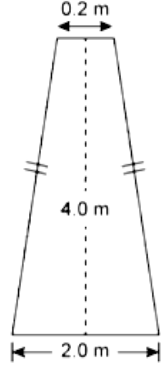
The figure shows the cross section of $0.2\ m$ a concrete wall to be constructed. It is $0.2\ m$ wide at the top, $2.0\ m$ wide at the bottom and its height is $4.0\ m$, and its length is $40\ m$. Calculate the cross sectional area
Answer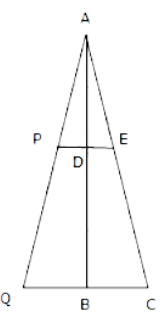
Complete the diagram as shown:
Ler $A D=x m$
$A B=A D+D B$
$=(x+4) m$
$B C=\frac{1}{2} \times Q C$
$=\frac{1}{2} \times 2$
$=1\ m$
$D E=\frac{1}{2} \times P E$
$=\frac{1}{2} \times 0.2$
$=0.1\ m$
In $\triangle A D E$ and $\triangle A B C$,
$\angle A D E=\angle A B C \ldots\left(90^{\circ}\right.$ each $)$
$\angle DAE -\angle BAC...($Common angle$)$
$\therefore \triangle ADE \sim \triangle ABC$ by $AA$ test
$\therefore \frac{ AD }{ AB }=\frac{ DE }{ BC } \ldots( \text{C.S.S.T.})$
$\frac{{ }^{ AB }}{x+4}=\frac{0.1}{1}$
$x+4$
$10 \times 10 \times 0.1$
$x+4 $
$\frac{10 x}{x+4}=\frac{10 \times 0.1}{1}...$Multiply by $10$ on both sides
$10 x = x +4$
$9 x=4$
$x =\frac{4}{9} m$
$\therefore AB =\frac{4}{9}+4$
$=\frac{40}{9} m$
Area of the cross section of the wall
$= A (\triangle AQC )- A (\triangle APE )$
$=\frac{1}{2} \times QC \times AB -\frac{1}{2} \times PE \times AD$
$=\frac{1}{2} \times 2 \times \frac{40}{9}-\frac{1}{2} \times 0.2 \times \frac{4}{9}$
$=\frac{40}{9}-\frac{0.4}{9}$
$=\frac{39.6}{9}$
$=4.4$
$\therefore$ The area of the cross section of the wall is $4.4 sq . m$. View full question & answer→Question 45 Marks
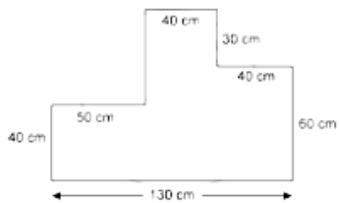
The given figure is a cross$-$section of a victory stand used in sports. All measurements are in centimetres. Assume all angles in the figure are right angles. If the width of the stand is $60 \ cm$, find The space it occupies in $cm^3.$
Answer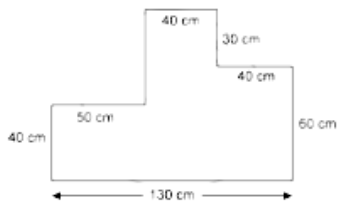
To find the volume, first find the area of the figure.
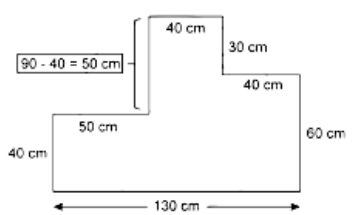
To find the area, we divide the figure into $3$ different rectangles.
Rectangle $1 ($left$):$
length$=50 \ cm$
width$=40 \ cm$
Area$=$length $\times$ width
$=50 \times 40$
$=2000\ cm ^2$
Rectangle $2 ($middle$):$
length$=(60+30) \ cm =90 \ cm$
width$=40\ cm$
Area $=$ length $\times$ width
$=90 \times 40$
$=3600 \ cm ^2$
Rectangle $3 ($right$):$
length$=60 \ cm$
width$=40 \ cm$
Area$=$length $\times$ width
$=60 \times 40$
$=2400 \ cm ^2$
Total area
$=2000+3600+2400$
$=8000 \ cm ^2$
Total area
$=2000+3600+2400$
$=8000 \ cm ^2$
Volume $=$ Total area $\times$ length
$=8000 \times 60$
$=4,80,000 \ cm ^3$
$\therefore$ The space occupied is $4,80,000 \ cm ^3$
View full question & answer→Question 55 Marks
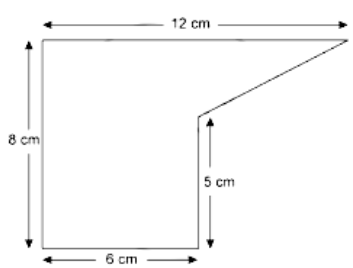
The cross section of a piece of metal $2\ m$ in length is shown. Calculate the area of cross section.
Answer
Divide the figure into $1$ rectangle and $1$ triangle.
Dimensions of the rectangle:
length$=8 \ cm$
breadth$=6 \ cm$
Area of rectangle
$=$length$ \times$ breadth
$=8 \times 6$
$=48 \ cm ^2$
Dimensions of the triangle:
base
$=12-6$
$=6 \ cm$
height
$=8-5$
$=3 \ cm$
Area of a triangle
$=\frac{1}{2} \times b \times h$
$=\frac{1}{2} \times 6 \times 3$
$=9 \ cm ^2$
Area of the cross section
$=48+9$
$=57 \ cm ^2$
$\therefore$ Area of the cross section is $57 \ cm ^2$. View full question & answer→Question 65 Marks
The total surface area of a cylinder is $3872 \ cm^2$. Find its height and volume if the circumference of the base is $88 \ cm .$
Answer$\text{T.S.A.}$ of cylinder $=3872 \ cm ^2$
Let $r$ and $h$ be the radius and height of the cylinder respectively.
Circumference of the base $=88 \ cm$
i.e. $2 \times \pi \times r=88$
$2 \times \frac{22}{7} \times r=88$
$r=\frac{88 \times 7}{44}$
$=14 \ cm$
$\text{T.S.A.}$ of cylinder $=3872 \ cm ^2$
$(2 \times \pi \times r \times h)+\left(2 \times \pi \times r^2\right)=3872$
$\left(2 \times \frac{22}{7} \times 14 \times h\right)+\left(2 \times \frac{22}{7} \times 14^2\right)=3872$
$88 h+1232=3872$
$88 h =2640$
$h=\frac{2640}{88}$
$h =30 \ cm$
Thus,
Volume of cylinder
$=\pi \times r^2 \times h$
$=\frac{22}{7} \times 14^2 \times 30$
$=18480 \ cm ^3 .$
View full question & answer→Question 75 Marks
The total surface area of a cylinder is $264\ m^2$. Find its volume if its height is $5$ more than its radius.
AnswerLet $r$ be the radius of the cylinder.
Then, Height $(h)=5+r...............(1)$
Total surface area of cylinder $=264\ m ^2$
$(2 \times \pi \times r \times h)+\left(2 \times \pi \times r^2\right)=264$
$2 \pi r(h+r)=264$
$2 \pi r(5+r+r)=264 \ldots[$From $(1)]$
$r(5+2 r)=\frac{264}{2 \pi}$
$5 r+2 r^2=42$
$2 r^2+5 r-42=0$
$2 r^2+12 r-7 r-42=0$
$2 r(r+6)-7(r+6)=0$
$(2 r-7)(r+6)=0$
$\text { i.e. }(2 r-7)=0$ or $(r+6)=0$
$2 r=7$ or $r=-6$
$r=\frac{7}{2}$
$r=3.5\ m$
Since, radius of a cylinder cannot be negative, we take the value of $r=3.5\ m$
$\therefore$ Height $(h)$
$=5+3.5$
$=8.5\ m$
Volume
$=\pi \times r^2 \times h$
$=\frac{22}{7} \times 3.5^2 \times 8.5$
$=327.25\ m ^3 .$
View full question & answer→Question 85 Marks
The sum of the height and the radius of a cylinder is $28\ cm$ and its total surface area is $616\ cm^2,$ find the volume of the cylinder.
AnswerLet height $= h$
radius $= r$
$h + r =28 \ cm \ldots($given$)$
$\therefore h =28- rcm $
Total surface area of cylinder
$ =2 \pi r h+2 \pi r^2$
$2 \pi r(28-r)+2 \pi r^2=616$
$56 \pi r-2 \pi r^2+2 \pi r^2=616$
$56 \pi r=616$
$r=\frac{616}{56 \pi}$
$r=3.5 \ cm$
$h=28-r$
$=28-3.5$
$=24.5 \ cm$
Volume of cylinder
$=\pi r^2 h$
$=\pi(3.5)^2 \times 24.5$
$=943 \ cm ^3$
$\therefore$ Volume of cylinder is $943 \ cm ^3$.
View full question & answer→Question 95 Marks
The difference between the outer and inner curved surface area of a hollow cylinder is $264 \ cm^2$. If its height is $14 \ cm$ and the volume of the material in it is $1980 \ cm^3$, find its total surface area.
AnswerCurved surface area of cylinder $=\pi r^2 h$
Height $h =14 \ cm$
The difference between the outer and inner curved surface area $=264 \ cm ^2$
$ 2 \pi \times\left\{\left(R_{\text {outer }}\right)-\left(R_{\text {in }}\right)\right\} \times h=264 \ cm ^2$
$\Rightarrow \pi \times\left\{\left(R_{\text {outer }}\right)-\left(R_{\text {in }}\right)\right\} \times h=132 . $
Volume of material in cylinder $=1980 \ cm ^3$
$ \pi\left\{\left(R_{\text {outer }}\right)^2-\left(R_{\text {in }}\right)^2\right\} \times h=1980$
$\pi\left\{\left(R_{\text {ouer }}\right)-\left(R_{\text {in }}\right)\left\{\left(R_{\text {outer }}+\left(R_{\text {in }}\right)\right\} \times h=1980\right.\right. $
Substituting $(1)$ in $(2)$, we get
$ \left\{\left(R_{\text {outer }}+\left(R_{\text {in }}\right)\right\} \times 132=1980\right.$
$\therefore\left\{\left(R_{\text {outer }}+R_{\text {in }}\right)\right\}=15 \ cm $
Total surface area of a hollow cylinder
$ =2 \pi\left\{\left(R_{\text {outer }}+R_{\text {in }}\right)\right\} \times h+2 \pi\left\{\left(R_{\text {outer }}\right)^2-\left(R_{\text {in }}\right)^2\right\}$
$=2 \pi \times 15 \times 14+2 \times \frac{1980}{14}$
$=1602 \ cm ^2 $
$\therefore$ The total surface area of the hollow cylinder is $1602 \ cm ^2$.
View full question & answer→Question 105 Marks
A cylindrical water tank has a diameter $4\ m$ and is $6\ m$ high. Water is flowing into it from a cylindrical pipe of diameter $4 \ cm$ at the rate of $10 m/s$. In how much time the tank will be filled?
AnswerFor the cylindrical tank:
diameter $=4\ m$
radius
$=2\ m$
$=200\ m$
Height
$=6\ m$
$=600 \ cm$
Volume of the cylindrical tank
$=\pi^2 h$
$=\pi(200)^2 \times 600$
$=2400000 \pi \ cm ^3$
For the cylindrical pipe:
diameter $=4 \ cm$
radius $=2 \ cm$
rate of flow water
$=10\ m / s$
$=100 \ cm / s$
Volume of water flown in $1 sec$
$=$ area of base $x$ rate of flow of water
$=\pi \times 2^2 \times 1000$
$=4000 \pi \ cm ^3$
$\therefore$ Time takken to fill the tank
$=\frac{24000000 \pi}{4000 \pi}$
$=\frac{24000}{4}$
$=6000 s$
$=\frac{6000}{60} mins$
$=100$ minutes
$\therefore$ The time taken to fill the tank is $100$ mins.
View full question & answer→Question 115 Marks
From a tap of inner radius $0.80\ cm,$ water flows at the rate of $7\ m/s.$ Find the volume in litres of water delivered by the pipe in $75$ minutes.
AnswerInner radius of tap$=0.8 \ cm$
Circular area
$=\pi R^2$
$=\pi(0.8)^2$
$=0.64 \pi \ cm ^2 $
Rate of water flow
$=7\ m / s$
$=700 \ cm / s$
Volume of water flowing out of the tap in one second $=$
rate of flowing of water $x$ circular ara of tap.
$=700 \times 0.64 \pi $
$=700 \times 0.64 \times 3.142$
$=1408 \ cm ^3$
So volume of water flowing out in $75$ minutes i.e. $75 \times 60\ s$
$=1408 \times 75 \times 60 \ cm ^3$
$=6336000 \ cm ^3$
$=\frac{63336000}{1000}$ litres
$=6336$ litres
$\therefore$ Volume of water delivered by the pipe is $6336$ litres.
View full question & answer→Question 125 Marks
The radius of a solid cylinder decreases by $10\%$ and its height increases by $20\ \%.$ Find the change in percentage of its volume and curved surface area
AnswerInitial values:
radius $=r$
height $= h$
Volume $\left(V_1\right)=\pi r^2 h$
Curved surface area $\left(C_1\right)=2 \pi r h$
New values after change:
radius
$=r-10 \%$ of $r$
$=r-0.1 r$
$=0.9 r$
height
$=h+20 \%$ of $h$
$= h +0.2 h$
$=1.2 h$
Volume $\left(V_2\right)$
$=\pi(0.9 r )^2 \times 1.2 h$
$=0.972 \pi r^2 h$
Curved surface area $\left(C_2\right)$
$=2 \pi(0.9 r)(1.2 h)$
$=2 \pi rh (1.08)$
Change in perenctage of Volume
$=\frac{\left(V _1- V _2\right)}{ V _1} \times 100 $
$=\frac{\left(\pi r ^2 h -0.972 \pi r ^2 h \right)}{\pi r ^2 h } \times 100 $
$=\frac{\pi r ^2 h (1-0.972)}{\pi r ^2 h } \times 100 $
$=0.028 \times 100 $
$=2.8 \%$
The positive value indicates that $V_1$ is greater than $V_2\left(V_1-V_2\right)$, which indicates that there is a decrease in volume by $2.8 \%...($Ans $1)$
Change in the percentage of the
Curved surface area
$=\frac{\left( C _1- C _2\right)}{ C _1} \times 100 $
$=\frac{(2 \pi rh -2 \pi rh \times 1.08)}{2 \pi rh } \times 100 $
$=\frac{2 \pi rh (1-1.08)}{2 \pi rh } \times 100 $
$=-0.08 \times 100$
$=8 \% \ldots($negative sign indicates that $C_1$ is smaller than $C_2)$
$\Rightarrow$ There is an $8 \%$ increase in the curved surface area$....($Ans $2)$
View full question & answer→Question 135 Marks
A well with $14\ m$ diameter is dug $21\ m$ deep. The earth taken out of it has been evenly spread all around it to a width of $14\ m$ to form an embankment. Find the height of the embankment.
AnswerThe shape of the well will be cylindrical.
Depth $\left(h_1\right)$ of well $=21\ m$
Diameter of the well $=14\ m$
Radius $\left(r_2\right)$ of well $=14\ m$
Width of embankment $\left(r_2\right)$
$=7\ m +14\ m$
$=21\ m$
Let height of the embankment be $h_2$
Volume of earth spread on the embankment
$=\pi h _2\left(r_2^2-r_1{ }^2\right)$
$=r h_2\left(r_2+r_1\right)\left(r_2-r_1\right)$
$=\frac{22}{7} \times h_2 \times 28 \times 14$
$=1232\ h_2 $
Volume of soil dug from well $=$ Volume of earth used to form embankment
i.e. $\pi \times r_1^2 \times h_1=\pi h_2\left(r_2^2-r_1^2\right)$
$\frac{22}{7} \times 7^2 \times 21=1232 h_2$
$h_2=\frac{3234}{1232}=2.625$
$=2.625\ m $
$\therefore$ Height of the embankment $=2.625\ m$.
View full question & answer→Question 145 Marks
How many cubic meters of earth must be dug out to sink a well $42\ m$ deep and $14\ m$ in diameter? Find the cost of plastering the inside walls of the well at $Rs.15$ per $m^2.$
AnswerDepth or height $(h)$ of cylindrical well $=42\ m$
Diameter $=14\ m$
$\therefore$ Radius $( r )=7\ m$
Volume of the well
$=\pi \times r^2 \times h$
$=\frac{22}{7} \times 7^2 \times 42$
$=6468\ m^3 $
Curved surface area of walls
$ =2 \times \pi \times r \times h$
$=2 \times \frac{22}{7} \times 7 \times 42$
$=1848\ m ^2 $
Cost of plastering $1\ m ^2$ area of the well $= Rs .15$
$\therefore$ Cost of plastering $1848\ m ^2$ area of wall
$ =\text { Rs. } 15 \times 1848$
$=\text { Rs. } 27,720 .$
View full question & answer→Question 155 Marks
A cylinder has a diameter $20 \ cm$ . The area of the curved surface is $1100 \ cm^2$. Find the height and volume of the cylinder.
AnswerDiameter of cylinder$=20 \ cm$
$\therefore$ Radius$(r)$
$=\frac{20}{2}$
$=10 \ cm $
Let $h$ be the height of the cylinder
Area of curved surface $=1100 \ cm ^2$
i.e., $\text{L.S.A}$ of cylinder $=1100 \ cm ^2$
$ 2 \times \pi \times r \times h=1100 \ldots[\because \text { L.S.A}$ of cylinder $=2 \times \pi \times r \times h]$
$2 \times \frac{22}{7} \times 10 \times h=1100$
$\frac{400}{7} h =1100$
$h =\frac{1100 \times 7}{440}$
$h =\frac{70}{4}$
$=17.5 \ cm $
Thus,
Volume of cylinder
$ =\pi \times r ^2 \times h$
$=\frac{22}{7} \times 10^2 \times 17.5$
$=5500 \ cm ^3 $
View full question & answer→Question 165 Marks
A rectangular strip $36\ cm \times 22\ cm$ is rotated about the longer side. Find the volume and the total surface area of the cylinder formed.
AnswerDimensions of rectangular strip $=36 \ cm \times 22 \ cm$
The rectangular strip is rotated about its length to form a cylinder, thus the length and breadth of the sheet will be equal to circumference and height $(h)$ of the cylinder respectively.
Let $r$ be the radius of the cylinder.
Circumference of cylinder $=36 \ cm$
$2 \times \pi \times r =36 \ cm............(1)$
$ r=\frac{36}{2 \pi}$
$r=\frac{18}{\pi} \ cm $
thus,
Volume of the cylinder so formed
$ =\pi \times r^2 \times h$
$=\pi \times\left(\frac{18}{\pi}\right)^2 \times 22$
$=18^2 \times 7$
$=2268 \ cm ^3 $
Now,
$\text{T.S.A.}$ of cylinder
$ =(2 \times \pi \times r \times h)+(2 \times \pi \times r \times r)$
$=(36 \times 22)+\left(36 \times \frac{18}{\pi}\right) \ldots[$from $(1)]$
$=792+206.18$
$=998.18 \ cm ^2 . $
View full question & answer→Question 175 Marks
Find the ratio of the volumes of the two cylinders formed by rolling an iron sheet $2.2\ m \times 1\ m$ ether along its length or by rolling along its breadth.
AnswerDimensions of iron sheet $=2.2\ m \times 1.5\ m$
Let the iron sheet be rolled along its length to form a cylinder, thus the length and breadth of the sheet will be equal to circumference and height $(h)$ of the cylinder respectively.
Let $r$ be the radius of the cylinder
Circumference cylinder $=2.2\ m$
$2 \times \pi \times r=2.2$
$r=\frac{2.2}{2 \pi}$
$r=\frac{1.1}{\pi}\ m$
Thus,
Volume of the cylinder so formed
$=\pi \times r ^2 \times h$
$=\pi \times\left(\frac{131}{\pi}\right)^2 \times 1.5$
$=\frac{1.815}{\pi} m ^3...........(1)$
Now, $_1$
Let the iron sheet be rolled along its breadth to form a cylinder, thus the length and breadth of the sheet will be equal to height $(H)$ and circumference of the cylinder respectively.
Let $R$ be the radius of the cylinder.
Circumference of cylinder $=1.5\ m$
$2 \times \pi \times R=1.5$
$R=\frac{1.5}{2 \pi}$
$R=\frac{0.75}{\pi} m$
thus,
Volume of the cylinder so formed
$=\pi \times R^2 \times H$
$=\pi \times\left(\frac{0.75}{\pi}\right)^2 \times 2.2$
$=\frac{1.2375}{\pi}m ^2...............(1)$
$\therefore$ Ratio of volumes of two cylinders
$=\frac{(1)}{(2)}$
$=\frac{1.815}{1.2375} \times \frac{10,000}{10,000}$
$=\frac{18150}{12375}$
$=22: 15 .$
View full question & answer→Question 185 Marks
A rectangular metal sheet $36\ cm \times 20\ cm$ can be formed into a right circular cylinder, either by rolling its length or by rolling along its breadth. Find the ratio of the volumes of the two cylinders thus formed.
AnswerDimensions of rectangle $=36 \ cm \times 20 \ cm$
Let the rectangle be rolled along its length to form a cylinder, thus the length and breadth of the rectangle will be equal to circumference and height $(h)$ of the cylinder respectively.
Let $r$ be the radius of the cylinder.
Circumference of cylinder $=36 \ cm$
$2 \times \pi \times r=36$
$r=\frac{36}{2 \pi}$
$r =\frac{18}{\pi} \ cm$
thus,
Volume of the cylinder so formed
$=\pi \times r^2 \times h$
$=\pi \times\left(\frac{18}{\pi}\right)^2 \times 20$
$=\frac{6480}{\pi} \ cm ^3.......................(1)$
Now,
Let the rectangular be rolled along its breadth to form a cylinder, thus the length and breadth of the rectangle will be equal to height $(H)$ and circumference of the cylinder respectively.
Let $R$ be the radius of the cylinder.
Circumference of cylinder $=20 \ cm$
$2 \times \pi \times R=20$
$R=\frac{20}{2 \pi}$
$R=\frac{10}{\pi} \ cm$
thus,
Volume of the cylinder so formed
$=\pi \times R^2 \times H$
$=\pi \times\left(\frac{10}{\pi}\right)^2 \times 36$
$=\frac{3600}{\pi} \ cm ^3..............(1)$
$\therefore$ Ratio of volumes of two cylinders
$=\frac{(1)}{(2)}$
$=\frac{6480}{3600}$
$=9: 5 .$
View full question & answer→Question 195 Marks
A hollow garden roller, $1\ m$ wide with outside diameter of $30 \ cm$, is made of $2 \ cm$ thick iron. Find the volume of the iron. If the roller rolls without sliding for $6$ seconds at the rate of $8$ complete rounds per second, find the distance travelled and the area covered by the roller in $6$ seconds.
AnswerOuter dameter of roller $=30 \ cm$
Outer radius$=\frac{30}{2}$
$=15 \ cm$
Thickness of iron $=2 \ cm$
Length of roller $=1\ m$
$=100 \ cm$
Inner radius
$=$Outer radius$-$ Thickness
$=13 \ cm$
Volume of iron
$=\pi\left\{\left(r_{\text {outer }}\right) 2-\left(r_{\text {inner }}\right) 2\right\} \times h$
$=\left\{(15)^2-(13)^2\right\} \times 100$
$=17600 \ cm ^3$
$\therefore$ The volume of the iron is $17600 \ cm ....($Ans $1)$
The roller travels $8$ round in $1$ second,
$\therefore$ Total round made in $6$ seconds
$=6 \times 8$
$=48$
In one round, distance travelled by roller
$=$ Circumference of the curved surface
$\therefore$ Distance travelled in 6 seconds
$=$ Circumference $x 48$
$=2 \pi r_{\text {outer }} \times 48$
$=4.52 m$
$\therefore$ Distance travelled in $6$ seconds is $4.52\ m. ...($Ans $2)$
Area covered in $6$ second $=$ Distance travelled $x\times$ Width
Area covered
$=4.52 \times 1$
$=4.52 m ^2$
$\therefore$ The area covered by the roller in $6$ seconds is $4.52\ m ^2 . .. ($Ans $3)$
View full question & answer→Question 205 Marks
Find the length of a solid cylinder of diameter $4 \ cm$ when recast into a hollow cylinder of outer diameter $10 \ cm$, thickness $0.25 \ cm$ and length $21 \ cm$? Give your answer correct to two decimal places.
AnswerFor the solid cylinder:
diameter $=4 \ cm$
radius $=2 \ cm$
Let its length be $I.$
Volume of solid cylinder
$=\pi r^2$
$=\pi 2^2$
$=4 \pi \ cm ^3$
For the hollow cylinder:
Outer diameter $=10 \ cm$
Outer radius $(R)=5 \ cm$
Inner radius $(r)=R -$ thickness
$r =5-0.25$
$r =4.75 \ cm$
Volume of the hollow cylinder
$=\pi R^2 h-\pi r^2 h$
$=\pi h\left(5^2-4.75^2\right)$
$=\pi \times 21(25-22.5625)$
$=51.1875 \pi \ cm ^3$
Since the solid cylinder is recast into a hollow cylinder,
Volume of solid cylinder
$=$ Volume of material in the hollow cylinder
$4 \pi =51.1875 \pi$
$I=\frac{51.1875 \pi}{4 \pi}$
$I =12.80 \ cm$
$\therefore$ The length of the solid cylinder is $12.80 \ cm$.
View full question & answer→Question 215 Marks
The volume of a cylinder of height $8 \ cm$ is $392 \pi \ cm^3$. Find its lateral surface area and its total surface area.
AnswerHeight $(h)=8 \ cm$
Let $r$ be the radius of the cylinder.
Volume of cylinder $=392 \pi \ cm ^3$
i.e.,$\pi r^2 h=392 \pi$
$r^2 \times 8=392$
$r^2=49$
$r=\sqrt{49}$
$r=7 \ cm$
Now,
$\text { L.S.A.}$ of cylinder
$=2 \times \pi \times rh$
$=2 \times \frac{22}{7} \times 7 \times 8$
$=352 \ cm ^2$
$\text{T.S.A.}$ of cylinder
$=(2 \times \pi \times r \times h)+\left(2 \times \pi \times r^2\right)$
$=\left(2 \times \frac{22}{7} \times 7 \times 8\right)+\left(2 \times \frac{22}{7} \times 7^2\right)$
$=352+308$
$=660 \ cm ^2 .$
View full question & answer→Question 225 Marks
Find the lateral surface area, total surface area and the volume of the following cylinders: Radius $= 4.2\ cm,$ Height $= 12\ cm$
AnswerGiven that:
Radius $(r)=4.2 \ cm$
Height $(h)=12 \ cm$
We know that:
Lateral surface Area $(\text{L.S.A})$ of cylinder $=2 \times \pi \times r \times h$
Total surface Area $(\text{T.S.A})$ of cylinder $=(2 \times \pi \times r \times h)+\left(2 \times \pi \times r^2\right)$
Volume of cylinder $=\pi \times r^2 \times h$
$\text{L.S.A}$ of cylinder
$=2 \times \pi \times r \times h$
$=2 \times \frac{22}{7} \times 4.2 \times 12$
$=316.8 \ cm ^2$
$\text{T.S.A}$ of cylinder
$=(2 \times \pi \times t \times h)+\left(2 \times \pi \times r^2\right)$
$=\left(2 \times \frac{22}{7} \times 4.2 \times 12\right)+\left(2 \times \frac{22}{7} \times 4.2^2\right)$
$=316.8+110.88$
$=427.68 \ cm ^2$
Volume of cylinder
$=\pi \times r ^2 \times h$
$=\frac{22}{7} \times 4.2^2 \times 12$
$=665.28 \ cm ^3 .$
View full question & answer→Question 235 Marks
The total surface area of a cuboid is $46\ m^2$. If its height is 1m and breadth $3\ m$, find its length and volume.
AnswerGiven that:
$\text{T.S.A.}$ of a cuboid $=46\ m ^2$
Height $=1\ m$
Breadth $=3\ m$
Let the length of cuboid $=1\ m$
We know that:-
$\text{T.S.A.}$ of cuboid $=2 \times\{(l \times b)+(b \times h)+(h \times l)\}$
On comparing $(1) \ (2)$ we get,
$2 \times\{(l \times b)+(b \times h)+(h \times l)\}=46$
$2 \times\{(l \times 3)+(3 \times 1)+(1 \times l)\}=46$
$2 \times\{3+3+l\}=46$
$2 \times\{4 l+3\}=46$
$81+6=46$
$81=46-6$
$81=40$
$I=\frac{40}{8}$
$I=5\ m$
$\therefore$ Length $(I)=5\ m$
Now,
Volume of cuboid
$=1 \times b \times h$
$=5 \times 3 \times 1$
$=15\ m ^3 .$
View full question & answer→Question 245 Marks
Find the volume of a cuboid whose diagonal is $3 \sqrt{29} \ cm$ when its length, breadth and height are in the ratio $2: 3: 4$.
AnswerGiven that:
Diagonal of cuboid $=3 \sqrt{29} \ cm$.
Ratio of Length, breadth $\ $ height $=2: 3: 4$
$\therefore$ Length$ (l)=2 x$
Breadth $(b)=3 x \ $
Height$(h)=4 x $
We know that:
Diagonal of cuboid
$ =\sqrt{1^2+ b ^2+ h ^2}$
$=\sqrt{(2 x)^2+(3 x)^2+(4 x)^2}$
$=\sqrt{4 x^2+9 x^2+16 x^2}$
$=\sqrt{29 x^2}$
$=x \sqrt{29} $
Also,
$x \sqrt{29}=3 \sqrt{29}...[$From $(1)]$
i.e.,$x=\frac{3 \sqrt{29}}{\sqrt{29}}$
$\therefore x =3 \ cm$
Thus,
Length$=2 \times 3=6 \ cm$
Breadth$=3 \times 3=9 \ cm$
Height$=4 \times 3=12 \ cm $
$\therefore$ Volume of cuboid
$ =1 \times b \times h$
$=6 \times 9 \times 12$
$=54 \times 12$
$=648 \ cm ^3 . $
View full question & answer→Question 255 Marks
A metallic sheet is of the rectangular shape with dimensions $48\ cm \times 36\ cm$. From each one of its corners, a square of $8\ cm$ is cutoff. An open box is made of the remaining sheet. Find the volume of the box.
AnswerGiven that
Dimensions of metallic sheet:
Length $(l)=48 \ cm$
Breadth (b) $=36 \ cm$
Side $(S)$ of each square $=8 \ cm$.
Now,
Area of metallic sheet
$ =1 \times b$
$=48 \times 36$
$=1728 \ cm ^2 $
Area of $1$ square
$ =S \times S$
$=8 \times 8$
$=64 \ cm ^2 $
$\therefore$ Area of $4$ square
$ =64 \times 4$
$=256 \ cm ^2 $
Thus, remaining area in the sheet after reducing the area of $4$ squares:
Remaining area
$ =1728-256$
$=1472 \ cm ^2 \ldots ........(1) $
Since $8 \ cm$ square is cut off from all sides, we get the dimensions of open box as:
Length $(I)=48-16=32 \ cm$
Breadth $(b)=36-16=20 \ cm$
Area of the box $= \text{L.S.A}$ of the box $+$ area of base of the box
$ 1472=\{2 \times h \times(l+b)\}+(l \times b) \ldots[$From $(1)]$
$1472=\{2 \times h \times(32+20)\}+(32 \times 20)$
$1472=\{2 h \times 52\}+640$
$1472=104 h+640$
$104 h=1472-640$
$h=\frac{832}{104} $
i.e., height $(h)=8 \ cm$
Thus,
volume of the box
$ =1 \times b \times h$
$=32 \times 20 \times 8$
$=5120 \ cm ^3 $
View full question & answer→Question 265 Marks
Find the volume of wood used in making a closed box $22 \ cm$ by $18 \ cm$ by $14 \ cm$, using a $1 \ cm$ thick wood. Also, find the cost of wood required to make the box at the rate of $Rs. 5$ per $cm^3$ How many cubes of side $2 \ cm$ can be placed in the box?
AnswerThickness of the closed box $=1 \ cm$
External Dimensions are:
$I =22 \ cm$
$b =18 \ cm$
$h =14 \ cm$
Internal dimensions $=$ External dimensions $- 2($thickness$)$
Internal dimensions are:
$I=20 \ cm$
$b =16 \ cm$
$h =12 \ cm$
Volume of wood used in making the box
$=$ Volume of External cuboid $-$ Volume of Internal cuboid
$=(22 \times 18 \times 14)-(20 \times 16 \times 12)$
$=5544-3840$
$=1704 \ cm ^3$
$\therefore$ The volume of the wood used in making the box is $1704 \ cm ^3. ...($Ans $1)$
The cost of the wood required to make the box at the rate of $Rs .5$ per $cm ^3$
$=5 \times 1704$
$= Rs. 8520 ...($Ans $2)$
Side of the cube $=2 \ cm$
$\therefore$ Volume of the cube $=8 \ cm ^3$
Volume of the box from inside $=$ Volume of internal cuboid
$=20 \times 16 \times 12$
$=3840 \ cm ^3$
$\therefore$ The no. of cubes that can fit inside the box
$=\frac{\text { Volume of internal cuboid }}{\text { Volume of each small cube }}$
$=\frac{3840}{8}$
$=480$ cubes. $\ldots ($Ans $3)$
View full question & answer→Question 275 Marks
A class room is $7\ m$ long, $6\ m$ wide and $4\ m$ high. It has two doors each of $3\ m \times 1.4\ m$ and six windows each of $2\ m \times 1\ m$ . The interior walls are to be coloured at the rate of Rs. $15$ per $m ^2$. Find the cost of colouring the walls.
AnswerGiven that:
Dimensions of the class room:
Length $\left(I_1\right)$ of the room $=7 \ m$
Breadth $\left(b_1\right)$ of the room $=6 \ m$
Height $\left(h_1\right)$ of the room $=4 \ m$
Dimensions of the doors:
Length $\left(I_2\right)=3 \ m$
Breadth $\left(b_2\right)=1.4 \ m$
No. of doors $= 2$
Dimensions of the windows:
Length $\left(I_3\right)=2 \ m$
Breadth $\left(b_3\right)=1 \ m$
No. of windows $=6$
Area of doors
$=\left(I_2\times b_2\right)\times 2$
$=(3\times 1.4)\times 2$
$=4.2\times 2$
$=8.4 \ m^2$
Area of windows
$=\left(l_3 \times b_3\right) \times 6$
$=(2 \times 1)\times 6$
$=2 \times 6$
$=12 \ m^2$
Now,
$\text{T.S.A}$ of the room
$= 2\times {(l_1\times b_1) + (b_1 \times h_1) + (h_1\times l_1)}$
$= 2\times {(7\times 6) + (6\times 4) + (4\times 7)}$
$= 2\times {42 + 24 + 28}$
$= 2\times 94$
$= 188\ m^2$
Since the iner walls of the room has to be painted,
$\therefore$ Total area to be painted
$= \text{T.S.A}$ of the room $- ($Ar . of doors$) - ($Ar . of windows$)$
$= 188 - 8.4 - 12$
$= 179.6 - 12$
$= 167.6\ m^2$
Cost of colouring $1\ m^2$ area $= Rs. 15$
$\therefore$ Cost of colouring $167.6\ m^2$ area of the wall
$= Rs.15 \times 167.6$
$= Rs.2514.$
View full question & answer→Question 285 Marks
$375$ persons can be accommodated in a room whose dimensions are in the ratio of $6 : 4 : 1.$ Calculate the area of the four walls of the room if the each person consumes $64\ m^3$ of air.
AnswerGiven that:
No of persons accommodated in a room $=375$
Ratio of dimensions of room $=6: 4: 1$
$\therefore$ Length $(l)$ of the room $=6 xm$
Breadth $(b)$ of the room $=4 x m$
Height ( $h$ ) of the room $=x m$
Air consumed by $1$ person $=64\ m ^3$
$\therefore$ Air consumed by $375$ persons $=64 \times 375$
$=24,000\ m ^3$
i.e. Volume of air in the room $=24,000\ m ^3...............(1)$
Also,
Volume $(V)$ of the room is given by:-
$V=1 \times b \times h$
Substituting $(1)$ we get,
$x b \times h =24000$
$6 \times \times 4 \times \times \times=24,000$
$24 \times 3=24,000$
$\times 3=\frac{24000}{24}$
$x=\sqrt[3]{1000}$
$x=10\ m$
$\therefore$ Length $(l)$ of the room $=6 \times 10=60\ m$
Breadth $(b)$ of the room $=4 \times 10=40\ m$
Height $(h)$ of the room $=1 \times 10=10\ m$
Now,
$\text{L.S.A}$ of the room
$=2 \times h \times(I+b)$
$=2 \times 10 \times(60+40)$
$=20 \times 100$
$=2000\ m ^2$
View full question & answer→Question 295 Marks
Three equal cubes of sides $5\ cm$ each are placed to form a cuboid. Find the volume and the total surface area of the cuboid.
AnswerGiven that:
Three cubes of equal side $(l) = 5\ cm$
Volume of $1$ cube
$= l^3$
$= 5^3$
$= 125\ cm^3$
Volume of $3$ cubes
$= 125 \times 3$
$= 375\ cm^3$
Since, Volume of $3$ cubes $=$ Volume of cuboid
$\therefore$ Volume of cuboid $= 375^3$
Now,
When the cubes are joined together, the breadth and height of the new cuboid
Formed remains the same whereas length changes.
Length of each cube $= 5\ cm$
$\therefore$ Length $(l)$ of $3$ cubes joined together
$= 3 \times 5\ cm$
$= 15\ cm$
Breadth $(b)$ of the new cuboid =$5\ cm$
Height $(h)$ of the new cuboid = $5\ cm$
$\therefore \text{ T.S.A}$ of the cuboid
$= 2 \times {(l \times b) + (b \times h) + (h \times l)}$
$= 2(15 \times 5) + (5 \times 5) + (5 \times 15)]$
$= 2{75 + 25 + 75}$
$= 2 \times 175$
$\therefore \text{ T.S.A}$ of cuboid $= 350\ cm^2$.
View full question & answer→Question 305 Marks
The square on the diagonal of a cube has an area of $441 \ cm^2. $Find the length of the side and total surface area of the cube.
Answer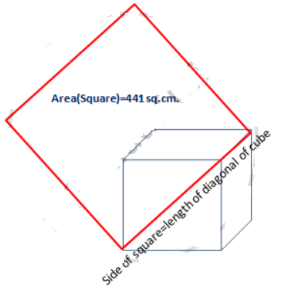
Area of $a$ Square $=441 \ cm ^2$
side $^2=441$
side $=\sqrt{441}$
$\therefore$ side $=21 \ cm$
$\therefore$ The length of the diagonals of the cube is $21 \ cm$.
Let $' a\ '$ be the side of the cube
Diagonal of a cube $=\sqrt{3} \times a$
$\therefore 21=\sqrt{3} \times a$
$a =\frac{21}{\sqrt{3}}$
$a=\frac{21}{\sqrt{3}} \times \frac{\sqrt{3}}{\sqrt{3}}$
$($rationalising the denominator$)$
$a =\frac{21 \sqrt{3}}{3}$
$a =7 \sqrt{3} \ cm$
Total surface area of a cube
$=6 a ^2$
$=6 \times(7 \sqrt{3})^2$
$=6 \times 49 \times 3$
$=882 \ cm ^2$
$\therefore$ Side of the cube is $7 \sqrt{3} \ cm$ and the total surface area of the cube is $882 \ cm ^2$. View full question & answer→Question 315 Marks
The length breadth and height of a cuboid are in the ratio of $3: 3: 4$. Find its volume in $m^3$ if its diagonal is $5 \sqrt{34} \ cm$.
AnswerGiven that:
Diagonal of cuboid $=5 \sqrt{34} \ cm..........(1)$
Ratio of Length, breadth $\ $ height $=3: 3: 4$
$\therefore$ Length $(l)=3 x$
Breadth $(b)=3 x \ $
Height $(h)=4 x$
We know that:-
Diagonal of cuboid
$ =\sqrt{1^2+ b ^2+ h ^2}$
$=\sqrt{(3 x)^2+(3 x)^2+(4 x)^2}$
$=\sqrt{9 x^2+9 x^2+16 x^2}$
$=\sqrt{34 x^2}$
$=x \sqrt{34} $
Also,
$x \sqrt{34}=5 \sqrt{34} \ldots[$ From $(1)]$
i.e., $x=5 \frac{\sqrt{34}}{\sqrt{34}}$
$\therefore x =5 \ cm$
Thus,
Length $=3 \times 5=15 \ cm$
Breadth $=3 \times 5=15 \ cm$
Height $=4 \times 5=20 \ cm$
$\therefore$ Volume of cuboid
$ =1 \times b \times h$
$=15 \times 15 \times 20$
$=225 \times 20$
$=4500 \ cm ^3$
$=0.0045\ m ^3 . \ldots\left[\because 1\ m ^3=10^6 \ cm ^3\right] $
View full question & answer→