Questions

[4 marks sum]

🎯

Test yourself on this topic

18 questions · timed · auto-graded

Question 14 Marks
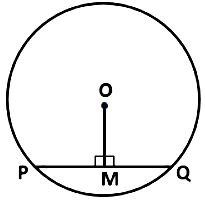
In a circle with center $O$. If $OM$ is perpendicular to $PQ$, prove that $PM = QM.$
​​​​​​​
Answer
Given:
In the figure, $O$ is centre of the circle and $PQ$ is a chord.
$OM \perp PQ$
To prove: $PM = QM$
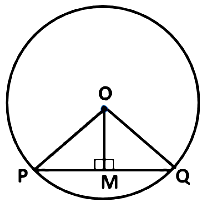
Construction: Join $Op$ and $OQ$
Proof:
In right triangles $\triangle OPM$ and $\triangle OQM,$
$OP = OQ ....[$radii of the same circle$]$
$OM = OM ....[$common$]$
$\therefore $ By right angle$-$Hypotenuse$-$Side criterion of congruency,
$\triangle OPM \cong \triangle OQM$
The corresponding parts of the congruent triangles are congruent.
$\therefore PM = QM.$
View full question & answer
Question 24 Marks
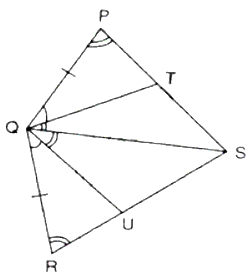
$\text{PQRS}$ is a quadrilateral and $T$ and $U$ are points on $PS$ and $RS$ respectively such that $PQ = RQ, ∠PQT = ∠RQU$and $∠TQS = ∠UQS$. Prove that $QT = QU.$
Answer
$\angle PQT = \angle RQU .....(i)$
$\angle TQS = \angle UQS .....(ii)$
Adding $(i)$ and $(ii)$
$\angle PQS = \angle RQS$
In $\triangle PQS$ and $\triangle RQS$
$\angle PQS = \angle RQS$
$PQ = RQ ...($given$)$
$QS = QS ...($common$)$
Therefore, $\triangle PQS \cong \triangle RQS ...(\text{SAS}$ criteria$)$
Hence, $\angle QPS = \angle QRS$
Now in $\triangle PQT$ and $\triangle RQU$
$\angle QPS = \angle QRS$
$PQ = RQ ...($given$)$
$\angle PQT = \angle RQU ...($given$)$
Therefore, $\triangle PQT ≅ \triangle RQU ...(\text{ASA}$ criteria$)$
Hence, $QT =QU.$
View full question & answer
Question 34 Marks
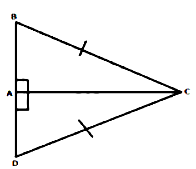
Two right$-$angled triangles $ABC$ and $ADC$ have the same base $AC$. If $BC = DC$, prove that $AC$ bisects $\angle BCD.$
Answer

In $\triangle ABC$ and $\triangle ADC$
$\angle BAC = \angle DAC ...(90^\circ )$
$BC = DC$
$AC = AC ...($common$)$
Therefore, $\triangle ABC ≅ \triangle ADC ...(\text{SSA}$ criteria$)$
Hence, $\angle BCA = \angle DCA$
Thus, $AC$ bisects $\angle BCD.$
View full question & answer
Question 44 Marks
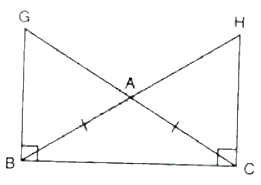
$\triangle ABC$ is an isosceles triangle with A$B = AC. GB$ and $HC ARE$ perpendiculars drawn on $BC.$

​​​​​​​Prove that
$(i) BG = CH$
$(ii) AG = AH$
Answer
In $\triangle ABC$
$AB = AC$
$\angle ABC = \angle ACB \dots...($equal sides have equal angles opposite to them$)\dots...(i)$
$\angle GBC = \angle HCB = 90^\circ \dots........(ii)$
Subtracting $(i)$ from $(ii)$
$\angle GBA = \angle HCA\dots..........(iii)$
In $\triangle GBA$ and $\triangle HCA$
$\angle GBA = \angle HCA ...($from $iii)$
$\angle BAG - \angle CAH ...($vertically opposite angles$)$
$BC = BC$
Therefore,$ \triangle GBA \cong \triangle HCA ...(\text{ASA}$ criteria$)$
Hence, $BG = CH$ and $AG = AH.$
View full question & answer
Question 54 Marks
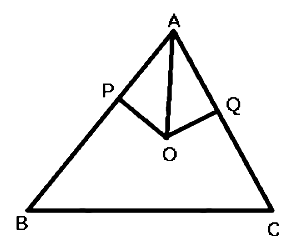
$O$ is any point in the $\triangle ABC$ such that the perpendicular drawn from $O$ on $AB$ and $AC$ are equal. Prove that $OA$ is the bisector of $\angle BAC.$
Answer

In $\triangle POA$ and $\triangle QOA$
$\angle OPA = \angle OQA = 90^\circ $
$OP = OQ ...($given$)$
$AO = AO$
Therefore, $\triangle POA \cong \triangle QOA ...(\text{SSA}$ criteria$)$
Hence, $\angle PAO = \angle QAO$
Thus, $OA$ bisects $\angle BAC.$
View full question & answer
Question 64 Marks
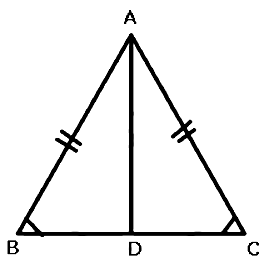
Prove that in an isosceles triangle the altitude from the vertex will bisect the base.
Answer

Now in $\triangle ABD$ and $\triangle ADC$
$AB = AC$
$AD = AD$
$\angle B = \angle C$
Therefore, $\triangle ABD \cong \triangle ADC ...(\text{SSA}$ criteria$)$
Hence, $BD = DC$
Thus, $AD$ bisects $BC.$
View full question & answer
Question 74 Marks
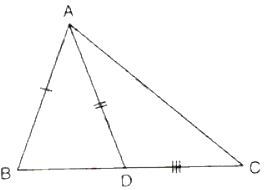
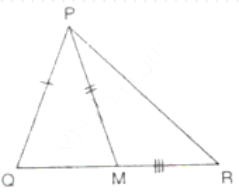
Sides, $A B, B C$ and the median $A D$ of $\triangle A B C$ are equal to the two sides $P Q, Q R$ and the median $P M$ of $\triangle P O R$. Prove that $\triangle A B C \cong \triangle P O R$.
Image
Answer
In $\triangle ABC$ and $\triangle PQR$
$BC = QR$
$AD$ and $PM$ are medians of $BC$ and $QR$ respectively
$\Rightarrow BD = DC = QM = MR$
In $\triangle ABD$ and $\triangle PQM$
$AB = PQ$
$D = PM$
BD = QM
Therefore, $\triangle ABD ≅ \triangle PQMABD \ \text{PQM} ...(\text{SSS}$ criteria$)$
Hence, $\angle B = \angle Q$
Now in $\triangle ABC$ and $\triangle PQR$
$AB = PQ$
$BC = QR$
$\angle B = \angle Q$
Therefore, $\triangle ABC ≅ \triangle PQRABC \ \text{PQR}. ...(\text{SAS}$ criteria$)$
View full question & answer
Question 84 Marks
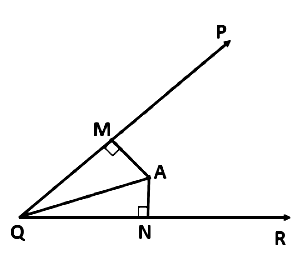
$A$ is any point in the $\angle PQR$ such that the perpendiculars drawn from $A$ on $PQ$ and $QR$ are equal. Prove that $\angle AQP = \angle AQR.$
Answer

Given,
$AM \perp PQ$ and $AN \perp QR$
$AM = AN$
In $\triangle AQM$ and $\triangle AQN,$
$AM = AN ....($given$)$
$AQ = AQ ....($common$)$
$\angle AMQ - \angle ANQ ....($Each $= 90^\circ )$
So, by $\text{R.H.S.}$ congruence, we have
$\triangle AQM \cong \triangle AQN$
$\Rightarrow \angle AQM = \angle AQN ....(\text{c.p.c.t})$
$\Rightarrow \angle AQP = \angle AQR.$
View full question & answer
Question 94 Marks
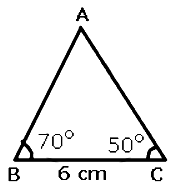
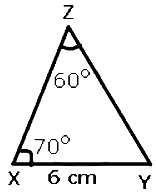
Which of the following pairs of triangles are congruent? Give reasons$\triangle ABC;(\angle B = 70^\circ ,BC = 6\ cm,\angle C = 50^\circ );\triangle XYZ;(\angle Z = 60^\circ ,XY = 6\ cm,\angle X = 70^\circ ).$
Answer

In $\triangle ABC$ and $\triangle XYZ$
$\angle B = \angle X$
$BC = XY$
$\angle Y = 180^\circ - (70^\circ + 60^\circ ) = 50^\circ $
$\angle C = \angle Y$
Therefore,
$\triangle ABC \cong \triangle XYZ ...(\text{ASA}$ criteria$).$
View full question & answer
Question 104 Marks
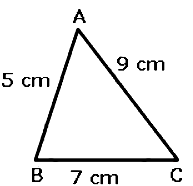
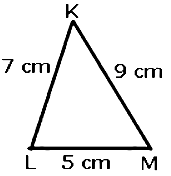
Which of the following pairs of triangles are congruent? Give reasons$\triangle ABC;(AB = 5\ cm,BC = 7\ cm,CA = 9\ cm);\triangle KLM;(KL = 7\ cm,LM = 5\ cm,KM = 9\ cm).$
Answer

In $\triangle ABC$ and $\triangle KLM$
$AB = LM$
$BC = KL$
$AC = KM$
Therefore,
$\triangle ABC \cong \triangle KLM ...(\text{SSS}$ criteria$).$
View full question & answer
Question 114 Marks
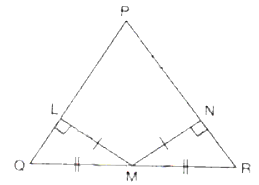
In $\triangle PQR, LM = MN, QM = MR$ and $ML$ and $MN$ are perpendiculars on $PQ$ and $PR$ respectively. Prove that $PQ = PR.$
​​​​​​​
Answer
In $\triangle QLM$ and $\triangle RNM$
$QM = MR$
$LM = MN$
$\angle QLM = \angle RNM = 90^\circ $
Therefore, $\triangle QLM ≅ \triangle RNM \dots...(\text{RHS}$ criteria$)$
Hence, $QL = RN \dots..........(i)$
Join $PM$
In $\triangle PLM$ and $\triangle PNM$ and
$PM = PM \dots...($common$)$
$LM = MN$
$\angle PLM = \angle PNM = 90^\circ $
Therefore, $\triangle PLM ≅ \triangle PNM ...(\text{RHS}$ criteria$)$
Hence, $PL = PN ..........(ii)$
From $(i)$ and $(ii)$
$PQ = PR.$
View full question & answer
Question 124 Marks
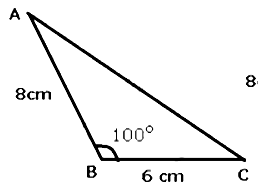
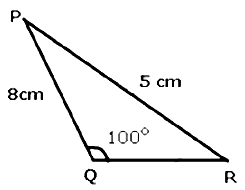
Which of the following pairs of triangles are congruent? Give reasons $\triangle ABC;(AB = 8\ cm,BC = 6\ cm,\angle B = 100^\circ );
\triangle PQR;(PQ = 8\ cm,RP = 5\ cm,\angle Q = 100^\circ ).$
Answer

In $\triangle ABC$ and $\triangle PQR$
$AB = PQ$
$\angle B = \angle Q =$
$BC$ can be equal to $QR$ or $AC$ can be equal to $RP$
Therefore,
$\triangle ABC$ can be congruent to $\triangle PQR.$
View full question & answer
Question 134 Marks
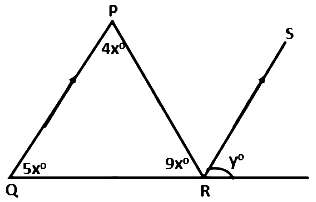
In the figure given below, if $RS$ is parallel to $PQ$, then find the value of $\angle y.$
Answer
In $\triangle PQR,$
$\angle P + \angle Q + \angle R = 180^\circ \dots....($angle sum property$)$
$\Rightarrow 4x^\circ + 5x^\circ + 9x^\circ = 180^\circ $
$\Rightarrow 18x^\circ = 180^\circ $
$\Rightarrow x = 10$
$\Rightarrow \angle P = 4x^\circ = 4 \times 10^\circ = 40^\circ $
$\angle Q = 5x^\circ = 5 \times 10^\circ = 50^\circ $
$\angle QPR = \angle PRS \dots....($Alternate angles$)$
And, $\angle QPR = 40^\circ $
$\angle PRS = 40^\circ $
By exterior angle property,
$\angle PQR + \angle QPR = \angle PRS + y^\circ $
$\Rightarrow 40^\circ + 50^\circ = 40^\circ + y^\circ $
$\Rightarrow y = 50^\circ $
View full question & answer
Question 144 Marks
The angles of a triangle are$ (x + 10)^\circ , (x + 30)^\circ $ and $(x - 10)^\circ $. Find the value of $'x\ '$. Also, find the measure of each angle of the triangle.
Answer
For ant triangle, sum of measures of all three angles $= 180^\circ $
Thus, we have
$( x + 10)^\circ + ( x + 30)^\circ + ( x - 10)^\circ = 180^\circ $
$\Rightarrow x^\circ + 10^\circ + x^\circ + 30^\circ + x^\circ - 10^\circ = 180^\circ $
$\Rightarrow 3x^\circ + 30^\circ = 180^\circ $
$\Rightarrow 3x^\circ = 150^\circ $
$\Rightarrow x = 50^\circ $
Now,
$( x + 10)^\circ = (50 + 10)^\circ = 60^\circ $
$(x + 30)^\circ = (50 + 30)^\circ = 80^\circ $
$(x - 10)^\circ = (50 - 10)^\circ = 40^\circ $
Thus, the angles of a triangle are $60^\circ , 80^\circ $ and $40^\circ .$
View full question & answer
Question 154 Marks
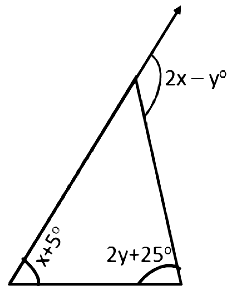
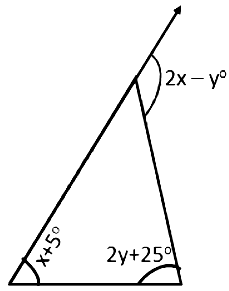
Use the given figure to find the value of $x$ in terms of $y$. Calculate $x$, if $y = 15^\circ .$
​​​​​​​
Answer

$(2x - y)^\circ = (x + 5)^\circ + (2y + 25)^\circ ....($Exterior angle property$)$
$\Rightarrow 2x^\circ - y^\circ = x^\circ + 5^\circ + 2y^\circ + 25^\circ $
$\Rightarrow 2x^\circ - x^\circ = 2y^\circ + y^\circ + 30^\circ $
$\Rightarrow x^\circ = 3y^\circ + 30^\circ $
When $y = 15$, we have
$x^\circ = 3 x 15^\circ + 30^\circ = 45^\circ + 30^\circ = 75^\circ .$
View full question & answer
Question 164 Marks
In a triangle, the sum of two angles is $139^\circ $ and their difference is $5^\circ $; find each angle of the triangle.
Answer
Let $\text{ABC}$ be a triangle such that
$\angle A + \angle B = 139^\circ ....(i)$
and $\angle A - \angle B = 5^\circ ....(ii)$
Adding $(i)$ and $(ii)$, we get
$2\angle A = 144^\circ $
$\Rightarrow \angle A = 72^\circ $
From $(i)$, we have
$\angle B = 139^\circ - 72^\circ = 67^\circ $
Now, $3^{rd}$ angle
$= 180^\circ - (\angle A + \angle B)$
$= 180^\circ - 139^\circ $
$= 41^\circ $
Thus, the angles of a triangle are $72^\circ , 67^\circ $ and $41^\circ .$
View full question & answer
Question 174 Marks
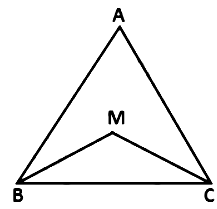
In a $\triangle ABC$, if the bisectors of angles $\text{ABC}$ and $\text{ACB}$ meet at $M$ then prove that: $\angle B M C=90^{\circ}+\frac{1}{2}\angle A$.
Answer

Since $BM$ and $CM$ are bisectors of $∠ABC$ and $∠ACB,$
$\angle B =2 \angle OBC$ and $\angle C =2 \angle OCB \quad \dots...(i)$
In $\triangle ABC$,
$\angle A +\angle B +\angle C =180^{\circ}$
$\Rightarrow \angle A +2 \angle OBC +2 \angle OCB =180^{\circ} \quad \ldots .[$From $(i)]$
$\Rightarrow \frac{\angle A }{2}+\angle OBC +\angle OCB =90^{\circ} \dots...[$Dividing both sides by $2]$
$\Rightarrow \angle OBC +\angle OCB =90^{\circ}-\frac{\angle A }{2} \quad \dots...(ii)$
Now, in $\triangle B M C$,
$\angle OBC +\angle OCB +\angle BMC =180^{\circ}$
$\Rightarrow 90^{\circ}-\frac{\angle A }{2}+\angle BMC =180^{\circ} \quad \ldots . .[$ From $(ii)]$
$\Rightarrow \angle BMC =180^{\circ}-90^{\circ}+\frac{\angle A }{2}$
$\Rightarrow \angle BMC =90^{\circ}+\frac{\angle A }{2} .$
View full question & answer
Question 184 Marks
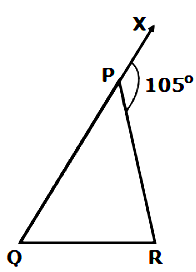
In the given figure, $\angle Q: \angle R = 1: 2.$ Find:$a. \angle Qb. \angle R$
Answer

$\angle Q : \angle R = 1 : 2$
Let $\angle Q = x^\circ $
$\Rightarrow \angle R = 2x^\circ $
Now,$ \angle RPX = \angle Q + \angle R ....[$Exterior angle property$]$
$\Rightarrow 105^\circ = x^\circ + 2x^\circ $
$\Rightarrow 105^\circ = 3x^\circ $
$\Rightarrow x = 35^\circ $
$\Rightarrow \angle Q = x^\circ = 35^\circ $ and $\angle R = 2x^\circ = 70^\circ .$
View full question & answer
[4 marks sum] - MATHEMATICS STD 9 Questions - Vidyadip