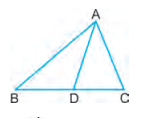
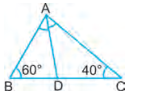
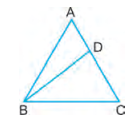
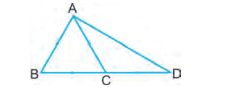
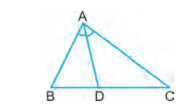
In the given figure, AD bisects $\angle A$. If $\angle B =60^{\circ}, \angle C =$ $40^{\circ}$, then arrange $AB , BD$ and DC in ascending order of their lengths.
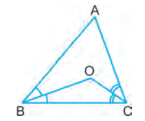
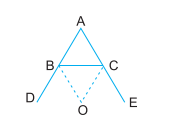
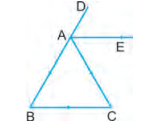
The sides AB and AC of $\triangle ABC$ are produced to D and E respectively and the bisectors of $\angle CBD$ and $\angle BCE$ meet at O . If $AB > AC$, prove that $OC > OB$.
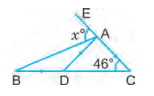
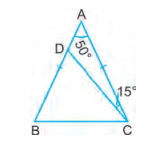
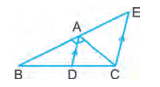
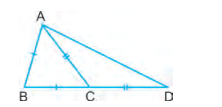
In the given figure, side CA of $\triangle ABC$ has been produced to E . If $AC = AD = BD ; \angle ACD =46^{\circ}$ and $\angle BAE =x^{\circ}$; find the value of $x$.
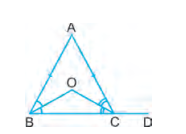
In the given figure, $AB = AC$. If BO and CO , the bisectors of $\angle B$ and $\angle C$ respectively meet at O and BC is produced to D , prove that $\angle BOC =\angle ACD$.
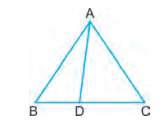
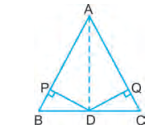
In the given figure, $AB = AC ; D$ is the mid-point of BC ; $DP \perp BA$ and $DQ \perp CA$. Prove that: (i) $DP = DQ$ (ii) $AP = AQ$ (iii) AD bisects $\angle A$.
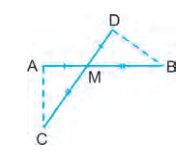
In the given figure, the line segments AB and CD intersect at a point M in such a way that $AM = MD$ and $CM = MB$. Prove that, $AC = BD$ but AC may not be parallel to BD.
Answer
[Hint. $\triangle M A C \cong \triangle M D B$. So, $\angle M D B=\angle M A C$.Thus, $\angle M D B \neq \angle M C A$.]
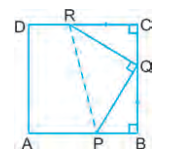
In the given figure, ABCD is a square and $P , Q , R$ are points on $A B, B C$ and $C D$ respectively such that $AP = BQ = CR$ and $\angle PQR =90^{\circ}$. Prove that : (i) $PB = QC$ (ii) $PQ = QR$ (iii) $\angle QPR =45^{\circ}$
Answer
[Hint.$\begin{array} {l}A B=B C \text { and } A P=B Q \Rightarrow A B-A P=B C-B Q \Rightarrow P B=Q C \\\text { Ext. } \angle R Q B=\angle Q C R+\angle Q R C=90^{\circ}+\angle Q R C \\\text { Also }, \angle R Q B=90^{\circ}+\angle P Q B \\\therefore \angle Q R C=\angle P Q B\end{array}$ Now, show that $\triangle P B Q \equiv \triangle Q C R$.]
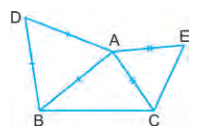
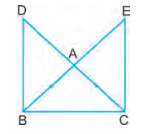
Equilateral triangles ABD and ACE are drawn on the sides $A B$ and $A C$ of $\triangle A B C$ as shown in the figure. Prove that : (i) $\angle DAC =\angle EAB$ (ii) $DC = BE$.
Answer
(Hint. (i) $\angle D A C=60^{\circ}+\angle B A C$ and $\angle E A B=60^{\circ}+\angle B A C$. (ii) Join DC and BE and show that $\triangle D A C \equiv \triangle B A E$.]
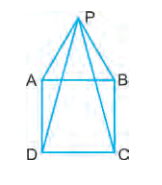
In the given figure, ABCD is a square and $\triangle PAB$ is an equilateral triangle. (i) Prove that $\triangle APD \cong \triangle BPC$. (ii) Show that $\angle DPC =15^{\circ}$.
Answer
[Hint. (i) $\angle P A D=90^{\circ}+60^{\circ}=150^{\circ}$ and $\angle P B C=90^{\circ}+60^{\circ}=150^{\circ}$. (ii) $\angle P A D=150^{\circ}$ and $A P=A D \Rightarrow \angle A P D=\angle A D P=15^{\circ}$.]
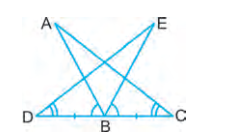
In the given figure : $\angle ABD =\angle EBC , BD = BC$ and $\angle ACB =\angle EDB$. Prove that $AB = BE$.
Answer
[Hint. $\angle E B D=\angle A B E+\angle A B D$ and $\angle A B C=\angle A B E+\angle E B C$. So, $\angle E B D=\angle A B C$. Now, show that $\triangle A C B \cong \triangle E D B$.]
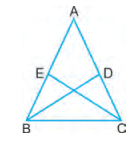
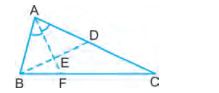
In a $\triangle A B C, A B=A C$. If the bisectors of $\angle B$ and $\angle C$ meet $A C$ and $A B$ at points $D$ and $E$ respectively, show that : (i) $\triangle DBC \cong \triangle ECB$ (ii) $BD = CE$.
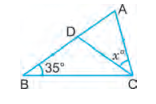
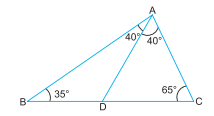
In $\triangle ABC , \angle B =35^{\circ}, \angle C =65^{\circ}$ and the bisector AD of $\angle BAC$ meets BC at D . Arrange the sides $AD , BD$ and CD in ascending order of their lengths.
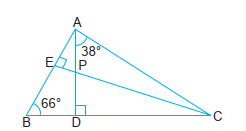
In the given figure, $\angle ABC =66^{\circ}, \angle DAC =38^{\circ}$. CE is perpendicular to $A B$ and $A D$ is perpendicular to $B C$. Prove that: $CP > AP$
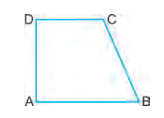
In the adjoining quadrilateral $ABCD , AB$ is the longest side and DC is the shortest side. Prove that: (i) $\angle C >\angle A$ (ii) $\angle D >\angle B$
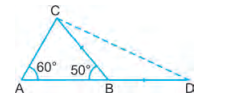
In the given figure, side $A B$ of $\triangle A B C$ is produced to $D$ such that $B D=B C$. If $\angle A=60^{\circ}$ and $\angle B=50^{\circ}$, prove that: (i) $AD > CD$ (ii) $AD > AC$