Questions

[2 Mark Question Answer]

🎯

Test yourself on this topic

29 questions · timed · auto-graded

Question 12 Marks
Give an example to explain that the use of modem eco-friendly technology is more efficient and less polluting.
Answer
Modern appliances like refrigerators make use of significantly less energy than older appliances as they have star rating according to their efficient use of electricity. Higher the star rating, higher is the efficiency.
View full question & answer
Question 22 Marks
How does the proper insulation of home save energy?
Answer
By properly insulating a home, it is possible to maintain a comfortable temperature inside. It will reduce the cost of heating devices in winter and cooling devices in summer.
View full question & answer
Question 32 Marks
State two ways to save the energy.
Answer
Two ways to save energy:
  1. Instead of fossil fuels, other renewable sources of energy such as the biogas prepared from animal dung should be used.
  2. The use of hydroelectric energy, wind energy etc. should be given priority.
View full question & answer
Question 42 Marks
State and define the S.I. unit of resistance.
Answer
The S.I. unit of resistance is 'ohm' (volt per ampere).
The resistance of a conductor is said to be 1 ohm if a current of 1 ampere flows through it when the potential difference across it is 1 volt.
View full question & answer
Question 52 Marks
Explain why does a metal wire when connected to a cell offer resistance to the flow of current.
Answer
A metal wire has free electrons which move in random directions. When the ends of the wire are connected to a cell, the electrons start moving from the negative terminal of the cell to its positive terminal through the metal wire. During their movement, they collide with the free electrons and fixed ions of the wire. This causes them to lose their speed and change their direction. As a result, the electrons slow down and slowly drift towards the positive terminal. Thus, the wire offers resistance to the flow of current (or electrons) through it.
View full question & answer
Question 62 Marks
The potential difference between two conductors is 1 volt'. Explain the meaning of this statement.
Answer
Potential difference between two points is 1 volt; it means 1 joule of work is done in transferring 1 coulomb of charge from one point to the other point.
View full question & answer
Question 72 Marks
State and define the S.I. unit of potential difference.
Answer
S.I. unit of potential difference is volt (joule per coulomb). Potential difference between two points is said to be 1 volt if work done in transferring 1 coulomb of charge from one point to the other point is 1 joule.
View full question & answer
Question 82 Marks
A current 0.2 A flows in a wire of resistance 15Ω. Find the potential difference across the ends of the wire.
Answer
I = 0.2 A R = 15 V According to Ohm's law , V = IR ∴ V = 0.2 × 15 = 3.0 V
View full question & answer
Question 92 Marks
Define the term potential difference?
Answer
Potential difference: The amount of work done in moving a unit positive charge from one point to another point in an electric field is called potential difference.
View full question & answer
Question 102 Marks
A bulb draws current 1.5 A at 6.0 V. Find the resistance of filament of bulb while glowing.
Answer
$I =1.5 A V=6.0 V$ According to Ohm's law, $V = IR \therefore R =\frac{ V }{ I }=\frac{6.0}{1.5}=4.0 \Omega$
View full question & answer
Question 112 Marks
Explain the concept of electric potential difference in terms of work done in transferring the charge.
Answer
Electric potential difference between two conductors is equal to the work done in transferring a unit positive charge from one conductor to other conductor.
View full question & answer
Question 122 Marks
A cell of potential difference 12 V is connected to a bulb. The resistance of filament of bulb when it glows is 24Ω. Find the current drawn from the cell.
Answer
Given, potential difference $(V)=12 V$
Resistance, $R=24 \Omega$
Therefore, current $( I )=\frac{ V }{ R }$
Or, $I =\frac{12}{24}=0.5 A$
View full question & answer
Question 132 Marks
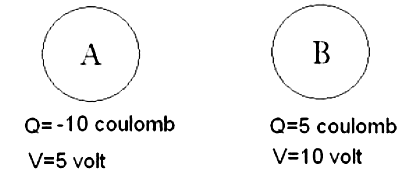
Figure. below shows two conductors A and B. Their charges and potentials are given in diagram. State the direction of (i) flow of electrons and (ii) flow of current, when both the conductors are joined by a metal wire.
Answer
When both the conductors are joined by a metal wire:
(i) Electrons will flow from A to B.
(ii) Current will flow from B to A.
View full question & answer
Question 142 Marks
How is the resistance of a wire affected if its (a) length is doubled, (b) radius is doubled?
Answer
(a) Resistance of a wire is directly proportional to the length of a wire; so if the length is doubled, resistance is also doubled.
(b) Resistance of a wire is inversely proportional to the area of cross-section the wire. Thus, if radius is doubled, area increases four times and hence the resistance becomes one-fourth.
View full question & answer
Question 152 Marks
State three factors on which the resistance of a wire depends. Explain how the resistance depends on the factors stated by you.
Answer
Resistance of a wire depends upon:
(i) Length of wire: Resistance is directly proportional to the length of a wire.
(ii) Area of cross-section of wire: Resistance is inversely proportional to the area of cross-section the wire.
(iii) The temperature of wire: Resistance of a wire is directly proportional to the temperature of the wire.
View full question & answer
Question 162 Marks
How is the current flowing in a conductor changed if the resistance of conductor is doubled keeping the potential difference across it the same?
Answer
$V=I R$ or, $I=\frac{V}{R} \ldots$. (i)

If $R$ is doubled,
Then, $I ^{\prime}=\frac{ V }{2 R }=\frac{ I }{2}$.

From (i) and (ii), it is clear that current will be halved.
View full question & answer
Question 172 Marks
State Ohm's law.
Answer
Ohm's law states that the electric current flowing through a metallic wire is directly proportional to the potential difference V across its ends provided its temperature remains the same.
View full question & answer
Question 182 Marks
What is a secondary cell? Name one such cell.
Answer
Secondary cells are cells which provide current as a result of reversible chemical reactions. It converts electrical energy into chemical energy when current is passed in it (i.e. during charging), while it converts chemical energy into electrical energy when current is drawn from it (i.e., during discharging). Example: Lead (or acid) accumulator.
View full question & answer
Question 192 Marks
What is a primary cell? Name two such cells.
Answer
Primary cells are cells which provide current as a result of irreversible chemical current. Examples: Simple Voltaic cell and Leclanche cell.
View full question & answer
Question 202 Marks
State the two kinds of cell. Give one example of each.
Answer
Two kinds of cells:
(a) Primary cell: e.g. Leclanche cell
(b) Secondary cell: Lead (or acid) accumulator
View full question & answer
Question 212 Marks
State two differences between a conductor and an insulator of electricity.
Answer
Conductors have a large number of free electrons and they offer a very small resistance in the path of current but insulators have no free electrons and they offer a very high resistance in the path of current.
View full question & answer
Question 222 Marks
What are conductors and insulators of electricity? Give two examples of each.
Answer
The substances which allow electric current to flow through them easily are called conductors. Examples: Impure water and metals.
The substances which do not allow the electric current to flow through them are called insulators. Examples: Rubber and wood.
View full question & answer
Question 232 Marks
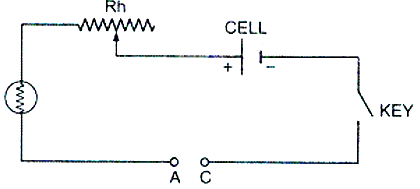
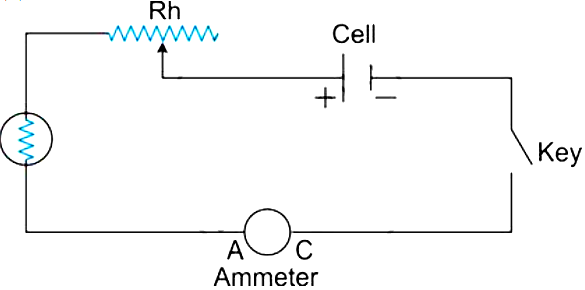
(a) Complete the circuit given in Fig. by inserting between the terminals A and C. an ammeter.

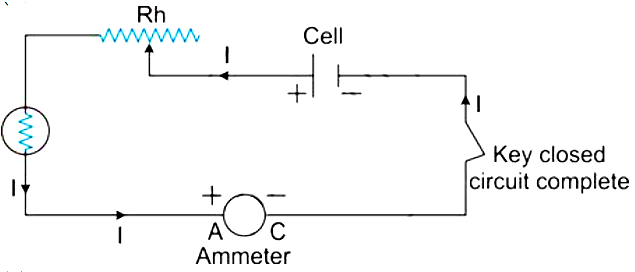
(b) In the diagram, mark the polarity at the terminals of ammeter and indicate clearly the direction of flow of current in the circuit when the circuit is complete.

(c) Name and state the purpose of Rh in the circuit.
Answer
(a) (b)
(c) A rheostat is used to control the current in the circuit.
View full question & answer
Question 242 Marks
Write symbol and state function of following component in an electric circuit:
voltmeter
Answer
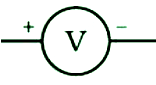
Voltmeter : ;
It is used to measure the potential difference between two points of a circuit.
View full question & answer
Question 252 Marks
Write symbol and state function of following component in an electric circuit :
ammeter 
Answer
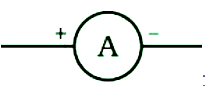
Ammeter : ; It is used to measure the current flowing through the circuit.

View full question & answer
Question 262 Marks
Write symbol and state function of following component in an electric circuit :
rheostat
Answer
Rheostat symbol : It is used to control the current in the circuit.
View full question & answer
Question 272 Marks
Write symbol and state function of following component in an electric circuit :
cell
Answer
Cell symbol : ; It acts as a source of direct current for the circuit.
View full question & answer
Question 282 Marks
Write symbol and state function of following component in an electric circuit : key
Answer
Key symbol : ; It is used to switch the current on or off in the circuit.
View full question & answer
Question 292 Marks
What do you understand by the term current? State and define its S.I. unit.
Answer
Current is the rate of flow of charge across a cross-section. It is a scalar quantity.
Its S.I. unit is ampere (coulomb per second).
If 1 ampere current flows through a conductor, it means that $6.25 \times 10^{18}$ electrons pass in 1 second across that crosssection of conductor.
View full question & answer
[2 Mark Question Answer] - PHYSICS STD 9 Questions - Vidyadip