Questions

[5 Mark Question Answer]

🎯

Test yourself on this topic

5 questions · timed · auto-graded

Question 14 Marks
Energy from various sources is considered to have been derived from the Sun. Do you agree? Justify your answer by giving two examples.
Answer
Yes, sun is the ultimate source of energy directly or indirectly, all the forms of energy derived from solar energy.
(i) Non-renewable sources of energy: Fossil fuels like coal, petroleum and natural gas are formed due to burial of large plants and ancient creatures whose ultimate source of energy is sun.

(ii) Renewable sources of energy: They are indirectly derived from solar energy such as :
(a) Energy from flowing water: In lakes, rivers, seas etc., evaporates due to solar energy. They bring rainfall and snow fall.
(b) Wind energy: Wind energy arises due to uneven heating of the earth's surface by the sun rays at two different adjoining places. Due to this, wind possesses kinetic energy.
(c) Bio energy: Plants in the process of photosynthesis convert the solar energy into food (chemical energy). This food is consumed by animals.
(d) Wave energy: The waves are generated by strong winds (due to solar energy)
blowing across the sea.
(e) Ocean thermal energy: Sun is responsible for the temperature difference between the water at the surface and water at depth in seas and oceans.

(iii) Solar devices: They derive their energy directly from solar energy and convert it into other usable forms of energy.
View full question & answer
Question 24 Marks
Explain how geothermal energy is used in generating electricity.
Answer
Geothermal energy: The natural occurring thermal energy found within rock formations
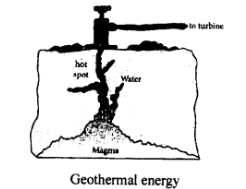
of the earth and the fluids hold within those formations is known as geothermal energy. The places under the surface of the earth, where the hot magma collects at fairly less depths, are called hot spots of the earth. The hot spots are the source of the geothermal energy which is used to generate electricity as follows:
(i) In some geological regions of the earth, the underground water comes in contact with hot spots and changes into steam. The steam so formed gets trapped between the underground rocks and gets compressed to very high pressure. This steam is extracted from the ground by sinking pipes from the surface of the earth. The steam coming up at high pressure is used in running turbines connected to the generator. This in turn produces electric energy.
Image
(ii) In some place, the steam formed under the surface of the earth does not get trapped. Instead it forces its way up through the cracks in the rocks along with hot water and rushes out from the surface of the earth to form natural geysers. The heat energy brought up by the natural geysers is used to generate electricity as stated above.
(iii) In some geological regions of the earth, there may be hot spots, but the underground water does not come in contact with them. In such regions, two holes are made in the Earth's crust. Through one hole is pumped in cold water. The cold water on coming in contact with hot spot changes to super heated steam, which emerges out from the other hole. The steam is then made to run a turbine coupled with generator to produce electricity.
View full question & answer
Question 34 Marks
(a) What do you understand by the term hydroelectric power?
(b) Explain the energy changes taking place in a hydroelectric dam?
Answer
(a) Hydroelectric power: Hydroelectric power is the power derived from energy of
falling water or fast running water. A hydroelectric power plant is an arrangement in which the kinetic energy of flowing water is transformed into electric energy and the electric energy so generated is called hydroelectric energy.
(b) Energy changes taking place in a hydroelectric dam:
1. As the water flows into reservoir from the catchment area, the kinetic energy of flowing water changes to potential energy.
2. As the water is released through control valve, the potential energy of water changes to kinetic energy.
3. As the water flowing at a high speed strikes the blades of the turbine, its kinetic energy changes to rotational kinetic energy of the turbine.
4. As the turbine is coupled to the shaft of generator, the rotational kinetic energy of turbine changes to the rotational kinetic energy of armature.
5. As the coils of armature rotate in magnetic field, the rotational kinetic energy of armature changes to the electric energy in its coils.
View full question & answer
Question 44 Marks
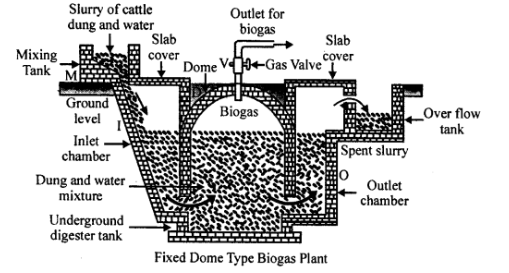
What is biogas? Which component of biogas is used as fuel? Describe a fixed dome type biogas plant with the help of a labelled diagram.
Answer
Biogas: Biogas is a mixture of gases formed when slurry of animal dung and water is allowed to ferment in the absence of oxygen (or air). Biogas is a mixture of methane, carbon dioxide, hydrogen and traces of hydrogen sulphide along with water vapours. Its chief component methane is used as fuel.
Fixed dome type biogas plant: It consists of follows parts:
Digester tank: It is an underground tank. Its base and walls are made of bricks and cement. Its roof is made in the form of dome either with cement or bricks or with concrete. The dome collects the biogas. It is provided with an outlet for biogas. The outflow of the gas is controlled by gas valve.
Slurry mixing tank: On the left hand side of the digester is constructed a brick lined tank above the ground level. The bottom of this tank connects the digester through a brick-lined channel near the base.
The fresh slurry of animal dung and water in equal proportions is poured into the slurry mixing tank. This slurry slowly flows into the digester.
Image
Spent slurry tank: On the right hand side of the digester is constructed spent slurry tank, below the ground level. The base of this tank is in line with the lowest point of the dome of the digester. The base of this tank is connected to the base of the digester through a brick-lined channel.
Working of fixed dome type biogas plant: Everyday the slurry of animal dung and water
in equal proportions is poured into the mixing tank. This slurry flows into the digester. In the digester anaerobic fermentation starts with the release of biogas. The biogas formed collects in the dome.
As more and more slurry flows into the digester everyday, the level of slurry rises up. It takes about 30 to 60 days for the slurry to fill the digester depending upon the temperature within the digester. During this time the biogas collects in the dome under pressure.
When the pressure of biogas exceeds certain limit, the biogas forces the spent slurry into overlfow tank. The biogas is withdrawn from the dome through outlet pipe. Its flow is regulated by a gas valve. The spent slurry is periodically removed and is allowed to dry. It is then used as manure.
Once the biogas plant gets operative, it is a continuous process. Everyday fresh slurry is added in the mixing tank and spent slurry is removed from the overflow tank.
View full question & answer
Question 54 Marks
State three ways by which you can enhance the collection of solar energy.
Answer
Following are the three ways by which we can enhance the collection of solar energy:
(i) Use of black painted surface: Black surfaces are good absorbers as well as good
radiators of radiant heat. Thus the surfaces of the objects which are to collect radiant heat are painted black, so that their temperature rises rapidly. But after some time, an equilibrium state is reached when the solar energy absorbed by a blackened object is equal to radiant heat radiating out from its surface. To overcome this difficulty, some means should be provided to that the rate of radiant heat from its surface is reduced or stopped altogether.
(ii) Use of insulated box with glass cover: The objects painted black, should be placed
in well insulated box provided with glass cover. The insulated box will prevent heat losses due to conduction, convection and radiation. The glass cover will allow the solar energy to pass through it as it is transparent to radiant heat of smaller wavelength. However, when the object with blackened surface gets hot within the box and radiates out radiant heat, the glass will not allow these radiations to pass through, as they are of longer wavelength. Thus, the heat radiations are trapped within the insulated box, thereby raising the temeperature of objects with blackened surface.
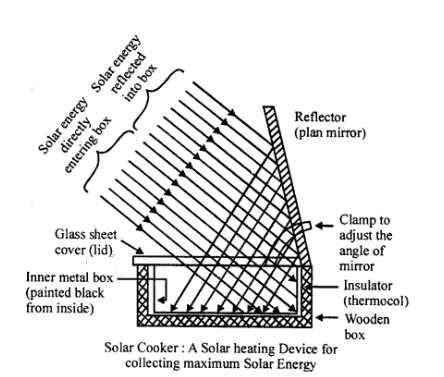
(iii) Use of reflectors: As mentioned earlier, the amount of solar energy per square
metre per second is too small to do any useful work. Thus, if solar energy is directly allowed to enter a solar heating device, it does not raise its temperature sufficiently. However, if solar energy is collected from a sufficiently large area and then reflected into the small area of a solar heating device, its temperature rises sufficiently to do some useful work. It is here that reflectors are useful for solar heating devices.
Image
Figure shows the use of plane mirror as a reflector. In the diagram it is clearly shown that a part of solar energy enters directly into solar heating device and a part is reflected into it by the plane mirror. As the solar heating device receives more energy per unit time, its temperature rises quickly.
View full question & answer
[5 Mark Question Answer] - PHYSICS STD 9 Questions - Vidyadip