Question
Explain how geothermal energy is used in generating electricity.

Answer

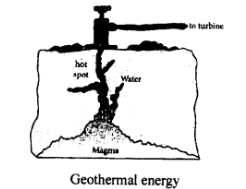
Geothermal energy: The natural occurring thermal energy found within rock formations
of the earth and the fluids hold within those formations is known as geothermal energy. The places under the surface of the earth, where the hot magma collects at fairly less depths, are called hot spots of the earth. The hot spots are the source of the geothermal energy which is used to generate electricity as follows:
(i) In some geological regions of the earth, the underground water comes in contact with hot spots and changes into steam. The steam so formed gets trapped between the underground rocks and gets compressed to very high pressure. This steam is extracted from the ground by sinking pipes from the surface of the earth. The steam coming up at high pressure is used in running turbines connected to the generator. This in turn produces electric energy.
Image
(ii) In some place, the steam formed under the surface of the earth does not get trapped. Instead it forces its way up through the cracks in the rocks along with hot water and rushes out from the surface of the earth to form natural geysers. The heat energy brought up by the natural geysers is used to generate electricity as stated above.
(iii) In some geological regions of the earth, there may be hot spots, but the underground water does not come in contact with them. In such regions, two holes are made in the Earth's crust. Through one hole is pumped in cold water. The cold water on coming in contact with hot spot changes to super heated steam, which emerges out from the other hole. The steam is then made to run a turbine coupled with generator to produce electricity.
Need a full question paper?

Generate a complete, print-ready paper with questions like this in minutes — across 16+ boards, with answer keys.

Start Generating Free

Similar questions

The following table gives the displacement of a car at different instants of time.
Time (s) 0 1 2 3 4
Displacement (m) 0 5 10 15 20
(a) Draw the displacement-time sketch and find the average velocity of the car. (b) What will be the displacement of the car at (i) 2.5 s and (ii) 4.5 s?
Define the terms magnetic declination and dip with reference to freely suspended magnet.
(a) What do you understand by the terms magnetic meridian and geographic meridian?
(b) At what places on the earth will the angle of dip be (1) maximum and (2) minimum?
Explain the working of a hydraulic brake with a simple labelled diagram.
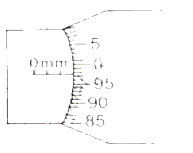
In the following figure, the pitch of the screw is $1\ mm.$ Calculate :
$(i)$ the least count of screw gauge and
$(ii)$ the reading represented in the figure.
How do you account for the following facts?
(a) Iron becomes magnetised when placed in a coil carrying direct current.
(b) Bar magnets lose their magnetism when heated strongly.
(c) Steel makes better permanent magnet than soft iron.
(d) Soft iron keepers help to prevent the magnets from losing their magnetic properties.
Give a tabular format for recording the observations in an experiment of the simple pendulum while measuring the time period of the pendulum for its different lengths.
QUESTION The density of ice is $0.92 g cm ^{-3}$ and that of sea water is $1.025 g cm ^{-3}$. Find the total volume of an iceberg which floats with its volume $800 cm^3$ above water.
How electric current flows in (i) solids, (ii) liquids?
(a) What do you understand by the term zero error?
(b) When does a vernier callipers has
1. positive error
2. negative error?
(c) State the correction if
1. positive error is 7 divisions
2. negative error is 7 divisions, when the least count is 0.01 cm .
The following Figure shows a concave mirror MM' on which a ray of light incident from a point P gets reflected to meet the principle axis at O.
(a) Find, by construction, the position of the centre of curvature of the concave mirror.
(b) Write down the value for the radius of curvature of the mirror.
(c) Calculate the focal length of the mirror.
(d ) Which relation is used in deducing the focal length from the radius of curvature?